
Request Free Sample ×

Kindly complete the form below to receive a free sample of this Report

* Please use a valid business email

Leading companies partner with us for data-driven Insights

clients tt-cursor
Hero Background

Comic Books Market

ID: MRFR/CG/9848-HCR
200 Pages
Snehal Singh
Last Updated: June 01, 2026
Comic Book Market Size, Share, Industry Trend & Analysis Research Report By Product Type (Physical Comic, Digital Comic), By End-user (Kids, Adults), By Distribution Channel (Book Stores, Comic Stores, Online Stores, Others), and By Regional (North America, Europe, South America, Asia Pacific, Middle East and Africa) - Forecast to 2035.
Download PDF ×

We do not share your information with anyone. However, we may send you emails based on your report interest from time to time. You may contact us at any time to opt-out.

  1. 1 Market Overview |
    1. 1.1 Study Assumptions & Market Definition |
    2. 1.2 Scope of the Study |
    3. 1.3 Research Methodology
  2. 2 Market Summary & Key Takeaways
  3. 3 Market Dynamics |
    1. 3.1 Market Drivers Analysis | |
      1. 3.1.1 Streaming-to-Print IP Flywheel | |
      2. 3.1.2 Digital Comic Book Platform Proliferation | |
      3. 3.1.3 Manga Globalization | |
      4. 3.1.4 Independent Comic Creator Market Expansion | |
      5. 3.1.5 Comic Book Collectible Grading Premiumization | |
      6. 3.1.6 AI-Powered Translation and Localization | |
      7. 3.1.7 Government Creative-Industry Subsidies |
    2. 3.2 Market Restraints Analysis | |
      1. 3.2.1 Print-Distribution Cost Inflation | |
      2. 3.2.2 Digital Piracy and Scan-Translation Sites | |
      3. 3.2.3 Reader Fatigue from Franchise Oversaturation | |
      4. 3.2.4 Paper and Pulp Supply-Chain Volatility | |
      5. 3.2.5 Fragmented Digital-Rights Licensing |
    3. 3.3 Market Opportunity Analysis | |
      1. 3.3.1 AI-Powered Localization and Simultaneous Global Release | |
      2. 3.3.2 Creator-Economy Platforms and Revenue Sharing | |
      3. 3.3.3 Augmented-Reality and Interactive Comics | |
      4. 3.3.4 Emerging-Market Broadband Expansion | |
      5. 3.3.5 Collectible and NFT-Adjacent Digital Ownership |
    4. 3.4 Industry Value Chain Analysis |
    5. 3.5 Porter's Five Forces Analysis
  4. 4 Global Comic Book Market Size & Forecast (2021–2035) |
    1. 4.1 Historical Market Size (2021–2025) |
    2. 4.2 Current & Forecast Market Size (2026–2035) |
    3. 4.3 Market Size by Revenue (USD Billion) |
    4. 4.4 Year-over-Year Growth Analysis
  5. 5 Segmentation Analysis |
    1. 5.1 By Type | |
      1. 5.1.1 Non-Digital | |
      2. 5.1.2 Digital |
    2. 5.2 By Format | |
      1. 5.2.1 Single Issues | |
      2. 5.2.2 Trade Paperbacks | |
      3. 5.2.3 Graphic Novels | |
      4. 5.2.4 Webcomics | |
      5. 5.2.5 Others (Tankōbon, Anthology Magazines) |
    3. 5.3 By Genre | |
      1. 5.3.1 Superhero | |
      2. 5.3.2 Manga | |
      3. 5.3.3 Horror / Thriller | |
      4. 5.3.4 Sci-Fi / Fantasy | |
      5. 5.3.5 Slice-of-Life / Non-Fiction |
    4. 5.4 By Distribution Channel | |
      1. 5.4.1 Comic-Book Stores | |
      2. 5.4.2 Bookstores & Mass Merchants | |
      3. 5.4.3 Direct-to-Consumer Digital | |
      4. 5.4.4 Online Retail (Physical) | |
      5. 5.4.5 Others (Libraries, Subscription Boxes)
  6. 6 Regional Analysis |
    1. 6.1 North America | |
      1. 6.1.1 United States | |
      2. 6.1.2 Canada | |
      3. 6.1.3 Mexico |
    2. 6.2 Europe | |
      1. 6.2.1 Germany | |
      2. 6.2.2 United Kingdom | |
      3. 6.2.3 France | |
      4. 6.2.4 Italy | |
      5. 6.2.5 Spain | |
      6. 6.2.6 Nordic Countries | |
      7. 6.2.7 Russia | |
      8. 6.2.8 Rest of Europe |
    3. 6.3 Asia-Pacific | |
      1. 6.3.1 Japan | |
      2. 6.3.2 China | |
      3. 6.3.3 South Korea | |
      4. 6.3.4 India | |
      5. 6.3.5 ASEAN | |
      6. 6.3.6 Rest of Asia-Pacific |
    4. 6.4 South America | |
      1. 6.4.1 Brazil | |
      2. 6.4.2 Argentina | |
      3. 6.4.3 Rest of South America |
    5. 6.5 Middle East & Africa | |
      1. 6.5.1 Saudi Arabia | |
      2. 6.5.2 UAE | |
      3. 6.5.3 South Africa | |
      4. 6.5.4 Egypt | |
      5. 6.5.5 Rest of MEA
  7. 7 Competitive Landscape |
    1. 7.1 Market Share Analysis (2025) |
    2. 7.2 Competitive Benchmarking Matrix |
    3. 7.3 Company Profiles | |
      1. 7.3.1 Marvel Entertainment (Disney) | |
      2. 7.3.2 DC Comics (Warner Bros. Discovery) | |
      3. 7.3.3 Shueisha | |
      4. 7.3.4 Kodansha | |
      5. 7.3.5 Image Comics | |
      6. 7.3.6 Dark Horse Comics | |
      7. 7.3.7 VIZ Media | |
      8. 7.3.8 Naver Webtoon | |
      9. 7.3.9 IDW Publishing | |
      10. 7.3.10 BOOM! Studios | |
      11. 7.3.11 Valiant Entertainment | |
      12. 7.3.12 Tapas Media
  8. 8 Future Outlook & Strategic Recommendations (2026–2035) |
    1. 8.1 AI-Augmented Creation and Personalization |
    2. 8.2 Platform Economics and Subscription Bundling |
    3. 8.3 Transmedia IP Valuation |
    4. 8.4 Sustainability and Print Innovation
  9. 9 Recent Developments & News
  10. 10 Frequently Asked Questions (FAQs)
  11. 11 Report Scope & Methodology |
    1. 11.1 Study Period & Base Year |
    2. 11.2 Data Sources & Citations |
    3. 11.3 Abbreviations
  12. 12 LIST OF TABLES
  13. 13 LIST OF FIGURES

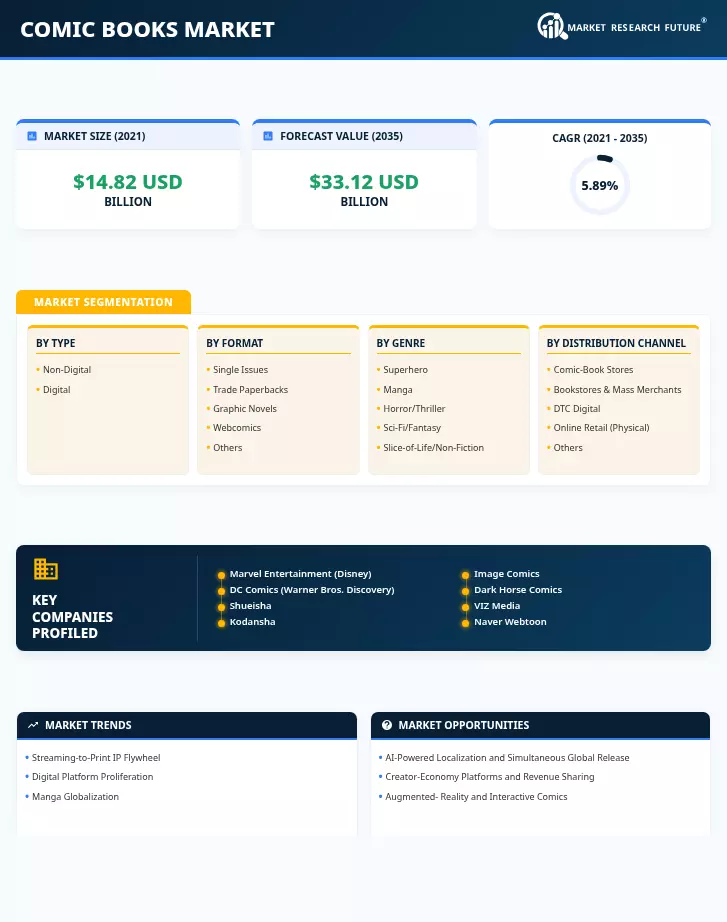
SEGMENTATION QUICK REFERENCE

Dimension Sub-Segments Dominant Segment Fastest Growing Segment
By Type Non-Digital, Digital Non-Digital Digital
By Format Single Issues, Trade Paperbacks, Graphic Novels, Webcomics, Others Single Issues Webcomics
By Genre Superhero, Manga, Horror/Thriller, Sci-Fi/Fantasy, Slice-of-Life/Non-Fiction Superhero Manga
By Distribution Channel Comic-Book Stores, Bookstores & Mass Merchants, DTC Digital, Online Retail (Physical), Others Comic-Book Stores DTC Digital
By Region North America, Europe, Asia-Pacific, South America, Middle East & Africa Asia-Pacific Asia-Pacific


MARKET SEGMENTATION OVERVIEW

By Type

Sub-Segment Key Trend
Non-Digital Premium editions and collector variants sustain pricing power amid digital migration
Digital Freemium and ad-supported models drive subscriber acquisition on mobile platforms


Non-digital formats retain dominance in the Comic Book Market because print collectibility and tactile reading experiences hold enduring consumer appeal. Digital is the growth engine, expanding as broadband penetration and smartphone adoption unlock new reader demographics across Asia-Pacific and Latin America.

By Format

Sub-Segment Key Trend
Single Issues Variant-cover programs and weekly release cadences maintain collector engagement
Trade Paperbacks Bookstore shelving and binge-reading culture drive steady backlist sales
Graphic Novels Literary crossover recognition elevates premium pricing and library procurement
Webcomics Vertical-scroll, mobile-first serialization attracts Gen-Z readership globally
Others Manga tankōbon and anthology magazines sustain high-frequency purchase cycles in Japan


Single issues lead by revenue, but webcomics represent the structural shift — converting casual smartphone users into paying subscribers through cliffhanger-driven chapter monetization.

By Genre

Sub-Segment Key Trend
Superhero Franchise adaptations continuously refresh audience engagement with source material
Manga Simulpub strategies and global licensing expand the addressable reader base
Horror / Thriller Streaming-platform demand for optionable IP drives publisher investment
Sci-Fi / Fantasy Independent creator innovation diversifies storylines beyond mainstream franchises
Slice-of-Life / Non-Fiction Educational and memoir titles drive bookstore crossover and institutional sales


Superhero titles maintain revenue leadership through franchise synergy, while manga's global expansion is the defining genre-level growth story of the decade.

By Distribution Channel

Sub-Segment Key Trend
Comic-Book Stores Exclusive variants and community events sustain specialty-retail loyalty
Bookstores & Mass Merchants Trade-paperback shelving and manga sections expand casual-reader access
Direct-to-Consumer Digital Subscription and freemium models grow first-party reader relationships
Online Retail (Physical) Discount pricing and convenience drive volume for backlist and collected editions
Others Library procurement and subscription-box services provide recurring institutional demand


Specialty comic-book stores anchor the cultural ecosystem, but direct-to-consumer digital platforms are capturing the fastest-growing share as publishers prioritize owned distribution channels.














