×
Request Free Sample ×

Kindly complete the form below to receive a free sample of this Report

* Please use a valid business email

Leading companies partner with us for data-driven Insights

clients tt-cursor
Hero Background

Commercial Printer Market

ID: MRFR/CG/32633-HCR
128 Pages
Sakshi Gupta
October 2025

Commercial Printer Market Research Report By Technology (Digital Printing, Offset Printing, Screen Printing, Flexographic Printing, Gravure Printing), By Product Type (Commercial Printers, Industrial Printers, Wide Format Printers, Label Printers, Packaging Printers), By End Use Industry (Advertising, Publishing, Packaging, Textiles, Commercial Printing), By Print Media (Paper, Plastic, Metal, Cardboard, Textile) and By Regional (North America, Europe, South America, Asia Pacific, Middle East and Africa) - Forecast to 2035

Share:
Download PDF ×

We do not share your information with anyone. However, we may send you emails based on your report interest from time to time. You may contact us at any time to opt-out.

Commercial Printer Market Infographic
Purchase Options

Commercial Printer Market Summary

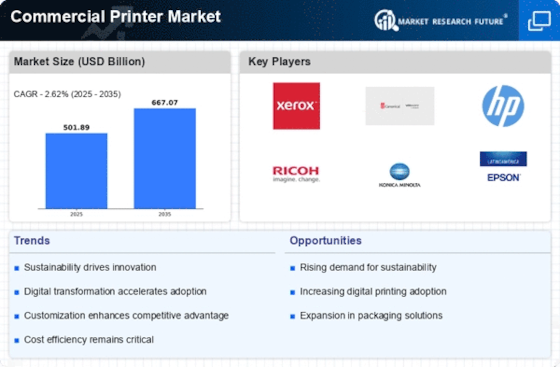
As per MRFR analysis, the Commercial Printer Market was estimated at 501.89 USD Billion in 2024. The Commercial Printer industry is projected to grow from 515.04 USD Billion in 2025 to 667.07 USD Billion by 2035, exhibiting a compound annual growth rate (CAGR) of 2.62 during the forecast period 2025 - 2035.

Key Market Trends & Highlights

The Commercial Printer Market is experiencing a dynamic shift driven by technological advancements and evolving consumer preferences.

  • Technological advancements are reshaping the landscape of the Commercial Printer Market, particularly in North America, which remains the largest market.
  • Sustainability initiatives are gaining traction, influencing printing practices and materials across the Asia-Pacific region, the fastest-growing market.
  • Customization and personalization are becoming increasingly important, especially within the Digital Printing segment, which holds the largest market share.
  • Rising demand for packaging solutions and increased adoption of digital printing technologies are key drivers propelling growth in both Commercial and Industrial Printer segments.

Market Size & Forecast

2024 Market Size 501.89 (USD Billion)
2035 Market Size 667.07 (USD Billion)
CAGR (2025 - 2035) 2.62%

Major Players

Xerox (US), Canon (JP), HP Inc. (US), Ricoh (JP), Konica Minolta (JP), Epson (JP), Lexmark (US), Brother Industries (JP), Sharp (JP)

Commercial Printer Market Trends

The Commercial Printer Market is currently experiencing a dynamic evolution, driven by advancements in technology and shifting consumer preferences. As businesses increasingly seek to enhance their operational efficiency, the demand for high-quality printing solutions is on the rise. This market encompasses a diverse range of products, including digital, offset, and large-format printers, each catering to specific needs within various industries. The integration of automation and smart technologies into printing processes appears to be a key factor influencing market growth, as companies strive to reduce costs and improve turnaround times. Furthermore, sustainability concerns are prompting manufacturers to innovate eco-friendly printing solutions, which may reshape competitive dynamics in the sector. In addition to technological advancements, the Commercial Printer Market is witnessing a notable shift towards personalized and customized printing services. This trend reflects a broader consumer desire for unique and tailored products, which could lead to increased demand for short-run printing capabilities. As businesses adapt to these changing preferences, they may invest in versatile printing equipment that can accommodate a variety of materials and formats. Overall, the Commercial Printer Market seems poised for continued growth, driven by innovation, customization, and a focus on sustainability.

Technological Advancements

The integration of cutting-edge technologies in the Commercial Printer Market is transforming traditional printing methods. Innovations such as digital printing, automation, and smart technologies are enhancing efficiency and quality, allowing businesses to meet diverse customer demands more effectively.

Sustainability Initiatives

Growing environmental concerns are prompting companies within the Commercial Printer Market to adopt sustainable practices. This includes the use of eco-friendly materials and processes, which not only appeal to environmentally conscious consumers but also comply with regulatory standards.

Customization and Personalization

There is a rising trend towards personalized printing solutions in the Commercial Printer Market. Businesses are increasingly seeking customized products to cater to specific consumer preferences, leading to a demand for short-run printing capabilities and versatile equipment.

Commercial Printer Market Drivers

Emergence of Smart Printing Solutions

The Commercial Printer Market is evolving with the emergence of smart printing solutions that leverage technology to enhance operational efficiency. Innovations such as cloud-based printing, automated workflows, and data analytics are transforming traditional printing processes. These advancements enable commercial printers to optimize resource management and reduce operational costs. Recent market analysis suggests that the adoption of smart printing technologies could lead to a reduction in production time by up to 20%. As businesses increasingly seek to streamline their operations, the demand for smart printing solutions is expected to rise, prompting commercial printers to invest in these technologies to stay competitive and meet client demands.

Rising Demand for Packaging Solutions

The Commercial Printer Market is experiencing a notable increase in demand for packaging solutions, driven by the expansion of e-commerce and retail sectors. As businesses seek to enhance their brand visibility and product presentation, the need for high-quality printed packaging materials has surged. According to recent data, the packaging segment is projected to grow at a compound annual growth rate of approximately 5.5% over the next few years. This trend indicates that commercial printers specializing in packaging are likely to benefit significantly, as they adapt to the evolving needs of various industries. Furthermore, the shift towards sustainable packaging options is prompting printers to innovate and offer eco-friendly materials, thereby aligning with consumer preferences for environmentally responsible products.

Focus on Quality and Customer Experience

The Commercial Printer Market is placing a heightened emphasis on quality and customer experience as key differentiators in a competitive landscape. Clients are increasingly seeking high-quality printed materials that reflect their brand identity and values. This trend is supported by data indicating that 70% of consumers associate print quality with brand credibility. As a result, commercial printers are likely to invest in advanced printing technologies and quality control measures to ensure superior output. Furthermore, enhancing customer experience through personalized services and responsive communication is becoming essential for retaining clients. This focus on quality and customer satisfaction is expected to drive growth in the commercial printing sector, as businesses recognize the value of investing in high-quality print solutions.

Growth in Advertising and Promotional Activities

The Commercial Printer Market is significantly influenced by the growth in advertising and promotional activities across various sectors. As companies strive to capture consumer attention in a crowded marketplace, the demand for printed marketing materials such as brochures, flyers, and banners is on the rise. Data indicates that the advertising sector is projected to grow at a rate of approximately 4% annually, which directly correlates with increased printing needs. This trend presents a lucrative opportunity for commercial printers to expand their service offerings and cater to diverse marketing strategies. Additionally, the integration of print with digital marketing efforts is likely to enhance the effectiveness of promotional campaigns, further driving demand for printed materials.

Increased Adoption of Digital Printing Technologies

The Commercial Printer Market is witnessing a shift towards digital printing technologies, which offer enhanced efficiency and flexibility. Digital printing allows for shorter print runs and quicker turnaround times, catering to the growing demand for customized and on-demand printing solutions. Recent statistics suggest that the digital printing segment is expected to account for over 30% of the total printing market by 2026. This transition is particularly beneficial for small to medium-sized enterprises that require cost-effective printing solutions without compromising on quality. As businesses increasingly recognize the advantages of digital printing, commercial printers are likely to invest in advanced digital equipment to remain competitive and meet client expectations.


Market Segment Insights

By Technology: Digital Printing (Largest) vs. Flexographic Printing (Fastest-Growing)

The Commercial Printer Market showcases a diverse array of technology segments, with Digital Printing holding the largest share among them. This segment has gained prominence due to its efficiency, high quality, and the ability to cater to short-run jobs. Meanwhile, Flexographic Printing is emerging as the fastest-growing technology, driven by its versatility in packaging applications and adaptability to various substrates, which make it ideal for label and flexible packaging printing.

Technology: Digital Printing (Dominant) vs. Flexographic Printing (Emerging)

Digital Printing stands out as the dominant force in the Commercial Printer Market, characterized by its on-demand printing capabilities and reduced setup times. This technology caters to businesses needing quick turnaround times and customization. On the other hand, Flexographic Printing is an emerging technology that is rapidly gaining traction. It is well-suited for large runs on a variety of materials, including plastic, paper, and metallic films. Its growth is bolstered by the increasing demand for packaging solutions that require high-quality graphics and flexibility in design, making it a strong candidate for future expansion.

By Product Type: Commercial Printers (Largest) vs. Industrial Printers (Fastest-Growing)

In the Commercial Printer Market, the distribution of market share among various product types showcases a diversified landscape. Commercial Printers hold the largest share due to their extensive application in various industries, including marketing and publishing. Their widespread usage and adaptability to different printing needs underline their significant role in the market. Meanwhile, other segments like Industrial Printers are experiencing notable gains, attributed to their specialized capabilities and growing demand in sectors such as manufacturing and packaging.

Commercial Printers (Dominant) vs. Label Printers (Emerging)

Commercial Printers dominate the market due to their ability to cater to a wide range of printing solutions, including brochures, flyers, and business cards. This segment benefits from technological advancements making them highly efficient and cost-effective for businesses. In contrast, Label Printers are emerging as a significant force, driven by the increasing need for product labeling in retail and compliance sectors. Their capacity for high-quality prints on diverse materials and formats makes them essential in meeting the rising demand for personalized marketing and branding solutions.

By End Use Industry: Packaging (Largest) vs. Advertising (Fastest-Growing)

In the Commercial Printer Market, the end use industry segment is crucial for understanding market dynamics. Packaging has emerged as the largest segment due to rising demand from various sectors, including food and consumer goods. This trend is driven by the need for innovative, sustainable packaging solutions that enhance product appeal while ensuring compliance with regulations. Advertising also plays a significant role, accounting for a substantial share of market demand as businesses seek creative print solutions to stand out in a crowded market.

Packaging (Dominant) vs. Advertising (Emerging)

Packaging is the dominant end-use industry in the Commercial Printer Market, characterized by its diverse applications across consumer goods, food, and healthcare. This sector relies heavily on high-quality printing to ensure product visibility and consumer attraction through vibrant, eye-catching designs. In contrast, advertising represents the emerging segment, adapting quickly to digital trends and shifts towards personalized marketing. Companies are increasingly investing in innovative print materials and techniques to capture consumer attention, thus driving growth within this sector. Both these segments are essential, with packaging representing stability and advertising embodying a shifting, adaptive market landscape.

By Print Media: Paper (Largest) vs. Plastic (Fastest-Growing)

In the Commercial Printer Market, the Print Media segment is predominantly shaped by diverse materials such as Paper, Plastic, Metal, Cardboard, and Textile. Paper continues to dominate the market, benefiting from its extensive use in traditional printing applications, including packaging and publishing. In contrast, Plastic has emerged as a rapidly growing segment due to advancements in printing technologies, which open new avenues for customization and durability, making it desirable for modern branding and packaging solutions.

Paper (Dominant) vs. Plastic (Emerging)

Paper remains the dominant print medium in the Commercial Printer Market, characterized by its versatility and widespread acceptance across various applications, including brochures, books, and packaging. The demand for high-quality printed materials drives its continued relevance. Conversely, Plastic is an emerging player, gaining traction for its unique properties, such as water resistance and customization potential. The adoption of innovative printing techniques allows for vibrant colors and intricate designs on plastic surfaces, appealing to industries looking for distinctive branding solutions. The shift towards eco-friendly alternatives also influences the market dynamics, as companies seek sustainable printing options.

Get more detailed insights about Commercial Printer Market

Regional Insights

North America : Innovation and Demand Surge

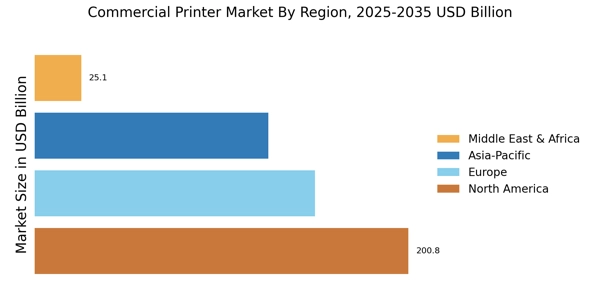
North America remains the largest market for commercial printers, holding approximately 40% of the global market share. The region's growth is driven by technological advancements, increasing demand for high-quality printing, and a shift towards digital solutions. Regulatory support for sustainable practices further catalyzes market expansion, as businesses seek eco-friendly printing options. The United States is the primary player, with significant contributions from Canada. Key players like Xerox, HP Inc., and Lexmark dominate the landscape, focusing on innovation and customer-centric solutions. The competitive environment is characterized by rapid technological advancements and a strong emphasis on service quality, ensuring that North America maintains its leadership in the commercial printer market.

Europe : Sustainable Printing Initiatives

Europe is witnessing a robust growth trajectory in the commercial printer market, accounting for around 30% of the global share. The region's focus on sustainability and eco-friendly practices is a significant driver, with regulations promoting green technologies. Countries like Germany and the UK are leading this charge, fostering innovation and demand for high-quality printing solutions. Germany stands out as the largest market, followed closely by the UK. The competitive landscape features major players such as Canon and Ricoh, who are investing in sustainable technologies. The European market is characterized by a strong emphasis on compliance with environmental regulations, which is shaping product offerings and driving market growth.

Asia-Pacific : Rapid Growth and Adoption

The Asia-Pacific region is rapidly emerging as a powerhouse in the commercial printer market, holding approximately 25% of the global market share. Key growth drivers include increasing urbanization, rising disposable incomes, and a growing demand for high-quality printing solutions. Countries like China and India are at the forefront, with significant investments in technology and infrastructure. China is the largest market in the region, followed by Japan. The competitive landscape is marked by the presence of major players such as Canon and Epson, who are adapting to local market needs. The region's dynamic environment is fostering innovation, with a strong focus on digital printing solutions and customization, ensuring sustained growth in the commercial printer market.

Middle East and Africa : Emerging Markets and Opportunities

The Middle East and Africa (MEA) region is witnessing gradual growth in the commercial printer market, accounting for about 5% of the global share. Key drivers include increasing investments in infrastructure, a growing emphasis on digital transformation, and rising demand for high-quality printing services. Countries like South Africa and the UAE are leading the market, supported by favorable government initiatives. South Africa is the largest market in the region, with the UAE following closely. The competitive landscape features both local and international players, including Brother Industries and Sharp. The MEA market is characterized by a diverse range of printing needs, with opportunities for growth in sectors such as education and retail, as businesses seek to enhance their branding and communication strategies.

Commercial Printer Market Regional Image

Key Players and Competitive Insights

The Commercial Printer Market is currently characterized by a dynamic competitive landscape, driven by technological advancements and evolving customer demands. Key players such as Xerox (US), Canon (JP), and HP Inc. (US) are at the forefront, each adopting distinct strategies to enhance their market positioning. Xerox (US) has been focusing on digital transformation, emphasizing the integration of AI and automation into their printing solutions. Canon (JP), on the other hand, appears to be leveraging its strong brand heritage to expand its product offerings, particularly in high-volume printing segments. HP Inc. (US) is actively pursuing sustainability initiatives, aiming to reduce its environmental footprint while enhancing product efficiency. Collectively, these strategies not only shape their individual trajectories but also influence the overall competitive dynamics of the market.

In terms of business tactics, companies are increasingly localizing manufacturing to reduce lead times and optimize supply chains. This approach is particularly relevant in a moderately fragmented market where agility can provide a competitive edge. The collective influence of major players like Ricoh (JP) and Konica Minolta (JP) further underscores the importance of strategic partnerships and collaborations, which are becoming essential for navigating the complexities of global supply chains and customer expectations.

In August 2025, Xerox (US) announced a strategic partnership with a leading AI firm to enhance its printing solutions through advanced data analytics. This move is likely to bolster Xerox's capabilities in providing personalized printing services, thereby catering to the growing demand for customized solutions in the commercial sector. The integration of AI is expected to streamline operations and improve customer engagement, positioning Xerox favorably in a competitive market.

In September 2025, Canon (JP) launched a new line of eco-friendly printers designed to minimize waste and energy consumption. This initiative aligns with the increasing consumer preference for sustainable products and reflects Canon's commitment to environmental stewardship. By prioritizing sustainability, Canon not only addresses regulatory pressures but also enhances its brand reputation, potentially attracting a broader customer base.

In October 2025, HP Inc. (US) unveiled its latest series of multifunction printers that incorporate advanced security features and cloud connectivity. This strategic focus on security and connectivity is indicative of the growing importance of cybersecurity in the printing industry. As businesses increasingly adopt remote work models, HP's innovations may provide a competitive advantage by addressing the security concerns of potential clients.

As of October 2025, the Commercial Printer Market is witnessing a pronounced shift towards digitalization, sustainability, and AI integration. These trends are reshaping competitive strategies, with companies increasingly forming strategic alliances to enhance their technological capabilities and market reach. The evolution of competition appears to be moving away from price-based strategies towards a focus on innovation, technology, and supply chain reliability. This shift suggests that future competitive differentiation will hinge on the ability to deliver advanced, sustainable solutions that meet the diverse needs of customers.

Key Companies in the Commercial Printer Market market include

Industry Developments

  • Q2 2024: Canon launches new imagePRESS V1350 commercial printer targeting high-volume print service providers Canon announced the release of its imagePRESS V1350, a high-speed commercial printer designed for print service providers requiring robust production capabilities and advanced automation features.
  • Q2 2024: Ricoh acquires German commercial printing firm ColorGATE to expand European footprint Ricoh completed the acquisition of ColorGATE, a leading provider of commercial printing software and services, strengthening Ricoh's presence in the European commercial print market.
  • Q3 2024: HP unveils Indigo 120K Digital Press for commercial printers at drupa 2024 HP Inc. introduced the Indigo 120K Digital Press, its latest high-volume digital printing solution, at the drupa 2024 trade show, targeting commercial printers seeking increased speed and flexibility.
  • Q2 2024: Quad Graphics announces $100M investment in new commercial printing facility in Texas Quad Graphics revealed plans to invest $100 million in a new state-of-the-art commercial printing facility in Texas, aiming to expand its production capacity and serve growing demand in the southern U.S.
  • Q1 2024: Xerox appoints Steven Bandrowczak as CEO to drive commercial printing innovation Xerox named Steven Bandrowczak as its new CEO, tasking him with accelerating innovation and growth in the commercial printing sector.
  • Q2 2024: Konica Minolta partners with EFI to integrate Fiery digital front ends into commercial printers Konica Minolta announced a strategic partnership with EFI to integrate Fiery digital front ends into its commercial printing systems, enhancing workflow automation and color management.
  • Q3 2024: Heidelberg launches Speedmaster XL 106 commercial press with AI-driven automation Heidelberg introduced the Speedmaster XL 106, a new commercial printing press featuring advanced AI-driven automation for improved productivity and reduced setup times.
  • Q2 2024: Toppan Printing wins multi-year contract to supply commercial print services for Japanese government Toppan Printing secured a multi-year contract to provide commercial printing services for various Japanese government agencies, reinforcing its leadership in the sector.
  • Q1 2025: R.R. Donnelley & Sons announces expansion of commercial print operations in India R.R. Donnelley & Sons announced the expansion of its commercial print operations in India, including new facilities and increased hiring to meet rising demand.
  • Q2 2025: Dai Nippon Printing launches eco-friendly commercial printer line for Asian markets Dai Nippon Printing introduced a new line of eco-friendly commercial printers designed for the Asian market, featuring reduced energy consumption and recyclable materials.
  • Q1 2025: Canon opens new commercial printer R&D center in Singapore Canon inaugurated a new research and development center in Singapore focused on advancing commercial printer technologies and supporting regional innovation.
  • Q2 2025: ACME Printing secures $50M funding round to scale commercial print technology ACME Printing closed a $50 million funding round led by institutional investors to accelerate the development and deployment of its commercial print technology solutions.

Future Outlook

Commercial Printer Market Future Outlook

The Commercial Printer Market is projected to grow at a 2.62% CAGR from 2024 to 2035, driven by technological advancements, sustainability initiatives, and increasing demand for customized printing solutions.

New opportunities lie in:

  • Expansion into eco-friendly printing materials
  • Development of integrated print management software
  • Investment in digital printing technologies for short runs

By 2035, the market is expected to achieve robust growth, adapting to evolving customer needs and technological advancements.

Market Segmentation

Commercial Printer Market Technology Outlook

  • Digital Printing
  • Offset Printing
  • Screen Printing
  • Flexographic Printing
  • Gravure Printing

Commercial Printer Market Print Media Outlook

  • Paper
  • Plastic
  • Metal
  • Cardboard
  • Textile

Commercial Printer Market Product Type Outlook

  • Commercial Printers
  • Industrial Printers
  • Wide Format Printers
  • Label Printers
  • Packaging Printers

Commercial Printer Market End Use Industry Outlook

  • Advertising
  • Publishing
  • Packaging
  • Textiles
  • Commercial Printing

Report Scope

MARKET SIZE 2024501.89(USD Billion)
MARKET SIZE 2025515.04(USD Billion)
MARKET SIZE 2035667.07(USD Billion)
COMPOUND ANNUAL GROWTH RATE (CAGR)2.62% (2024 - 2035)
REPORT COVERAGERevenue Forecast, Competitive Landscape, Growth Factors, and Trends
BASE YEAR2024
Market Forecast Period2025 - 2035
Historical Data2019 - 2024
Market Forecast UnitsUSD Billion
Key Companies ProfiledMarket analysis in progress
Segments CoveredMarket segmentation analysis in progress
Key Market OpportunitiesAdoption of sustainable printing technologies drives growth in the Commercial Printer Market.
Key Market DynamicsTechnological advancements drive efficiency and sustainability in the Commercial Printer Market, reshaping competitive dynamics.
Countries CoveredNorth America, Europe, APAC, South America, MEA

Leave a Comment

FAQs

What is the current valuation of the Commercial Printer Market?

The Commercial Printer Market was valued at 501.89 USD Billion in 2024.

What is the projected market size for the Commercial Printer Market by 2035?

The market is projected to reach 667.07 USD Billion by 2035.

What is the expected CAGR for the Commercial Printer Market during the forecast period?

The expected CAGR for the Commercial Printer Market from 2025 to 2035 is 2.62%.

Which technology segment holds the largest market share in the Commercial Printer Market?

Offset Printing appears to hold the largest market share, with valuations ranging from 180.0 to 230.0 USD Billion.

What are the key product types in the Commercial Printer Market?

Key product types include Commercial Printers, Industrial Printers, and Packaging Printers, with valuations of 150.0 to 200.0 USD Billion, 100.0 to 130.0 USD Billion, and 101.89 to 147.07 USD Billion, respectively.

Which end-use industry is expected to drive growth in the Commercial Printer Market?

The Packaging industry is likely to drive growth, with a market size projected between 200.0 and 280.0 USD Billion.

Who are the leading players in the Commercial Printer Market?

Key players include Xerox, Canon, HP Inc., Ricoh, and Konica Minolta, among others.

What is the market size for digital printing technology in the Commercial Printer Market?

Digital Printing technology is valued between 150.0 and 200.0 USD Billion.

How does the market for wide format printers compare to other product types?

The market for Wide Format Printers is projected to be between 80.0 and 100.0 USD Billion, indicating a substantial segment.

What materials are primarily used in the Commercial Printer Market?

The primary materials include Paper, Plastic, and Cardboard, with valuations of 200.0 to 260.0 USD Billion, 100.0 to 130.0 USD Billion, and 80.0 to 100.0 USD Billion, respectively.

Download Free Sample

Kindly complete the form below to receive a free sample of this Report

Compare Licence

×
Features License Type
Single User Multiuser License Enterprise User
Price $4,950 $ $7,250
Maximum User Access Limit 1 User Upto 10 Users Unrestricted Access Throughout the Organization
Free Customization
Direct Access to Analyst
Deliverable Format
Platform Access
Discount on Next Purchase 10% 15% 15%
Printable Versions