Download Free Sample
Kindly complete the form below to receive a free sample of this Report
Commercial Tableware Service Market Size, Share, Industry Trend & Analysis Research Report By Material (Ceramic, Glass, Plastic, Metal, Wood), By Product Type (Dinnerware, Serveware, Flatware, Drinkware), By End Use (Restaurants, Cafes, Catering Services, Hotels), By Distribution Channel (Online Retail, Offline Retail, Direct Sales) andBy Regional (North America, Europe, South America, Asia Pacific, Middle East and Africa)- Forecast to 2035
As per Market Research Future analysis, the Commercial Tableware Service Market was estimated at 27.04 USD Billion in 2024. The Commercial Tableware Service industry is projected to grow from 27.76 USD Billion in 2025 to 36.1 USD Billion by 2035, exhibiting a compound annual growth rate (CAGR) of 2.66% during the forecast period 2025 - 2035
The Commercial Tableware Service Market is experiencing a dynamic shift towards sustainability and technological innovation.
| 2024 Market Size | 27.04 (USD Billion) |
| 2035 Market Size | 36.1 (USD Billion) |
| CAGR (2025 - 2035) | 2.66% |
Libbey Inc (US), Bunzl PLC (GB), Villeroy & Boch AG (DE), Arc International (FR), Churchill China PLC (GB), Dudson Ltd (GB), Homer Laughlin China Company (US), Steelite International (GB), Tablecraft Products Company (US)
Our Impact
Enabled $4.3B Revenue Impact for Fortune 500 and Leading Multinationals
Partnering with 2000+ Global Organizations Each Year
30K+ Citations by Top-Tier Firms in the Industry
The Commercial Tableware Service Market is currently experiencing a dynamic evolution, driven by various factors that influence consumer preferences and industry standards. The increasing emphasis on sustainability appears to be reshaping the landscape, as businesses seek eco-friendly materials and practices. This shift not only aligns with global environmental goals but also caters to a growing demographic that prioritizes responsible consumption. Additionally, the rise of experiential dining, where ambiance and presentation play crucial roles, suggests that tableware design is becoming more innovative and aesthetically pleasing. As restaurants and hotels strive to create memorable experiences, the demand for unique and high-quality tableware is likely to surge. Moreover, technological advancements in manufacturing processes may enhance the efficiency and quality of tableware production. Automation and smart technologies could streamline operations, potentially reducing costs and improving product consistency. This trend may also lead to the introduction of new materials and designs that were previously unattainable. As the Commercial Tableware Service Market continues to adapt to these changes, stakeholders must remain vigilant and responsive to emerging trends, ensuring they meet the evolving needs of consumers and businesses alike.
The emphasis on sustainable practices is increasingly influencing the Commercial Tableware Service Market. Businesses are prioritizing eco-friendly materials and production methods, responding to consumer demand for environmentally responsible options. This trend not only supports global sustainability efforts but also enhances brand reputation among conscientious consumers.
The rise of experiential dining is reshaping the Commercial Tableware Service Market. Establishments are investing in unique and visually appealing tableware to enhance the overall dining experience. This focus on aesthetics and presentation is likely to drive demand for innovative designs that captivate customers and elevate their meals.
Technological innovations are transforming the Commercial Tableware Service Market. Automation and smart manufacturing processes are improving production efficiency and product quality. These advancements may lead to the development of new materials and designs, allowing businesses to offer a wider range of options to meet diverse consumer preferences.
Sustainability initiatives are becoming increasingly important in the commercial tableware service Market, as consumers and businesses alike prioritize eco-friendly practices. The demand for sustainable materials, such as biodegradable and recyclable tableware, is on the rise. This trend is driven by a growing awareness of environmental issues and the desire for responsible consumption. Data suggests that the market for sustainable tableware is expected to witness substantial growth, as more foodservice establishments seek to align their operations with eco-conscious values. As a result, manufacturers in the Commercial Tableware Service Market are likely to innovate and develop products that meet these sustainability criteria, thereby appealing to a broader customer base.
The aesthetic appeal of tableware is increasingly recognized as a crucial factor in the dining experience, driving demand within the Commercial Tableware Service Market. As consumers become more discerning, restaurants and cafes are investing in visually appealing tableware to create memorable dining experiences. This trend is supported by data indicating that establishments with well-designed tableware can enhance customer satisfaction and encourage repeat visits. The market for decorative and unique tableware is expected to grow, as operators seek to differentiate themselves in a competitive landscape. Thus, the focus on aesthetics not only influences purchasing decisions but also shapes the overall branding strategies of foodservice providers.
The expansion of online food delivery services has transformed the way consumers access dining options, thereby impacting the Commercial Tableware Service Market. As more consumers opt for delivery, restaurants are adapting their tableware choices to ensure that food presentation remains appealing even when served off-premises. This shift has led to an increased demand for packaging solutions that maintain the quality and appearance of food during transit. Market analysis indicates that the online food delivery segment is expected to grow significantly, prompting foodservice operators to invest in tableware that aligns with this trend. Consequently, the Commercial Tableware Service Market must adapt to these changing dynamics to meet the needs of both restaurants and consumers.
Technological innovations in manufacturing processes are significantly influencing the Commercial Tableware Service Market. Advances in materials science and production techniques are enabling manufacturers to create tableware that is not only more durable but also more cost-effective. For instance, the introduction of advanced ceramics and composite materials has led to the development of lightweight yet sturdy tableware options. This evolution in manufacturing is expected to enhance product offerings and reduce production costs, thereby benefiting both manufacturers and consumers. As the market continues to evolve, the integration of technology in the production of tableware will likely play a pivotal role in shaping the future landscape of the Commercial Tableware Service Market.
The increasing number of foodservice establishments, including restaurants, cafes, and catering services, appears to be a primary driver for the Commercial Tableware Service Market. As dining out becomes a prevalent social activity, the need for high-quality tableware is likely to rise. According to industry reports, the foodservice sector is projected to grow at a compound annual growth rate of approximately 4.5% over the next few years. This growth suggests that more establishments will require durable and aesthetically pleasing tableware to enhance customer experience. Consequently, manufacturers in the Commercial Tableware Service Market may find opportunities to innovate and expand their product lines to meet the evolving demands of these establishments.
The Commercial Tableware Service Market is notably characterized by its diverse material offerings. Among these, Ceramic holds the largest market share, favored for its aesthetic appeal and durability in commercial settings. The inherent qualities of Ceramic, such as heat resistance and ease of maintenance, contribute significantly to its widespread adoption across restaurants and hotels. Glass follows closely, recognized for its elegance and versatility, making it a preferred choice for upscale dining experiences and trendy cafes seeking to enhance their presentation.
In recent years, the market has seen a pivotal shift towards innovative materials, with Glass emerging as the fastest-growing segment. Factors driving this growth include increasing consumer preference for sustainable and stylish dining options, alongside the rise of experiential dining. Additionally, advancements in tempered glass technology have enhanced its safety and durability, further promoting its use in commercial applications. As a result, the demand for Glass tableware is poised to rise, reflecting evolving consumer trends in the hospitality industry.
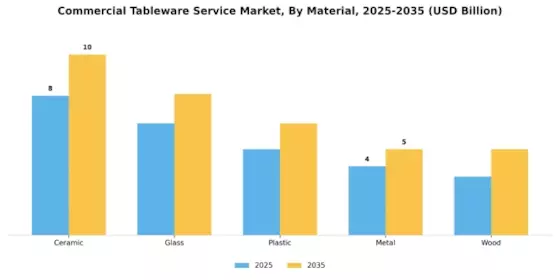
Ceramic (Dominant) vs. Plastic (Emerging)
ceramic tableware dominates the Commercial Tableware Service Market due to its exceptional quality and timeless appeal. It is often favored for formal dining settings, offering a premium feel that enhances the dining experience. On the other hand, Plastic tableware is gaining traction as an emerging alternative, particularly in catering and fast-casual dining environments. While it may lack the aesthetic qualities of Ceramic, Plastic provides significant advantages such as lightweight handling, affordability, and high durability, making it ideal for high-volume service. The growing focus on convenience and cost-effective solutions drives the acceptance of Plastic tableware despite environmental concerns. Together, these segments illustrate the shifting dynamics in consumer preferences, balancing traditional elegance with modern practicality.
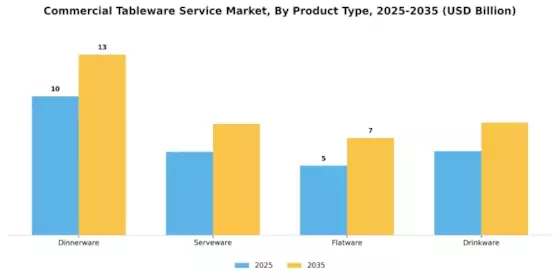
In the Commercial Tableware Service Market, Dinnerware holds the largest market share, favored for its essential role in professional dining settings. Its broad variety, including plates, bowls, and serving platters, meets the demands of various cuisines and dining experiences. Following dinnerware, Serveware and Flatware also contribute significantly, providing necessary functionality and style to commercial establishments. Drinkware, while traditionally seen as secondary, has gained traction as dining experiences evolve to include specialized beverages, enhancing overall appeal to customers.
The growth trajectory of the Commercial Tableware Service Market is underscored by increasing dining out trends, driven by consumer demand for unique and high-quality dining experiences. The Drinkware segment, in particular, is witnessing rapid growth, fueled by the rise of artisanal beverages and craft cocktails, inspiring hospitality venues to invest in stylish drinkware. Additionally, eco-friendly materials are becoming a strong driver across all product types, reflecting a shift towards sustainability within the sector.
Dinnerware: Core Segment (Dominant) vs. Drinkware: Specialty Offerings (Emerging)
Dinnerware is a foundational element of the Commercial Tableware Service Market, encompassing a wide array of products designed to serve food in various culinary settings. Its dominance is attributed to the essential role it plays in both fine and casual dining experiences. This segment caters to different styles and materials, from elegant porcelain to durable melamine, ensuring that restaurants and catering services can find options that match their brand image and operational requirements. On the other hand, Drinkware is emerging as a significant category, with innovations in design and material enhancing its appeal. The rise of specialty cocktails and beverages has led to an increased focus on unique drinkware designs, and this segment is evolving with trends toward sustainable options, including compostable and reusable materials, shaping the market dynamics further.
In the Commercial Tableware Service Market, the end use segments are primarily dominated by Restaurants, which account for a significant share of the overall market. Cafes and Hotels hold considerable shares as well, but the competitive landscape is heavily influenced by the performance of Restaurants. Catering Services, while smaller in comparison, are emerging as a pivotal segment that is reshaping market dynamics due to rising demand for organized food events and gatherings.
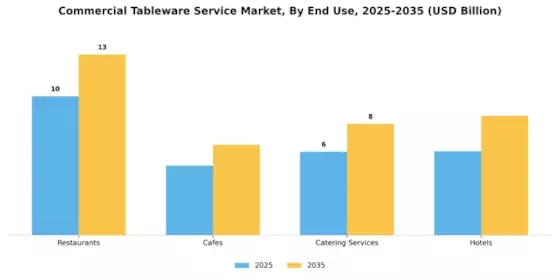
Restaurants (Dominant) vs. Catering Services (Emerging)
Restaurants are the dominant force in the Commercial Tableware Service Market, characterized by their high-volume needs for a diverse range of tableware that enhances customer experience and meets aesthetic standards. The emphasis on dining ambiance and customer service drives restaurants to invest in high-quality tableware that reflects their brand identity. Conversely, Catering Services represent the emerging segment, fueled by increasing demand for catered events, parties, and corporate gatherings. Their growth is driven by versatility, as they require adaptable and portable tableware solutions that can cater to various events, making them an attractive segment for innovation.
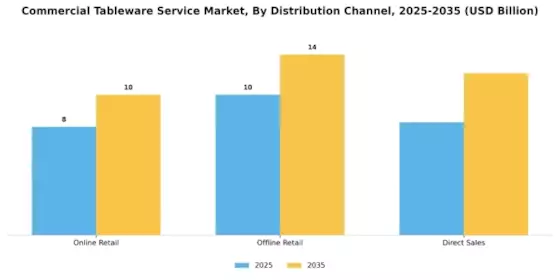
In the Commercial Tableware Service Market, the distribution share is predominantly led by online retail, which accounts for the largest portion of market sales. This trend can be attributed to the rising use of e-commerce platforms among businesses seeking convenience and comprehensive product selections. Conversely, offline retail is showing signs of robust growth, fueled by a resurgence in face-to-face interactions and the experience-driven buying behaviors of customers who prefer to see and touch products before making a purchase.
Online Retail (Dominant) vs. Offline Retail (Emerging)
Online retail serves as the dominant distribution channel in the Commercial Tableware Service Market, leveraging the convenience of digital shopping and a wide array of product availability. Businesses favor this channel for its ability to streamline ordering processes and provide access to competitive pricing. On the other hand, offline retail is emerging as a significant player, driven by the consumer desire for tangible shopping experiences. Brick-and-mortar stores are adapting by enhancing their in-store experiences and offering personalized services. This blend of traditional and modern retail mechanisms allows both channels to coexist and meet diverse customer preferences.
Get more detailed insights about Commercial Tableware Service Market Request Free Sample
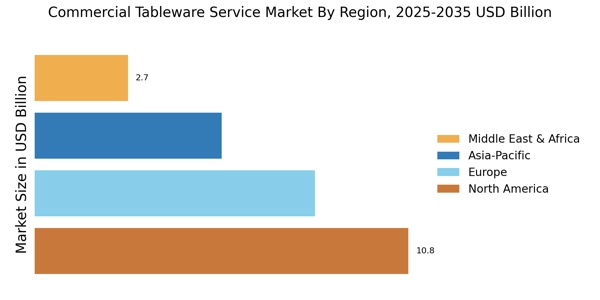
North America is the largest market for commercial tableware services, holding approximately 40% of the global market share. The growth is driven by a robust hospitality sector, increasing consumer spending on dining experiences, and a trend towards sustainable and high-quality tableware. Regulatory support for food safety and hygiene standards further catalyzes market expansion, ensuring compliance and quality assurance. The United States is the leading country in this region, with significant contributions from Canada. Key players like Libbey Inc and Homer Laughlin China Company dominate the landscape, focusing on innovation and sustainability. The competitive environment is characterized by a mix of established brands and emerging players, all striving to meet the evolving demands of the food service industry.
Europe is the second-largest market for commercial tableware services, accounting for around 30% of the global market share. The region's growth is fueled by a rich culinary culture, increasing tourism, and a rising trend towards premium dining experiences. Regulatory frameworks emphasizing food safety and environmental sustainability are also significant drivers, encouraging the adoption of eco-friendly materials and practices. Leading countries include Germany, France, and the UK, where companies like Villeroy & Boch AG and Churchill China PLC are prominent. The competitive landscape is marked by a blend of traditional craftsmanship and modern design, with a focus on innovation. The presence of key players ensures a dynamic market, catering to diverse consumer preferences and trends.
Asia-Pacific is witnessing rapid growth in the commercial tableware service market, holding approximately 20% of the global market share. The region's expansion is driven by urbanization, rising disposable incomes, and a burgeoning food service industry. Countries like China and India are at the forefront, with increasing investments in hospitality and dining sectors. Regulatory initiatives promoting food safety standards are also contributing to market growth. China is the largest market in this region, followed by India and Japan. The competitive landscape features both local and international players, with companies like Arc International and Steelite International making significant inroads. The market is characterized by a mix of traditional and modern tableware designs, catering to diverse consumer tastes and preferences.
The Middle East and Africa region is emerging as a significant player in the commercial tableware service market, holding about 10% of the global market share. The growth is driven by increasing tourism, a growing middle class, and investments in the hospitality sector. Regulatory frameworks are evolving to support food safety and quality standards, which are crucial for market expansion in this region. Leading countries include the UAE and South Africa, where the hospitality industry is booming. The competitive landscape is diverse, with both local artisans and international brands vying for market share. Key players like Tablecraft Products Company are focusing on innovative designs and sustainable practices to meet the demands of a rapidly changing market.
The Commercial Tableware Service Market is currently characterized by a dynamic competitive landscape, driven by factors such as increasing demand for high-quality dining experiences and the growing trend of sustainability in food service. Key players like Libbey Inc (US), Bunzl PLC (GB), and Villeroy & Boch AG (DE) are strategically positioning themselves through innovation and regional expansion. For instance, Libbey Inc (US) has focused on enhancing its product offerings with eco-friendly materials, while Bunzl PLC (GB) has been expanding its distribution networks to cater to emerging markets. These strategies collectively shape a competitive environment that emphasizes quality, sustainability, and accessibility.The market structure appears moderately fragmented, with numerous players vying for market share. Key business tactics such as localizing manufacturing and optimizing supply chains are prevalent among leading companies. This fragmentation allows for a diverse range of products and services, catering to various customer preferences. The collective influence of these key players fosters a competitive atmosphere where innovation and operational efficiency are paramount.
In August Villeroy & Boch AG (DE) announced the launch of a new line of biodegradable tableware, reflecting a significant shift towards sustainable practices. This strategic move not only aligns with global sustainability trends but also positions the company as a leader in eco-conscious dining solutions. The introduction of biodegradable products is likely to attract environmentally aware consumers, enhancing brand loyalty and market share.
In September Churchill China PLC (GB) unveiled a partnership with a leading technology firm to integrate AI-driven design processes into their product development. This collaboration aims to streamline operations and enhance product customization, which could significantly improve customer satisfaction. By leveraging AI, Churchill China PLC (GB) is poised to respond more effectively to market demands, thereby strengthening its competitive edge.
In October Steelite International (GB) announced the acquisition of a local tableware manufacturer in Asia, aiming to bolster its presence in the rapidly growing Asian market. This strategic acquisition is indicative of a broader trend where companies seek to localize production to reduce costs and improve supply chain efficiency. Such moves are likely to enhance Steelite's market responsiveness and operational agility.
As of October the competitive trends in the Commercial Tableware Service Market are increasingly defined by digitalization, sustainability, and the integration of advanced technologies. Strategic alliances are becoming more common, as companies recognize the value of collaboration in enhancing innovation and market reach. Looking ahead, competitive differentiation is expected to evolve, shifting from traditional price-based competition to a focus on innovation, technological advancements, and reliable supply chains. This transition underscores the importance of adaptability and forward-thinking strategies in maintaining a competitive advantage.






The Commercial Tableware Service Market has seen significant recent developments, with key companies actively adapting to changing consumer preferences and sustainability trends. Companies like Arc Cardinal, Bauscher Hepp, and TableCraft are increasingly investing in eco-friendly materials and innovative designs to enhance product appeal. Notably, the demand for unique and customizable tableware is rising, leading firms such as Bonna and Schott Zwiesel to focus on personalized offerings. The market is also witnessing a consolidation phase, with mergers and acquisitions surfacing among major players; however, there have been no recent high-profile mergers reported concerning Arc Cardinal, Libbey, or Villeroy & Boch.
Concurrently, manufacturers like Denby Pottery and Churchill China are experiencing growth in market valuation, which has positively impacted their product development and operational strategies. The competitive landscape is intensified by increasing online sales channels, motivating brands such as Corelle Brands and WMF Group to enhance their e-commerce strategies. Additionally, traditional ceramics and stoneware are gaining popularity, impacting overall market dynamics as companies strive to maintain relevance in a rapidly evolving environment. Key trends, including health-conscious dining and aesthetic considerations, influence both manufacturing and consumer purchasing decisions.
The Commercial Tableware Service Market is projected to grow at a 2.66% CAGR from 2025 to 2035, driven by increasing demand for sustainable materials and innovative designs.
New opportunities lie in:
By 2035, the market is expected to achieve robust growth, driven by innovation and sustainability.
| MARKET SIZE 2024 | 27.04(USD Billion) |
| MARKET SIZE 2025 | 27.76(USD Billion) |
| MARKET SIZE 2035 | 36.1(USD Billion) |
| COMPOUND ANNUAL GROWTH RATE (CAGR) | 2.66% (2025 - 2035) |
| REPORT COVERAGE | Revenue Forecast, Competitive Landscape, Growth Factors, and Trends |
| BASE YEAR | 2024 |
| Market Forecast Period | 2025 - 2035 |
| Historical Data | 2019 - 2024 |
| Market Forecast Units | USD Billion |
| Key Companies Profiled | Libbey Inc (US), Bunzl PLC (GB), Villeroy & Boch AG (DE), Arc International (FR), Churchill China PLC (GB), Dudson Ltd (GB), Homer Laughlin China Company (US), Steelite International (GB), Tablecraft Products Company (US) |
| Segments Covered | Material, Product Type, End Use, Distribution Channel, Regional |
| Key Market Opportunities | Integration of sustainable materials and smart technology in the Commercial Tableware Service Market. |
| Key Market Dynamics | Rising consumer preference for sustainable materials drives innovation and competition in the commercial tableware service market. |
| Countries Covered | North America, Europe, APAC, South America, MEA |
The projected market valuation for the Commercial Tableware Service Market is expected to reach 36.1 USD Billion by 2035.
The overall market valuation of the Commercial Tableware Service Market was 27.04 USD Billion in 2024.
The expected CAGR for the Commercial Tableware Service Market during the forecast period 2025 - 2035 is 2.66%.
The Ceramic material segment is projected to reach a valuation of 10.5 USD Billion by 2035.
The Dinnerware segment was valued at 10.0 USD Billion in 2024 and is projected to grow to 13.0 USD Billion by 2035.
Key players in the market include Libbey Inc, Bunzl PLC, Villeroy & Boch AG, and Churchill China PLC, among others.
The Online Retail distribution channel is projected to reach a valuation of 10.5 USD Billion by 2035.
The Hotels end-use segment is expected to grow from 6.04 USD Billion in 2024 to 8.6 USD Billion by 2035.
The Flatware product type is projected to reach a valuation of 7.0 USD Billion by 2035.
The Cafes end-use segment was valued at 5.0 USD Billion in 2024 and is projected to grow to 6.5 USD Billion by 2035.



Kindly complete the form below to receive a free sample of this Report

“This is really good guys. Excellent work on a tight deadline. I will continue to use you going forward and recommend you to others. Nice job”


“Thanks. It’s been a pleasure working with you, please use me as reference with any other Intel employees.”


“Thanks for sending the report it gives us a good global view of the Betaïne market.”


“Thank you, this will be very helpful for OQS.”


“We found the report very insightful! we found your research firm very helpful. I'm sending this email to secure our future business.”


“I am very pleased with how market segments have been defined in a relevant way for my purposes (such as "Portable Freezers & refrigerators" and "last-mile"). In general the report is well structured. Thanks very much for your efforts.”


“I have been reading the first document or the study, ,the Global HVAC and FP market report 2021 till 2026. Must say, good info! I have not gone in depth at all parts, but got a good indication of the data inside!”


“We got the report in time, we really thank you for your support in this process. I also thank to all of your team as they did a great job.”


“The Automotive 48V ECU Components Procurement Intelligence Study” was a complex project, but the Market Research Future (MRFR) team handled it with quality, agility, and customer-centricity. They delivered all requested data on time and within the agreed scope. The team, including Shubhendra Anand and Rahul Gotadki, was always readily available to clarify questions and swiftly implement necessary adjustments, driving the project to a successful conclusion within a very demanding timeframe.
I would also like to specifically commend Akshay Agarwal for his responsiveness and support at every stage—from our initial inquiry on May 6th through to final delivery on June 18th. His dedication made the entire process seamless.”



