×
Request Free Sample ×

Kindly complete the form below to receive a free sample of this Report

Leading companies partner with us for data-driven Insights

clients tt-cursor
Hero Background

Commercial Vehicle Financing Market

ID: MRFR/AT/33253-HCR
100 Pages
Swapnil Palwe
October 2025

Commercial Vehicle Financing Market Research Report By Type of Commercial Vehicle (Trucks, Buses, Vans, Trailers), By Financing Type (Leasing, Loans, Financing Through Manufacturers, Finance Brokers), By End Use Application (Freight Transportation, Construction, Public Transport, Logistics), By Customer Type (Small and Medium Enterprises, Large Enterprises, Government Organizations) and By Regional (North America, Europe, South America, Asia Pacific, Middle East and Africa) - Forecast to 2035

Share:
Download PDF ×

We do not share your information with anyone. However, we may send you emails based on your report interest from time to time. You may contact us at any time to opt-out.

Commercial Vehicle Financing Market Infographic
Purchase Options

Commercial Vehicle Financing Market Summary

As per MRFR analysis, the The Commercial Vehicle Financing Market sector. was estimated at 139.87 USD Billion in 2024. The Commercial Vehicle Financing industry is projected to grow from 145.06 USD Billion in 2025 to 208.85 USD Billion by 2035, exhibiting a compound annual growth rate (CAGR) of 3.71 during the forecast period 2025 - 2035.

Key Market Trends & Highlights

The Commercial Vehicle Financing Market is experiencing a transformative shift towards more adaptable and technology-driven solutions.

  • The market is witnessing a notable shift towards flexible financing solutions, catering to diverse customer needs.
  • Digital transformation is reshaping financing processes, enhancing efficiency and customer experience in North America.
  • Sustainable vehicle financing is gaining traction, reflecting a growing awareness of environmental concerns in the Asia-Pacific region.
  • The increasing demand for e-commerce and logistics services, coupled with government initiatives, drives growth in the truck financing segment.

Market Size & Forecast

2024 Market Size 139.87 (USD Billion)
2035 Market Size 208.85 (USD Billion)
CAGR (2025 - 2035) 3.71%

Major Players

Wells Fargo (US), Ford Credit (US), Mercedes-Benz Financial Services (DE), Toyota Financial Services (JP), Volvo Financial Services (SE), PACCAR Financial (US), CNH Industrial Capital (GB), Hitachi Capital (JP), Ally Financial (US)

Commercial Vehicle Financing Market Trends

The Commercial Vehicle Financing Market is evolving dynamically, driven by various factors influencing the demand for commercial vehicles. As businesses increasingly recognize the importance of efficient logistics and transportation, the need for financing solutions tailored to commercial vehicles has become more pronounced. This market appears to be characterized by a growing preference for flexible financing options, which may include leasing and installment plans. Additionally, the rise of e-commerce and the subsequent demand for last-mile delivery services seem to be propelling the market forward, as companies seek to expand their fleets to meet consumer expectations. Moreover, advancements in technology are likely reshaping the landscape of the Commercial Vehicle Financing Market. Digital platforms for financing applications and approvals are becoming more prevalent, streamlining the process for businesses. This shift towards digitalization not only enhances customer experience but also allows financial institutions to assess risk more effectively. Furthermore, sustainability concerns are influencing purchasing decisions, with many companies exploring financing options for electric and hybrid commercial vehicles. As the market continues to adapt to these trends, it is poised for further growth and transformation in the coming years.

Shift Towards Flexible Financing Solutions

The Commercial Vehicle Financing Market is witnessing a notable shift towards flexible financing options. Businesses are increasingly favoring leasing and installment plans that allow for better cash flow management. This trend indicates a growing recognition of the need for adaptable financial solutions that align with varying operational demands.

Digital Transformation in Financing Processes

The rise of digital platforms is significantly impacting the Commercial Vehicle Financing Market. Enhanced online applications and approval processes are streamlining financing, making it more accessible for businesses. This digital transformation not only improves efficiency but also enables lenders to better evaluate risk.

Focus on Sustainable Vehicle Financing

Sustainability is becoming a key consideration in the Commercial Vehicle Financing Market. Companies are increasingly exploring financing options for electric and hybrid vehicles, reflecting a broader commitment to environmental responsibility. This trend suggests a potential shift in consumer preferences towards greener transportation solutions.

Commercial Vehicle Financing Market Drivers

Government Initiatives and Incentives

Government initiatives aimed at promoting the use of commercial vehicles play a crucial role in the Commercial Vehicle Financing Market. Various countries have introduced incentives such as tax breaks, subsidies, and grants to encourage businesses to invest in new vehicles. These initiatives not only stimulate demand for commercial vehicles but also enhance the attractiveness of financing options available to businesses. For instance, in 2025, it is estimated that government incentives could account for up to 15% of the total financing volume in the market. This support from governments is likely to foster growth in the Commercial Vehicle Financing Market.

Rising Fuel Prices and Operational Costs

Rising fuel prices and operational costs are compelling businesses to reassess their vehicle financing strategies within the Commercial Vehicle Financing Market. As fuel prices fluctuate, companies are increasingly looking for financing options that allow them to invest in more fuel-efficient vehicles. This trend is expected to lead to a 7% increase in financing for energy-efficient commercial vehicles by 2026. Businesses are recognizing that investing in modern, fuel-efficient fleets can mitigate rising operational costs, thus driving demand for tailored financing solutions in the Commercial Vehicle Financing Market.

Expansion of Ride-Sharing and Mobility Services

The expansion of ride-sharing and mobility services is reshaping the landscape of the Commercial Vehicle Financing Market. As companies like Uber and Lyft continue to grow, there is a corresponding increase in demand for vehicles that can be used for these services. This trend is likely to result in a 6% increase in financing requests for commercial vehicles specifically designed for ride-sharing purposes by 2026. The need for flexible financing solutions that cater to the unique requirements of mobility services is becoming increasingly apparent, thereby influencing the Commercial Vehicle Financing Market.

Technological Advancements in Vehicle Manufacturing

Technological advancements in vehicle manufacturing are significantly influencing the Commercial Vehicle Financing Market. Innovations such as electric and hybrid vehicles are becoming more prevalent, prompting businesses to seek financing for these new technologies. The shift towards more fuel-efficient and environmentally friendly vehicles is expected to drive a 10% increase in financing requests for commercial vehicles by 2026. As manufacturers continue to develop advanced features, the demand for financing solutions that accommodate these innovations is likely to rise, thereby impacting the Commercial Vehicle Financing Market positively.

Increasing Demand for E-commerce and Logistics Services

The rise in e-commerce and logistics services is a pivotal driver for the Commercial Vehicle Financing Market. As online shopping continues to expand, businesses require a robust fleet of commercial vehicles to meet delivery demands. This trend has led to an increased need for financing solutions tailored to logistics companies. In 2025, the demand for commercial vehicles is projected to grow by approximately 5% annually, indicating a strong market for financing options. Companies are increasingly seeking flexible financing arrangements to acquire vehicles that can support their operational needs, thereby propelling the Commercial Vehicle Financing Market forward.

Market Segment Insights

By Type of Commercial Vehicle: Trucks (Largest) vs. Trailers (Fastest-Growing)

The trucks segment predominantly influences the Commercial Vehicle Financing Market, holding the largest market share due to relentless demand from logistics and freight sectors. Buses and vans are also noteworthy, with considerable market shares driven by urban transportation needs and e-commerce growth respectively. Trailers, while currently smaller in share, are quickly gaining traction as businesses expand their logistics capabilities, adapting to market needs by investing in modern trailer units.

Trucks: Dominant vs. Trailers: Emerging

Trucks remain the dominant segment in the Commercial Vehicle Financing Market, typically utilized for their versatility in freight transport and their crucial role in supply chain logistics. Businesses rely on trucks for various applications from short deliveries to long-haul transports, making them a preferred choice for financing. On the other hand, trailers are an emerging segment, increasingly recognized for their cost-effectiveness in expanding cargo capacity without the need for additional vehicles. Their adaptability in fitting various truck types and the rising demand for efficient logistics solutions underscore their growth potential. As companies seek to upgrade their logistics fleet, trailers are becoming indispensable, thus enhancing their market position.

By Financing Type: Leasing (Largest) vs. Loans (Fastest-Growing)

In the Commercial Vehicle Financing Market, leasing holds the largest market share among the financing types, offering flexibility and lower initial costs that attract businesses looking to optimize cash flow. Loans, on the other hand, are experiencing rapid growth as companies recognize the benefits of asset ownership and the potential for equity accumulation through financed purchases. Meanwhile, financing through manufacturers and finance brokers plays a substantial role in providing tailored options for businesses seeking specific terms and conditions to suit their operational needs.

Leasing (Dominant) vs. Loans (Emerging)

Leasing is often viewed as the dominant financing option within the commercial vehicle sector due to its low upfront costs and the flexibility it provides to businesses. Companies prefer leasing to maintain cash flow and reduce long-term investment risks. Conversely, loans are emerging as an increasingly popular choice, particularly among businesses aiming for asset ownership and the benefits that come with it. The desire for equity building, coupled with favorable interest rates, has made loans more attractive, driving significant growth in this segment. This evolution reflects a changing mindset within the market as firms seek to capitalize on ownership advantages while navigating financial constraints.

By End Use Application: Freight Transportation (Largest) vs. Public Transport (Fastest-Growing)

In the Commercial Vehicle Financing Market, Freight Transportation holds the largest market share due to the consistent demand for logistics and goods movement. This segment benefits from the increasing reliance on freight services amidst growing e-commerce and globalization trends. The Construction and Logistics applications follow closely, with notable contributions as both sectors expand their fleets to meet growing operational demands. Public Transport, while smaller in market share, shows a significant upward traction driven by urbanization trends and a push towards sustainable mobility solutions. Growth in the Commercial Vehicle Financing Market is significantly fueled by sectoral demands. The Freight Transportation sector capitalizes on expanding e-commerce, necessitating larger and more efficient fleets. The Construction segment benefits from infrastructural development and urban growth initiatives, while Logistics is evolving with advancements in technology enhancing operational efficiencies. Public Transport is witnessing a surge as municipalities increasingly invest in cleaner, electric vehicle options, positioning it as the fastest-growing segment amidst societal shifts towards greener transportation solutions.

Freight Transportation (Dominant) vs. Construction (Emerging)

Freight Transportation stands as the dominant sector within the Commercial Vehicle Financing Market, significantly driven by the logistical necessities of a globalized economic environment. It involves financing a wide range of vehicles, including heavy trucks and trailers, which are integral for moving goods efficiently across vast distances. This segment enjoys stable demand owing to consistent shipping needs across multiple industries. In contrast, the Construction sector is emerging as a significant segment, spurred by increasing investments in infrastructure and construction projects. The demand for commercial vehicles in this sector includes specialized machinery and unmanned vehicles which are essential for modern construction processes. Both segments are characterized by their adaptive financing solutions catering to evolving operational requirements.

By Customer Type: Small and Medium Enterprises (Largest) vs. Large Enterprises (Fastest-Growing)

In the Commercial Vehicle Financing Market, Small and Medium Enterprises (SMEs) hold the largest share, driven by their dependence on commercial vehicles for logistics, delivery, and service operations. They are often more agile and adaptable, leading to a significant market presence. Meanwhile, Large Enterprises, while smaller in market share compared to SMEs, are the fastest-growing segment due to aggressive expansion strategies and investments in modern fleets. Their need for financing solutions is compounded by the increasing operational demands and market competitiveness. As the market evolves, growth trends show that technological advancements and a growing focus on sustainability are influencing financing preferences. For SMEs, the ability to negotiate favorable terms and flexible repayment options is driving growth, while Large Enterprises are rapidly adopting innovative financing solutions to manage scale and efficiency. This dynamic leads to a competitive environment where adaptability and technology play crucial roles in financing decisions.

Small and Medium Enterprises (Dominant) vs. Large Enterprises (Emerging)

In the Commercial Vehicle Financing Market, Small and Medium Enterprises are considered the dominant force due to their extensive participation in various industries, including retail, logistics, and services. Their financing needs are often more immediate, as they rely heavily on commercial vehicles for day-to-day operations, providing opportunities for tailored financing products to suit their specific requirements. On the other hand, Large Enterprises represent an emerging segment characterized by substantial fleet sizes and complex financing requirements. They frequently seek more sophisticated financing options and are becoming increasingly focused on leveraging technology to streamline procurement and finance processes. As they scale operations, the demand for innovative and flexible financing solutions is expected to rise, indicating a shift towards more strategic financing approaches within this segment.

Get more detailed insights about Commercial Vehicle Financing Market

Regional Insights

North America : Market Leader in Financing

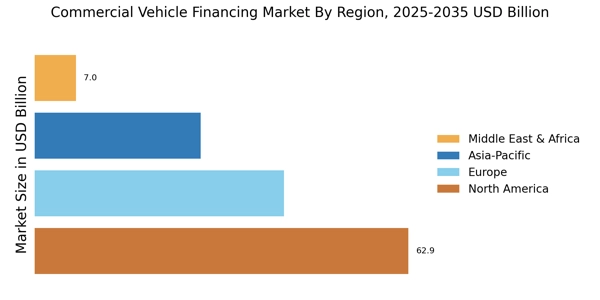
North America is the largest market for commercial vehicle financing, holding approximately 45% of the global market share. The growth is driven by increasing demand for logistics and transportation services, alongside favorable regulatory frameworks that support financing options. The rise in e-commerce has further fueled the need for commercial vehicles, leading to a robust financing landscape. The United States and Canada are the leading countries in this region, with major players like Wells Fargo, Ford Credit, and PACCAR Financial dominating the market. The competitive landscape is characterized by a mix of traditional banks and specialized financial services, ensuring a diverse range of financing solutions for businesses. The presence of established automotive manufacturers also enhances financing options for commercial vehicles.

Europe : Regulatory Support for Growth

Europe is the second-largest market for commercial vehicle financing, accounting for around 30% of the global market share. The region benefits from stringent environmental regulations that encourage the adoption of eco-friendly commercial vehicles, thus driving demand for financing solutions. Additionally, government initiatives aimed at improving infrastructure and logistics are expected to further stimulate market growth. Germany, the UK, and France are the leading countries in this market, with key players such as Mercedes-Benz Financial Services and CNH Industrial Capital. The competitive landscape is marked by a mix of traditional banks and innovative fintech companies, providing a variety of financing options tailored to the needs of businesses. The presence of strong automotive manufacturers also supports the financing ecosystem.

Asia-Pacific : Emerging Market Potential

Asia-Pacific is witnessing rapid growth in the commercial vehicle financing market, holding approximately 20% of the global market share. The region's growth is driven by increasing urbanization, rising demand for logistics, and government initiatives to enhance transportation infrastructure. Countries like China and India are leading this growth, supported by favorable financing regulations and a growing middle class. China is the largest market in the region, with significant contributions from local players and international firms like Toyota Financial Services and Hitachi Capital. The competitive landscape is evolving, with traditional banks and new entrants offering innovative financing solutions. The increasing focus on electric and hybrid commercial vehicles is also shaping the financing landscape, providing new opportunities for growth.

Middle East and Africa : Untapped Financing Opportunities

The Middle East and Africa region is emerging as a significant player in the commercial vehicle financing market, holding about 5% of the global market share. The growth is driven by increasing investments in infrastructure and logistics, alongside a growing demand for commercial vehicles in various sectors. Regulatory support for financing options is also enhancing market dynamics, making it an attractive region for investment. Countries like South Africa and the UAE are at the forefront of this market, with a mix of local and international players providing financing solutions. The competitive landscape is characterized by a growing number of financial institutions and partnerships with vehicle manufacturers, which are crucial for expanding financing options. The region's potential for growth is significant, especially as economic diversification efforts continue.

Commercial Vehicle Financing Market Regional Image

Key Players and Competitive Insights

The Commercial Vehicle Financing Market encapsulates a vital segment of the transportation and logistics industry, characterized by the provision of various financing solutions aimed at facilitating the acquisition of commercial vehicles.

This market plays a significant role as it caters to businesses ranging from small to large enterprises, allowing them to optimize their operational capabilities through the effective financing of vehicles designed for commercial use.

Competitive insights within this space reveal dynamic interactions among key market players, emerging financial technologies, and evolving customer preferences. The landscape is influenced by macroeconomic factors, regulatory changes, and the growing demand for efficient and eco-friendly commercial vehicles.

The ability to offer competitive interest rates, flexible terms, and personalized service are critical components that differentiate stakeholders in this market. As the demand for commercial vehicles continues to rise, the financing market shows promise for innovation and growth.

Ford Credit maintains a strong presence in the Commercial Vehicle Financing Market, leveraging its extensive experience and reputation within the automotive sector. The company's strengths lie in its ability to provide tailored financing solutions that cater to various business needs, ensuring that customers can acquire the vehicles necessary for their operations.

Ford Credit differentiates itself through its deep understanding of the commercial vehicle market, enabling it to offer competitive financing options with favorable terms. Additionally, the integration of digital platforms hastens the financing process, enhancing customer experience and convenience.

This agility in service delivery, combined with Ford Credit's robust portfolio of commercial vehicle financing products, positions it favorably in the competitive landscape. Moreover, the company's longstanding relationships with dealers and customers reinforce its credibility and attract a loyal customer base, further enhancing its market standing.

Toyota Financial Services also plays a pivotal role in the Commercial Vehicle Financing Market, offering appealing financing solutions that support businesses in acquiring Toyota's reliable commercial vehicles. With an emphasis on customer satisfaction and flexible payment options, Toyota Financial Services capitalizes on its strong brand reputation and trusted vehicle reliability.

The company provides a diverse range of financing products, including loans, leases, and specialized programs tailored for commercial clients, which enhances its appeal in the competitive landscape. The backing of Toyota's extensive dealer network enables Toyota Financial Services to facilitate seamless transactions and create customized financing experiences for customers.

Furthermore, the company's commitment to integrating innovative financing solutions aligns with industry trends, thereby strengthening its position within the market. The value it places on fostering long-term relationships with clients reflects Toyota Financial Services' proactive approach to maintaining and expanding its footprint in the commercial vehicle financing domain.

Key Companies in the Commercial Vehicle Financing Market market include

Industry Developments

Recent developments in the Commercial Vehicle Financing Market indicate a surge in demand driven by the growth of e-commerce and logistics sectors. Companies such as Ford Credit and Toyota Financial Services are enhancing their financing solutions to accommodate the increasing need for commercial vehicles.

Notably, Mercedes-Benz Financial Services is expanding its presence in emerging markets, tapping into the rising demand for efficient transportation solutions. Mergers and acquisitions in this sector are shaping the landscape; for instance, BMO Harris Bank has recently acquired a portfolio from a smaller competitor, strengthening its position.

Ally Financial and BMW Financial Services are also focusing on innovative financing options to attract fleet operators. Furthermore, Element Financial and CIT Group have announced strategic collaborations to improve asset management and financing efficiencies, reflecting a trend towards greater synergy in commercial vehicle financing.

Market valuations are climbing, fueled by increased consumer spending and investment in infrastructure, positively impacting companies like Paccar Financial and Hitachi Capital Corporation as they adapt to newfound challenges and growth opportunities in this evolving market.

Future Outlook

Commercial Vehicle Financing Market Future Outlook

The Commercial Vehicle Financing Market is projected to grow at a 3.71% CAGR from 2024 to 2035, driven by increasing demand for logistics and technological advancements.

New opportunities lie in:

  • Integration of telematics for real-time financing assessments.
  • Development of green financing options for electric commercial vehicles.
  • Partnerships with logistics firms for tailored financing solutions.

By 2035, the market is expected to be robust, reflecting evolving financing needs and sustainable practices.

Market Segmentation

Commercial Vehicle Financing Market Customer Type Outlook

  • Small and Medium Enterprises
  • Large Enterprises
  • Government Organizations

Commercial Vehicle Financing Market Financing Type Outlook

  • Leasing
  • Loans
  • Financing Through Manufacturers
  • Finance Brokers

Commercial Vehicle Financing Market End Use Application Outlook

  • Freight Transportation
  • Construction
  • Public Transport
  • Logistics

Commercial Vehicle Financing Market Type of Commercial Vehicle Outlook

  • Trucks
  • Buses
  • Vans
  • Trailers

Report Scope

MARKET SIZE 2024 139.87(USD Billion)
MARKET SIZE 2025 145.06(USD Billion)
MARKET SIZE 2035 208.85(USD Billion)
COMPOUND ANNUAL GROWTH RATE (CAGR) 3.71% (2024 - 2035)
REPORT COVERAGE Revenue Forecast, Competitive Landscape, Growth Factors, and Trends
BASE YEAR 2024
Market Forecast Period 2025 - 2035
Historical Data 2019 - 2024
Market Forecast Units USD Billion
Key Companies Profiled Market analysis in progress
Segments Covered Market segmentation analysis in progress
Key Market Opportunities Integration of digital financing solutions enhances accessibility in the Commercial Vehicle Financing Market.
Key Market Dynamics Rising demand for electric commercial vehicles drives financing innovations and regulatory adaptations in the market.
Countries Covered North America, Europe, APAC, South America, MEA

Leave a Comment

FAQs

What is the current valuation of the Commercial Vehicle Financing Market as of 2024?

The market valuation was 139.87 USD Billion in 2024.

What is the projected market size for the Commercial Vehicle Financing Market by 2035?

The projected valuation for 2035 is 208.85 USD Billion.

What is the expected CAGR for the Commercial Vehicle Financing Market during the forecast period 2025 - 2035?

The expected CAGR during this period is 3.71%.

Which types of commercial vehicles are included in the market segments?

The market segments include Trucks, Buses, Vans, and Trailers.

What was the market size for Trucks in 2024?

The market size for Trucks was between 60.0 and 90.0 USD Billion in 2024.

How does financing through manufacturers compare to other financing types?

Financing through manufacturers was valued between 40.0 and 60.0 USD Billion, indicating a strong position in the market.

What are the primary end-use applications for commercial vehicles?

The primary end-use applications include Freight Transportation, Construction, Public Transport, and Logistics.

What customer types are represented in the Commercial Vehicle Financing Market?

The market includes Small and Medium Enterprises, Large Enterprises, and Government Organizations.

Who are the key players in the Commercial Vehicle Financing Market?

Key players include Wells Fargo, Ford Credit, Mercedes-Benz Financial Services, and others.

What was the market size for Logistics in 2024?

The market size for Logistics was between 44.87 and 68.85 USD Billion in 2024.

Download Free Sample

Kindly complete the form below to receive a free sample of this Report

Compare Licence

×
Features License Type
Single User Multiuser License Enterprise User
Price $4,950 $5,950 $7,250
Maximum User Access Limit 1 User Upto 10 Users Unrestricted Access Throughout the Organization
Free Customization
Direct Access to Analyst
Deliverable Format
Platform Access
Discount on Next Purchase 10% 15% 15%
Printable Versions