×
Request Free Sample ×

Kindly complete the form below to receive a free sample of this Report

* Please use a valid business email

Leading companies partner with us for data-driven Insights

clients tt-cursor
Hero Background

Congestive Heart Failure Treatment Device Market

ID: MRFR/HC/7753-HCR
100 Pages
Rahul Gotadki
October 2025

Congestive Heart Failure Treatment Device Market Research Report By Device Type (Implantable Cardioverter Defibrillators (ICDs), Cardiac Resynchronization Therapy (CRT) Devices, Left Ventricular Assist Devices (LVADs), Monitoring Devices), By Technology (Mechanical Circulatory Support, Electrophysiological Devices, Wearable Devices), By Therapeutic Application (Acute Heart Failure, Chronic Heart Failure, Heart Failure with Preserved Ejection Fraction (HFpEF)), By End User (Hospitals, Cardiac Specialty Clinics, Home Care Settings), By Regulat... read more

Share:
Download PDF ×

We do not share your information with anyone. However, we may send you emails based on your report interest from time to time. You may contact us at any time to opt-out.

Congestive Heart Failure Treatment Device Market Infographic
Purchase Options

Congestive Heart Failure Treatment Device Market Summary

As per MRFR analysis, the Congestive Heart Failure Treatment Device Market was estimated at 10.01 USD Billion in 2024. The Congestive Heart Failure Treatment Device industry is projected to grow from 10.63 USD Billion in 2025 to 19.31 USD Billion by 2035, exhibiting a compound annual growth rate (CAGR) of 6.15 during the forecast period 2025 - 2035.

Key Market Trends & Highlights

The Congestive Heart Failure Treatment Device Market is experiencing robust growth driven by technological advancements and increasing patient needs.

  • Technological advancements are enhancing the efficacy and safety of treatment devices in the market.
  • Personalized treatment approaches are gaining traction, allowing for tailored therapies that improve patient outcomes.
  • North America remains the largest market, while the Asia-Pacific region is emerging as the fastest-growing area for congestive heart failure devices.
  • The rising prevalence of congestive heart failure and technological innovations in treatment devices are key drivers propelling market growth.

Market Size & Forecast

2024 Market Size 10.01 (USD Billion)
2035 Market Size 19.31 (USD Billion)
CAGR (2025 - 2035) 6.15%

Major Players

Medtronic (US), Abbott (US), Boston Scientific (US), Philips (NL), Cardinal Health (US), Baxter International (US), LivaNova (GB), Terumo Corporation (JP), AtriCure (US)

Congestive Heart Failure Treatment Device Market Trends

The Congestive Heart Failure Treatment Device Market is currently experiencing a notable evolution, driven by advancements in technology and an increasing prevalence of heart failure conditions. The integration of innovative devices, such as implantable cardioverter-defibrillators and ventricular assist devices, appears to enhance patient outcomes significantly. Furthermore, the growing awareness of heart health and the importance of early intervention may contribute to a rising demand for these treatment options. As healthcare systems worldwide adapt to the challenges posed by chronic diseases, the focus on improving quality of life for patients with congestive heart failure remains paramount. In addition, the market seems to be influenced by a shift towards personalized medicine, where treatment plans are tailored to individual patient needs. This trend indicates a potential for more effective management of heart failure, as devices become increasingly sophisticated and capable of monitoring patient conditions in real-time. Moreover, collaborations between technology firms and healthcare providers may foster the development of new solutions that address unmet needs in the market. Overall, the Congestive Heart Failure Treatment Device Market is poised for growth, reflecting a commitment to enhancing patient care and outcomes in the face of evolving healthcare demands.

Technological Advancements

The Congestive Heart Failure Treatment Device Market is witnessing rapid technological advancements, which are likely to improve device efficacy and patient outcomes. Innovations in materials and design are enhancing the functionality of devices, making them more reliable and user-friendly. This trend suggests a future where devices are not only more effective but also more accessible to a broader patient population.

Personalized Treatment Approaches

There is a growing emphasis on personalized treatment approaches within the Congestive Heart Failure Treatment Device Market. Tailoring therapies to individual patient profiles may lead to improved management of heart failure symptoms. This trend indicates a shift towards more customized solutions, potentially enhancing patient adherence and satisfaction.

Increased Collaboration in Healthcare

The Congestive Heart Failure Treatment Device Market appears to be benefiting from increased collaboration between technology companies and healthcare providers. Such partnerships may facilitate the development of innovative solutions that address specific patient needs. This trend suggests a more integrated approach to treatment, which could lead to better health outcomes.

Congestive Heart Failure Treatment Device Market Drivers

Rising Prevalence of Heart Failure

The increasing incidence of heart failure globally is a primary driver for the Global Congestive Heart Failure Treatment Device Market Industry. As populations age and lifestyle-related health issues become more prevalent, the number of individuals diagnosed with congestive heart failure continues to rise. It is estimated that by 2024, the market will reach 10.0 USD Billion, reflecting the urgent need for effective treatment devices. This trend is expected to persist, with projections indicating that the market could expand to 19.3 USD Billion by 2035, driven by advancements in technology and an increasing focus on patient-centered care.

Market Segment Insights

By Application: Cardiac Resynchronization Therapy (Largest) vs. Left Ventricular Assist Device (Fastest-Growing)

In the Congestive Heart Failure Treatment Device Market, the application segment showcases a diverse array of devices, with Cardiac Resynchronization Therapy (CRT) leading the market. CRT is gaining substantial market share due to its effectiveness in improving heart function and reducing symptoms for many patients. The Implantable Cardioverter Defibrillator (ICD) follows, recognized for its life-saving capabilities in arrhythmias, while the Left Ventricular Assist Device (LVAD) is rapidly gaining momentum as an innovative alternative for advanced heart failure management. The Medication Delivery System serves a vital role but has a smaller market presence compared to these devices.

Device: CRT (Dominant) vs. LVAD (Emerging)

Cardiac Resynchronization Therapy (CRT) remains the dominant force in the market, providing synchronized heart contractions, significantly enhancing patients' quality of life. Its established technology and clinical acceptance ensure its continual growth and utilization. In contrast, the Left Ventricular Assist Device (LVAD) is categorized as an emerging solution that targets patients with advanced heart failure, particularly those awaiting transplant. LVADs are characterized by their ability to support heart functions externally while being implanted. As technology advances, LVADs are becoming more compact and efficient, appealing to a growing demographic within heart failure patients, thus contributing to a notable upward trend in its market share.

By Device Type: Implantable Devices (Largest) vs. External Devices (Fastest-Growing)

In the Congestive Heart Failure Treatment Device Market, the distribution of market share shows that Implantable Devices are the largest segment, commanding a significant portion due to their established presence and efficacy in long-term patient management. External Devices, while smaller in share, are gaining traction as they align with the increasing preference for non-invasive treatment options, appealing particularly to patients seeking minimally invasive interventions. Monitoring Devices, although crucial for patient management, occupy a niche market segment focused on data collection and patient compliance. The growth trends in this segment are robust, driven by advancements in technology, an aging population, and escalating incidences of heart failure globally. The demand for Implantable Devices is fortified by their proven track record in enhancing patient outcomes. In contrast, the surge in popularity of External Devices can be attributed to their convenience and the ongoing innovations that make them more user-friendly. Monitoring Devices are expected to grow as healthcare moves towards personalized and data-driven treatment paradigms.

Implantable Devices (Dominant) vs. External Devices (Emerging)

Implantable Devices represent the dominant force in the Congestive Heart Failure Treatment Device Market, renowned for their effectiveness in delivering continuous care and improving patients' quality of life. They include technologies such as implantable cardioverter-defibrillators (ICDs) and cardiac resynchronization therapy (CRT) devices. These devices are designed for long-term use, providing substantial support to patients suffering from chronic heart failure. On the other hand, External Devices are emerging rapidly in the market as innovative solutions aimed at offering flexibility and simplicity in treatment. They encompass wearable devices and portable monitors, which are particularly appealing for patients preferring non-invasive methods. This comparative dynamic illustrates a market increasingly influenced by patients' preferences for convenience alongside the efficacy traditional Implantable Devices offer.

By End User: Hospitals (Largest) vs. Home Care Settings (Fastest-Growing)

In the Congestive Heart Failure Treatment Device Market, hospitals hold the largest share, serving as the primary setting for advanced monitoring and treatment. This segment benefits from high patient volumes and access to specialized healthcare teams and advanced technologies. Home care settings, on the other hand, are rapidly gaining traction as they cater to an increasing number of patients seeking comfort and convenience outside traditional hospital environments. This shift towards home care demonstrates evolving patient preferences and advancements in remote monitoring technologies. The growth trends reflect a significant shift towards decentralized care models, facilitating timely interventions in home care settings. The growing aging population coupled with a rise in heart failure cases is driving demand in both settings. However, the home care segment is experiencing rapid expansions due to technological advancements that allow for effective patient monitoring and management at home. The emphasis on improving the quality of life for patients and reducing hospital readmissions further enhances this trend.

End User: Hospitals (Dominant) vs. Home Care Settings (Emerging)

Hospitals remain the dominant end user in the Congestive Heart Failure Treatment Device Market, providing critical resources and expertise for complex patient care. They typically have the latest technologies and specialized staff to address severe heart failure conditions, thereby facilitating comprehensive treatment protocols. In contrast, home care settings are emerging as a viable alternative, driven by technological innovations that enable efficient remote monitoring and management. Patients increasingly prefer home care for its convenience, comfort, and decreased risk of hospital-acquired infections. Coupled with a patient-centric approach that prioritizes individuality and quality of life, the home care segment is becoming a competitive challenger, often leveraging telehealth services to enhance care delivery. As health systems evolve, both segments will play essential roles in the continuum of heart failure management.

By Technology: Mechanical Circulatory Support (Largest) vs. Electrical Stimulation (Fastest-Growing)

In the Congestive Heart Failure Treatment Device Market, the Mechanical Circulatory Support (MCS) segment currently dominates with the largest market share among the technology-focused treatments. This is primarily due to the increasing prevalence of congestive heart failure and a growing aging population, driving demand for more advanced and supportive treatment options. On the other hand, the Electrical Stimulation segment has been rapidly gaining traction, leveraging advancements in neurostimulation technologies that enhance heart function, thereby catering to a broader patient demographic.

Technology: Mechanical Circulatory Support (Dominant) vs. Electrical Stimulation (Emerging)

Mechanical Circulatory Support systems, such as ventricular assist devices (VADs), are the dominant technology in the Congestive Heart Failure Treatment Device Market. These devices are critical in managing severe heart failure, providing effective circulatory support for patients awaiting heart transplants or as a long-term treatment option. Meanwhile, Electrical Stimulation is an emerging segment, focusing on innovative approaches like cardiac resynchronization therapy (CRT) that enhances the heart's performance. As technology progresses, the Electrical Stimulation segment is expected to gain significant attention due to its potential in addressing diverse patient needs and improving overall outcomes.

Get more detailed insights about Congestive Heart Failure Treatment Device Market

Regional Insights

North America : Market Leader in Innovation

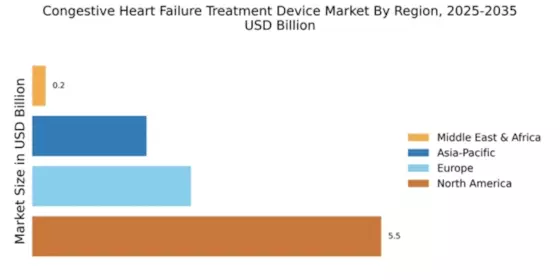
North America is poised to maintain its leadership in the Congestive Heart Failure Treatment Device Market, holding a market size of $5.5B in 2025. Key growth drivers include an aging population, increasing prevalence of heart diseases, and advancements in medical technology. Regulatory support from agencies like the FDA has accelerated the approval of innovative devices, enhancing market accessibility and consumer trust. The U.S. stands as the largest market, with major players like Medtronic, Abbott, and Boston Scientific leading the charge. The competitive landscape is characterized by continuous innovation and strategic partnerships aimed at improving patient outcomes. The presence of established healthcare infrastructure further supports the growth of these devices, ensuring a robust market environment.

Europe : Emerging Market with Potential

Europe's Congestive Heart Failure Treatment Device Market is projected to reach $2.5B by 2025, driven by rising healthcare expenditures and a growing elderly population. Regulatory frameworks, such as the EU Medical Device Regulation, are enhancing safety and efficacy standards, thereby boosting consumer confidence. The increasing incidence of heart failure across European nations is also a significant demand driver, leading to a surge in device adoption. Leading countries like Germany, France, and the UK are at the forefront of this market, with key players such as Philips and LivaNova making substantial contributions. The competitive landscape is marked by innovation and collaboration among manufacturers, healthcare providers, and regulatory bodies, ensuring that patients have access to the latest treatment options. The market is expected to grow as awareness and diagnosis of heart conditions improve.

Asia-Pacific : Rapidly Growing Healthcare Sector

The Asia-Pacific region is witnessing significant growth in the Congestive Heart Failure Treatment Device Market, projected to reach $1.8B by 2025. Key growth drivers include increasing urbanization, rising disposable incomes, and a growing awareness of heart health. Governments are also investing in healthcare infrastructure, which is expected to enhance access to advanced medical technologies and treatment options for patients. Countries like Japan, China, and India are leading the market, with a mix of local and international players such as Terumo Corporation and Baxter International. The competitive landscape is evolving, with companies focusing on innovation and affordability to cater to diverse patient needs. As healthcare systems in these countries continue to develop, the demand for effective heart failure treatment devices is anticipated to rise significantly.

Middle East and Africa : Untapped Market Potential

The Middle East and Africa region is gradually emerging in the Congestive Heart Failure Treatment Device Market, with a market size of $0.21B projected for 2025. Key growth drivers include increasing healthcare investments and a rising prevalence of cardiovascular diseases. Governments are focusing on improving healthcare access and quality, which is expected to drive demand for advanced medical devices in the region. Countries like South Africa and the UAE are leading the market, with a growing presence of international players. The competitive landscape is characterized by a mix of local and global companies striving to meet the increasing demand for heart failure treatment solutions. As awareness of heart health improves, the market is expected to expand, presenting new opportunities for growth.

Key Players and Competitive Insights

The Congestive Heart Failure Treatment Device Market is currently characterized by a dynamic competitive landscape, driven by an increasing prevalence of heart failure and a growing demand for innovative treatment solutions. Key players such as Medtronic (US), Abbott (US), and Boston Scientific (US) are strategically positioned to leverage advancements in technology and patient care. Medtronic (US) focuses on enhancing its product portfolio through continuous innovation, particularly in implantable devices, while Abbott (US) emphasizes partnerships to expand its reach in emerging markets. Boston Scientific (US) appears to be concentrating on digital health solutions, integrating data analytics into its devices to improve patient outcomes. Collectively, these strategies contribute to a competitive environment that is increasingly centered around technological advancement and patient-centric solutions.

In terms of business tactics, companies are localizing manufacturing and optimizing supply chains to enhance efficiency and reduce costs. The market structure is moderately fragmented, with several players vying for market share. However, the collective influence of major companies like Medtronic (US) and Abbott (US) suggests a trend towards consolidation, as these firms seek to strengthen their market positions through strategic acquisitions and collaborations.

In November 2025, Medtronic (US) announced the launch of its latest heart failure monitoring device, which utilizes advanced AI algorithms to provide real-time patient data. This strategic move is significant as it not only enhances Medtronic's product offerings but also positions the company at the forefront of digital health innovation, potentially improving patient management and outcomes.

In October 2025, Abbott (US) entered into a partnership with a leading telehealth provider to integrate remote monitoring capabilities into its heart failure devices. This collaboration is likely to enhance patient engagement and adherence to treatment protocols, reflecting a broader trend towards telemedicine in chronic disease management.

In September 2025, Boston Scientific (US) acquired a startup specializing in digital health analytics, aiming to bolster its capabilities in data-driven patient care. This acquisition underscores the growing importance of data analytics in the treatment of heart failure, as it allows for more personalized and effective treatment strategies.

As of December 2025, current competitive trends in the Congestive Heart Failure Treatment Device Market include a strong emphasis on digitalization, sustainability, and the integration of AI technologies. Strategic alliances are increasingly shaping the landscape, enabling companies to pool resources and expertise. Looking ahead, competitive differentiation is expected to evolve, with a shift from price-based competition to a focus on innovation, technological advancements, and supply chain reliability. This transition may redefine how companies approach market entry and product development, ultimately benefiting patient care.

Key Companies in the Congestive Heart Failure Treatment Device Market market include

Industry Developments

Recent developments in the Congestive Heart Failure Treatment Device Market reflect a dynamic evolution driven by technological advancements and an increasing focus on patient-centric care.

Innovators are rapidly introducing next-generation devices, such as implantable cardioverter-defibrillators (ICDs) and left ventricular assist devices (LVADs), designed to improve the quality of life for patients suffering from heart failure.

The integration of telehealth solutions and remote monitoring technologies is gaining traction, enabling healthcare providers to offer timely interventions. Furthermore, increased investments in research and development, supported by favorable regulatory advancements, are enhancing product pipelines and market accessibility.

The rising prevalence of congestive heart failure, exacerbated by an aging global population, highlights the urgent need for improved therapeutic options. Collaborations between healthcare institutions and technology companies are also fostering innovation and accelerating the commercialization of novel treatment modalities.

Overall, the heightened focus on reducing hospitalization rates and improving clinical outcomes is shaping a promising landscape for key players in this market.

Future Outlook

Congestive Heart Failure Treatment Device Market Future Outlook

The Congestive Heart Failure Treatment Device Market is projected to grow at a 6.15% CAGR from 2024 to 2035, driven by technological advancements, increasing prevalence, and rising healthcare expenditure.

New opportunities lie in:

  • Development of remote monitoring devices for patient management.
  • Expansion into emerging markets with tailored solutions.
  • Integration of AI for predictive analytics in treatment planning.

By 2035, the market is expected to be robust, driven by innovation and strategic expansions.

Market Segmentation

Congestive Heart Failure Treatment Device Market End User Outlook

  • Hospitals
  • Home Care Settings
  • Specialty Clinics

Congestive Heart Failure Treatment Device Market Technology Outlook

  • Mechanical Circulatory Support
  • Biological Therapy
  • Electrical Stimulation

Congestive Heart Failure Treatment Device Market Application Outlook

  • Cardiac Resynchronization Therapy
  • Implantable Cardioverter Defibrillator
  • Left Ventricular Assist Device
  • Medication Delivery System

Congestive Heart Failure Treatment Device Market Device Type Outlook

  • Implantable Devices
  • External Devices
  • Monitoring Devices

Report Scope

MARKET SIZE 202410.01(USD Billion)
MARKET SIZE 202510.63(USD Billion)
MARKET SIZE 203519.31(USD Billion)
COMPOUND ANNUAL GROWTH RATE (CAGR)6.15% (2024 - 2035)
REPORT COVERAGERevenue Forecast, Competitive Landscape, Growth Factors, and Trends
BASE YEAR2024
Market Forecast Period2025 - 2035
Historical Data2019 - 2024
Market Forecast UnitsUSD Billion
Key Companies ProfiledMedtronic (US), Abbott (US), Boston Scientific (US), Philips (NL), Cardinal Health (US), Baxter International (US), LivaNova (GB), Terumo Corporation (JP), AtriCure (US)
Segments CoveredApplication, Device Type, End User, Technology
Key Market OpportunitiesIntegration of advanced monitoring technologies enhances patient management in the Congestive Heart Failure Treatment Device Market.
Key Market DynamicsTechnological advancements and regulatory changes drive innovation in the Congestive Heart Failure Treatment Device Market.
Countries CoveredNorth America, Europe, APAC, South America, MEA

Leave a Comment

FAQs

What is the projected growth of the Congestive Heart Failure Treatment Device market?

The Congestive Heart Failure Treatment Device market is the expected increase in total market value of 19.31 USD billion over a defined forecast period 2025–2035. It is driven by factors such as demand trends, technological advances, regulatory changes, and geographic expansion.

What is the size of the Congestive Heart Failure Treatment Device market?

Congestive Heart Failure Treatment Device market size was valued at approximately 10.01 billion USD in 2024. This figure will reach 19.31 billion USD covering all regions (America, Europe, Asia, MEA and ROW), focusing its segments / services / distribution channels till 2035.

What is the CAGR of the Congestive Heart Failure Treatment Device market?

Congestive Heart Failure Treatment Device market is expected to grow at a CAGR of 6.15% between 2025 and 2035.

How much will the Congestive Heart Failure Treatment Device market be worth by 2035?

Congestive Heart Failure Treatment Device market is expected to be worth of 19.31 billion USD, reflecting growth driven by usage, technology and global demands by the end of 2035.

How will the Congestive Heart Failure Treatment Device market perform over the next 10 years?

Over the next 10 years the Congestive Heart Failure Treatment Device market is expected to shift from usd billion 10.01 to 19.31 billion USD, led by adoption of advanced tech, demographic trends, regulatory approvals, with potential headwinds from 2025 to 2035.

Which region is expected to hold the largest share of the market in 2035?

North America is expected to dominate the market, valued at 6.12 USD Billion in 2035.

What is the market size for Implantable Cardioverter Defibrillators (ICDs) in 2035?

The market for Implantable Cardioverter Defibrillators (ICDs) is projected to reach 5.4 USD Billion by 2035.

How much is the market for Cardiac Resynchronization Therapy (CRT) Devices expected to be valued in 2035?

The Cardiac Resynchronization Therapy (CRT) Devices market is expected to be valued at 4.7 USD Billion in 2035.

What will be the market size for Left Ventricular Assist Devices (LVADs) in 2035?

The market for Left Ventricular Assist Devices (LVADs) is anticipated to reach 3.0 USD Billion by 2035.

What is the projected market size for Monitoring Devices in 2035?

The Monitoring Devices market is expected to be valued at 2.1 USD Billion in 2035.

Download Free Sample

Kindly complete the form below to receive a free sample of this Report

Compare Licence

×
Features License Type
Single User Multiuser License Enterprise User
Price $4,950 $5,950 $7,250
Maximum User Access Limit 1 User Upto 10 Users Unrestricted Access Throughout the Organization
Free Customization
Direct Access to Analyst
Deliverable Format
Platform Access
Discount on Next Purchase 10% 15% 15%
Printable Versions