Download Free Sample
Kindly complete the form below to receive a free sample of this Report
Consumer Financial Education Services Market Research Report By Service Type (Workshops, Online Courses, One-on-One Coaching, Webinars, Mobile Applications), By Content Focus (Budgeting, Investing, Debt Management, Credit Education, Retirement Planning), By Delivery Method (In-Person, Virtual, Hybrid, Self-Paced, Interactive), By Target Audience (Individuals, Families, Small Business Owners, Students, Retirees), By Regulatory Compliance (Consumer Financial Protection Bureau Guidelines, State Regulations, Financial Literacy Standards, Nonprofit Organization Standards, Industry Best Practices) And By Region (North America, Europe, Asia-Pacific, And Rest Of The World) – Market Forecast Till 2035.
As per MRFR analysis, the Consumer Financial Education Services Market was estimated at 5.8 USD Billion in 2024. The Consumer Financial Education Services industry is projected to grow from 6.05 USD Billion in 2025 to 9.2 USD Billion by 2035, exhibiting a compound annual growth rate (CAGR) of 4.28% during the forecast period 2025 - 2035.
The Consumer Financial Education Services Market is experiencing a transformative shift towards digital and targeted educational approaches.
| 2024 Market Size | 5.8 (USD Billion) |
| 2035 Market Size | 9.2 (USD Billion) |
| CAGR (2025 - 2035) | 4.28% |
National Endowment for Financial Education (US), Jumpstart Coalition for Personal Financial Literacy (US), American Association of Family and Consumer Sciences (US), Financial Literacy and Education Commission (US), Consumer Financial Protection Bureau (US), National Foundation for Credit Counseling (US), Smart About Money (US), Operation HOPE (US)
Our Impact
Enabled $4.3B Revenue Impact for Fortune 500 and Leading Multinationals
Partnering with 2000+ Global Organizations Each Year
30K+ Citations by Top-Tier Firms in the Industry
The Consumer Financial Education Services Market is currently experiencing a notable evolution, driven by a growing awareness of the importance of financial literacy among consumers. As individuals increasingly seek to enhance their understanding of personal finance, the demand for educational resources and services has surged. This market encompasses a wide array of offerings, including workshops, online courses, and one-on-one coaching, all aimed at equipping consumers with the knowledge necessary to make informed financial decisions. Furthermore, the rise of digital platforms has facilitated access to these resources, allowing for a more diverse audience to engage with financial education materials. In addition to the increasing consumer interest, regulatory bodies are also emphasizing the need for financial education. This push from authorities suggests a recognition of the role that informed consumers play in fostering economic stability. As a result, organizations providing financial education services are likely to adapt their offerings to align with regulatory expectations while also addressing the unique needs of various demographic groups. The Consumer Financial Education Services Market appears poised for continued growth, as both consumers and institutions recognize the value of financial literacy in navigating an increasingly complex financial landscape.
The shift towards digital platforms is reshaping the Consumer Financial Education Services Market. Online courses and mobile applications are becoming prevalent, offering flexible learning options that cater to diverse consumer needs. This trend indicates a move away from traditional classroom settings, allowing for a more personalized and accessible approach to financial education.
There is a growing emphasis on holistic financial wellness within the Consumer Financial Education Services Market. Organizations are expanding their curricula to include topics such as mental health and financial stress management. This trend suggests that consumers are seeking comprehensive support that addresses not only financial knowledge but also emotional well-being.
The development of tailored educational programs for specific demographics is gaining traction in the Consumer Financial Education Services Market. Providers are recognizing the necessity of addressing the unique financial challenges faced by various groups, such as young adults, retirees, and low-income families. This trend indicates a more inclusive approach to financial education, ensuring that resources are relevant and effective for all consumers.
The increasing complexity of financial products and services appears to drive a heightened demand for financial literacy among consumers. As individuals face a myriad of choices regarding investments, loans, and savings, the need for comprehensive education becomes paramount. The Consumer Financial Education Services Market is witnessing a surge in interest, with reports indicating that nearly 60 percent of adults express a desire for improved financial knowledge. This trend suggests that educational services tailored to demystify financial concepts are likely to thrive, as consumers seek to make informed decisions. Furthermore, the emphasis on financial literacy is not merely a personal concern; it is increasingly recognized as a societal imperative, prompting organizations and governments to invest in educational initiatives. Such investments may further bolster the Consumer Financial Education Services Market, creating a robust ecosystem for financial learning.
The growing awareness of financial wellness among consumers is emerging as a pivotal driver for the Consumer Financial Education Services Market. As individuals increasingly recognize the impact of financial health on overall well-being, there is a corresponding demand for educational resources that address financial management. Surveys indicate that over 70 percent of consumers believe that financial education is essential for achieving personal financial goals. This awareness is prompting organizations, including employers, to offer financial education programs as part of employee benefits. Such initiatives not only enhance employee satisfaction but also contribute to a more financially literate workforce. Consequently, the Consumer Financial Education Services Market is likely to expand as more entities seek to provide resources that promote financial wellness and empower individuals to take control of their financial futures.
Regulatory bodies are increasingly recognizing the importance of financial education, which appears to be a significant driver for the Consumer Financial Education Services Market. Governments and financial institutions are implementing policies that promote financial literacy as a means to enhance consumer protection and economic stability. For instance, initiatives aimed at integrating financial education into school curricula are gaining traction, with some countries mandating such programs. This regulatory support not only legitimizes the need for financial education but also encourages investment in educational services. As a result, the Consumer Financial Education Services Market is likely to benefit from increased funding and resources, fostering a more informed consumer base. The alignment of regulatory frameworks with educational initiatives may create a conducive environment for growth in this sector.
Technological advancements are reshaping the landscape of education, including the Consumer Financial Education Services Market. The proliferation of online learning platforms and mobile applications has made financial education more accessible than ever. Data indicates that e-learning in financial education is projected to grow at a compound annual growth rate of over 15 percent in the coming years. This shift towards digital platforms allows for personalized learning experiences, catering to diverse consumer needs. Moreover, the integration of gamification and interactive tools enhances engagement, making financial concepts more relatable. As technology continues to evolve, it is likely that the Consumer Financial Education Services Market will adapt, leveraging innovative solutions to reach a broader audience and improve financial literacy outcomes.
The development of targeted educational programs for diverse populations is becoming increasingly relevant in the Consumer Financial Education Services Market. Recognizing that financial literacy needs vary across demographics, organizations are tailoring their educational offerings to address specific cultural, linguistic, and socioeconomic factors. For instance, programs designed for low-income communities or non-native speakers are gaining traction, as they aim to bridge the knowledge gap. Data suggests that customized financial education initiatives can lead to improved financial behaviors and outcomes among participants. This focus on inclusivity not only enhances the effectiveness of educational programs but also expands the reach of the Consumer Financial Education Services Market. By addressing the unique challenges faced by various groups, the industry is likely to foster a more equitable financial landscape.
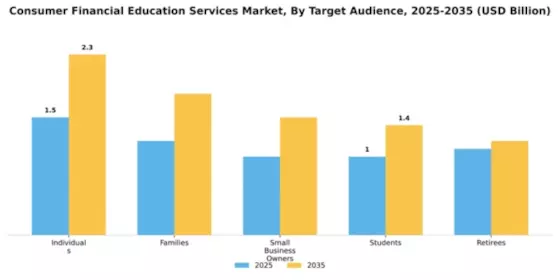
In the Consumer Financial Education Services Market, the segment of Individuals holds the largest market share, reflecting a substantial demand for personal finance knowledge tailored to individual circumstances. Families, meanwhile, represent the fastest-growing segment, indicating a shifting focus where household financial education is increasingly prioritized for well-rounded financial literacy and stability.
Individuals (Dominant) vs. Families (Emerging)
The Individuals segment dominates the Consumer Financial Education Services Market, characterized by a significant range of services focused on personal finance management, including budgeting and investment guidance tailored to single clients. In contrast, the Families segment, which demonstrates rapid growth, signifies an increasing recognition of collaborative financial planning in households—encompassing services designed for both parents and children. This evolution points toward a broader educational approach that engages multiple generations in sound financial practices, underlining the changing dynamics in financial education that cater to comprehensive family needs.
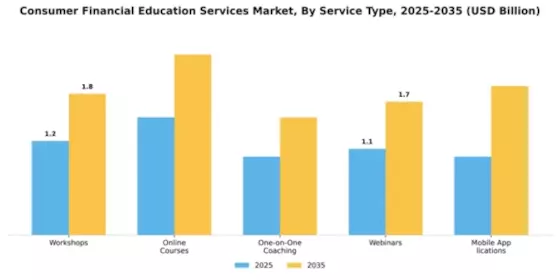
In the Consumer Financial Education Services Market, the service type segment is diverse, consisting of Workshops, Online Courses, One-on-One Coaching, Webinars, and Mobile Applications. Among these, Workshops hold the largest market share due to their interactive nature and personal engagement, making them attractive to participants. However, Online Courses are rapidly gaining traction as they cater to the demand for flexible learning environments, which has seen a noticeable increase in adoption over the years. As consumers seek more accessible financial education, growth trends show a significant shift towards technology-driven solutions. Online Courses are benefiting from advancements in digital learning platforms, appealing to a broader audience, while One-on-One Coaching continues to provide personalized support. Moreover, Mobile Applications are emerging as a convenient alternative for users looking for on-the-go learning solutions.
Workshops (Dominant) vs. One-on-One Coaching (Emerging)
Workshops remain a dominant force in the Consumer Financial Education Services Market, characterized by their structured, face-to-face interactions that foster a community learning environment. These sessions enable participants to engage directly with instructors and peers, enhancing understanding and retention of financial concepts. In contrast, One-on-One Coaching is an emerging segment that offers personalized financial advice tailored to individual needs. This customization appeals to consumers looking for specific guidance, making it a growing choice for those seeking to achieve their financial goals. While Workshops thrive on group dynamics, One-on-One Coaching emphasizes personal attention, appealing to different demographics with distinct learning preferences.
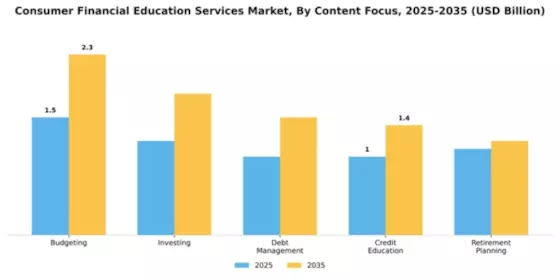
In the Consumer Financial Education Services Market, the segment values reveal a meaningful distribution of focus areas. Budgeting holds the largest market share as consumers prioritize foundational financial literacy, while Investing is noted as the fastest-growing area as individuals seek to enhance their wealth management skills and capitalize on market opportunities. Other segments like Debt Management, Credit Education, and Retirement Planning also contribute to the landscape but lag behind in terms of market share and growth rates. The upward trend in Investing can be attributed to a growing awareness among consumers about the importance of investment strategies in securing long-term financial health. Concurrently, Budgeting remains critical, with educational programs emphasizing the value of proper financial planning. As economic conditions evolve, the demand for tailored financial education services addressing these themes will continue to shape market dynamics and consumer preferences.
Budgeting (Dominant) vs. Debt Management (Emerging)
Budgeting, as the dominant segment in the Consumer Financial Education Services Market, addresses essential practices for managing daily finances, helping individuals track expenses and optimize savings strategies. It attracts consumers through various platforms, including workshops, online courses, and mobile applications tailored to diverse demographics. On the other hand, Debt Management emerges as a vital area, focusing on guiding clients through the complexities of debt repayment and consolidation. As consumer debt levels rise, the demand for debt management education increases, accommodating a diverse clientele ranging from individuals struggling with credit to those seeking effective strategies for maintaining financial stability. Both segments reflect a shared emphasis on financial empowerment and education, albeit with differing approaches and levels of consumer engagement.
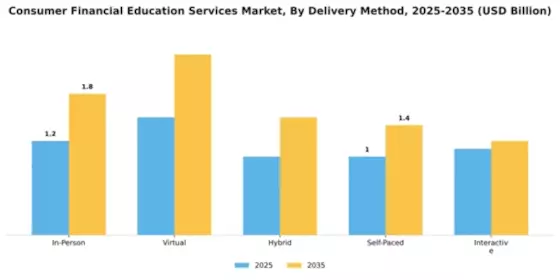
In the Consumer Financial Education Services Market, the delivery method segments show diverse preferences among consumers. In-Person delivery continues to dominate, reflecting a strong demand for personal interactions and tailored advice. It appeals particularly to older demographics and those seeking personalized financial guidance. Conversely, Virtual delivery has gained traction, especially among younger consumers, who prefer the convenience of online learning and access to resources from anywhere, indicating a shift in consumer behavior regarding financial education. The growth trends in the Delivery Method segment highlight a transition towards Virtual and Hybrid models, which are increasingly becoming popular due to advancements in technology and the rising comfort level with online platforms. The COVID-19 pandemic accelerated this change, reinforcing the demand for accessible, flexible, and interactive financial education. As consumers embrace self-paced and interactive formats, providers are adapting their offerings to meet diverse consumer needs and preferences, pointing to a more digitally inclined market in the future.
In-Person (Dominant) vs. Hybrid (Emerging)
In-Person delivery remains the dominant method in the Consumer Financial Education Services Market, primarily catering to individuals seeking direct communication and personalized guidance from financial educators. This method fosters trust and deepens relationships, which is crucial for effective financial learning. However, Hybrid models, which combine in-person and online learning formats, are emerging as a popular alternative. They provide flexibility, allowing consumers to engage in face-to-face sessions while also accessing digital resources. This dual approach appeals to tech-savvy consumers looking for convenience. The Hybrid model can also enhance retention rates as it caters to different learning preferences, thereby positioning itself as a noteworthy competitor that aligns with the evolving expectations of modern learners.
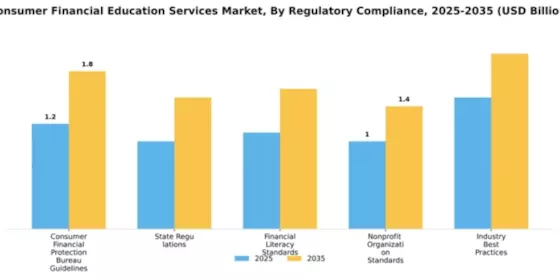
In the Consumer Financial Education Services Market, the market share distribution is significantly influenced by adherence to the Consumer Financial Protection Bureau (CFPB) guidelines, which stand as the largest segment driving the market. These guidelines provide essential frameworks that organizations adopt to ensure compliance and enhance educational quality. On the other hand, state regulations are emerging as a fast-growing aspect of this market, reflecting the increasing initiative at state levels to promote financial literacy and education tailored to local communities.
Consumer Financial Protection Bureau Guidelines (Dominant) vs. State Regulations (Emerging)
The Consumer Financial Protection Bureau Guidelines serve as a dominant force in the Consumer Financial Education Services Market, offering a robust structure for financial education programs. These guidelines ensure that content delivered is not only informative but also aligned with consumer protection standards. Conversely, state regulations are rapidly emerging, as various states recognize the importance of financial literacy initiatives tailored to their specific demographic and economic environments. These regulations encourage local organizations to develop programs that resonate with their community's needs, thereby expanding access to financial education and fostering a culture of informed financial decision-making. Together, these segments shape the landscape of financial education.
Get more detailed insights about Consumer Financial Education Services Market Request Free Sample
North America holds a commanding position in the Consumer Financial Education Services Market, with a market size of $3.2 billion in 2024. The region's growth is driven by increasing awareness of financial literacy, regulatory support, and a surge in demand for educational resources. Government initiatives and partnerships with non-profits are pivotal in promoting financial education, ensuring that consumers are better equipped to manage their finances effectively. The competitive landscape is robust, featuring key players such as the National Endowment for Financial Education and the Consumer Financial Protection Bureau. These organizations play a crucial role in shaping policies and providing resources that enhance financial literacy. The U.S. leads the charge, supported by various state-level initiatives aimed at improving financial education across demographics. The presence of established organizations ensures a comprehensive approach to consumer financial education.
Europe's Consumer Financial Education Services Market is expanding, with a market size of €1.5 billion in 2024. The region is witnessing a growing emphasis on financial literacy, driven by regulatory frameworks that encourage educational initiatives. Governments are increasingly recognizing the importance of equipping citizens with financial knowledge to foster economic stability and personal financial management. This trend is supported by various EU directives aimed at enhancing consumer protection and financial education. Leading countries such as Germany and the UK are at the forefront of this movement, with numerous organizations dedicated to improving financial literacy. The competitive landscape includes both governmental and non-governmental entities, working collaboratively to provide resources and training. The presence of key players, such as the Jumpstart Coalition for Personal Financial Literacy, underscores the commitment to enhancing financial education across Europe.
The Asia-Pacific region is gradually emerging in the Consumer Financial Education Services Market, with a market size of $0.9 billion in 2024. The growth is fueled by increasing urbanization, rising disposable incomes, and a growing awareness of financial management among consumers. Governments are beginning to implement policies that promote financial literacy, recognizing its importance in fostering economic growth and consumer protection. This shift is expected to drive demand for educational services in the coming years. Countries like Australia and Japan are leading the charge, with various initiatives aimed at enhancing financial literacy among their populations. The competitive landscape is characterized by a mix of local and international organizations, all striving to provide effective financial education. Key players are increasingly collaborating with educational institutions to develop comprehensive programs that cater to diverse consumer needs, ensuring a more financially literate society.
The Middle East and Africa region is in the nascent stages of developing its Consumer Financial Education Services Market, with a market size of $0.2 billion in 2024. The growth is primarily driven by increasing awareness of the importance of financial literacy, particularly among the youth. Governments and NGOs are beginning to recognize the need for educational programs that empower consumers to make informed financial decisions. This emerging focus is expected to catalyze growth in the sector over the next few years. Countries like South Africa and the UAE are taking the lead in implementing financial education initiatives. The competitive landscape is evolving, with various organizations working to provide resources and training. Key players are collaborating with local governments to develop tailored programs that address the unique financial challenges faced by consumers in the region, fostering a culture of financial literacy and empowerment.
The Consumer Financial Education Services Market is characterized by a dynamic competitive landscape, driven by increasing consumer demand for financial literacy and the growing recognition of its importance in personal financial management. Key players such as the National Endowment for Financial Education (US), Jumpstart Coalition for Personal Financial Literacy (US), and the Consumer Financial Protection Bureau (US) are strategically positioned to leverage their expertise and resources to enhance financial education initiatives. These organizations focus on innovation in educational content delivery, partnerships with educational institutions, and the integration of technology to reach broader audiences, thereby shaping a competitive environment that emphasizes accessibility and engagement.The market structure appears moderately fragmented, with various organizations contributing to the overall landscape. Key business tactics include localizing educational programs to cater to diverse demographic needs and optimizing outreach through digital platforms. This collective influence of major players fosters a collaborative approach to financial education, where shared resources and knowledge enhance the overall effectiveness of initiatives aimed at improving financial literacy.In November the National Endowment for Financial Education (US) launched a new online platform designed to provide personalized financial education resources tailored to individual user needs. This strategic move is significant as it reflects a growing trend towards digital transformation in financial education, allowing for more interactive and engaging learning experiences that can adapt to the unique circumstances of users.In October the Jumpstart Coalition for Personal Financial Literacy (US) announced a partnership with several major universities to integrate financial literacy into their core curricula. This initiative is crucial as it aims to institutionalize financial education, ensuring that students receive essential financial skills as part of their academic journey, thereby potentially increasing the long-term impact of financial literacy on future generations.In September the Consumer Financial Protection Bureau (US) introduced a new initiative aimed at enhancing financial education for underserved communities. This program focuses on providing resources and support to individuals who may lack access to traditional financial education, highlighting the organization's commitment to inclusivity and equity in financial literacy efforts. Such initiatives are likely to strengthen the Bureau's role as a leader in promoting financial well-being across diverse populations.As of December current competitive trends in the Consumer Financial Education Services Market indicate a strong emphasis on digitalization, sustainability, and the integration of artificial intelligence (AI) in educational tools. Strategic alliances among key players are shaping the landscape, fostering innovation and collaboration. The shift from price-based competition to a focus on technological advancement and supply chain reliability is evident, suggesting that future competitive differentiation will hinge on the ability to innovate and adapt to the evolving needs of consumers.




The Consumer Financial Education Services Market is projected to grow at a 4.28% CAGR from 2025 to 2035, driven by increasing financial literacy demands and technological advancements.
New opportunities lie in:
By 2035, the market is expected to be robust, reflecting enhanced consumer engagement and diversified service offerings.
| MARKET SIZE 2024 | 5.8(USD Billion) |
| MARKET SIZE 2025 | 6.05(USD Billion) |
| MARKET SIZE 2035 | 9.2(USD Billion) |
| COMPOUND ANNUAL GROWTH RATE (CAGR) | 4.28% (2025 - 2035) |
| REPORT COVERAGE | Revenue Forecast, Competitive Landscape, Growth Factors, and Trends |
| BASE YEAR | 2024 |
| Market Forecast Period | 2025 - 2035 |
| Historical Data | 2019 - 2024 |
| Market Forecast Units | USD Billion |
| Key Companies Profiled | National Endowment for Financial Education (US), Jumpstart Coalition for Personal Financial Literacy (US), American Association of Family and Consumer Sciences (US), Financial Literacy and Education Commission (US), Consumer Financial Protection Bureau (US), National Foundation for Credit Counseling (US), Smart About Money (US), Operation HOPE (US) |
| Segments Covered | Target Audience, Service Type, Content Focus, Delivery Method, Regulatory Compliance |
| Key Market Opportunities | Integration of digital platforms enhances accessibility and engagement in the Consumer Financial Education Services Market. |
| Key Market Dynamics | Rising consumer demand for financial literacy drives innovation and competition among education service providers. |
| Countries Covered | North America, Europe, APAC, South America, MEA |
The market valuation was 5.8 USD Billion in 2024.
The projected valuation for 2035 is 9.2 USD Billion.
The expected CAGR during the forecast period 2025 - 2035 is 4.28%.
Key players include the National Endowment for Financial Education, Jumpstart Coalition for Personal Financial Literacy, and the Consumer Financial Protection Bureau.
In 2024, the segment for Online Courses had the highest valuation at 1.5 USD Billion.
The Individuals segment is projected to grow from 1.5 USD Billion in 2024 to 2.3 USD Billion by 2035.
Services include Workshops, Online Courses, One-on-One Coaching, Webinars, and Mobile Applications.
The Debt Management content focus is projected to grow from 1.0 USD Billion in 2024 to 1.5 USD Billion by 2035.
Delivery methods include In-Person, Virtual, Hybrid, Self-Paced, and Interactive formats.
Regulatory compliance standards, such as Consumer Financial Protection Bureau Guidelines, are projected to grow from 1.2 USD Billion in 2024 to 1.8 USD Billion by 2035.


Kindly complete the form below to receive a free sample of this Report

“This is really good guys. Excellent work on a tight deadline. I will continue to use you going forward and recommend you to others. Nice job”


“Thanks. It’s been a pleasure working with you, please use me as reference with any other Intel employees.”


“Thanks for sending the report it gives us a good global view of the Betaïne market.”


“Thank you, this will be very helpful for OQS.”


“We found the report very insightful! we found your research firm very helpful. I'm sending this email to secure our future business.”


“I am very pleased with how market segments have been defined in a relevant way for my purposes (such as "Portable Freezers & refrigerators" and "last-mile"). In general the report is well structured. Thanks very much for your efforts.”


“I have been reading the first document or the study, ,the Global HVAC and FP market report 2021 till 2026. Must say, good info! I have not gone in depth at all parts, but got a good indication of the data inside!”


“We got the report in time, we really thank you for your support in this process. I also thank to all of your team as they did a great job.”


“The Automotive 48V ECU Components Procurement Intelligence Study” was a complex project, but the Market Research Future (MRFR) team handled it with quality, agility, and customer-centricity. They delivered all requested data on time and within the agreed scope. The team, including Shubhendra Anand and Rahul Gotadki, was always readily available to clarify questions and swiftly implement necessary adjustments, driving the project to a successful conclusion within a very demanding timeframe.
I would also like to specifically commend Akshay Agarwal for his responsiveness and support at every stage—from our initial inquiry on May 6th through to final delivery on June 18th. His dedication made the entire process seamless.”



