×
Request Free Sample ×

Kindly complete the form below to receive a free sample of this Report

* Please use a valid business email

Leading companies partner with us for data-driven Insights

clients tt-cursor
Hero Background

Continuous Fiber Reinforced Thermoplastic Market

ID: MRFR/CnM/8031-HCR
111 Pages
Chitranshi Jaiswal
October 2025

Continuous Fiber Reinforced Thermoplastic Market Research Report By Application (Automotive, Aerospace, Industrial), By Type (Continuous Fiber Reinforced Thermoplastic Composites, Short Fiber Reinforced Thermoplastics, Hybrid Thermoplastic Composites), By Fiber Type (Glass Fiber, Carbon Fiber, Natural Fiber), By Manufacturing Process (Injection Molding, Compression Molding, Thermoforming) and By Regional (North America, Europe, South America, Asia Pacific, Middle East and Africa) - Forecast to 2035.

Share:
Download PDF ×

We do not share your information with anyone. However, we may send you emails based on your report interest from time to time. You may contact us at any time to opt-out.

Continuous Fiber Reinforced Thermoplastic Market Infographic
Purchase Options

Continuous Fiber Reinforced Thermoplastic Market Summary

As per MRFR analysis, the Continuous Fiber Reinforced Thermoplastic Market Size was estimated at 2388.79 USD Million in 2024. The Continuous Fiber Reinforced Thermoplastic industry is projected to grow from 2794.52 USD Million in 2025 to 13414.91 USD Million by 2035, exhibiting a compound annual growth rate (CAGR) of 16.98 during the forecast period 2025 - 2035.

Key Market Trends & Highlights

The Continuous Fiber Reinforced Thermoplastic Market is poised for substantial growth driven by sustainability and technological advancements.

  • North America remains the largest market for continuous fiber reinforced thermoplastics, reflecting robust demand across various industries.
  • The Asia-Pacific region is emerging as the fastest-growing market, fueled by increasing industrialization and innovation.
  • The aerospace segment continues to dominate the market, while the automotive segment is experiencing rapid growth due to evolving consumer preferences.
  • Key market drivers include sustainability initiatives and advancements in technology, particularly in the automotive and healthcare sectors.

Market Size & Forecast

2024 Market Size 2388.79 (USD Million)
2035 Market Size 13414.91 (USD Million)
CAGR (2025 - 2035) 16.98%

Major Players

Toray Industries (JP), SABIC (SA), Solvay (BE), BASF (DE), Teijin Limited (JP), Hexcel Corporation (US), Mitsubishi Chemical Corporation (JP), Covestro AG (DE), DSM (NL)

Continuous Fiber Reinforced Thermoplastic Market Trends

The Continuous Fiber Reinforced Thermoplastic Market is currently experiencing a notable transformation, driven by advancements in material science and increasing demand for lightweight, high-performance materials across various industries. This market encompasses a range of applications, including automotive, aerospace, and consumer goods, where the need for enhanced mechanical properties and durability is paramount. The integration of continuous fibers into thermoplastic matrices not only improves strength but also contributes to reduced weight, which is particularly advantageous in sectors focused on energy efficiency and sustainability. As manufacturers seek to innovate and optimize production processes, the Continuous Fiber Reinforced Thermoplastic Market is poised for substantial growth, reflecting a shift towards more sustainable and efficient material solutions. In addition to the technological advancements, the market is also influenced by evolving regulatory frameworks that promote the use of eco-friendly materials. Companies are increasingly investing in research and development to create composites that meet stringent environmental standards while maintaining performance characteristics. This trend indicates a broader commitment to sustainability within the industry, as stakeholders recognize the importance of reducing environmental impact. Overall, the Continuous Fiber Reinforced Thermoplastic Market appears to be on a trajectory of growth, characterized by innovation, sustainability, and a focus on high-performance applications.

Sustainability Initiatives

The Continuous Fiber Reinforced Thermoplastic Market is witnessing a growing emphasis on sustainability, as manufacturers strive to develop eco-friendly materials. This trend is driven by increasing regulatory pressures and consumer demand for greener products, prompting companies to innovate in material formulations and production processes.

Technological Advancements

Recent advancements in processing technologies are enhancing the capabilities of continuous fiber reinforced thermoplastics. Innovations such as automated fiber placement and advanced molding techniques are enabling more efficient production, which may lead to broader adoption across various sectors.

Automotive Industry Demand

The automotive sector is a significant driver of growth within the Continuous Fiber Reinforced Thermoplastic Market. As automakers seek to reduce vehicle weight for improved fuel efficiency and performance, the demand for lightweight composite materials is expected to rise, influencing market dynamics.

Continuous Fiber Reinforced Thermoplastic Market Drivers

Growing Demand in Automotive Sector

The automotive industry is experiencing a notable shift towards lightweight materials, which enhances fuel efficiency and reduces emissions. Continuous Fiber Reinforced Thermoplastic Market materials are increasingly adopted in vehicle manufacturing due to their high strength-to-weight ratio. In 2024, the Global Continuous Fiber Reinforced Thermoplastic Market Industry is valued at approximately 2.16 USD Billion, driven by the need for sustainable and efficient automotive solutions. Major automotive manufacturers are integrating these materials into their designs, which is expected to propel the market further as consumer preferences lean towards eco-friendly vehicles.

Market Segment Insights

By Application: Aerospace (Largest) vs. Automotive (Fastest-Growing)

In the Continuous Fiber Reinforced Thermoplastic Market, the application segment is led by aerospace, which has captured the largest share due to the rising demand for lightweight, strong materials that enhance fuel efficiency and performance in aircraft. Following closely is the automotive segment, which has been rapidly adopting these materials to meet the increasing structural and safety performance demands while reducing vehicle weight and improving fuel economy. Other segments, such as consumer electronics and industrial equipment, contribute to the market but at a lesser volume, focusing on durability and robustness in their applications.

Aerospace: Dominant vs. Automotive: Emerging

The aerospace sector remains the dominant application for continuous fiber reinforced thermoplastics, leveraging advanced materials to achieve enhanced performance and regulatory compliance. As aerospace manufacturers strive for weight reduction in aircraft, these thermoplastics offer significant advantages in structural integrity and thermal stability. In contrast, the automotive sector is emerging as the fastest-growing application, driven by trends towards electric vehicles and stringent emissions regulations. Automotive applications focus on the integration of these materials for both structural components and interior parts, showcasing their lightweight properties while enhancing safety features and allowing for complex geometries not achievable with traditional materials. Both segments are pivotal for future advancements in material technology.

By End Use: Transportation (Largest) vs. Healthcare (Fastest-Growing)

In the Continuous Fiber Reinforced Thermoplastic Market, the transportation segment holds the largest market share due to increasing demand for lightweight and durable materials in automotive and aerospace applications. The rising focus on fuel efficiency and performance enhancement has led manufacturers to adopt continuous fiber reinforced thermoplastics in vehicle designs, ensuring robustness while minimizing weight. Meanwhile, other sectors like healthcare are emerging strongly, as the demand for advanced materials for medical devices and equipment continues to rise. This shift reflects a broader trend of integrating advanced materials into various end-use applications.

Healthcare: Medical Devices (Dominant) vs. Energy: Wind Turbines (Emerging)

The healthcare sector is witnessing a significant shift towards continuous fiber reinforced thermoplastics, particularly for medical devices. Such materials offer superior mechanical properties, biocompatibility, and design flexibility, making them an ideal choice for various applications, including prosthetics and surgical tools. Contrastingly, the energy segment, while emerging with applications like wind turbine blades, is not yet as dominant in terms of market influence. The versatility and weight-saving advantages of continuous fiber reinforced thermoplastics in wind energy applications is gaining traction, marking it as an important player in the sustainable energy landscape.

By Material Type: Polyamide (Largest) vs. Polycarbonate (Fastest-Growing)

The Continuous Fiber Reinforced Thermoplastic Market shows a dynamic distribution of market share among various material types, with Polyamide leading the way as the largest segment. It boasts superior strength-to-weight ratios and excellent thermal stability, making it a preferred choice in aerospace and automotive applications. Following closely are Polypropylene and Polyethylene, which are favored for their cost-effectiveness and versatility in manufacturing. Polycarbonate and Polyurethane, while smaller, are gaining traction for their unique properties and specialized applications, contributing to a diversified segment landscape.

Polyamide (Dominant) vs. Polycarbonate (Emerging)

Polyamide's dominance in the Continuous Fiber Reinforced Thermoplastic Market stems from its robust mechanical properties and resistance to harsh environmental conditions, making it ideal for high-performance applications in industries like automotive and aerospace. Polycarbonate, on the other hand, is an emerging material due to its lightweight nature and impact resistance. It is increasingly being adopted for projects requiring clear transparency and durability. As industries seek lightweight yet strong materials, both Polyamide and Polycarbonate are paving new paths, with the latter rapidly gaining market share through innovative applications in consumer goods and electronics.

By Fiber Type: Glass Fiber (Largest) vs. Carbon Fiber (Fastest-Growing)

The Continuous Fiber Reinforced Thermoplastic Market displays a dynamic distribution among its fiber types, with glass fiber taking the lead due to its widespread use in applications such as automotive and construction. Carbon fiber follows closely, gaining ground as industries increasingly recognize its superior strength-to-weight ratio, making it particularly appealing for high-performance applications. Other fibers, such as natural, aramid, and basalt fibers, cater to niche markets, adding diversity to the overall segment landscape as they find unique applications.

Glass Fiber (Dominant) vs. Carbon Fiber (Emerging)

Glass fiber is known for its versatility and cost-effectiveness, making it the dominant choice in the Continuous Fiber Reinforced Thermoplastic Market. It offers excellent mechanical properties such as high tensile strength and resistance to thermal degradation. This allows glass fiber to be extensively utilized in various sectors, notably in lightweight structures that require durability. Conversely, carbon fiber emerges as a growing choice among manufacturers seeking advanced materials, attributed to its unmatched strength and lightweight nature. While its cost remains a barrier for some applications, ongoing developments aim to reduce production costs, thus enhancing its market position as an alternative to traditional materials.

By Processing Technique: Injection Molding (Largest) vs. 3D Printing (Fastest-Growing)

In the Continuous Fiber Reinforced Thermoplastic Market, Injection Molding holds a significant share, being the most prominent processing technique utilized by manufacturers. This method is favored for its efficiency in high-volume production, enabling quick cycle times while maintaining the quality of the final product. Compression Molding, while also important, occupies a smaller segment of the market but serves a unique role in producing larger components that require robust mechanical properties and surface finishes. On the other hand, 3D Printing is emerging as a rapid growth segment within the market. Driven by advancements in additive manufacturing technologies, it allows for customization and complex geometries in production. The need for lightweight and strong materials in various applications, such as automotive and aerospace, fuels this trend, with manufacturers increasingly adopting 3D printing for prototyping and small-batch productions.

Injection Molding (Dominant) vs. 3D Printing (Emerging)

Injection Molding, as the dominant processing technique, benefits from established industry practices and widespread adoption due to its ability to produce intricate designs consistently. It excels in creating parts that require high precision and durability, making it ideal for applications in automotive, aerospace, and consumer products. In contrast, 3D Printing, as an emerging technique, offers the versatility of on-demand production and the ability to create complex structures that traditional methods cannot achieve. Its adaptability to various materials and reduced lead times make it an attractive option for innovative industries looking for customization and rapid prototyping solutions. This dual dynamic highlights the traditional strength of injection molding while also recognizing the disruptive potential of 3D printing.

Get more detailed insights about Continuous Fiber Reinforced Thermoplastic Market

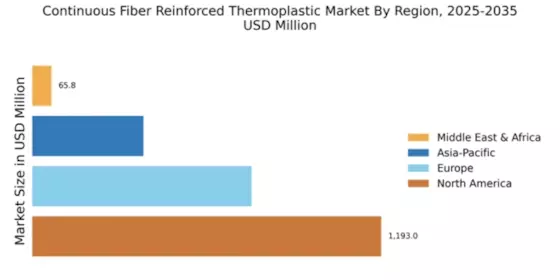
Regional Insights

North America : Market Leader in Innovation

North America is poised to maintain its leadership in the Continuous Fiber Reinforced Thermoplastic Market, holding a significant market share of 1190.0M in 2024. The region's growth is driven by increasing demand in automotive and aerospace sectors, alongside supportive regulations promoting lightweight materials. The push for sustainability and energy efficiency further catalyzes market expansion, with companies investing in advanced manufacturing technologies. The competitive landscape is robust, featuring key players such as Toray Industries, SABIC, and Hexcel Corporation. The U.S. leads the market, supported by a strong manufacturing base and innovation in composite materials. Canada and Mexico are also emerging as important players, contributing to the regional growth through strategic partnerships and investments in R&D. The presence of major corporations ensures a dynamic market environment, fostering continuous advancements in product offerings.

Europe : Emerging Hub for Sustainability

Europe is rapidly evolving as a significant player in the Continuous Fiber Reinforced Thermoplastic Market, with a market size of 800.0M. The region's growth is fueled by stringent environmental regulations and a strong emphasis on sustainability. The European Union's initiatives to reduce carbon emissions and promote lightweight materials in transportation are key drivers. This regulatory landscape encourages innovation and investment in advanced thermoplastic composites. Leading countries such as Germany, France, and the UK are at the forefront of this market, with major companies like BASF and Solvay driving advancements. The competitive landscape is characterized by collaborations between manufacturers and research institutions, enhancing product development. The presence of a skilled workforce and robust supply chains further strengthens Europe's position in the global market. "The European market is committed to achieving sustainability goals through innovative materials and technologies," European Commission report.

Asia-Pacific : Emerging Powerhouse in Composites

Asia-Pacific is emerging as a vital region in the Continuous Fiber Reinforced Thermoplastic Market, with a market size of 350.0M. The growth is driven by increasing industrialization, particularly in countries like China and India, where demand for lightweight materials in automotive and aerospace sectors is surging. Government initiatives promoting advanced manufacturing and infrastructure development are also significant catalysts for market expansion. China stands out as the leading country in this region, with substantial investments in composite materials. Japan and South Korea are also key players, with companies like Mitsubishi Chemical and Teijin Limited contributing to the competitive landscape. The region's market is characterized by rapid technological advancements and a growing focus on sustainability, positioning Asia-Pacific as a formidable player in the global market.

Middle East and Africa : Resource-Rich Frontier

The Middle East and Africa (MEA) region is gradually developing in the Continuous Fiber Reinforced Thermoplastic Market, with a market size of 48.79M. The growth is primarily driven by increasing investments in infrastructure and automotive sectors, alongside a rising demand for lightweight materials. The region's diverse resources and strategic location are advantageous for market development, although challenges such as regulatory hurdles and market awareness persist. Countries like South Africa and the UAE are leading the charge, with initiatives aimed at enhancing manufacturing capabilities. The presence of key players is still limited, but growing interest from international companies is expected to boost market dynamics. As the region continues to invest in technology and innovation, it is poised for gradual growth in the coming years.

Key Players and Competitive Insights

The Continuous Fiber Reinforced Thermoplastic Market is currently characterized by a dynamic competitive landscape, driven by increasing demand for lightweight and high-performance materials across various industries, including automotive, aerospace, and consumer goods. Key players such as Toray Industries (Japan), SABIC (Saudi Arabia), and Solvay (Belgium) are strategically positioned to leverage their technological expertise and extensive product portfolios. For instance, Toray Industries (Japan) focuses on innovation in composite materials, while SABIC (Saudi Arabia) emphasizes sustainability in its product offerings. Collectively, these strategies foster a competitive environment that prioritizes advanced material solutions and environmental responsibility.

In terms of business tactics, companies are increasingly localizing manufacturing to enhance supply chain efficiency and reduce lead times. The market structure appears moderately fragmented, with several key players exerting considerable influence. This fragmentation allows for niche players to emerge, yet the collective strength of major companies like BASF (Germany) and Teijin Limited (Japan) shapes market dynamics significantly, as they engage in strategic partnerships and collaborations to expand their reach.

In November 2025, BASF (Germany) announced a partnership with a leading automotive manufacturer to develop advanced continuous fiber reinforced thermoplastic components aimed at reducing vehicle weight and enhancing fuel efficiency. This collaboration underscores BASF's commitment to innovation and positions it favorably within the automotive sector, where lightweight materials are increasingly critical for meeting regulatory standards and consumer expectations.

In October 2025, Teijin Limited (Japan) launched a new line of continuous fiber reinforced thermoplastics designed specifically for aerospace applications. This strategic move not only diversifies Teijin's product offerings but also aligns with the growing trend towards lightweight materials in the aerospace industry, potentially enhancing its competitive edge in a sector that demands high-performance solutions.

In September 2025, Solvay (Belgium) expanded its production capacity for continuous fiber reinforced thermoplastics in Europe, responding to the rising demand from the automotive and aerospace sectors. This expansion reflects Solvay's proactive approach to market needs and its intent to solidify its position as a leading supplier of advanced materials, thereby enhancing its market share and operational efficiency.

As of December 2025, current competitive trends indicate a strong emphasis on digitalization, sustainability, and the integration of AI technologies within the Continuous Fiber Reinforced Thermoplastic Market. Strategic alliances are increasingly shaping the landscape, as companies recognize the value of collaboration in driving innovation and enhancing supply chain resilience. Looking ahead, competitive differentiation is likely to evolve from traditional price-based competition towards a focus on technological advancements, sustainable practices, and reliable supply chains, suggesting a transformative shift in how companies position themselves in the market.

Key Companies in the Continuous Fiber Reinforced Thermoplastic Market market include

Industry Developments

The  Continuous Fiber Reinforced Thermoplastic Market has recently experienced significant activity. Companies like Covestro and BASF have been expanding their product lines to enhance their market presence and meet increasing demand for lightweight materials in industries such as automotive and aerospace. Teijin Limited and Toray Industries are investing in developing high-performance thermoplastic composites, aiming to leverage advancements in technology for lighter, stronger materials. On the mergers and acquisitions front, Hexcel Corporation has been actively pursuing partnerships to strengthen its position in the aerospace sector, while Lanxess announced its acquisition of a thermoplastic composite business to bolster its portfolio further.

Meanwhile, SABIC is focusing on sustainable practices by integrating environmentally friendly manufacturing processes, contributing to overall market growth. The expansion of companies like Solvay and Evonik Industries is also indicative of the industry's robust trajectory. Recent evaluations suggest the continuous fiber reinforced thermoplastic market is projected to attain substantial valuation growth, driven by heightened environmental awareness and demand for innovative materials across various sectors, which is positively impacting investments and RD efforts in the marketplace.

Future Outlook

Continuous Fiber Reinforced Thermoplastic Market Future Outlook

The Continuous Fiber Reinforced Thermoplastic Market is projected to grow at a 16.98% CAGR from 2024 to 2035, driven by advancements in manufacturing technologies and increasing demand in automotive applications.

New opportunities lie in:

  • Development of lightweight automotive components for electric vehicles.
  • Expansion into aerospace applications for weight reduction and performance enhancement.
  • Investment in recycling technologies for sustainable thermoplastic solutions.

By 2035, the market is expected to achieve substantial growth, solidifying its position as a leader in advanced materials.

Market Segmentation

Continuous Fiber Reinforced Thermoplastic Market End Use Outlook

  • Transportation
  • Construction
  • Energy
  • Electronics
  • Healthcare

Continuous Fiber Reinforced Thermoplastic Market Fiber Type Outlook

  • Glass Fiber
  • Carbon Fiber
  • Natural Fiber
  • Aramid Fiber
  • Basalt Fiber

Continuous Fiber Reinforced Thermoplastic Market Application Outlook

  • Aerospace
  • Automotive
  • Consumer Electronics
  • Industrial Equipment
  • Medical Devices

Continuous Fiber Reinforced Thermoplastic Market Material Type Outlook

  • Polyamide
  • Polypropylene
  • Polyethylene
  • Polycarbonate
  • Polyurethane

Continuous Fiber Reinforced Thermoplastic Market Processing Technique Outlook

  • Injection Molding
  • Compression Molding
  • Filament Winding
  • 3D Printing
  • Thermoforming

Report Scope

MARKET SIZE 20242388.79(USD Million)
MARKET SIZE 20252794.52(USD Million)
MARKET SIZE 203513414.91(USD Million)
COMPOUND ANNUAL GROWTH RATE (CAGR)16.98% (2024 - 2035)
REPORT COVERAGERevenue Forecast, Competitive Landscape, Growth Factors, and Trends
BASE YEAR2024
Market Forecast Period2025 - 2035
Historical Data2019 - 2024
Market Forecast UnitsUSD Million
Key Companies ProfiledToray Industries (JP), SABIC (SA), Solvay (BE), BASF (DE), Teijin Limited (JP), Hexcel Corporation (US), Mitsubishi Chemical Corporation (JP), Covestro AG (DE), DSM (NL)
Segments CoveredApplication, End Use, Material Type, Fiber Type, Processing Technique
Key Market OpportunitiesGrowing demand for lightweight, high-performance materials in automotive and aerospace sectors drives Continuous Fiber Reinforced Thermoplastic Market expansion.
Key Market DynamicsRising demand for lightweight materials drives innovation and competition in the Continuous Fiber Reinforced Thermoplastic Market.
Countries CoveredNorth America, Europe, APAC, South America, MEA

Leave a Comment

FAQs

What is the projected market size of the Continuous Fiber Reinforced Thermoplastic Market by 2035?

The projected market size of the Continuous Fiber Reinforced Thermoplastic Market is expected to reach 6.95 USD Billion by 2035.

What is the expected compound annual growth rate (CAGR) for the Continuous Fiber Reinforced Thermoplastic Market from 2024 to 2035?

The expected CAGR for the Continuous Fiber Reinforced Thermoplastic Market from 2025-2035 is 15.91%.

Which region is anticipated to have the largest market value for the Continuous Fiber Reinforced Thermoplastic Market by 2035?

North America is anticipated to have the largest market value of 2.55 USD Billion for the Continuous Fiber Reinforced Thermoplastic Market by 2035.

What was the market size of the Automotive application segment in the Continuous Fiber Reinforced Thermoplastic Market in 2024?

The market size of the Automotive application segment in 2023 was valued at 0.84 USD Billion.

Who are some of the major players in the Continuous Fiber Reinforced Thermoplastic Market?

Some of the major players include Covestro, Teijin Limited, BASF, and Hexcel Corporation.

What is the projected market value of the Aerospace application segment by 2035?

The projected market value of the Aerospace application segment is expected to reach 2.18 USD Billion by 2035.

What is the expected market size for the Industrial application segment by 2035?

The expected market size for the Industrial application segment by 2035 is 1.52 USD Billion.

How does the market value of the South America region change from 2024 to 2035?

The market value of the South America region is projected to change from 0.11 USD Billion in 2023 to 0.43 USD Billion by 2035.

  What was the overall market value of the Continuous Fiber Reinforced Thermoplastic Market in 2024?

The overall market value of the Continuous Fiber Reinforced Thermoplastic Market in 2023 was 1.84 USD Billion.

What is the expected overall market growth for the APAC region by 2035?

The expected overall market growth for the APAC region is projected to reach 1.68 USD Billion by 2035.

Download Free Sample

Kindly complete the form below to receive a free sample of this Report

Compare Licence

×
Features License Type
Single User Multiuser License Enterprise User
Price $4,950 $ $7,250
Maximum User Access Limit 1 User Upto 10 Users Unrestricted Access Throughout the Organization
Free Customization
Direct Access to Analyst
Deliverable Format
Platform Access
Discount on Next Purchase 10% 15% 15%
Printable Versions