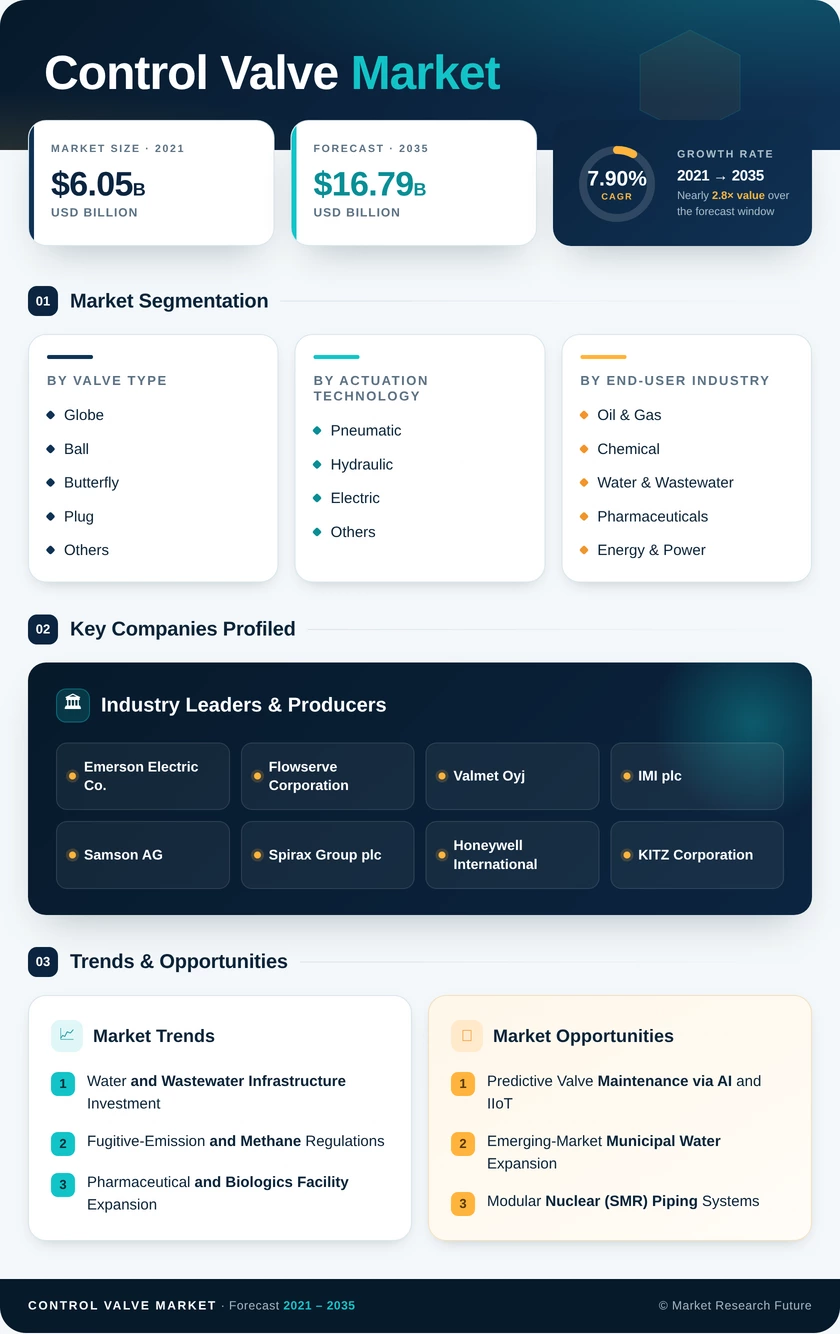
Control Valve Market

ID: MRFR/EnP/1408-CR
155 Pages
Priya Nagrale
Last Updated: June 22, 2026
Control Valve Market Research Report Information By Valve Type (Rotary valves [ball valves, butterfly valves, plug valve], linear valves [globe valves, diaphragm valves, others]), Valve Size (Below 1, 1 To 6, 25 To 50 and Above 50), By Material ( Stainless Steel, Cast Iron, Alloy-based, Cryogenic, Others) by Component (Valve Body, Actuator and Others), End-Use (Oil & Gas, Water & Wastewater Treatment, Energy & Power, Chemicals, Food & Beverage, Pharmaceuticals and Others) - Growth & Industry Forecast to 2035
Download PDF ×

We do not share your information with anyone. However, we may send you emails based on your report interest from time to time. You may contact us at any time to opt-out.

  1. 1 Market Overview |
    1. 1.1 Study Assumptions & Market Definition |
    2. 1.2 Scope of the Study |
    3. 1.3 Research Methodology
  2. 2 Market Summary & Key Takeaways
  3. 3 Market Dynamics |
    1. 3.1 Market Drivers Analysis | |
      1. 3.1.1 Water & Wastewater Infrastructure Investment | |
      2. 3.1.2 Fugitive-Emission and Methane Regulations | |
      3. 3.1.3 Pharmaceutical & Biologics Facility Expansion | |
      4. 3.1.4 Hydrogen Economy Valve Specifications | |
      5. 3.1.5 Electric-Actuator Electrification Trend | |
      6. 3.1.6 SMR & Advanced Nuclear Construction | |
      7. 3.1.7 Digital Positioner & IIoT Integration |
    2. 3.2 Market Restraints Analysis | |
      1. 3.2.1 High Upfront Cost of Smart Valve Assemblies | |
      2. 3.2.2 Raw Material Price Volatility (Nickel, Chromium) | |
      3. 3.2.3 Skilled Workforce Shortage for Commissioning | |
      4. 3.2.4 Interoperability Gaps Between OEM Digital Platforms | |
      5. 3.2.5 Geopolitical Trade Barriers on Specialty Alloys |
    3. 3.3 Market Opportunity Analysis | |
      1. 3.3.1 Predictive Valve Maintenance via AI and IIoT | |
      2. 3.3.2 Emerging-Market Municipal Water Expansion | |
      3. 3.3.3 Modular Nuclear (SMR) Piping Systems | |
      4. 3.3.4 Carbon Capture and Storage (CCS) Valve Demand | |
      5. 3.3.5 Valve-as-a-Service and Subscription Models |
    4. 3.4 Industry Value Chain Analysis |
    5. 3.5 Porter's Five Forces Analysis
  4. 4 Global Control Valve Market Size & Forecast (2021–2035) |
    1. 4.1 Historical Market Size (2021–2025) |
    2. 4.2 Current & Forecast Market Size (2026–2035) |
    3. 4.3 Market Size by Revenue (USD Billion) |
    4. 4.4 Year-over-Year Growth Analysis
  5. 5 Segmentation Analysis |
    1. 5.1 By Valve Type | |
      1. 5.1.1 Globe | |
      2. 5.1.2 Ball | |
      3. 5.1.3 Butterfly | |
      4. 5.1.4 Plug | |
      5. 5.1.5 Others |
    2. 5.2 By Actuation Technology | |
      1. 5.2.1 Pneumatic | |
      2. 5.2.2 Hydraulic | |
      3. 5.2.3 Electric | |
      4. 5.2.4 Others |
    3. 5.3 By End-User Industry | |
      1. 5.3.1 Oil and Gas | |
      2. 5.3.2 Chemical | |
      3. 5.3.3 Water & Wastewater Treatment | |
      4. 5.3.4 Pharmaceuticals | |
      5. 5.3.5 Energy & Power | |
      6. 5.3.6 Petrochemical & Fertilizer | |
      7. 5.3.7 Others |
    4. 5.4 By Material | |
      1. 5.4.1 Steel | |
      2. 5.4.2 Cast Iron | |
      3. 5.4.3 Alloy-Based | |
      4. 5.4.4 Plastic
  6. 6 Regional Analysis |
    1. 6.1 North America | |
      1. 6.1.1 United States | |
      2. 6.1.2 Canada | |
      3. 6.1.3 Mexico |
    2. 6.2 Europe | |
      1. 6.2.1 Germany | |
      2. 6.2.2 United Kingdom | |
      3. 6.2.3 France | |
      4. 6.2.4 Italy | |
      5. 6.2.5 Spain | |
      6. 6.2.6 Nordic Countries | |
      7. 6.2.7 Russia | |
      8. 6.2.8 Rest of Europe |
    3. 6.3 Asia-Pacific | |
      1. 6.3.1 China | |
      2. 6.3.2 India | |
      3. 6.3.3 Japan | |
      4. 6.3.4 South Korea | |
      5. 6.3.5 ASEAN | |
      6. 6.3.6 Rest of Asia-Pacific |
    4. 6.4 South America | |
      1. 6.4.1 Brazil | |
      2. 6.4.2 Argentina | |
      3. 6.4.3 Rest of South America |
    5. 6.5 Middle East & Africa | |
      1. 6.5.1 Saudi Arabia | |
      2. 6.5.2 UAE | |
      3. 6.5.3 South Africa | |
      4. 6.5.4 Egypt | |
      5. 6.5.5 Rest of MEA
  7. 7 Competitive Landscape |
    1. 7.1 Market Share Analysis (2025) |
    2. 7.2 Competitive Benchmarking Matrix |
    3. 7.3 Company Profiles | |
      1. 7.3.1 Emerson Electric Co. | |
      2. 7.3.2 Flowserve Corporation | |
      3. 7.3.3 Valmet Oyj | |
      4. 7.3.4 IMI plc | |
      5. 7.3.5 Baker Hughes Company | |
      6. 7.3.6 Samson AG | |
      7. 7.3.7 Spirax Group plc | |
      8. 7.3.8 Honeywell International Inc. | |
      9. 7.3.9 KITZ Corporation | |
      10. 7.3.10 Azbil Corporation
  8. 8 Future Outlook & Strategic Recommendations (2026–2035) |
    1. 8.1 AI-Driven Autonomous Valve Control |
    2. 8.2 Electrification of Actuation Systems |
    3. 8.3 ESG Disclosure and Supply-Chain Traceability |
    4. 8.4 Platform Consolidation and Software Economics
  9. 9 Recent Developments & News
  10. 10 Frequently Asked Questions (FAQs)
  11. 11 Report Scope & Methodology |
    1. 11.1 Study Period & Base Year |
    2. 11.2 Data Sources & Citations |
    3. 11.3 Abbreviations
  12. 12 LIST OF TABLES |
  13. TABLE 1 Global Control Valve Market Size & Forecast, by Revenue (USD Billion), 2021–2035 |
  14. TABLE 2 Global Control Valve Market — Year-over-Year Growth Analysis, 2021–2035 |
  15. TABLE 3 Global Control Valve Market — Driver Impact Analysis, 2026–2035 |
  16. TABLE 4 Global Control Valve Market — Restraint Impact Analysis, 2026–2035 |
  17. TABLE 5 Global Control Valve Market Size, by Valve Type, 2021–2035 (USD Billion) |
  18. TABLE 6 Global Control Valve Market Size, by Actuation Technology, 2021–2035 (USD Billion) |
  19. TABLE 7 Global Control Valve Market Size, by End-User Industry, 2021–2035 (USD Billion) |
  20. TABLE 8 Global Control Valve Market Size, by Material, 2021–2035 (USD Billion) |
  21. TABLE 9 Global Control Valve Market Size, by Region, 2021–2035 (USD Billion) |
  22. TABLE 10 North America Control Valve Market Size, by Country, 2021–2035 (USD Billion) |
  23. TABLE 11 Europe Control Valve Market Size, by Country, 2021–2035 (USD Billion) |
  24. TABLE 12 Asia-Pacific Control Valve Market Size, by Country, 2021–2035 (USD Billion) |
  25. TABLE 13 South America Control Valve Market Size, by Country, 2021–2035 (USD Billion) |
  26. TABLE 14 Middle East & Africa Control Valve Market Size, by Country, 2021–2035 (USD Billion) |
  27. TABLE 15 Competitive Benchmarking Matrix — Global Control Valve Market, 2025 |
  28. TABLE 16 Company Profiles — Key Players, Global Control Valve Market |
  29. TABLE 17 Recent Developments & Strategic Announcements, 2023–2025 |
  30. TABLE 18 Report Scope & Methodology Summary |
  31. TABLE 19 Detailed Sources and Citations
  32. 13 LIST OF FIGURES |
  33. FIGURE 1 Global Control Valve Market Dynamics — Drivers, Restraints, and Opportunities |
  34. FIGURE 2 Industry Value Chain Analysis — Control Valve Market |
  35. FIGURE 3 Porter's Five Forces Analysis — Control Valve Market |
  36. FIGURE 4 Global Control Valve Market Size Trend (USD Billion), 2021–2035 |
  37. FIGURE 5 Control Valve Market Share, by Valve Type (%), 2025 |
  38. FIGURE 6 Control Valve Market Share, by Actuation Technology (%), 2025 |
  39. FIGURE 7 Control Valve Market Share, by End-User Industry (%), 2025 |
  40. FIGURE 8 Control Valve Market Share, by Material (%), 2025 |
  41. FIGURE 9 Control Valve Market Share, by Region (%), 2025 |
  42. FIGURE 10 North America Control Valve Market — Country-Level Analysis |
  43. FIGURE 11 Europe Control Valve Market — Country-Level Analysis |
  44. FIGURE 12 Asia-Pacific Control Valve Market — Country-Level Analysis |
  45. FIGURE 13 South America Control Valve Market — Country-Level Analysis |
  46. FIGURE 14 Middle East & Africa Control Valve Market — Country-Level Analysis |
  47. FIGURE 15 Competitive Landscape — Market Share Analysis, 2025

Segmentation Quick Reference

DimensionSub-SegmentsDominant SegmentFastest Growing Segment
Valve TypeGlobe, Ball, Butterfly, Plug, OthersButterfly (32.1% share, 2025)Plug (8.35% CAGR)
Actuation TechnologyPneumatic, Hydraulic, Electric, OthersPneumatic (43.9% share, 2025)Electric (10.75% CAGR)
End-User IndustryOil & Gas, Chemical, Water & Wastewater, Pharmaceuticals, Energy & Power, Petrochemical & Fertilizer, OthersWater & Wastewater (23.05% share, 2025)Pharmaceuticals (9.75% CAGR)
MaterialSteel, Cast Iron, Alloy-Based, PlasticSteel (44.8% share, 2025)Alloy-Based (9.20% CAGR)
GeographyNorth America, Europe, Asia-Pacific, South America, Middle East & AfricaNorth America (36.0% share, 2025)Asia-Pacific (8.95% CAGR)


Market Segmentation Overview

By Valve Type

Sub-SegmentKey Trend
GlobeHigh-precision throttling in pharma and nuclear-grade piping
BallExpanding in modulating duties with characterized-ball trim
ButterflyDominant in water treatment and HVAC large-diameter lines
PlugRising adoption of multiport diverting and corrosive-media isolation
OthersNiche applications in pinch, diaphragm, and gate configurations


Globe and butterfly valves collectively represent over half of industry revenue, but ball and plug designs are narrowing the gap through engineered trim innovations that extend their applicability into precision-control duties previously reserved for globe-style bodies.

By Actuation Technology

Sub-SegmentKey Trend
PneumaticEntrenched in safety instrumented systems requiring sub-second response
HydraulicPreferred for high-force subsea and long-stroke pipeline applications
ElectricRapidly displacing pneumatic in greenfield facilities with Industry 4.0 architectures
OthersIncludes manual-override and electrohydraulic hybrid configurations


Pneumatic actuation remains the installed-base leader, but electric actuators are winning the majority of new-specification awards in greenfield chemical, pharmaceutical, and water-treatment plants due to energy efficiency and native digital connectivity.

By End-User Industry

Sub-SegmentKey Trend
Oil and GasUpstream production optimization and midstream methane compliance
ChemicalSpecialty-chemical capacity expansion in Asia and Europe
Water & WastewaterInfrastructure rehabilitation and advanced nutrient-removal mandates
PharmaceuticalsBiologics CDMO expansion and continuous-manufacturing adoption
Energy & PowerThermal plant retrofits and SMR construction programs
Petrochemical & FertilizerDownstream integration and feedstock-diversification projects
OthersFood & beverage, pulp & paper, and mining process automation


Water and wastewater overtook oil and gas as the top end-user segment in 2025, reflecting the global prioritization of water security and the softening of upstream exploration capex cyclicality.

By Material

Sub-SegmentKey Trend
SteelGeneral-purpose industrial standard across temperature and pressure ranges
Cast IronCost-effective option for low-pressure municipal distribution
Alloy-BasedGrowing in hydrogen, cryogenic, and severe-corrosion service environments
PlasticAdopted in chemical dosing, semiconductor, and ultrapure water systems


Alloy-based materials are experiencing the strongest growth trajectory as hydrogen-readiness, offshore sour-gas, and high-temperature power applications push end users toward Inconel, Hastelloy, and duplex stainless-steel valve bodies.