Request Free Sample ×

Kindly complete the form below to receive a free sample of this Report

* Please use a valid business email

Leading companies partner with us for data-driven Insights

clients tt-cursor
Hero Background

Cookies Market

ID: MRFR/FnB/1392-HCR
110 Pages
Tejas Chaudhary
Last Updated: May 27, 2026
Cookies Market Size, Share, Industry Trend & Analysis Research Report Information By Product Type (Butter/Shortbread & Plain, Bar Cookies, Molded/Drop Cookies, Sandwich Cookies, Others), By Category (Conventional, Free-From), By Distribution Channel (Hypermarkets & Supermarkets, Convenience Stores, Online Retail, Others), By Packaging Format (Pouches & Sachets, Cartons, Others), By Geography (North America, Europe, Asia-Pacific, South America, Middle East & Africa) – Forecast Till 2035
Download PDF ×

We do not share your information with anyone. However, we may send you emails based on your report interest from time to time. You may contact us at any time to opt-out.

  1. 1 Market Overview |
    1. 1.1 Study Assumptions & Market Definition |
    2. 1.2 Scope of the Study |
    3. 1.3 Research Methodology
  2. 2 Market Summary & Key Takeaways
  3. 3 Market Dynamics |
    1. 3.1 Market Drivers Analysis | |
      1. 3.1.1 Rising Snacking Frequency | |
      2. 3.1.2 Premiumization and Indulgence Positioning | |
      3. 3.1.3 Health-Focused Reformulation | |
      4. 3.1.4 Online and D2C Channel Expansion | |
      5. 3.1.5 Clean-Label and Free-From Demand | |
      6. 3.1.6 Portion-Controlled Packaging Innovation | |
      7. 3.1.7 Emerging-Market Urbanization |
    2. 3.2 Market Restraints Analysis | |
      1. 3.2.1 Raw-Material Cost Volatility | |
      2. 3.2.2 Sugar and Front-of-Pack Labeling Restrictions | |
      3. 3.2.3 Private-Label Price Competition | |
      4. 3.2.4 Consumer Shift Toward Fresher Snack Alternatives | |
      5. 3.2.5 Supply-Chain Disruption and Freight Inflation |
    3. 3.3 Market Opportunity Analysis | |
      1. 3.3.1 Protein Enriched Cookies and Functional Snacking | |
      2. 3.3.2 Plant-Based Vegan Cookies for Flexitarian Consumers | |
      3. 3.3.3 Emerging-Market Organized Retail Buildout | |
      4. 3.3.4 Direct-to-Consumer Subscription Models | |
      5. 3.3.5 Clean-Label and Transparency-Led Innovation |
    4. 3.4 Industry Value Chain Analysis |
    5. 3.5 Porter's Five Forces Analysis
  4. 4 Global Cookies Market Size & Forecast (2021–2035) |
    1. 4.1 Historical Market Size (2021–2025) |
    2. 4.2 Current & Forecast Market Size (2026–2035) |
    3. 4.3 Market Size by Revenue (USD Billion) |
    4. 4.4 Year-over-Year Growth Analysis
  5. 5 Segmentation Analysis |
    1. 5.1 By Product Type | |
      1. 5.1.1 Butter/Shortbread & Plain Cookies | |
      2. 5.1.2 Bar Cookies | |
      3. 5.1.3 Molded/Drop Cookies | |
      4. 5.1.4 Sandwich Cookies | |
      5. 5.1.5 Others (Wafer, Filled, Rolled) |
    2. 5.2 By Category | |
      1. 5.2.1 Conventional | |
      2. 5.2.2 Free-From |
    3. 5.3 By Distribution Channel | |
      1. 5.3.1 Hypermarkets & Supermarkets | |
      2. 5.3.2 Convenience Stores | |
      3. 5.3.3 Online Retail | |
      4. 5.3.4 Others (Specialty, Vending) |
    4. 5.4 By Packaging Format | |
      1. 5.4.1 Pouches & Sachets | |
      2. 5.4.2 Cartons | |
      3. 5.4.3 Others (Tins, Trays, Bulk)
  6. 6 Regional Analysis |
    1. 6.1 North America | |
      1. 6.1.1 United States | |
      2. 6.1.2 Canada | |
      3. 6.1.3 Mexico |
    2. 6.2 Europe | |
      1. 6.2.1 Germany | |
      2. 6.2.2 United Kingdom | |
      3. 6.2.3 France | |
      4. 6.2.4 Italy | |
      5. 6.2.5 Spain | |
      6. 6.2.6 Nordic Countries | |
      7. 6.2.7 Russia | |
      8. 6.2.8 Rest of Europe |
    3. 6.3 Asia-Pacific | |
      1. 6.3.1 China | |
      2. 6.3.2 India | |
      3. 6.3.3 Japan | |
      4. 6.3.4 South Korea | |
      5. 6.3.5 ASEAN | |
      6. 6.3.6 Rest of Asia-Pacific |
    4. 6.4 South America | |
      1. 6.4.1 Brazil | |
      2. 6.4.2 Argentina | |
      3. 6.4.3 Rest of South America |
    5. 6.5 Middle East & Africa | |
      1. 6.5.1 Saudi Arabia | |
      2. 6.5.2 UAE | |
      3. 6.5.3 South Africa | |
      4. 6.5.4 Egypt | |
      5. 6.5.5 Rest of MEA
  7. 7 Competitive Landscape |
    1. 7.1 Market Share Analysis (2025) |
    2. 7.2 Competitive Benchmarking Matrix |
    3. 7.3 Company Profiles | |
      1. 7.3.1 Mondelēz International | |
      2. 7.3.2 Nestlé S.A. | |
      3. 7.3.3 Ferrero Group | |
      4. 7.3.4 Campbell Soup Co. (Pepperidge Farm) | |
      5. 7.3.5 Lotus Bakeries | |
      6. 7.3.6 Kellanova | |
      7. 7.3.7 Grupo Bimbo | |
      8. 7.3.8 Britannia Industries | |
      9. 7.3.9 Bahlsen Group | |
      10. 7.3.10 Parle Products
  8. 8 Future Outlook & Strategic Recommendations (2026–2035) |
    1. 8.1 AI-Optimized Baking and Supply Chains |
    2. 8.2 Sustainability and ESG-Driven Reformulation |
    3. 8.3 Personalization and Functional Nutrition |
    4. 8.4 Channel Convergence and Omnichannel Retail
  9. 9 Recent Developments & News
  10. 10 Frequently Asked Questions (FAQs)
  11. 11 Report Scope & Methodology |
    1. 11.1 Study Period & Base Year |
    2. 11.2 Data Sources & Citations |
    3. 11.3 Abbreviations
  12. 1 LIST OF TABLES
  13. 2 LIST OF FIGURES

Segmentation Quick Reference

DimensionSub-SegmentsDominant SegmentFastest Growing Segment
Product TypeButter/Shortbread & Plain; Bar Cookies; Molded/Drop Cookies; Sandwich Cookies; OthersButter/Shortbread & Plain CookiesBar Cookies
CategoryConventional; Free-FromConventionalFree-From
Distribution ChannelHypermarkets & Supermarkets; Convenience Stores; Online Retail; OthersHypermarkets & SupermarketsOnline Retail
Packaging FormatPouches & Sachets; Cartons; OthersPouches & SachetsCartons
GeographyNorth America; Europe; Asia-Pacific; South America; Middle East & AfricaEuropeSouth America


Market Segmentation Overview

By Product Type

Sub-SegmentKey Trend
Butter/Shortbread & Plain CookiesStable heritage demand; clean-label reformulations gaining ground
Bar CookiesRapid growth via protein-enriched cookies and on-the-go formats
Molded/Drop CookiesArtisan and chocolate chip cookie brand premiumization
Sandwich CookiesCream-filling innovation; dual-texture formats
Others (Wafer, Filled, Rolled)Regional specialty niches; seasonal gifting


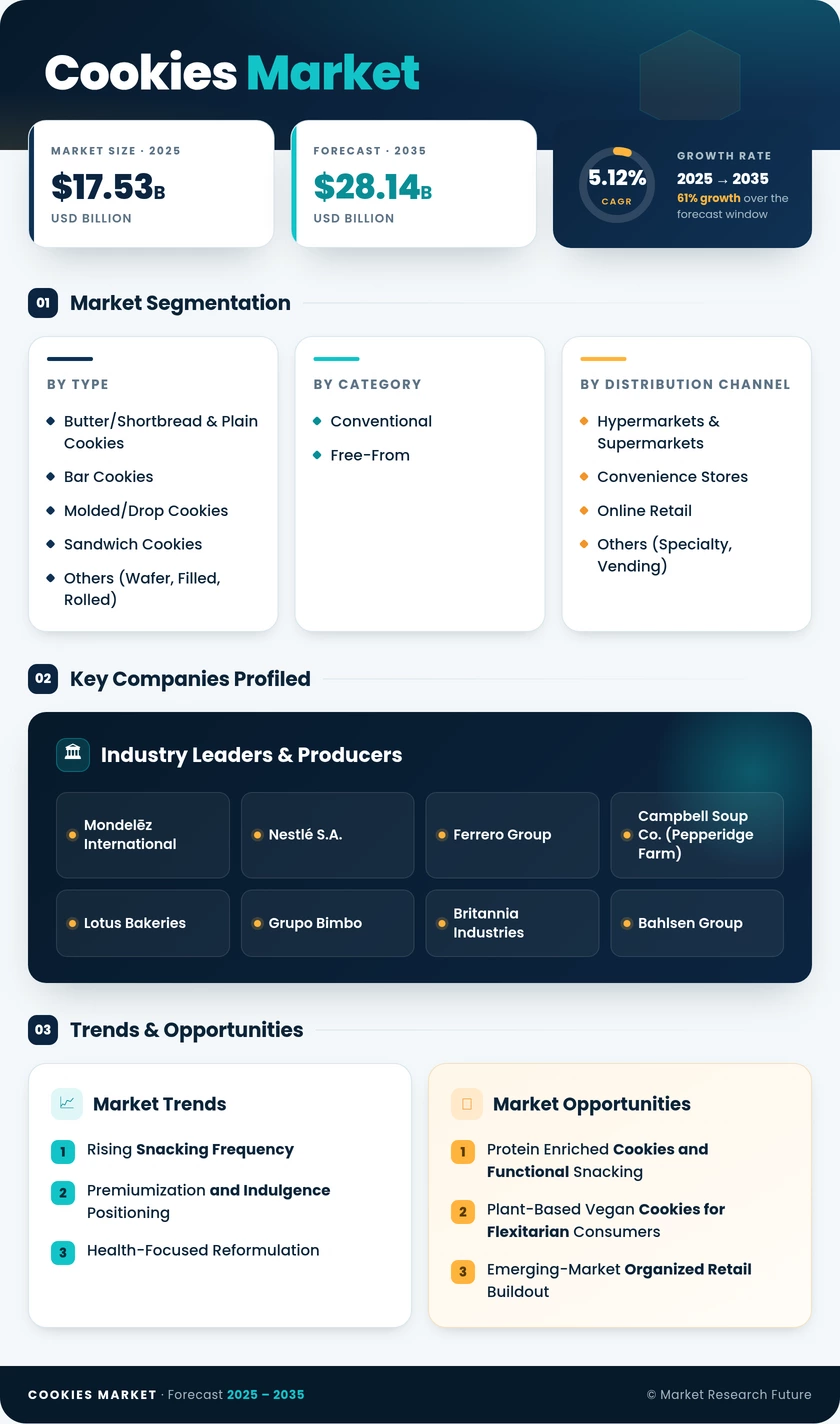
Butter and plain cookies maintain their leading position through universal consumer familiarity, while bar cookies are accelerating as functional snacking intersects with portability. Molded/drop cookies benefit from the artisan movement and direct-to-consumer chocolate chip cookie brand launches.

By Category

Sub-SegmentKey Trend
ConventionalMass-market dominance; incremental sugar-reduction efforts
Free-FromPlant-based vegan cookies and allergen-free formulations are driving rapid expansion.


The conventional category continues to anchor global Cookies Market revenue. The free-from segment, though small in absolute terms, captures disproportionate innovation investment as brands target flexitarian households and allergen-sensitive consumers with plant-based vegan cookies.

By Distribution Channel

Sub-SegmentKey Trend
Hypermarkets & SupermarketsDominant share; private-label competition intensifying
Convenience StoresSingle-serve and impulse-purchase growth
Online RetailSubscription models; D2C soft-baked premium cookies platforms
Others (Specialty, Vending)Artisan boutiques and experiential retail


Hypermarkets retain their distribution leadership, but online retail is the fastest-growing channel. Brand-owned subscription services for curated healthy oat cookie snack assortments represent a high-margin digital opportunity.

By Packaging Format

Sub-SegmentKey Trend
Pouches & SachetsPortion-control alignment; cost-efficient single-serve
CartonsPremium gift positioning; sustainability via recyclable materials
Others (Tins, Trays, Bulk)Heritage tins for seasonal occasions; bulk for food-service


Pouches and sachets dominate due to their alignment with on-the-go consumption patterns and portion-controlled healthy oat cookie snack packaging. Cartons are the fastest-growing format, driven by premium gifting and sustainability preferences.