Credit Card Payment Market Size, Share and Research Report By Transaction Type (In-Store Payments, Online Payments, Mobile Payments), By Provider Type (Banks, Non-Bank Financial Institutions, Fintech Companies), By Card Type (Standard Credit Cards, Premium Credit Cards, Reward Credit Cards, Secured Credit Cards), By Usage Category (Travel, Dining, Retail, Healthcare, Education) and By Regional (North America, Europe, South America, Asia Pacific, Middle East and Africa) - Industry Forecast Till 2035
As per Market Research Future analysis, the Credit Card Payment Market Size was estimated at 676.4 USD Billion in 2024. The Credit Card Payment industry is projected to grow from USD 736.06 Billion in 2025 to USD 1714.01 Billion by 2035, exhibiting a compound annual growth rate (CAGR) of 8.82% during the forecast period 2025 - 2035
Key Market Trends & Highlights
The Credit Card Payment Market is experiencing a dynamic evolution driven by technological advancements and changing consumer preferences.
The rise of digital wallets is reshaping payment methods, particularly in North America, where convenience is paramount.
Enhanced security measures are becoming increasingly critical as consumers demand safer transaction environments, especially in the Asia-Pacific region.
A notable shift towards subscription models is evident, reflecting changing consumer behaviors and preferences in payment structures.
Technological advancements in payment processing and the growth of e-commerce are key drivers propelling the market forward, particularly in the in-store payments segment.
Market Size & Forecast
2024 Market Size
676.4 (USD Billion)
2035 Market Size
1714.01 (USD Billion)
CAGR (2025 - 2035)
8.82%
Major Players
Visa (US), Mastercard (US), American Express (US), Discover (US), JCB (JP), UnionPay (CN), Diners Club (US), RuPay (IN), Interac (CA)
Our Impact
Enabled $4.3B Revenue Impact for Fortune 500 and Leading Multinationals
Partnering with 2000+ Global Organizations Each Year
30K+ Citations by Top-Tier Firms in the Industry
Credit Card Payment Market Trends
The Credit Card Payment Market is currently experiencing a dynamic evolution, driven by technological advancements and changing consumer preferences. The proliferation of digital payment solutions has led to an increased reliance on credit cards for both online and in-store transactions. This shift appears to be influenced by the growing demand for convenience and security among consumers, who are increasingly seeking seamless payment experiences. Furthermore, the integration of artificial intelligence and machine learning into payment processing systems is enhancing fraud detection and risk management, thereby fostering greater trust in credit card transactions.
In addition, the Credit Card Payment Market is witnessing a notable trend towards contactless payments. This method, which allows consumers to make transactions by simply tapping their cards, is gaining traction due to its speed and ease of use. As more merchants adopt contactless technology, the overall consumer experience is likely to improve, potentially leading to higher transaction volumes. across the credit card payments market moreover, the ongoing emphasis on sustainability and ethical practices may influence the market, as consumers become more conscious of the environmental impact of their purchasing decisions. Overall, the Credit Card Payment Market is poised for continued growth, shaped by innovation and evolving consumer expectations.
Rise of Digital Wallets
The emergence of digital wallets is reshaping the Credit Card Payment Market. These platforms enable users to store multiple credit card details securely, facilitating quick and easy transactions. As consumers increasingly prefer mobile solutions, the integration of digital wallets with traditional credit cards is likely to enhance user convenience.
Enhanced Security Measures
Security remains a paramount concern within the Credit Card Payment Market. The implementation of advanced security protocols, such as biometric authentication and tokenization, is becoming more prevalent. These measures aim to protect sensitive information, thereby fostering consumer confidence in credit card usage.
Shift Towards Subscription Models
There is a noticeable shift towards subscription-based payment models in the Credit Card Payment Market. This trend reflects changing consumer behavior, as individuals seek predictable payment structures for services. As businesses adapt to this model, it may lead to increased customer loyalty and recurring revenue streams.
Credit Card Payment Market Drivers
E-commerce Growth and Online Shopping Trends
The Credit Card Payment Market is significantly influenced by the ongoing growth of e-commerce and online shopping. As more consumers turn to digital platforms for their purchasing needs, the demand for seamless and secure payment options has surged. In 2025, e-commerce sales are projected to reach approximately 6 trillion dollars, with credit cards remaining a preferred payment method due to their convenience and rewards programs. This trend indicates that the Credit Card Payment Market will continue to expand, as businesses adapt to consumer preferences by offering diverse payment options that cater to the online shopping experience.
Regulatory Changes and Compliance Requirements
The Credit Card Payment Market is subject to evolving regulatory changes and compliance requirements that can significantly impact operations. Governments and regulatory bodies are increasingly focusing on consumer protection, data security, and anti-fraud measures. In 2025, new regulations may emerge that mandate stricter compliance for payment processors and financial institutions, potentially reshaping the competitive landscape. While these regulations aim to enhance consumer trust and security, they may also impose additional costs on businesses within the Credit Card Payment Market. Adapting to these changes will be crucial for maintaining market position and ensuring compliance.
Consumer Demand for Rewards and Loyalty Programs
The Credit Card Payment Market is increasingly driven by consumer demand for rewards and loyalty programs. As individuals seek to maximize the value of their spending, credit card issuers are responding by offering attractive incentives such as cashback, travel rewards, and points systems. In 2025, it is anticipated that over 70% of credit card users will actively participate in some form of rewards program. This trend not only enhances customer satisfaction but also encourages higher spending, thereby contributing to the overall growth of the Credit Card Payment Market. Financial institutions are likely to continue innovating their offerings to retain and attract customers.
Technological Advancements in Payment Processing
The Credit Card Payment Market is experiencing a notable transformation due to rapid technological advancements. Innovations such as contactless payments, mobile wallets, and blockchain technology are reshaping how transactions are conducted. In 2025, it is estimated that contactless payments will account for over 30% of all credit card transactions, reflecting a growing consumer preference for speed and convenience. Furthermore, the integration of artificial intelligence in fraud detection systems enhances security, thereby fostering consumer trust. As technology continues to evolve, the Credit Card Payment Market is likely to witness increased adoption rates, as both consumers and merchants seek efficient and secure payment solutions.
Increasing Global Connectivity and Financial Inclusion
The Credit Card Payment Market is benefiting from increasing global connectivity and efforts towards financial inclusion. As internet access expands and mobile technology becomes more prevalent, previously underserved populations are gaining access to credit card services. In 2025, it is estimated that the number of credit card users in emerging markets will rise significantly, driven by initiatives aimed at promoting financial literacy and access to banking services. This trend not only opens new avenues for growth within the Credit Card Payment Market but also fosters economic development by enabling more individuals to participate in the formal economy.
Market Segment Insights
By Transaction Type: In-Store Payments (Largest) vs. Mobile Payments (Fastest-Growing)
In the Credit Card Payment Market, the distribution among transaction types reflects diverse consumer preferences and technological advancements. In-Store Payments account for the largest share due to the continued reliance on physical retail experiences. Shoppers often prefer using credit cards for immediate purchases, securing their dominant position. Conversely, Online Payments, while significant, are experiencing a plateau as more consumers migrate towards mobile solutions for ease of use. Mobile Payments are carving out a notable share as they blend convenience with innovative tech solutions.
In-Store Payments (Dominant) vs. Mobile Payments (Emerging)
In-Store Payments remain the dominant force in the Credit Card Payment Market, leveraging the tactile shopping experience and established consumer habits. Shoppers visiting brick-and-mortar stores value the immediacy and security that credit cards provide. However, Mobile Payments are quickly emerging as a significant player, capturing the attention of tech-savvy consumers seeking seamless transaction experiences. With the rise of contactless technology and mobile wallets, this segment is rapidly gaining traction as it aligns with the growing trend of cashless transactions, especially among younger demographics looking for convenience and efficiency.
By Provider Type: Banks (Largest) vs. Fintech Companies (Fastest-Growing)
In the Credit Card Payment Market, provider type segmentation reveals that banks dominate the landscape, accounting for a substantial market share due to their established customer bases and extensive service networks. Non-Bank Financial Institutions follow, closely catering to niche markets, while fintech companies are carving out a significant presence by leveraging technology to offer innovative payment solutions. This distribution showcases how traditional players maintain dominance while new entrants quickly gain traction. Examining growth trends, fintech companies are leading the charge in innovation, driven by factors such as the rise of digital payment preferences and increasing consumer demand for seamless transactions. As traditional banks adapt to these changes by enhancing their digital offerings, the landscape is increasingly competitive. Non-Bank Financial Institutions, too, are experiencing growth as they diversify their services, presenting a balanced dynamic in the provider type segment.
Banks (Dominant) vs. Fintech Companies (Emerging)
Banks remain the dominant provider type in the Credit Card Payment Market, benefiting from their long-standing market presence and trust among consumers. They offer a comprehensive range of services under one roof, including credit card issuance and management. Meanwhile, fintech companies represent the emerging force, distinguished by their agility and technology-driven solutions. They focus on enhancing customer experience through user-friendly interfaces and faster processing times. This shift towards digital-centric services has allowed fintechs to capture the interest of younger consumers who prioritize convenience and speed. As consumer behavior changes, the rivalry between established banks and nimble fintechs intensifies, fostering innovation and improved service offerings, ultimately benefiting end users.
By Card Type: Reward Credit Cards (Largest) vs. Premium Credit Cards (Fastest-Growing)
In the Credit Card Payment Market, the segment values show a diverse distribution with Reward Credit Cards holding the largest share due to their attractive cash-back offers and loyalty incentives. Meanwhile, Premium Credit Cards are gaining traction as consumers seek exclusive rewards and enhanced services, indicating a shift towards more value-driven credit solutions. This results in a compelling competition among card issuers to innovate and attract customers into these profitable segments.
Reward Credit Cards (Dominant) vs. Premium Credit Cards (Emerging)
Reward Credit Cards are characterized by their ability to provide cardholders with points, cash-back, or other rewards based on their spending, making them the most sought-after option in the market. This segment has become synonymous with customer loyalty and satisfaction, driving a substantial share of the market. Conversely, Premium Credit Cards, often accompanied by high fees, offer luxurious benefits such as travel perks, concierge services, and insurance coverage. Their emergence is fueled by a growing affluent consumer base desiring exclusive privileges and services, indicating a burgeoning trend towards premium offerings in credit options.
By Usage Category: Travel (Largest) vs. Dining (Fastest-Growing)
The Credit Card Payment Market shows a dynamic distribution among its various usage categories, with Travel dominating the space as consumers increasingly utilize credit cards for booking flights and accommodations. This segment captures a significant portion of market share, reflecting the strong consumer preference for credit card transactions in travel-related expenditures. Following close behind, Dining has emerged as a rapidly growing segment, driven by the trend of using credit cards for online food delivery and dining experiences, particularly post-pandemic.
Travel: Dominant vs. Dining: Emerging
Travel remains the dominant segment within the Credit Card Payment Market, characterized by high-value transactions as consumers favor credit card payments for booking travel services ranging from flights to hotels. This segment benefits from the expanding travel industry, with credit card companies offering rewards and incentives specifically catered to travelers. On the other hand, Dining is regarded as an emerging segment, gaining traction due to the increasing acceptance of credit cards in restaurants and the rise of food delivery services. The convenience of credit cards, coupled with promotional deals, is propelling this segment’s growth, attracting younger consumers who prioritize digital payments.
Get more detailed insights about Credit Card Payment MarketRequest Free Sample
Regional Insights
North America : Market Leader in Payments
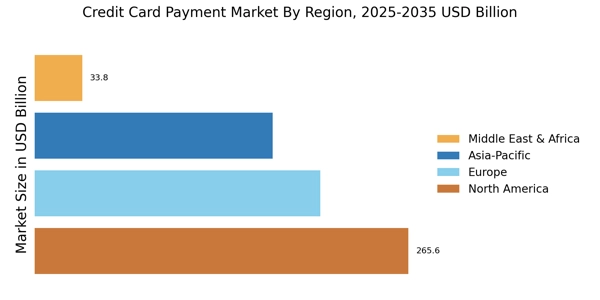
North America remains the largest market for credit card payments, accounting for approximately 40% of the global market share. Growth in the market USA credit card payment segment is driven by high consumer spending, technological advancements, and a robust regulatory framework that supports digital payments. The increasing adoption of contactless payments and mobile wallets further fuels demand, making it a key player in the global landscape. The United States is the leading country in this market USA credit card payment space, with major players like Visa, Mastercard, and American Express dominating the market. Financial products such as the American Express credit card payment money market account further strengthen ecosystem integration by linking payment solutions with savings and investment tools Canada also plays a significant role, with Interac facilitating a large volume of transactions. The competitive landscape is characterized by innovation and partnerships among key players, enhancing customer experience and expanding market reach.
Europe : Evolving Payment Landscape
Europe is witnessing a significant transformation in the credit card payment market, holding approximately 30% of the global share. The region's growth is propelled by increasing e-commerce activities, regulatory support for digital payments, and a shift towards cashless transactions. The European Union's PSD2 regulation encourages competition and innovation, further enhancing market dynamics. Leading countries in Europe include the United Kingdom, Germany, and France, where major players like Visa and Mastercard are well-established. The competitive landscape is marked by the emergence of fintech companies and alternative payment methods, which are reshaping consumer preferences. The presence of diverse payment solutions caters to a wide range of customer needs, driving further growth in the sector.
Asia-Pacific : Emerging Market Potential
Asia-Pacific is an emerging powerhouse in the credit card payment market, accounting for around 25% of the global market share. The region's growth is fueled by rising disposable incomes, increasing urbanization, and a growing preference for digital payment solutions. Regulatory initiatives aimed at promoting financial inclusion and digital transactions are also significant growth drivers. China and India are the leading countries in this region, with UnionPay and RuPay making substantial inroads into the market. The competitive landscape is characterized by a mix of traditional banks and fintech companies, which are innovating to meet the diverse needs of consumers. The rapid adoption of mobile payments and e-commerce platforms is further enhancing the market's growth potential.
Middle East and Africa : Untapped Market Opportunities
The Middle East and Africa region is witnessing a gradual increase in credit card payment adoption, holding approximately 5% of the global market share. The growth is driven by improving financial infrastructure, increasing smartphone penetration, and a young population eager to embrace digital payment solutions. Regulatory frameworks are evolving to support the growth of cashless transactions, creating new opportunities in the market. Countries like South Africa and the UAE are leading the charge, with local players and international brands competing for market share. The competitive landscape is diverse, with a mix of traditional banks and emerging fintech companies offering innovative payment solutions. The region's potential for growth is significant, as more consumers shift towards digital payment methods.
Key Players and Competitive Insights
The Credit Card Payment Market is currently characterized by a dynamic competitive landscape, driven by technological advancements and evolving consumer preferences. Major players such as Visa (US), Mastercard (US), and American Express (US) are at the forefront, each adopting distinct strategies to enhance their market positioning. Visa (US) focuses on expanding its digital payment solutions, emphasizing security and user experience, while Mastercard (US) is heavily investing in partnerships with fintech companies to foster innovation in payment technologies. American Express (US), on the other hand, is concentrating on premium customer service and loyalty programs, which appear to resonate well with its affluent customer base. Collectively, these strategies not only enhance their competitive edge but also contribute to a rapidly evolving market environment.In terms of business tactics, companies are increasingly localizing their operations and optimizing supply chains to respond to regional demands effectively. The market structure is moderately fragmented, with a mix of established players and emerging fintech disruptors. This fragmentation allows for diverse offerings, yet the collective influence of key players like Visa (US) and Mastercard (US) remains substantial, often setting industry standards that smaller entities strive to meet.In August Visa (US) announced a strategic partnership with a leading blockchain technology firm to enhance its payment security protocols. This move is significant as it not only positions Visa (US) as a pioneer in integrating blockchain technology into traditional payment systems but also addresses growing consumer concerns regarding data security. Such innovations are likely to bolster consumer trust and drive adoption of digital payment solutions.Similarly, in September 2025, Mastercard (US) launched a new initiative aimed at promoting sustainable payment solutions by collaborating with eco-friendly startups. This initiative underscores Mastercard's commitment to sustainability, potentially attracting environmentally conscious consumers and businesses. By aligning its brand with sustainability, Mastercard (US) may enhance its market appeal and differentiate itself from competitors.In October American Express (US) unveiled a new rewards program that integrates AI-driven personalization features, allowing customers to receive tailored offers based on their spending habits. This strategic move is indicative of a broader trend towards personalization in the financial services sector, suggesting that American Express (US) is keen on leveraging technology to enhance customer engagement and loyalty.As of October the Credit Card Payment Market is witnessing a pronounced shift towards digitalization, with trends such as AI integration and sustainability becoming increasingly prominent. Strategic alliances among key players are shaping the competitive landscape, fostering innovation and enhancing service offerings. Looking ahead, it appears that competitive differentiation will increasingly hinge on technological innovation and supply chain reliability, rather than merely price-based competition. Companies that prioritize these aspects are likely to thrive in this evolving market.
Key Companies in the Credit Card Payment Market include
Industry Developments
Q4 2024: Major issuers like Chase and American Express reported record-high application volumes in Q4 2024, indicating sustained momentum into 2025. Chase and American Express, two of the largest credit card issuers in the U.S., announced that they saw record-high volumes of credit card applications in the fourth quarter of 2024, reflecting strong consumer demand and signaling continued growth in the credit card payment market into 2025.
Future Outlook
Credit Card Payment Market Future Outlook
The Credit Card Payment Market is projected to grow at an 8.82% CAGR from 2025 to 2035, driven by technological advancements, increasing consumer demand, and enhanced security measures.
New opportunities lie in:
Integration of AI-driven fraud detection systems Expansion of contactless payment solutions in retail Development of tailored loyalty programs for credit card users
By 2035, the market is expected to be robust, reflecting substantial growth and innovation.
Market Segmentation
Credit Card Payment Market Card Type Outlook
Standard Credit Cards
Premium Credit Cards
Reward Credit Cards
Secured Credit Cards
Credit Card Payment Market Provider Type Outlook
Banks
Non-Bank Financial Institutions
Fintech Companies
Credit Card Payment Market Usage Category Outlook
Travel
Dining
Retail
Healthcare
Education
Credit Card Payment Market Transaction Type Outlook
In-Store Payments
Online Payments
Mobile Payments
Report Scope
MARKET SIZE 2024
676.4(USD Billion)
MARKET SIZE 2025
736.06(USD Billion)
MARKET SIZE 2035
1714.01(USD Billion)
COMPOUND ANNUAL GROWTH RATE (CAGR)
8.82% (2025 - 2035)
REPORT COVERAGE
Revenue Forecast, Competitive Landscape, Growth Factors, and Trends
BASE YEAR
2024
Market Forecast Period
2025 - 2035
Historical Data
2019 - 2024
Market Forecast Units
USD Billion
Key Companies Profiled
Visa (US), Mastercard (US), American Express (US), Discover (US), JCB (JP), UnionPay (CN), Diners Club (US), RuPay (IN), Interac (CA)
Integration of advanced security technologies enhances consumer trust in the Credit Card Payment Market.
Key Market Dynamics
Technological advancements and evolving consumer preferences drive competitive dynamics in the credit card payment market.
Countries Covered
North America, Europe, APAC, South America, MEA
FAQs
What is the current valuation of the Credit Card Payment Market in 2024?
The Credit Card Payment Market was valued at 676.4 USD Billion in 2024.
What is the projected market valuation for the Credit Card Payment Market in 2035?
The market is projected to reach 1714.01 USD Billion by 2035.
What is the expected CAGR for the Credit Card Payment Market from 2025 to 2035?
The expected CAGR for the Credit Card Payment Market during the forecast period 2025 - 2035 is 8.82%.
Which companies are the key players in the Credit Card Payment Market?
Key players include Visa, Mastercard, American Express, Discover, JCB, UnionPay, Diners Club, RuPay, and Interac.
What are the main transaction types in the Credit Card Payment Market?
The main transaction types include In-Store Payments, Online Payments, and Mobile Payments, with valuations of 511.0, 511.0, and 692.01 USD Billion respectively.
How do different provider types contribute to the Credit Card Payment Market?
What are the various card types available in the Credit Card Payment Market?
Card types include Standard Credit Cards, Premium Credit Cards, Reward Credit Cards, and Secured Credit Cards, with valuations ranging from 350.0 to 600.0 USD Billion.
What are the primary usage categories for credit cards?
Primary usage categories include Retail, Travel, Dining, Healthcare, and Education, with Retail leading at 650.0 USD Billion.
How does the Credit Card Payment Market's growth compare across different segments?
The market shows varied growth across segments, with Mobile Payments expected to grow significantly, reaching 692.01 USD Billion.
What trends are influencing the Credit Card Payment Market in 2025?
Trends include the increasing adoption of mobile payments and the growing influence of fintech companies in the market.
Author
Author
Nirmit Biswas
Senior Research Analyst
With 5+ years of expertise in Market Intelligence and Strategic Research, Nirmit Biswas specializes in ICT, Semiconductors, and BFSI. Backed by an MBA in Financial Services and a Computer Science foundation, Nirmit blends technical depth with business acumen. He has successfully led 100+ projects for global enterprises and startups, including Amazon, Cisco, L&T and Huawei, delivering market estimations, competitive benchmarking, and GTM strategies. His focus lies in transforming complex data into clear, actionable insights that drive growth, innovation, and investment decisions. Recognized for bridging engineering innovation with executive strategy, Nirmit helps businesses navigate dynamic markets with confidence.
read more
Co-Author
Aarti Dhapte
AVP - Research
A consulting professional focused on helping businesses navigate complex markets through structured research and strategic insights.
I partner with clients to solve high-impact business problems across market entry strategy, competitive intelligence, and opportunity assessment. Over the course of my experience, I have led and contributed to 100+ market research and consulting engagements, delivering insights across multiple industries and geographies, and supporting strategic decisions linked to $500M+ market opportunities.
My core expertise lies in building robust market sizing, forecasting, and commercial models (top-down and bottom-up), alongside deep-dive competitive and industry analysis. I have played a key role in shaping go-to-market strategies, investment cases, and growth roadmaps, enabling clients to make confident, data-backed decisions in dynamic markets.
The secondary research process involved comprehensive analysis of regulatory databases, financial industry publications, payment industry reports, and authoritative banking organizations. Key sources included the US Federal Reserve System, Consumer Financial Protection Bureau (CFPB), Office of the Comptroller of the Currency (OCC), Federal Deposit Insurance Corporation (FDIC), European Central Bank (ECB), European Banking Authority (EBA), Bank for International Settlements (BIS), International Monetary Fund (IMF) Financial Stability Reports, World Bank Global Payment Systems Survey, Bank of England, Financial Conduct Authority (FCA) UK, Reserve Bank of India (RBI), People's Bank of China (PBOC), Monetary Authority of Singapore (MAS), Payment & Clearing Association of China, National Automated Clearing House Association (NACHA), EMVCo, PCI Security Standards Council, Nilson Report, Federal Reserve Payment Study, and central bank payment statistics from key markets. These sources were used to collect transaction volume data, regulatory compliance frameworks, fraud statistics, digital adoption trends, and market landscape analysis for in-store payments, online payments, mobile payments, and emerging payment technologies.
Primary Research
Qualitative and quantitative insights were obtained by interviewing supply-side and demand-side stakeholders during the primary research process. The supply-side sources consist of CEOs, CTOs, VPs of Digital Innovation, directors of Payment Products, and regulatory compliance officers from fintech companies, payment processors, acquiring banks, payment networks, and credit card issuers. Consumer banking executives and merchant acquirer relationship managers were among the demand-side sources, which included chief financial officers, treasury managers, procurement leaders from retail and e-commerce enterprises, hospitality chains, healthcare providers, and travel companies. Market segmentation was validated, digital transformation timelines were confirmed, and insights regarding the adoption patterns of contactless and mobile payment technologies, interchange fee structures, and fraud prevention investments were obtained through primary research.
Primary Respondent Breakdown:
By Designation: C-level Primaries (32%), Director Level (31%), Others (37%)
By Region: North America (32%), Europe (30%), Asia-Pacific (33%), Rest of World (5%)
Market Size Estimation
Global market valuation was derived through transaction volume mapping and revenue analysis across the payment value chain. The methodology included:
Identification of 50+ key payment networks, issuers, processors, and fintech providers across North America, Europe, Asia-Pacific, Latin America, and Middle East & Africa
Product mapping across in-store payments, online payments, mobile payments, and emerging biometric/authentication technologies
Analysis of reported and modeled transaction volumes and interchange revenues specific to credit card portfolios
Coverage of providers representing 75-80% of global credit card transaction value in 2024
Extrapolation using bottom-up (transaction volume × average ticket size by country/segment) and top-down (network and issuer revenue validation) approaches to derive segment-specific valuations across transaction types (in-store, online, mobile), provider types (banks, non-bank financial institutions, fintech companies), card types (standard, premium, reward, secured), and usage categories (travel, dining, retail, healthcare, education)
No country-specific reports available for this market.
Customer Stories
“This is really good guys. Excellent work on a tight deadline. I will continue to use you going forward and recommend you to others. Nice job”
Noah MalgeriCo-Founder
“Thanks. It’s been a pleasure working with you, please use me as reference with any other Intel employees.”
Joseph AguayoSales Operations & Pricing Manager
“Thanks for sending the report it gives us a good global view of the Betaïne market.”
Peter Groot koerkampAccount and Business Manager
“Thank you, this will be very helpful for OQS.”
La Terria DoddProgram Support Specialist
“We found the report very insightful! we found your research firm very helpful. I'm sending this email to secure our future business.”
Younghwan ChoiSenior Retail Manager
“I am very pleased with how market segments have been defined in a relevant way for my purposes (such as "Portable Freezers & refrigerators" and "last-mile").
In general the report is well structured. Thanks very much for your efforts.”
Mark IrwinManagement Consultant
“I have been reading the first document or the study, ,the Global HVAC and FP market report 2021 till 2026. Must say, good info! I have not gone in depth at all parts, but got a good indication of the data inside!”
Rob KooikerGroup Product Manager HVAC & Fire Protection GMA
“We got the report in time, we really thank you for your support in this process. I also thank to all of your team as they did a great job.”
Akif MorogluStrategy & Business Development Director
“The Automotive 48V ECU Components Procurement Intelligence Study” was a complex project, but the Market Research Future (MRFR) team handled it with quality, agility, and customer-centricity. They delivered all requested data on time and within the agreed scope. The team, including Shubhendra Anand and Rahul Gotadki, was always readily available to clarify questions and swiftly implement necessary adjustments, driving the project to a successful conclusion within a very demanding timeframe.
I would also like to specifically commend Akshay Agarwal for his responsiveness and support at every stage—from our initial inquiry on May 6th through to final delivery on June 18th. His dedication made the entire process seamless.”
Guilherme Gomes MartinsProduct Management Director