×
Request Free Sample ×

Kindly complete the form below to receive a free sample of this Report

* Please use a valid business email

Leading companies partner with us for data-driven Insights

clients tt-cursor
Hero Background

Cryogenic Equipment Market

ID: MRFR/EnP/0758-CR
190 Pages
Chitranshi Jaiswal
December 2024

Cryogenic Equipment Market Research Report Information by Product Type (Valve, Tank, Vaporizer, Pumps, Others), and by Region (North America, Europe, Asia-Pacific, Rest of the World (ROW)) –Market Forecast Till 2035

Share:
Download PDF ×

We do not share your information with anyone. However, we may send you emails based on your report interest from time to time. You may contact us at any time to opt-out.

Cryogenic Equipment Market Infographic
Purchase Options

Cryogenic Equipment Market Summary

As per MRFR analysis, the Cryogenic Equipment Market Size was estimated at 13894.0 USD Million in 2024. The Cryogenic Equipment industry is projected to grow from 14809.9 in 2025 to 28041.36 by 2035, exhibiting a compound annual growth rate (CAGR) of 6.59 during the forecast period 2025 - 2035.

Key Market Trends & Highlights

The Cryogenic Equipment Market is poised for substantial growth driven by technological advancements and increasing demand across various sectors.

  • Technological advancements are enhancing the efficiency and performance of cryogenic equipment, particularly in North America.
  • The focus on sustainability is driving innovations in cryogenic applications, especially in the Asia-Pacific region.
  • Rising demand in the healthcare sector is propelling the growth of cryogenic storage solutions, which remain the largest segment.
  • Expansion of space exploration initiatives and emerging applications in energy storage are key drivers influencing the market dynamics.

Market Size & Forecast

2024 Market Size 13894.0 (USD Million)
2035 Market Size 28041.36 (USD Million)
CAGR (2025 - 2035) 6.59%

Major Players

Linde (DE), Air Products and Chemicals (US), Cryofab (US), Chart Industries (US), Praxair (US), Messer Group (DE), Herose (DE), Advanced Cryogenics (US), Cryogenic Industries (US)

Cryogenic Equipment Market Trends

The Cryogenic Equipment Market is currently experiencing a notable transformation, driven by advancements in technology and increasing demand across various sectors. Industries such as healthcare, aerospace, and energy are increasingly relying on cryogenic solutions for applications ranging from medical storage to liquefied natural gas production. This growing reliance suggests a shift towards more efficient and sustainable practices, as organizations seek to optimize their operations while minimizing environmental impact. Furthermore, the expansion of research and development initiatives in cryogenics indicates a commitment to innovation, potentially leading to the introduction of new products and services that cater to evolving market needs. In addition, the competitive landscape of the Cryogenic Equipment Market appears to be intensifying, with numerous players striving to establish a foothold. Collaborations and partnerships among manufacturers, suppliers, and research institutions are becoming more prevalent, as stakeholders recognize the benefits of shared expertise and resources. This collaborative approach may enhance the overall quality and performance of cryogenic equipment, ultimately benefiting end-users. As the market continues to evolve, it is essential for industry participants to remain agile and responsive to emerging trends and consumer preferences, ensuring they are well-positioned for future growth.

Technological Advancements

Recent innovations in cryogenic technology are reshaping the landscape of the Cryogenic Equipment Market. Enhanced insulation materials and improved liquefaction processes are contributing to greater efficiency and reliability. These advancements not only reduce operational costs but also extend the lifespan of equipment, making them more appealing to end-users.

Sustainability Focus

There is a growing emphasis on sustainability within the Cryogenic Equipment Market. Companies are increasingly adopting eco-friendly practices, such as utilizing renewable energy sources for cryogenic processes. This shift reflects a broader trend towards environmental responsibility, as organizations seek to align their operations with global sustainability goals.

Rising Demand in Healthcare

The healthcare sector is witnessing a surge in demand for cryogenic equipment, particularly for applications in biobanking and medical research. The need for efficient storage solutions for biological samples and pharmaceuticals is driving growth in this segment. As the importance of preserving sensitive materials becomes more pronounced, the Cryogenic Equipment Market is likely to expand further.

Cryogenic Equipment Market Drivers

Rising Demand for LNG

The Global Cryogenic Equipment Market Industry is experiencing a surge in demand for liquefied natural gas (LNG) as countries transition towards cleaner energy sources. This shift is driven by the need to reduce carbon emissions and enhance energy security. The increasing number of LNG terminals and the expansion of LNG infrastructure globally are indicative of this trend. In 2024, the market is projected to reach 13.9 USD Billion, with expectations to grow significantly as LNG becomes a preferred energy source. This demand for LNG is likely to propel the growth of cryogenic equipment, which is essential for the storage and transportation of LNG.

Market Growth Projections

The Global Cryogenic Equipment Market Industry is poised for substantial growth, with projections indicating a market value of 13.9 USD Billion in 2024 and an anticipated increase to 28.0 USD Billion by 2035. This growth trajectory suggests a robust compound annual growth rate (CAGR) of 6.59% from 2025 to 2035. The expansion is driven by various factors, including rising demand for LNG, technological advancements, and increased applications in healthcare and space exploration. These projections highlight the potential for investment and innovation within the cryogenic equipment sector, reflecting a dynamic market landscape.

Technological Advancements

Technological innovations in cryogenic equipment are playing a pivotal role in enhancing efficiency and safety in the Global Cryogenic Equipment Market Industry. Advancements such as improved insulation materials, automated control systems, and enhanced safety features are making cryogenic processes more reliable. These innovations not only reduce operational costs but also increase the lifespan of equipment. As industries such as healthcare and aerospace adopt these technologies, the market is expected to benefit substantially. The anticipated growth from 2024 to 2035, with a projected CAGR of 6.59%, underscores the importance of technological advancements in driving market expansion.

Growth in Healthcare Sector

The Global Cryogenic Equipment Market Industry is witnessing increased utilization of cryogenic technology in the healthcare sector, particularly in the preservation of biological samples and the storage of vaccines. Cryogenic freezers and storage systems are essential for maintaining the integrity of sensitive materials. As the healthcare sector continues to expand, the demand for cryogenic equipment is likely to rise. The market's value is expected to reach 28.0 USD Billion by 2035, reflecting the growing reliance on cryogenic solutions in medical applications. This trend indicates a robust future for the cryogenic equipment market, driven by healthcare advancements.

Expansion of Space Exploration

The Global Cryogenic Equipment Market Industry is significantly influenced by the expansion of space exploration initiatives. As space agencies and private companies invest in advanced rocket technologies, the need for cryogenic propellants is increasing. Cryogenic fuels, such as liquid hydrogen and liquid oxygen, are critical for launching spacecraft. The ongoing projects and missions planned for the coming years are likely to drive demand for cryogenic equipment. This sector's growth could contribute to the overall market expansion, aligning with the projected CAGR of 6.59% from 2025 to 2035, as investments in space exploration continue to rise.

Environmental Regulations and Sustainability

The Global Cryogenic Equipment Market Industry is being shaped by stringent environmental regulations aimed at promoting sustainability. Governments worldwide are implementing policies that encourage the adoption of cleaner technologies, including cryogenic processes. These regulations are fostering a shift towards more sustainable practices in various industries, including energy and manufacturing. As companies seek to comply with these regulations, the demand for cryogenic equipment is likely to increase. This trend aligns with the market's projected growth, as industries adapt to meet environmental standards while enhancing operational efficiency.
Market Segment Insights

By Application: Cryogenic Storage (Largest) vs. Cryogenic Transportation (Fastest-Growing)

The Cryogenic Equipment Market is segmented by application into Cryogenic Storage, Cryogenic Transportation, Cryogenic Processing, and Cryogenic Cooling. Among these, Cryogenic Storage holds the largest share as it caters to various industries such as healthcare, food and beverage, and energy. Cryogenic Transportation, while smaller currently, is rapidly gaining traction due to its essential role in moving cryogenic materials across facilities and countries. This balance illustrates the diverse needs of different sectors and points to an evolving landscape driven by technological advancements. The growth trends in this segment are influenced by the increasing demand for efficient and secure storage solutions, particularly in the healthcare and energy sectors. Innovations in cryogenic technology and escalating investments in research and development are propelling the evolution of these applications. Furthermore, regulatory changes and environmental concerns are prompting industries to seek cutting-edge solutions that reduce risk and enhance operational efficiency, supporting further growth in these application areas.

Cryogenic Storage (Dominant) vs. Cryogenic Processing (Emerging)

Cryogenic Storage remains the dominant player in the Cryogenic Equipment Market, owing to its critical function in preserving products at ultra-low temperatures, thus extending shelf life and maintaining quality. This application is extensively utilized in healthcare for storing biological samples and medications, as well as in the food industry for preserving perishables. Conversely, Cryogenic Processing is an emerging segment gaining interest, particularly due to its potential in advanced manufacturing and materials processing. This method involves using cryogenic temperatures to alter materials’ properties, enhancing performance and durability. As industries continue to seek innovative solutions for high-performance applications, the adoption of cryogenic processing technologies is set to rise, complementing the established practices in cryogenic storage.

By End Use: Healthcare (Largest) vs. Aerospace (Fastest-Growing)

In the Cryogenic Equipment Market, the end-use segments exhibit varied distribution, with Healthcare holding the largest share. This is driven by the demand for advanced medical procedures like cryopreservation and surgical applications. The Aerospace sector, while smaller in comparison, is quickly gaining traction due to the increasing need for cryogenic systems in space exploration and high-performance cooling. Meanwhile, Energy and Food and Beverage sectors also show potential growth, though they lag behind healthcare and aerospace in terms of market share.

Healthcare: Cryopreservation (Dominant) vs. Aerospace: Space Exploration (Emerging)

The Healthcare sector, particularly in cryopreservation, is a dominant player in the Cryogenic Equipment Market. This segment encompasses technologies for freezing biological samples, enhancing medical research, and improving patient outcomes. Conversely, the Aerospace sector is an emerging market as it utilizes cryogenic equipment for propulsion systems and thermal management in spacecraft. As innovations continue to unfold, this segment is witnessing rapid advancements, supported by rising investments in space missions and exploration initiatives. Both segments are pivotal, though their focuses differ significantly in terms of applications and technological requirements.

By Product Type: Cryogenic Tanks (Largest) vs. Cryogenic Pumps (Fastest-Growing)

The Cryogenic Equipment Market exhibits diverse product types, with Cryogenic Tanks leading in market share due to their essential role in storing liquefied gases. They hold a significant proportion of the market, driven by demand across various industries, including healthcare and liquefied natural gas (LNG). In contrast, Cryogenic Pumps are rapidly gaining traction, reflecting their increasing necessity in efficient gas handling and transfer applications, particularly in expanding sectors like energy and aerospace. As industrial sectors evolve and demand for reliable and efficient gas management systems rises, growth trends for Cryogenic Pumps are markedly positive. Factors such as technological advancements, increased investment in liquefied natural gas infrastructure, and rising applications in medical fields greatly contribute to this upward trajectory. The market is expected to see a shift in focus toward maintaining and optimizing pump performance, ensuring a continuous rise in demand against a backdrop of evolving industry standards.

Cryogenic Tanks (Dominant) vs. Cryogenic Valves (Emerging)

Cryogenic Tanks represent the dominant segment in the Cryogenic Equipment Market, characterized by their robustness, scalability, and integral nature in storing gases at extremely low temperatures. They cater to various industries, particularly in energy and biomedical fields, where storage efficiency is paramount. The construction of tanks is optimized for safety and resistance to extreme thermal conditions, thus ensuring reliability. On the other hand, Cryogenic Valves, while emerging, are essential to control and regulate the flow of cryogenic fluids within systems. They are increasingly being recognized for their role in enhancing safety and efficiency in operations. As technology progresses, innovations in valve designs are anticipated, catering to the industry's need for precision and durability, further solidifying their position in the changing market landscape.

By Technology: Liquid Nitrogen Technology (Largest) vs. Helium Technology (Fastest-Growing)

In the Cryogenic Equipment Market, Liquid Nitrogen Technology holds the largest share, widely utilized across various industries including food preservation, medical applications, and industrial processes. Conversely, Helium Technology, although smaller in share, is emerging rapidly due to its unique properties for cooling applications in scientific research and electronic systems, driving innovations in specialized sectors.

Technology: Liquid Nitrogen Technology (Dominant) vs. Helium Technology (Emerging)

Liquid Nitrogen Technology is recognized for its extensive applications, particularly in the food and beverage industries, where it plays a crucial role in cryogenic freezing and preservation. Additionally, its use in medical settings for cryopreservation of cells and tissues enhances its market dominance. On the other hand, Helium Technology is gaining traction as an emerging player in the cryogenic equipment landscape, predominantly due to its effectiveness in maintaining low temperatures for superconducting magnets and various research-related applications. The demand for more sophisticated cooling solutions and advancements in technology are propelling the growth of Helium Technology, making it a significant focus for innovation.

By Material Type: Stainless Steel (Largest) vs. Aluminum (Fastest-Growing)

In the Cryogenic Equipment Market, the material type segment showcases a competitive landscape dominated by Stainless Steel. It holds the largest share due to its excellent mechanical properties, corrosion resistance, and suitability for extreme temperatures. Following closely is Aluminum, recognized for its lightweight and cost-effectiveness, making it an attractive choice for various cryogenic applications. Other materials like Copper and Composite Materials also play critical roles but do not command similar market shares, establishing a clear hierarchy in material preferences within this niche market. The growth trends within the material type segment are driven by advancements in technology and the expanding application of cryogenic systems in industries such as healthcare and aerospace. Stainless Steel maintains its relevance due to its reliability, whereas Aluminum is experiencing rapid growth facilitated by innovations that enhance its performance in cryogenic environments. These trends underscore a shift towards materials that provide both efficiency and performance, indicating a dynamic evolution within the Cryogenic Equipment Market.

Stainless Steel (Dominant) vs. Aluminum (Emerging)

Stainless Steel remains the dominant player in the Cryogenic Equipment Market, characterized by its robustness and exceptional durability, making it ideal for various cryogenic applications. It is preferred for its ability to withstand extreme conditions without compromising structural integrity. Meanwhile, Aluminum is emerging as a strong contender in this segment due to its lightweight nature and cost advantages, making it increasingly popular in low-temperature applications. As industries seek to optimize performance while reducing weight, the utilization of Aluminum is on the rise, particularly for components where transportation and handling are crucial. Both materials have unique performance benchmarks that cater to different market needs, reflecting a diverse material ecosystem in the cryogenic sector.

Get more detailed insights about Cryogenic Equipment Market

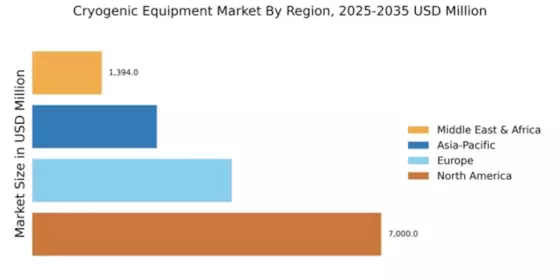
Regional Insights

North America : Market Leader in Cryogenics

North America is poised to maintain its leadership in the cryogenic equipment market, holding a significant share of 6000.0. The region's growth is driven by increasing demand in sectors such as healthcare, aerospace, and energy. Regulatory support for clean energy initiatives and advancements in technology further catalyze market expansion. The presence of major players like Air Products and Chemicals and Linde enhances competitive dynamics, ensuring innovation and efficiency in product offerings. The United States stands out as the leading country in this region, contributing significantly to market growth. The competitive landscape is characterized by key players such as Chart Industries and Praxair, which are investing heavily in R&D to develop advanced cryogenic solutions. The focus on sustainability and energy efficiency is shaping product development, making North America a hub for cutting-edge cryogenic technologies.

Europe : Emerging Market with Growth Potential

Europe is witnessing a robust growth trajectory in the cryogenic equipment market, with a market size of 4000.0. The region benefits from stringent regulations promoting energy efficiency and environmental sustainability, driving demand across various industries, including liquefied natural gas (LNG) and pharmaceuticals. The European Union's commitment to reducing carbon emissions is a significant catalyst for the adoption of cryogenic technologies, enhancing market prospects. Leading countries such as Germany and France are at the forefront of this growth, supported by key players like Messer Group and Herose. The competitive landscape is marked by innovation and collaboration among industry leaders, focusing on developing efficient cryogenic systems. The presence of advanced manufacturing capabilities and a skilled workforce further strengthens Europe's position in The Cryogenic Equipment.

Asia-Pacific : Rapid Growth in Emerging Markets

The Asia-Pacific region is experiencing rapid growth in the cryogenic equipment market, with a market size of 3000.0. This growth is fueled by increasing industrialization, urbanization, and rising demand for energy-efficient solutions. Countries like China and India are investing heavily in infrastructure and energy projects, creating a favorable environment for cryogenic technology adoption. Regulatory frameworks supporting clean energy initiatives are also contributing to market expansion in this region. China is the leading country in the Asia-Pacific market, with significant contributions from local manufacturers and international players. The competitive landscape is evolving, with companies like Cryofab and Advanced Cryogenics focusing on innovation and cost-effective solutions. The presence of a growing number of startups in the region is further enhancing competition, driving advancements in cryogenic technologies.

Middle East and Africa : Emerging Opportunities in Cryogenics

The Middle East and Africa region is gradually emerging in the cryogenic equipment market, with a market size of 1894.0. The growth is primarily driven by increasing investments in the oil and gas sector, where cryogenic technologies are essential for liquefaction processes. Additionally, the region's focus on diversifying its economy and investing in renewable energy projects is creating new opportunities for cryogenic applications. Regulatory support for energy efficiency is also a key driver of market growth. Countries like South Africa and the UAE are leading the way in adopting cryogenic technologies, supported by investments from major players. The competitive landscape is characterized by a mix of established companies and new entrants, focusing on innovative solutions tailored to local market needs. The presence of international firms is enhancing the technological capabilities of the region, fostering growth in the cryogenic sector.

Key Players and Competitive Insights

The Cryogenic Equipment Market is currently characterized by a dynamic competitive landscape, driven by increasing demand across various sectors such as healthcare, aerospace, and energy. Key players are actively engaging in strategies that emphasize innovation, regional expansion, and partnerships to enhance their market positioning. For instance, Linde (DE) has been focusing on expanding its product portfolio and enhancing its service capabilities, which appears to strengthen its competitive edge. Similarly, Air Products and Chemicals (US) is investing in digital transformation initiatives, aiming to optimize operations and improve customer engagement, thereby reinforcing its market presence.

In terms of business tactics, companies are increasingly localizing manufacturing to reduce lead times and enhance supply chain efficiency. The market structure is moderately fragmented, with several players vying for market share. However, the collective influence of major companies like Cryofab (US) and Chart Industries (US) is notable, as they leverage their technological expertise to drive innovation and meet evolving customer needs.

In November 2025, Cryofab (US) announced the launch of a new line of cryogenic storage tanks designed to improve energy efficiency and reduce operational costs. This strategic move is significant as it aligns with the growing emphasis on sustainability within the industry, potentially attracting environmentally conscious customers and enhancing Cryofab's market position. Furthermore, in October 2025, Chart Industries (US) entered into a partnership with a leading renewable energy firm to develop cryogenic energy storage solutions. This collaboration is likely to position Chart Industries at the forefront of the emerging energy storage market, showcasing its commitment to innovation and sustainability.

In September 2025, Messer Group (DE) expanded its production capabilities by investing in a new manufacturing facility in Eastern Europe. This expansion is indicative of Messer's strategy to localize production and cater to the growing demand in the region, thereby enhancing its competitive stance. The facility is expected to streamline operations and reduce costs, which could provide Messer with a significant advantage in pricing and service delivery.

As of December 2025, the competitive trends in the Cryogenic Equipment Market are increasingly defined by digitalization, sustainability, and the integration of AI technologies. Strategic alliances are becoming more prevalent, as companies recognize the need to collaborate to innovate and meet customer demands effectively. The shift from price-based competition to a focus on technological advancement and supply chain reliability is evident, suggesting that future competitive differentiation will hinge on the ability to innovate and adapt to changing market dynamics.

Key Companies in the Cryogenic Equipment Market market include

Industry Developments

  • Q3 2024: Nikkiso Clean Energy & Industrial Gases Group Expands Wurzen, Germany Facility to Meet Growing Demand Nikkiso Clean Energy & Industrial Gases Group announced the expansion of its Wurzen, Germany facility, nearly doubling its capacity to address increasing demand for cryogenic equipment in hydrogen, LNG, and ammonia clean energy projects across Europe.[4]

Future Outlook

Cryogenic Equipment Market Future Outlook

The Cryogenic Equipment Market is projected to grow at a 6.59% CAGR from 2024 to 2035, driven by advancements in technology, increasing demand in healthcare, and expanding industrial applications.

New opportunities lie in:

  • Development of advanced cryogenic storage solutions for pharmaceuticals.
  • Expansion into emerging markets with tailored cryogenic systems.
  • Integration of IoT technology for real-time monitoring of cryogenic processes.

By 2035, the Cryogenic Equipment Market is expected to achieve substantial growth, reflecting evolving industry needs.

Market Segmentation

Cryogenic Equipment Market End Use Outlook

  • Healthcare
  • Aerospace
  • Energy
  • Food and Beverage

Cryogenic Equipment Market Technology Outlook

  • Liquid Nitrogen Technology
  • Helium Technology
  • Cryocooler Technology

Cryogenic Equipment Market Application Outlook

  • Cryogenic Storage
  • Cryogenic Transportation
  • Cryogenic Processing
  • Cryogenic Cooling

Cryogenic Equipment Market Product Type Outlook

  • Cryogenic Tanks
  • Cryogenic Pumps
  • Cryogenic Valves
  • Cryogenic Freezers

Cryogenic Equipment Market Material Type Outlook

  • Stainless Steel
  • Aluminum
  • Copper
  • Composite Materials

Report Scope

MARKET SIZE 202413894.0(USD Million)
MARKET SIZE 202514809.9(USD Million)
MARKET SIZE 203528041.36(USD Million)
COMPOUND ANNUAL GROWTH RATE (CAGR)6.59% (2024 - 2035)
REPORT COVERAGERevenue Forecast, Competitive Landscape, Growth Factors, and Trends
BASE YEAR2024
Market Forecast Period2025 - 2035
Historical Data2019 - 2024
Market Forecast UnitsUSD Million
Key Companies ProfiledLinde (DE), Air Products and Chemicals (US), Cryofab (US), Chart Industries (US), Praxair (US), Messer Group (DE), Herose (DE), Advanced Cryogenics (US), Cryogenic Industries (US)
Segments CoveredApplication, End Use, Product Type, Technology, Material Type
Key Market OpportunitiesAdvancements in superconducting technologies drive demand in the Cryogenic Equipment Market.
Key Market DynamicsTechnological advancements and regulatory changes drive innovation and competition in the Cryogenic Equipment Market.
Countries CoveredNorth America, Europe, APAC, South America, MEA

Market Highlights

Author
Chitranshi Jaiswal
Research Analyst Level I

In her 3 years of experience in the market research field, she has handled critical cross-domain projects. She has an in-depth knowledge of market estimation & analysis, problem-solving, primary as well as secondary research, and team management.She holds an engineering degree and is an MBA professional from a well-known university, capable of evaluating the market and competitive conditions. An exceptional strategist with excellent communication skills and a passion for delivering cutting-edge & practical insights for the market. Proficient in multi-tasking, and can successfully deal with competing demands, while maintaining complete confidentiality. Generated business through active client and project development, networking, and high-quality responses. Her knowledge and skills have helped in making solid business decisions, securing funding from investors, and avoiding business failures.

Leave a Comment

FAQs

How much is the Cryogenic Equipment Market?

The Cryogenic Equipment Market size is expected to be valued at USD 23,150.0 Million in 2032.

What is the growth rate of the Cryogenic Equipment Market?

The global market is projected to grow at a CAGR of 6.59% during the forecast period, 2024-2032.

Which region held the largest market share in the Cryogenic Equipment Market?

Asia Pacific had the largest share of the global market.

Who are the key players in the Cryogenic Equipment Market?

The key players in the market are Chart Industries, Air Liquide, Nikkiso Co., Ltd., Cryofab Inc., Air Products and Chemicals, Inc., INOX India Limited, Parker Hannifin Corp., Flowserve Corporation, Linde plc, SHI Cryogenics Group.

Which product type had the largest market share in the Cryogenic Equipment Market?

Tank segment had the largest revenue share of the global market.

Download Free Sample

Kindly complete the form below to receive a free sample of this Report

Compare Licence

×
Features License Type
Single User Multiuser License Enterprise User
Price $4,950 $5,950 $7,250
Maximum User Access Limit 1 User Upto 10 Users Unrestricted Access Throughout the Organization
Free Customization
Direct Access to Analyst
Deliverable Format
Platform Access
Discount on Next Purchase 10% 15% 15%
Printable Versions