×
Request Free Sample ×

Kindly complete the form below to receive a free sample of this Report

* Please use a valid business email

Leading companies partner with us for data-driven Insights

clients tt-cursor
Hero Background

Multi Layer Cryogenic Insulation Market

ID: MRFR/CnM/9308-HCR
100 Pages
Anshula Mandaokar
October 2025

Multi-Layer Cryogenic Insulation Market Research Report Information By PU & PIR, Cellular Glass, Polystrene, Fiberglass, Perlite, Others) End Use (Energy & Power, Chemicals, Metallurgical, Electronics, Shipping Others) Forecast till 2035

Share:
Download PDF ×

We do not share your information with anyone. However, we may send you emails based on your report interest from time to time. You may contact us at any time to opt-out.

Multi Layer Cryogenic Insulation Market Infographic
Purchase Options

Multi Layer Cryogenic Insulation Market Summary

As per MRFR analysis, the Multi Layer Cryogenic Insulation Market Size was estimated at 9.77 USD Million in 2024. The Multi Layer Cryogenic Insulation industry is projected to grow from 10.49 USD Million in 2025 to 21.35 USD Million by 2035, exhibiting a compound annual growth rate (CAGR) of 7.36 during the forecast period 2025 - 2035.

Key Market Trends & Highlights

The Multi Layer Cryogenic Insulation Market is poised for substantial growth driven by technological advancements and increasing demand across various sectors.

  • North America remains the largest market for multi layer cryogenic insulation, primarily due to its robust aerospace sector.
  • Asia-Pacific is emerging as the fastest-growing region, fueled by rapid industrialization and infrastructure development.
  • The cryogenic storage segment holds the largest market share, while the cryogenic transportation segment is witnessing the fastest growth.
  • Key market drivers include the rising demand in the aerospace sector and the expansion of LNG infrastructure.

Market Size & Forecast

2024 Market Size 9.77 (USD Million)
2035 Market Size 21.35 (USD Million)
CAGR (2025 - 2035) 7.36%

Major Players

Linde AG (DE), Cryofab Inc (US), Insulfoam (US), Aearo Technologies (US), BASF SE (DE), Johns Manville (US), Owens Corning (US), Thermal Insulation (US), KryoTech (US)

Multi Layer Cryogenic Insulation Market Trends

The Multi Layer Cryogenic Insulation Market is currently experiencing a notable evolution, driven by advancements in technology and increasing demand across various sectors. This market encompasses a range of applications, including aerospace, liquefied natural gas, and industrial processes, where maintaining low temperatures is crucial. The materials used in multi-layer insulation systems are designed to minimize heat transfer, thereby enhancing energy efficiency and performance. As industries seek to optimize their operations, the adoption of these insulation solutions appears to be on the rise, reflecting a broader trend towards sustainability and energy conservation. In addition to technological advancements, regulatory frameworks are also influencing the Multi Layer Cryogenic Insulation Market. Governments worldwide are implementing stricter environmental regulations, which may encourage industries to adopt more efficient insulation solutions. This shift not only aligns with global sustainability goals but also promotes innovation within the sector. As the market continues to evolve, stakeholders are likely to explore new materials and methods to enhance insulation performance, potentially leading to a more competitive landscape in the coming years.

Technological Advancements

Recent innovations in materials science are enhancing the performance of multi-layer cryogenic insulation. New composites and manufacturing techniques are being developed, which may improve thermal efficiency and reduce weight, making these solutions more appealing for various applications.

Sustainability Focus

There is a growing emphasis on sustainability within the Multi Layer Cryogenic Insulation Market. Companies are increasingly seeking eco-friendly materials and processes, which could lead to the development of greener insulation solutions that meet both performance and environmental standards.

Regulatory Influences

Government regulations aimed at reducing carbon emissions are likely to impact the Multi Layer Cryogenic Insulation Market. Stricter guidelines may drive industries to adopt advanced insulation technologies, thereby fostering market growth and innovation.

Multi Layer Cryogenic Insulation Market Drivers

Growth in Cryogenic Applications

The expansion of cryogenic applications in sectors like healthcare, aerospace, and energy is propelling the Global Multi-layer cryogenic insulation market Industry forward. For instance, the use of cryogenic technology in medical applications, such as the storage of biological samples, necessitates reliable insulation to maintain low temperatures. Additionally, the aerospace sector increasingly relies on cryogenic fuels, which require robust insulation systems to ensure safety and efficiency. This growing reliance on cryogenic applications is expected to contribute to the market's growth, with projections indicating a rise to 2.11 USD Billion by 2035.

Rising Demand for Energy Efficiency

The Global Multi-layer cryogenic insulation market Industry is experiencing a surge in demand driven by the increasing focus on energy efficiency across various sectors. Industries such as aerospace, liquefied natural gas, and cryogenic storage are adopting advanced insulation technologies to minimize energy losses. This trend is particularly evident as companies seek to comply with stringent energy regulations and reduce operational costs. The market is projected to reach 1.01 USD Billion in 2024, reflecting a growing recognition of the importance of effective insulation solutions in enhancing energy efficiency.

Increasing Investments in LNG Infrastructure

The Global Multi-layer cryogenic insulation market Industry is being bolstered by rising investments in liquefied natural gas (LNG) infrastructure. As countries aim to transition to cleaner energy sources, the demand for LNG is escalating, necessitating advanced insulation solutions for storage and transportation. The construction of new LNG terminals and expansion of existing facilities require effective cryogenic insulation to ensure safety and efficiency. This trend is expected to drive market growth, as investments in LNG infrastructure continue to rise, aligning with global energy transition goals.

Regulatory Support for Cryogenic Technologies

Government regulations promoting the use of cryogenic technologies are playing a crucial role in the Global Multi-layer cryogenic insulation market Industry. Policies aimed at reducing greenhouse gas emissions and enhancing energy efficiency are encouraging industries to adopt advanced insulation solutions. For example, regulations in the energy sector are pushing companies to implement better insulation in cryogenic applications to comply with environmental standards. This regulatory support is likely to foster market growth, as industries seek to align with governmental initiatives and invest in innovative insulation technologies.

Technological Advancements in Insulation Materials

Innovations in insulation materials are significantly influencing the Global Multi-layer cryogenic insulation market Industry. The development of advanced materials, such as aerogels and vacuum insulation panels, enhances thermal performance and reduces weight, making them ideal for cryogenic applications. These technological advancements not only improve insulation efficiency but also expand the range of applications across various industries. As manufacturers continue to invest in research and development, the market is likely to benefit from these innovations, potentially leading to a compound annual growth rate of 6.91% from 2025 to 2035.

Market Segment Insights

By Application: Cryogenic Storage (Largest) vs. Cryogenic Transportation (Fastest-Growing)

In the Multi Layer Cryogenic Insulation Market, the application segments exhibit varying levels of market share, with Cryogenic Storage leading as the largest segment. This dominance can be attributed to the increasing demand for efficient storage solutions across various industries, particularly in energy and manufacturing. Following closely is Cryogenic Transportation, which is rapidly gaining momentum due to rising global trade and the need for temperature-sensitive logistics, contributing significantly to the overall market dynamics.

Cryogenic Storage (Dominant) vs. Cryogenic Transportation (Emerging)

Cryogenic Storage represents a dominant segment in the Multi Layer Cryogenic Insulation Market, characterized by robust utilization in industries needing sustained low temperatures, such as liquefied natural gas (LNG) and liquid oxygen storage. Its established infrastructure, along with technology advancements in insulation materials, reinforces its leadership position. On the other hand, Cryogenic Transportation is emerging as a crucial part of the market, driven by the increasing transport of cryogenic liquids. Innovations in cryogenic tank designs and logistics are propelling growth in this segment, as the need for safe and efficient transit of temperature-sensitive materials becomes essential in global supply chains.

By End Use: Aerospace (Largest) vs. Energy (Fastest-Growing)

In the Multi Layer Cryogenic Insulation Market, the end-use segment reveals a significant distribution of market share among Aerospace, Energy, Industrial, and Medical applications. Aerospace stands out as the largest segment, driven by increasing investments in space exploration and advancements in aircraft technologies. In contrast, the Energy sector is witnessing rapid growth, driven by the rising demand for efficient energy storage solutions and the implementation of renewable energy projects.

Energy (Dominant) vs. Medical (Emerging)

Within the Multi Layer Cryogenic Insulation Market, the Energy segment is emerging as a dominant force, primarily due to the global shift towards renewable energy sources and the need for enhanced efficiency in energy storage systems. Cryogenic insulation plays a vital role in liquefied natural gas (LNG) and hydrogen energy storage. Meanwhile, the Medical segment represents an emerging area, fueled by advancements in medical technologies and innovations in cryogenic preservation for bio-materials. Although currently smaller, its growth potential is significant, as the medical industry increasingly embraces cryogenic solutions for storage and transport.

By Material Type: Polymer (Largest) vs. Composite (Fastest-Growing)

In the Multi Layer Cryogenic Insulation Market, the material type segment is primarily dominated by polymers, which hold the largest share due to their excellent thermal performance and lightweight characteristics. Other materials such as metals, ceramics, and composites also play significant roles but do not match the extensive usability and cost-effectiveness of polymers in various applications, including storage and transportation of cryogenic fluids. Composite materials are emerging as the fastest-growing segment, attributed to their combination of strength and lightweight properties. As industries seek more efficient and effective insulation solutions, the versatility of composite materials is driving their adoption. Innovations in composite manufacturing are offering tailored solutions that meet specific performance criteria, thus positioning them for substantial growth in the coming years.

Polymer (Dominant) vs. Ceramic (Emerging)

Polymer materials, characterized by their advantageous properties such as low density, chemical resistance, and high thermal efficiency, dominate the Multi Layer Cryogenic Insulation Market. Their widespread application in both industrial and commercial sectors underscores their effectiveness in maintaining low temperatures for cryogenic applications. On the other hand, ceramic materials are emerging due to their remarkable thermal stability and robustness at extremely low temperatures. Although currently less prominent than polymers, ceramics are gaining traction in niche applications where high temperature resistance and durability are paramount. Continued advancements in processing and formulations are likely to enhance their performance and expand their market presence.

By Thickness: Medium (Largest) vs. Thin (Fastest-Growing)

The Multi Layer Cryogenic Insulation Market exhibits a distinct distribution of market share among the thickness segments: Thin, Medium, and Thick. Medium thickness insulation currently holds the largest market share, appealing to a broad spectrum of applications due to its balanced properties. Thin insulation, on the other hand, has shown significant growth in recent years, gaining traction among manufacturers seeking lightweight and efficient options, particularly in space-constrained environments. Thick insulation remains important but has a more niche market presence, focusing predominantly on specific industrial uses.

Thickness: Medium (Dominant) vs. Thin (Emerging)

The Medium thickness segment in the Multi Layer Cryogenic Insulation Market is characterized by its versatility and performance, making it the dominant choice for a variety of applications, including transportation and storage of cryogenic liquids. It provides an optimal balance between insulation performance and physical space requirements. Conversely, the Thin thickness segment, though emerging, has quickly gained popularity due to its lightweight and efficient thermal management properties. This segment caters primarily to advanced applications in aerospace and energy sectors, where minimizing weight without compromising thermal efficiency is critical. As technological advancements continue to promote efficiency and innovation, the Thin thickness segment is expected to expand further, capturing interest from a diverse range of end-users.

By Temperature Range: High Temperature (Largest) vs. Low Temperature (Fastest-Growing)

In the Multi Layer Cryogenic Insulation Market, the temperature range segment reveals interesting dynamics. High Temperature insulation leads the market, positioning itself as the largest portion by catering to industrial applications where effective thermal management is crucial. Meanwhile, Low Temperature insulation is emerging as a significant player, capturing increasing attention from various industries seeking enhanced performance in extreme conditions. As industries evolve, the Low Temperature segment is experiencing rapid growth driven by advancements in cryogenic technology and rising demand from sectors such as aerospace and energy production. The need for improved energy efficiency and minimized thermal losses is propelling innovations within this segment. As manufacturers focus on developing more efficient materials, Low Temperature insulation is poised for accelerated adoption in the marketplace.

High Temperature (Dominant) vs. Medium Temperature (Emerging)

The High Temperature segment is currently dominant in the Multi Layer Cryogenic Insulation Market, known for its robust performance in extreme industrial environments. This insulation type is frequently utilized in areas requiring superior thermal management, ensuring that operational efficiency is maintained without compromising safety. On the other hand, the Medium Temperature segment is quickly establishing itself as an emerging choice among manufacturers, appealing especially to industries that balance performance with cost-effectiveness. This segment benefits from the increasing demand for versatile solutions, as it can serve a variety of applications without the extremes of high-temperature requirements. Both segments are critical in their own rights but cater to different market needs, influencing overall trends in the industry.

Get more detailed insights about Multi Layer Cryogenic Insulation Market

Regional Insights

North America : Market Leader in Insulation

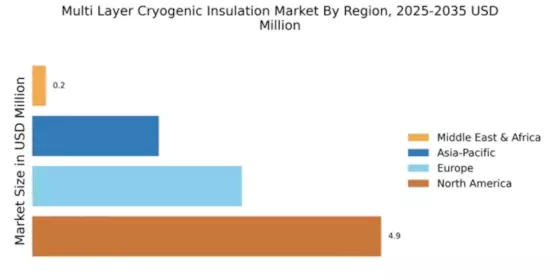
North America is poised to maintain its leadership in the Multi Layer Cryogenic Insulation Market, holding a market size of $4.88 billion in 2025. The region's growth is driven by increasing demand from the aerospace and energy sectors, alongside stringent regulations promoting energy efficiency. The presence of key players like Linde AG and Cryofab Inc further fuels market expansion, supported by technological advancements and innovation in insulation materials. The competitive landscape in North America is robust, with major companies investing heavily in R&D to enhance product performance. The U.S. stands out as the leading country, accounting for a significant share of the market. The focus on sustainable practices and the adoption of advanced insulation technologies are expected to propel growth, ensuring that North America remains at the forefront of the Multi Layer Cryogenic Insulation Market.

Europe : Emerging Market with Potential

Europe is witnessing a growing interest in the Multi Layer Cryogenic Insulation Market, with a market size of $2.93 billion projected for 2025. The region's growth is driven by increasing investments in renewable energy and stringent environmental regulations aimed at reducing carbon emissions. Countries like Germany and France are leading the charge, with policies that encourage the adoption of advanced insulation technologies to enhance energy efficiency in various sectors. The competitive landscape in Europe is characterized by the presence of established players such as BASF SE and Owens Corning. These companies are focusing on innovation and sustainability to capture market share. The European market is also seeing a rise in collaborations and partnerships aimed at developing cutting-edge insulation solutions. As stated by the European Commission, "The transition to a low-carbon economy requires innovative insulation solutions to meet energy efficiency targets."

Asia-Pacific : Rapid Growth and Development

The Asia-Pacific region is emerging as a significant player in the Multi Layer Cryogenic Insulation Market, with a projected market size of $1.77 billion by 2025. The growth is primarily driven by rapid industrialization and increasing demand for energy-efficient solutions in countries like China and India. Government initiatives promoting the use of advanced insulation materials are also contributing to market expansion, alongside rising investments in infrastructure and energy sectors. China is the leading country in this region, with a substantial share of the market, followed by India and Japan. The competitive landscape is evolving, with local manufacturers and international players vying for market share. Companies are focusing on enhancing product offerings and expanding their distribution networks to meet the growing demand for cryogenic insulation solutions. The region's potential for growth is significant, driven by both economic development and regulatory support.

Middle East and Africa : Niche Market with Opportunities

The Middle East and Africa (MEA) region represents a niche market for Multi Layer Cryogenic Insulation, with a market size of $0.19 billion anticipated by 2025. The growth in this region is primarily driven by increasing investments in the oil and gas sector, where cryogenic insulation is essential for maintaining operational efficiency. Additionally, the region's focus on diversifying its economy is leading to greater adoption of advanced insulation technologies in various industries. Countries like the UAE and South Africa are at the forefront of this market, with several projects aimed at enhancing energy efficiency. The competitive landscape is gradually evolving, with both local and international players entering the market. As the region continues to develop its infrastructure and energy sectors, the demand for multi-layer insulation solutions is expected to rise significantly, presenting opportunities for growth and investment.

Key Players and Competitive Insights

The Multi Layer Cryogenic Insulation Market is currently characterized by a dynamic competitive landscape, driven by increasing demand for efficient thermal management solutions across various industries, including aerospace, liquefied natural gas (LNG), and industrial applications. Key players such as Linde AG (DE), Cryofab Inc (US), and BASF SE (DE) are strategically positioning themselves through innovation and partnerships to enhance their market presence. Linde AG (DE) has focused on expanding its product portfolio to include advanced insulation materials, while Cryofab Inc (US) emphasizes technological advancements in manufacturing processes to improve product performance. Collectively, these strategies contribute to a competitive environment that is increasingly focused on sustainability and efficiency.

In terms of business tactics, companies are localizing manufacturing to reduce lead times and optimize supply chains, which is particularly crucial in the context of global supply chain disruptions. The market appears moderately fragmented, with several players vying for market share, yet the influence of major companies remains significant. This competitive structure allows for a diverse range of products and innovations, fostering an environment where companies must continuously adapt to maintain their competitive edge.

In November 2025, Linde AG (DE) announced a strategic partnership with a leading aerospace manufacturer to develop next-generation cryogenic insulation solutions tailored for space applications. This collaboration is expected to leverage Linde's expertise in cryogenics and the aerospace manufacturer's advanced engineering capabilities, potentially leading to breakthroughs in thermal management for space missions. Such partnerships not only enhance product offerings but also position Linde as a leader in specialized applications within the market.

In October 2025, Cryofab Inc (US) launched a new line of multilayer insulation products designed specifically for LNG applications. This product line aims to address the growing demand for efficient insulation solutions in the LNG sector, which is experiencing rapid growth due to the global shift towards cleaner energy sources. The introduction of these products signifies Cryofab's commitment to innovation and responsiveness to market needs, potentially increasing its market share in a competitive landscape.

In September 2025, BASF SE (DE) unveiled a sustainability initiative aimed at reducing the carbon footprint of its insulation materials. This initiative includes the development of bio-based insulation products and the implementation of circular economy principles in its manufacturing processes. By prioritizing sustainability, BASF not only meets regulatory demands but also appeals to environmentally conscious consumers, thereby enhancing its competitive positioning in the market.

As of December 2025, the Multi Layer Cryogenic Insulation Market is witnessing trends such as digitalization and the integration of AI technologies, which are reshaping competitive dynamics. Strategic alliances are becoming increasingly important, as companies recognize the value of collaboration in driving innovation and enhancing supply chain reliability. The competitive differentiation is likely to evolve from traditional price-based competition towards a focus on technological advancements and sustainable practices, indicating a shift in how companies will compete in the future.

Key Companies in the Multi Layer Cryogenic Insulation Market market include

Future Outlook

Multi Layer Cryogenic Insulation Market Future Outlook

The Multi Layer Cryogenic Insulation Market is projected to grow at a 7.36% CAGR from 2024 to 2035, driven by advancements in technology and increasing demand for energy efficiency.

New opportunities lie in:

  • Development of customized insulation solutions for aerospace applications.
  • Expansion into emerging markets with tailored product offerings.
  • Integration of smart technologies for real-time monitoring and performance optimization.

By 2035, the market is expected to achieve robust growth, positioning itself as a leader in energy-efficient insulation solutions.

Market Segmentation

Multi Layer Cryogenic Insulation Market End Use Outlook

  • Aerospace
  • Energy
  • Industrial
  • Medical

Multi Layer Cryogenic Insulation Market Thickness Outlook

  • Thin
  • Medium
  • Thick

Multi Layer Cryogenic Insulation Market Application Outlook

  • Cryogenic Storage
  • Cryogenic Transportation
  • Cryogenic Processing
  • Cryogenic Research

Multi Layer Cryogenic Insulation Market Material Type Outlook

  • Polymer
  • Metal
  • Composite
  • Ceramic

Multi Layer Cryogenic Insulation Market Temperature Range Outlook

  • High Temperature
  • Medium Temperature
  • Low Temperature

Report Scope

MARKET SIZE 20249.77(USD Million)
MARKET SIZE 202510.49(USD Million)
MARKET SIZE 203521.35(USD Million)
COMPOUND ANNUAL GROWTH RATE (CAGR)7.36% (2024 - 2035)
REPORT COVERAGERevenue Forecast, Competitive Landscape, Growth Factors, and Trends
BASE YEAR2024
Market Forecast Period2025 - 2035
Historical Data2019 - 2024
Market Forecast UnitsUSD Million
Key Companies ProfiledLinde AG (DE), Cryofab Inc (US), Insulfoam (US), Aearo Technologies (US), BASF SE (DE), Johns Manville (US), Owens Corning (US), Thermal Insulation (US), KryoTech (US)
Segments CoveredApplication, End Use, Material Type, Thickness, Temperature Range
Key Market OpportunitiesAdvancements in insulation materials enhance efficiency in the Multi Layer Cryogenic Insulation Market.
Key Market DynamicsRising demand for energy-efficient solutions drives innovation in Multi Layer Cryogenic Insulation technologies and applications.
Countries CoveredNorth America, Europe, APAC, South America, MEA

Market Highlights

Author
Anshula Mandaokar
Team Lead - Research

Anshula Mandaokar holds an academic degree in Chemical Engineering and has been contributing to the field for more than 5 years. She has expertise in Market Research and Business Consulting and serves as a Team Lead for a reputed Market Research firm under the Chemicals and Materials domain spectrum. She has worked on multiple projects, generating explicit results in a quick turnaround time. Her understanding of data interpretation justifies her role as a leader.

Leave a Comment

FAQs

What growth rate global Multi-layer cryogenic insulation market would register in the future?

The global Multi-layer cryogenic insulation market would register a growth of 6.70%.

Which industry will play a crucial role in taking the Multi-layer cryogenic insulation market ahead??

The energy & power industry will play a prominent role in taking the market forward.

What is the key restraining factor for the global Multi-layer cryogenic insulation market?

Volatile raw material prices could restrain the market.

Which region would enjoy the upper hand in the Multi-layer cryogenic insulation market?

North America would enjoy the upper hand in the Multi-layer cryogenic insulation market.

Which Asia-Pacific country would set the trend in the Multi-layer cryogenic insulation market?

China, as the largest consumer, would set the trend.

Download Free Sample

Kindly complete the form below to receive a free sample of this Report

Compare Licence

×
Features License Type
Single User Multiuser License Enterprise User
Price $4,950 $5,950 $7,250
Maximum User Access Limit 1 User Upto 10 Users Unrestricted Access Throughout the Organization
Free Customization
Direct Access to Analyst
Deliverable Format
Platform Access
Discount on Next Purchase 10% 15% 15%
Printable Versions