×
Request Free Sample ×

Kindly complete the form below to receive a free sample of this Report

* Please use a valid business email

Leading companies partner with us for data-driven Insights

clients tt-cursor
Hero Background

Multi-layer Security Market

ID: MRFR/SEM/5488-HCR
100 Pages
Ankit Gupta
October 2025

Multi-Layer Security Market Research Report By Application (Network Security, Application Security, Endpoint Security, Data Security), By Deployment Type (On-Premises, Cloud-Based, Hybrid), By Solution (Firewall, Intrusion Detection System, Encryption, Identity and Access Management), By End Use Sector (BFSI, Healthcare, Retail, Government) and By Regional (North America, Europe, South America, Asia Pacific, Middle East and Africa) – Industry Forecast to 2035

Share:
Download PDF ×

We do not share your information with anyone. However, we may send you emails based on your report interest from time to time. You may contact us at any time to opt-out.

Multi-layer Security Market Infographic
Purchase Options

Multi-layer Security Market Summary

As per MRFR analysis, the Multi-Layer Security Market Size was estimated at 40.28 USD Billion in 2024. The Multi-Layer Security industry is projected to grow from 43.3 USD Billion in 2025 to 89.25 USD Billion by 2035, exhibiting a compound annual growth rate (CAGR) of 7.5 during the forecast period 2025 - 2035.

Key Market Trends & Highlights

The Multi-Layer Security Market is poised for substantial growth driven by technological advancements and increasing cyber threats.

  • The integration of Artificial Intelligence is transforming security protocols across various sectors.
  • North America remains the largest market, while Asia-Pacific is emerging as the fastest-growing region in multi-layer security solutions.
  • Network Security continues to dominate the market, whereas Endpoint Security is witnessing rapid growth due to evolving threats.
  • Rising cyber threats and increased regulatory requirements are key drivers propelling the adoption of cloud-based security solutions.

Market Size & Forecast

2024 Market Size 40.28 (USD Billion)
2035 Market Size 89.25 (USD Billion)
CAGR (2025 - 2035) 7.5%

Major Players

Palo Alto Networks (US), Fortinet (US), Cisco Systems (US), Check Point Software Technologies (IL), McAfee (US), Trend Micro (JP), Sophos (GB), Barracuda Networks (US), CyberArk (IL)

Multi-layer Security Market Trends

The Multi-Layer Security Market is currently experiencing a transformative phase, driven by the increasing complexity of cyber threats and the growing need for comprehensive security solutions. Organizations across various sectors are recognizing that a single-layered approach to security is insufficient. As a result, they are adopting multi-layered strategies that integrate various security measures, including firewalls, intrusion detection systems, and advanced threat intelligence. This shift reflects a broader understanding of the necessity for robust protection against evolving threats, which appear to be more sophisticated and persistent than ever before. Moreover, the emphasis on regulatory compliance and data protection is propelling the demand for multi-layer security solutions. Businesses are compelled to adhere to stringent regulations, which often require the implementation of advanced security protocols. This trend is further amplified by the increasing reliance on cloud services and remote work arrangements, necessitating a more layered approach to safeguard sensitive information. As organizations continue to navigate this complex landscape, the Multi-Layer Security Market is poised for sustained growth, with innovations in technology and strategic partnerships likely to shape its future trajectory.

Integration of Artificial Intelligence

The integration of artificial intelligence into multi-layer security solutions is becoming increasingly prevalent. AI technologies enhance threat detection and response capabilities, allowing organizations to identify potential vulnerabilities more effectively. This trend suggests a shift towards automated security measures that can adapt to new threats in real-time, thereby improving overall security posture.

Focus on Regulatory Compliance

A heightened focus on regulatory compliance is influencing the Multi-Layer Security Market. Organizations are prioritizing security measures that align with legal requirements, particularly in sectors such as finance and healthcare. This trend indicates a growing recognition of the importance of adhering to regulations to avoid penalties and protect sensitive data.

Adoption of Cloud-Based Security Solutions

The adoption of cloud-based security solutions is gaining momentum within the Multi-Layer Security Market. As businesses increasingly migrate to cloud environments, there is a corresponding need for security measures that can effectively protect data across multiple layers. This trend highlights the necessity for scalable and flexible security solutions that can adapt to the dynamic nature of cloud computing.

Multi-layer Security Market Drivers

Rising Cyber Threats

The increasing frequency and sophistication of cyber threats is a primary driver for the Multi-Layer Security Market. Organizations are facing a myriad of attacks, including ransomware, phishing, and advanced persistent threats. According to recent data, cybercrime is projected to cost businesses over 10 trillion dollars annually by 2025. This alarming trend compels enterprises to adopt multi-layer security solutions that provide comprehensive protection against various attack vectors. As a result, the demand for advanced security measures is surging, leading to significant growth in the Multi-Layer Security Market. Companies are investing in technologies that offer layered defenses, ensuring that even if one layer is breached, others remain intact. This proactive approach to security is likely to shape the future landscape of the industry.

Shift Towards Remote Work

The shift towards remote work has emerged as a significant driver for the Multi-Layer Security Market. As organizations adapt to flexible work arrangements, the need for secure access to corporate resources has intensified. Remote work environments often expose businesses to various security risks, including unsecured networks and personal devices. Consequently, companies are increasingly investing in multi-layer security solutions to ensure secure remote access and protect sensitive data. The market is witnessing a surge in demand for technologies that facilitate secure connections, such as Virtual Private Networks (VPNs) and multi-factor authentication. This trend is expected to persist, as remote work becomes a permanent fixture in many organizations, thereby driving the growth of the Multi-Layer Security Market.

Growing Adoption of IoT Devices

The proliferation of Internet of Things (IoT) devices is significantly influencing the Multi-Layer Security Market. As more devices become interconnected, the attack surface for cyber threats expands, necessitating enhanced security measures. Research indicates that the number of connected IoT devices is expected to reach 30 billion by 2025, creating a pressing need for multi-layer security solutions that can effectively protect these devices. Organizations are increasingly recognizing the importance of securing their IoT ecosystems, leading to a rise in investments in multi-layer security technologies. This trend not only addresses the vulnerabilities associated with IoT but also fosters consumer trust in connected technologies. Consequently, the Multi-Layer Security Market is likely to experience substantial growth as businesses seek to safeguard their IoT infrastructures.

Increased Regulatory Requirements

The evolving landscape of regulatory requirements is another crucial driver for the Multi-Layer Security Market. Organizations are now mandated to comply with stringent data protection laws, such as the General Data Protection Regulation (GDPR) and the California Consumer Privacy Act (CCPA). These regulations necessitate the implementation of robust security measures to safeguard sensitive information. Failure to comply can result in hefty fines and reputational damage, prompting businesses to invest in multi-layer security solutions. The market is witnessing a surge in demand for compliance-driven security technologies, as organizations seek to mitigate risks associated with non-compliance. This trend is expected to continue, further propelling the growth of the Multi-Layer Security Market as companies prioritize regulatory adherence in their security strategies.

Technological Advancements in Security Solutions

Technological advancements are playing a pivotal role in shaping the Multi-Layer Security Market. Innovations in artificial intelligence, machine learning, and automation are enhancing the capabilities of security solutions, enabling organizations to detect and respond to threats more effectively. The integration of these technologies allows for real-time threat analysis and automated responses, significantly improving security posture. As organizations seek to leverage these advancements, the demand for multi-layer security solutions is expected to rise. Furthermore, the market is witnessing the emergence of next-generation security technologies that offer improved visibility and control over security environments. This trend indicates a shift towards more sophisticated security measures, positioning the Multi-Layer Security Market for continued growth in the coming years.
Market Segment Insights

By Application: Network Security (Largest) vs. Endpoint Security (Fastest-Growing)

In the Multi-Layer Security Market, the application segment is primarily dominated by Network Security, which accounts for the largest share due to its critical role in protecting organizational data and infrastructure. Following closely, Endpoint Security and Application Security are also significant, with Endpoint Security experiencing rapid adoption as organizations increasingly focus on securing user devices against threats. Data Security plays a crucial role but remains smaller in comparison to these two. The growth trends in these segments highlight the evolving landscape of cyber threats and the corresponding increase in awareness among businesses. Network Security enjoys consistent demand as data breaches rise, while Endpoint Security is positioned as the fastest-growing segment due to the surge in remote work and the proliferation of personal devices accessing corporate networks. Application Security and Data Security are adapting by integrating advanced technologies to enhance their offerings.

Network Security (Dominant) vs. Application Security (Emerging)

Network Security stands as the dominant force in the Multi-Layer Security Market, primarily due to its foundational role in safeguarding core infrastructure and data networks from various cyber threats. Its robustness and established technologies make it a preferred choice for enterprises looking to fortify their defenses. On the other hand, Application Security is emerging as a vital component, driven by the increasing need for robust defenses against application-level vulnerabilities, particularly as software development cycles accelerate. Both segments serve unique purposes; Network Security centers around perimeter protection, while Application Security focuses on securing the software itself, thus complementing each other in providing comprehensive security solutions.

By Deployment Type: Cloud-Based (Largest) vs. On-Premises (Fastest-Growing)

In the Multi-Layer Security Market, the distribution of market share among deployment types reveals a significant trend towards Cloud-Based solutions, which have established themselves as the largest segment. This preference is driven largely by the demand for scalable solutions and reduced operational overhead, making Cloud-Based deployments highly favorable among organizations. In contrast, On-Premises solutions, while currently smaller in market share, are seeing rapid adoption, especially in sectors where data security and compliance are paramount, highlighting a diverse market landscape. The growth trends in this segment are underscored by an increasing shift towards remote work and digital transformation initiatives across industries. Organizations are increasingly recognizing the need for flexible and agile security solutions, which has invigorated the adoption of Hybrid models, combining the strengths of both Cloud and On-Premises deployments. This influx is spurred by a growing emphasis on cybersecurity measures and the complexity of modern threats that necessitate multilayered security strategies, further positioning Cloud-Based and Hybrid solutions as vital components of organizational security frameworks.

Deployment Type: Cloud-Based (Dominant) vs. On-Premises (Emerging)

The Cloud-Based deployment type dominates the Multi-Layer Security Market due to its flexibility, scalability, and cost-effectiveness. By enabling organizations to manage security measures without significant capital investments in hardware, Cloud-Based solutions cater to businesses of all sizes, especially startups and small to medium enterprises looking to enhance their security posture. In contrast, On-Premises deployments, while enjoying an emerging status with rapid adoption rates, appeal to organizations that prioritize complete control over their data and security infrastructure. The integration of comprehensive security protocols within On-Premises environments resonates particularly well with industries such as finance and healthcare, where regulatory compliance is critical. Together, these two models represent a multifaceted approach to security, catering to diverse organizational needs and preferences.

By Solution: Firewall (Largest) vs. Encryption (Fastest-Growing)

In the Multi-Layer Security Market, the segment displays a competitive landscape characterized by diverse solutions including Firewall, Intrusion Detection Systems, Encryption, and Identity and Access Management. Currently, Firewalls dominate the market as the largest segment, showcasing a steady demand due to their critical role in network security. In contrast, Encryption is emerging as the fastest-growing solution in the market, driven by increasing data privacy concerns and regulatory requirements across industries.

Firewall (Dominant) vs. Encryption (Emerging)

The Firewall segment stands out as the dominant solution in the Multi-Layer Security Market, primarily due to its proven effectiveness in intercepting unauthorized access and preventing cyber threats. Organizations heavily rely on firewalls to safeguard their networks, offering a robust first line of defense against external attacks. On the other hand, Encryption is gaining momentum as an emerging solution, propelled by advancements in technology and the growing recognition of the importance of data security. With a focus on protecting sensitive information and ensuring privacy, Encryption is quickly becoming a vital component of security strategies, appealing to businesses looking to comply with strict data regulations and mitigate risks associated with data breaches.

By End Use Sector: BFSI (Largest) vs. Healthcare (Fastest-Growing)

The end-use sector for the Multi-Layer Security Market showcases a diverse distribution among its key segments: BFSI, Healthcare, Retail, and Government. BFSI stands out as the largest segment, significantly influencing the market dynamics due to its stringent security requirements and continuous digital transformation. Meanwhile, Healthcare is rapidly gaining traction, driven by the increasing demand for patient data protection and regulatory compliance, fostering a competitive landscape among various providers.

BFSI (Dominant) vs. Healthcare (Emerging)

The BFSI segment is characterized by its robust security protocols that are essential in managing sensitive financial information under regulatory scrutiny. Financial institutions are adopting advanced multi-layer security solutions to mitigate the risks of cyber threats and data breaches, ensuring customer trust and compliance. Conversely, the Healthcare sector, labeled an emerging segment, is witnessing rapid growth as organizations seek to secure electronic health records and patient data against escalating cyber threats. This segment is increasingly investing in security measures prompted by regulatory bodies and the necessity for maintaining patient confidentiality, thus presenting significant growth opportunities for security providers.

Get more detailed insights about Multi-layer Security Market

Regional Insights

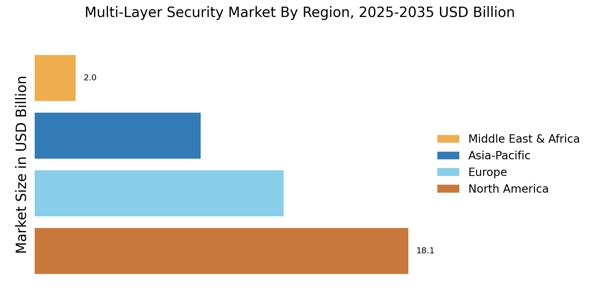
The Multi-Layer Security Market revenue exhibits a robust growth potential across various regions North America dominates this market segment, holding a value of 13.5 USD Billion in 2023, reflecting a majority holding due to advanced technological infrastructure and increasing security threats that compel investments in multi-layer solutions. Europe follows closely, with a value of 10.5 USD Billion, benefiting from stringent regulatory requirements and an emphasis on cybersecurity for both public and private sectors.The APAC region, valued at 10.0 USD Billion, shows significant growth driven by rapid digital transformation and increasing awareness of security among businesses.

In comparison, South America and MEA show lower valuations at 3.0 USD Billion and 3.28 USD Billion, respectively, but these regions represent emerging markets with growing opportunities as they enhance their security frameworks. The diverse Multi-Layer Security Market segmentation underscores the importance of tailoring security solutions to meet specific regional needs, which can drive market growth and further innovation in a landscape marked by evolving threats.

Multi-layer Security Market Regional Image

Key Players and Competitive Insights

The Multi-Layer Security Market has witnessed significant growth as organizations increasingly prioritize cybersecurity amid the evolving threat landscape. Competition in this market is driven by the rising sophistication of cyber-attacks, coupled with the urgency to protect sensitive data and ensure regulatory compliance. Key players are enhancing their product offerings by integrating advanced technologies such as artificial intelligence and machine learning into their security solutions. The focus on multi-layered security systems has led to an emphasis on solutions that provide comprehensive protection across various endpoints, on-premises systems, and cloud infrastructures.

As businesses pursue strategies for digital transformation, the demand for innovative and adaptable security frameworks has intensified, resulting in an ever-changing competitive arena characterized by partnerships, mergers, and acquisitions to secure market position and sustain growth.Cisco Systems enjoys a robust presence within the Multi-Layer Security Market, attributed to its longstanding reputation as a leader in networking and cybersecurity solutions. The company leverages an extensive portfolio of security products, including firewalls, intrusion prevention systems, and cloud-based security offerings designed to address diverse customer needs.

Cisco Systems is recognized for its holistic security approach, which integrates seamlessly with existing network infrastructures and emphasizes threat intelligence sharing. Their strength lies in their ability to provide end-to-end security solutions that cater to organizations of varying sizes, enabling them to mitigate risks effectively.

Additionally, Cisco maintains a strong commitment to research and development, ensuring their technological offerings remain at the forefront of the ever-evolving cybersecurity landscape, which solidifies their competitive advantage in the multi-layer security domain.Zscaler has emerged as a noteworthy competitor in the Multi-Layer Security Market with its cloud-native security platform designed to secure organizations' digital environments efficiently. The company's innovative zero-trust model enables users to maintain secure connections without the need for traditional network security appliances, thus streamlining security processes and enhancing user experience.

Zscaler's strength lies in its ability to provide comprehensive protection for both internal and external threats, aiding organizations in achieving their security objectives regardless of user location or device type. The platform's scalability allows businesses to adapt swiftly to changing requirements and growing user bases while maintaining rigorous security measures. Furthermore, Zscaler's focus on continuous innovation through regular updates and enhancements to its platform ensures that it addresses emerging threats, thereby reinforcing its competitive stance in the dynamic multi-layer security market.

Key Companies in the Multi-layer Security Market market include

Industry Developments

Recent developments in the Multi-Layer Security Market indicate significant advancements and trends among key players. Cisco Systems has been enhancing its security protocols amidst increasing cyber threats, while Zscaler has expanded its cloud security capabilities, catering to remote work environments. Proofpoint continues to innovate in email security solutions, and Fortinet has reported notable growth driven by rising demand for its firewall systems. Palo Alto Networks is actively acquiring new cloud-based technologies to bolster its security offerings. Both CrowdStrike and FireEye are focusing on AI-driven security solutions to counter advanced cyber threats.

Additionally, mergers and acquisitions have marked the landscape, with notable activity among these firms. For instance, recent moves by Check Point Software Technologies to merge with smaller cybersecurity firms showcase their drive toward expansion. The rising market valuation of companies like McAfee and Trend Micro reflects the increasing importance of multi-layer security strategies in protecting against evolving threats. As organizations prioritize robust security measures, the market is witnessing an influx of investments aimed at enhancing overall protection frameworks across various sectors.

Future Outlook

Multi-layer Security Market Future Outlook

The Multi-Layer Security Market is projected to grow at a 7.5% CAGR from 2024 to 2035, driven by increasing cyber threats, regulatory compliance, and technological advancements.

New opportunities lie in:

  • Integration of AI-driven threat detection systems
  • Development of customizable security solutions for SMEs
  • Expansion of managed security service offerings globally

By 2035, the Multi-Layer Security Market is expected to be robust, reflecting substantial growth and innovation.

Market Segmentation

Multi-layer Security Market Solution Outlook

  • Firewall
  • Intrusion Detection System
  • Encryption
  • Identity and Access Management

Multi-layer Security Market Application Outlook

  • Network Security
  • Application Security
  • Endpoint Security
  • Data Security

Multi-layer Security Market End Use Sector Outlook

  • BFSI
  • Healthcare
  • Retail
  • Government

Multi-layer Security Market Deployment Type Outlook

  • On-Premises
  • Cloud-Based
  • Hybrid

Report Scope

MARKET SIZE 202440.28(USD Billion)
MARKET SIZE 202543.3(USD Billion)
MARKET SIZE 203589.25(USD Billion)
COMPOUND ANNUAL GROWTH RATE (CAGR)7.5% (2024 - 2035)
REPORT COVERAGERevenue Forecast, Competitive Landscape, Growth Factors, and Trends
BASE YEAR2024
Market Forecast Period2025 - 2035
Historical Data2019 - 2024
Market Forecast UnitsUSD Billion
Key Companies ProfiledMarket analysis in progress
Segments CoveredMarket segmentation analysis in progress
Key Market OpportunitiesIntegration of artificial intelligence enhances threat detection in the Multi-Layer Security Market.
Key Market DynamicsRising demand for advanced threat detection drives innovation in Multi-Layer Security solutions across various sectors.
Countries CoveredNorth America, Europe, APAC, South America, MEA

Market Highlights

Author
Ankit Gupta
Senior Research Analyst

Ankit Gupta is an analyst in market research industry in ICT and SEMI industry. With post-graduation in "Telecom and Marketing Management" and graduation in "Electronics and Telecommunication" vertical he is well versed with recent development in ICT industry as a whole. Having worked on more than 150+ reports including consultation for fortune 500 companies such as Microsoft and Rio Tinto in identifying solutions with respect to business problems his opinions are inclined towards mixture of technical and managerial aspects.

Leave a Comment

FAQs

What is the projected market valuation of the Multi-Layer Security Market by 2035?

The Multi-Layer Security Market is projected to reach a valuation of 89.25 USD Billion by 2035.

What was the market valuation of the Multi-Layer Security Market in 2024?

In 2024, the market valuation of the Multi-Layer Security Market was 40.28 USD Billion.

What is the expected CAGR for the Multi-Layer Security Market during the forecast period 2025 - 2035?

The expected CAGR for the Multi-Layer Security Market during the forecast period 2025 - 2035 is 7.5%.

Which segment of the Multi-Layer Security Market had the highest valuation in 2024?

In 2024, Endpoint Security had the highest valuation at 12.09 USD Billion.

What are the key players in the Multi-Layer Security Market?

Key players in the Multi-Layer Security Market include Palo Alto Networks, Fortinet, Cisco Systems, and Check Point Software Technologies.

How does the valuation of Cloud-Based deployment compare to On-Premises deployment in 2024?

In 2024, Cloud-Based deployment was valued at 12.0 USD Billion, whereas On-Premises deployment was valued at 15.0 USD Billion.

What is the projected valuation for the Application Security segment by 2035?

The Application Security segment is projected to reach a valuation of 17.75 USD Billion by 2035.

Which end-use sector is expected to show significant growth in the Multi-Layer Security Market?

The Healthcare sector is expected to show significant growth, with a projected valuation of 25.0 USD Billion by 2035.

What was the valuation of the Identity and Access Management solution in 2024?

In 2024, the Identity and Access Management solution was valued at 10.28 USD Billion.

How does the projected growth of the Multi-Layer Security Market reflect on the increasing need for cybersecurity?

The projected growth of the Multi-Layer Security Market indicates a rising demand for robust cybersecurity solutions, driven by increasing threats and vulnerabilities.

Download Free Sample

Kindly complete the form below to receive a free sample of this Report

Compare Licence

×
Features License Type
Single User Multiuser License Enterprise User
Price $4,950 $5,950 $7,250
Maximum User Access Limit 1 User Upto 10 Users Unrestricted Access Throughout the Organization
Free Customization
Direct Access to Analyst
Deliverable Format
Platform Access
Discount on Next Purchase 10% 15% 15%
Printable Versions