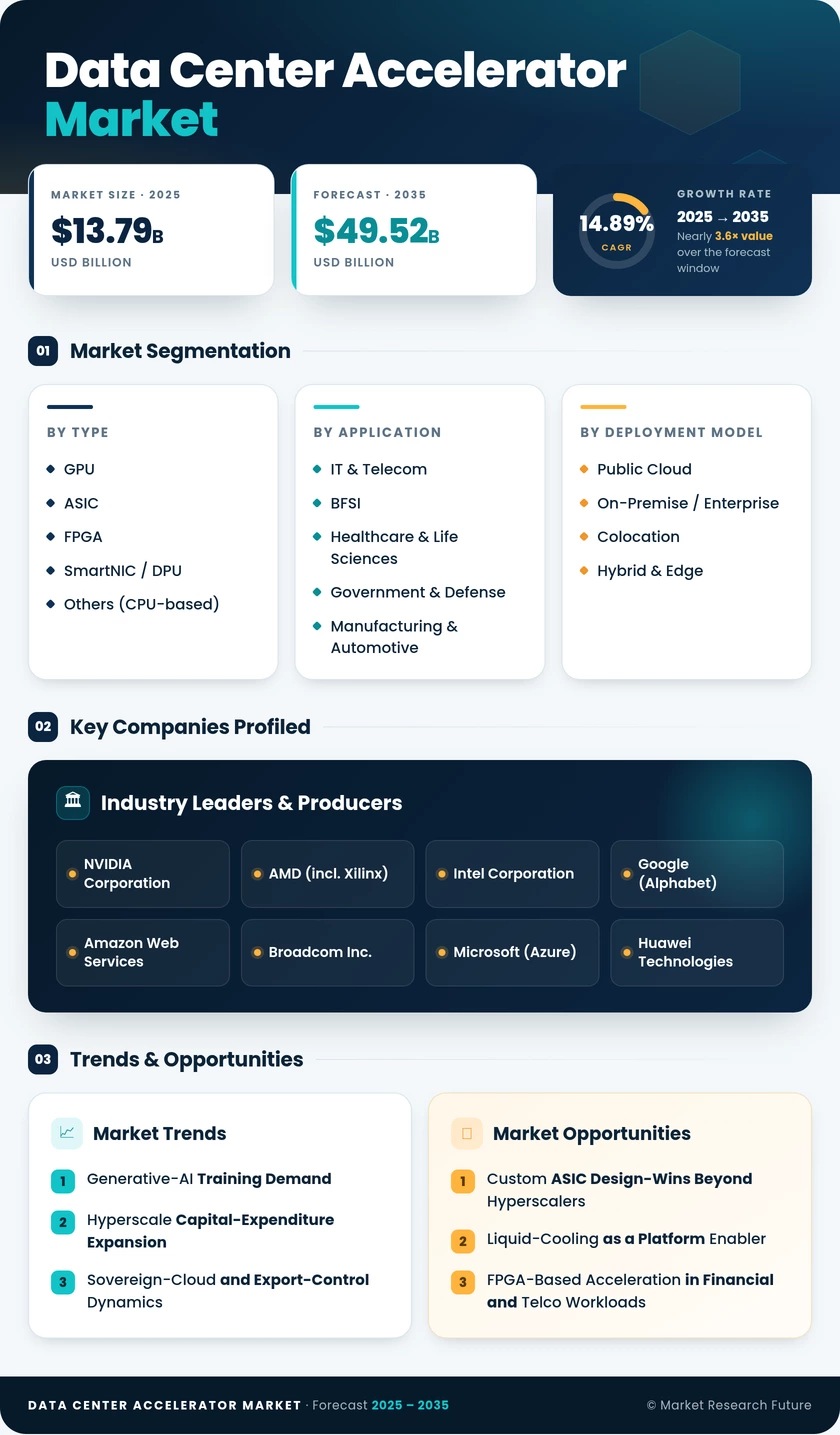
Segmentation Quick Reference
| Dimension | Sub-Segments | Dominant Segment (2025) | Fastest Growing Segment (2026–2035) |
| By Processor Type | GPU, ASIC, FPGA, SmartNIC / DPU, Others (CPU-based) | GPU (~77% share) | SmartNIC / DPU (17.2% CAGR) |
| By Application | AI Training, AI Inference, High-Performance Computing, Data Analytics & Databases | AI Training (~52% share) | AI Inference (16.6% CAGR) |
| By Deployment Model | Public Cloud, On-Premise / Enterprise, Colocation, Hybrid & Edge | Public Cloud (~60% share) | Hybrid & Edge (16.8% CAGR) |
| By End-User Industry | IT & Telecom, BFSI, Healthcare & Data Center Accelerator Market, Government & Defense, Manufacturing & Automotive | IT & Telecom (~41% share) | Healthcare & Data Center Accelerator Market (15.6% CAGR) |
Market Segmentation Overview
By Processor Type
| Sub-Segment | Key Trend |
| GPU | NVIDIA H100/H200 and AMD Instinct MI300X dominate AI training; CUDA ecosystem lock-in sustains GPU primacy |
| ASIC | Google TPU v6, Amazon Trainium2, and Broadcom custom designs drive hyperscaler adoption for cost-optimized inference |
| FPGA | Intel Agilex and AMD-Xilinx Versal target sub-microsecond latency workloads in financial trading and 5G packet processing |
| SmartNIC / DPU | NVIDIA BlueField-3, AMD Pensando, and Intel Mount Evans accelerate infrastructure offloading in bare-metal cloud |
| Others (CPU-based) | Legacy HPC workloads transitioning to heterogeneous compute; declining share as domain-specific silicon gains ground |
GPU accelerators for AI data centers continue to anchor the data center accelerator market, accounting for roughly three-quarters of total revenue in 2025. NVIDIA's decade-long CUDA software advantage creates steep switching costs, though AMD Instinct and Intel Gaudi AI accelerators are making inroads among cost-conscious inference buyers. The fastest growth sits in the SmartNIC / DPU category, where SmartNIC DPU for data center offloading enables hardware-isolated networking and storage virtualization across hyperscale and enterprise deployments. AI inference accelerator ASICs for servers represent the second-fastest segment, as hyperscalers shift custom-silicon budgets from experimental to production-scale volumes.
By Application
| Sub-Segment | Key Trend |
| AI Training | Foundation-model parameter counts doubling every ~10 months; single training runs cost USD 50–100M in compute |
| AI Inference | Generative-AI API proliferation drives sustained demand for low-latency, high-throughput token generation |
| High-Performance Computing | Scientific simulation, weather modeling, and molecular dynamics rely on GPU and FPGA-based acceleration |
| Data Analytics & Databases | Real-time query acceleration and in-database ML push accelerator adoption into enterprise data platforms |
AI training commands the largest share of the data center accelerator market by application, reflecting the capital-intensive nature of large-language-model development. AI inference is the fastest-growing application segment, fueled by billions of daily generative-AI API calls across search, customer service, and content-creation platforms. FPGA-based network acceleration for data centers plays a niche but growing role in HPC and data-analytics workloads that require deterministic latency and reconfigurable compute pipelines.
By Deployment Model
| Sub-Segment | Key Trend |
| Public Cloud | Hyperscaler AI service platforms (AWS, Azure, GCP) consume the majority of accelerator shipments globally |
| On-Premise / Enterprise | Data-sovereignty and regulatory compliance requirements drive private AI infrastructure investments |
| Colocation | Carrier-neutral GPU-as-a-Service offerings expand as mid-market enterprises avoid CapEx-heavy deployments |
| Hybrid & Edge | Real-time inference at edge nodes and distributed training across cloud-edge topologies gain traction |
Public cloud remains the dominant deployment model in the data center accelerator market, with hyperscalers purchasing accelerators at volumes that dwarf enterprise procurement. Hybrid and edge configurations represent the fastest-growing deployment segment, propelled by latency-sensitive AI inference use cases in autonomous vehicles, retail analytics, and industrial IoT. Colocation providers are differentiating through pre-provisioned GPU clusters and liquid-cooling-ready cabinets, lowering the barrier for enterprises seeking accelerator capacity without facility buildouts.
By End-User Industry
| Sub-Segment | Key Trend |
| IT & Telecom | Cloud service providers and telecom operators anchor accelerator demand for AI workloads and 5G core processing |
| BFSI | Fraud detection, algorithmic trading, and risk modeling drive GPU and FPGA adoption in financial institutions |
| Healthcare & Data Center Accelerator Market | Drug discovery, genomics, and medical imaging AI create high-growth demand for inference-optimized accelerators |
| Government & Defense | Sovereign AI programs and intelligence analytics fuel classified-environment accelerator deployments |
| Manufacturing & Automotive | Autonomous-driving simulation, digital-twin modeling, and predictive maintenance drive industrial adoption |
IT and telecom holds the largest industry share in the data center accelerator market, a position underpinned by cloud service provider infrastructure buildouts that consume the majority of GPU and ASIC shipments. Healthcare and life sciences is the fastest-growing end-user vertical, as AI-powered drug discovery pipelines and medical imaging models demand dedicated inference capacity. Government and defense spending is accelerating in parallel, with sovereign AI initiatives in the U.S., EU, and Asia-Pacific channeling classified-infrastructure budgets toward domestically manufactured accelerators.