Download Free Sample
Kindly complete the form below to receive a free sample of this Report
Data Center Cooling Systems MRO Services Market Research Report By End Use (Colocation Data Centers, Enterprise Data Centers, Cloud Service Providers, Telecommunication Data Centers), By Application (Chilled Water Systems, Direct Expansion Systems, Evaporative Cooling Systems, Liquid Cooling Systems), By System Type (Modular Cooling Systems, In-Row Cooling Systems, Overhead Cooling Systems, Rack-Mounted Cooling Systems), By Service Type (Maintenance Services, Repair Services, Installation Services, Consultation Services), By Cooling Technology (Air Cooling Technology, Liquid Cooling Technology, Hybrid Cooling Technology) And By Region (North America, Europe, Asia-Pacific, And Rest Of The World) – Market Forecast Till 2035.
As per MRFR analysis, the Data Center Cooling Systems MRO Services Market was estimated at 18.5 USD Billion in 2024. The Data Center Cooling Systems MRO Services industry is projected to grow from 19.37 USD Billion in 2025 to 30.7 USD Billion by 2035, exhibiting a compound annual growth rate (CAGR) of 4.71% during the forecast period 2025 - 2035.
The Data Center Cooling Systems MRO Services Market is experiencing a transformative shift towards sustainability and advanced technologies.
| 2024 Market Size | 18.5 (USD Billion) |
| 2035 Market Size | 30.7 (USD Billion) |
| CAGR (2025 - 2035) | 4.71% |
Schneider Electric (FR), Vertiv (US), Emerson Electric (US), Rittal (DE), Airedale International (GB), Stulz (DE), CoolIT Systems (CA), Mitsubishi Electric (JP), Daikin Industries (JP)
Our Impact
Enabled $4.3B Revenue Impact for Fortune 500 and Leading Multinationals
Partnering with 2000+ Global Organizations Each Year
30K+ Citations by Top-Tier Firms in the Industry
The Data Center Cooling Systems MRO Services Market is currently experiencing a transformative phase, driven by the increasing demand for efficient cooling solutions in data centers. As organizations continue to expand their digital infrastructure, the need for reliable maintenance, repair, and operations services becomes paramount. This market appears to be influenced by several factors, including the rising energy costs and the growing emphasis on sustainability. Companies are likely to seek innovative cooling technologies that not only enhance performance but also reduce environmental impact. Furthermore, the integration of advanced monitoring systems and automation in cooling processes suggests a shift towards more intelligent and responsive solutions. In addition, the competitive landscape of the Data Center Cooling Systems MRO Services Market is evolving, with numerous players striving to differentiate their offerings. Collaboration between technology providers and service companies may emerge as a strategy to enhance service delivery and customer satisfaction. The focus on predictive maintenance and real-time monitoring indicates a trend towards proactive rather than reactive approaches in managing cooling systems. Overall, the market seems poised for growth, driven by technological advancements and an increasing awareness of the importance of efficient cooling in maintaining optimal data center operations.
The Data Center Cooling Systems MRO Services Market is witnessing a notable shift towards sustainability. Companies are increasingly prioritizing eco-friendly cooling solutions that minimize energy consumption and reduce carbon footprints. This trend reflects a broader commitment to environmental responsibility, as organizations seek to align their operations with global sustainability goals.
Rapid advancements in technology are reshaping the Data Center Cooling Systems MRO Services Market. Innovations such as AI-driven monitoring systems and smart cooling solutions are becoming more prevalent. These technologies enhance operational efficiency and enable predictive maintenance, allowing organizations to optimize their cooling systems effectively.
There is a growing demand for automation within the Data Center Cooling Systems MRO Services Market. Organizations are recognizing the benefits of automated cooling management systems, which streamline operations and improve response times. This trend suggests a movement towards more integrated and efficient cooling solutions that can adapt to changing conditions.
The rising operational costs associated with data center management are influencing the Data Center Cooling Systems MRO Services Market. As energy prices continue to climb, data center operators are compelled to seek more efficient cooling solutions to mitigate expenses. This economic pressure drives the need for MRO services that can optimize existing cooling systems and implement cost-effective upgrades. Market data suggests that operational costs for data centers could increase by as much as 25% over the next few years if energy efficiency is not addressed. Consequently, MRO service providers that can deliver effective solutions to reduce these costs will likely find a growing customer base.
The proliferation of data centers is a key driver for the Data Center Cooling Systems MRO Services Market. As businesses increasingly rely on digital infrastructure, the number of data centers continues to rise. This expansion necessitates efficient cooling systems to manage heat generated by high-density computing environments. According to industry reports, the number of data centers is expected to increase by approximately 20% over the next five years. Consequently, the demand for MRO services that ensure optimal performance and reliability of cooling systems is likely to surge. Service providers that can deliver timely maintenance and upgrades will find ample opportunities in this expanding market.
Sustainability has become a central theme in the Data Center Cooling Systems MRO Services Market. Companies are increasingly prioritizing eco-friendly practices, leading to a demand for cooling solutions that minimize carbon footprints. This shift is driven by both regulatory pressures and consumer expectations for greener operations. MRO services that focus on retrofitting existing cooling systems to improve energy efficiency and reduce waste are likely to see heightened demand. The market for sustainable cooling solutions is projected to grow, with estimates indicating a potential increase of 15% in the next few years. This trend presents a significant opportunity for MRO service providers to align their offerings with sustainability initiatives.
The Data Center Cooling Systems MRO Services Market is experiencing a notable shift towards enhanced energy efficiency standards. Regulatory bodies are increasingly mandating stricter energy consumption guidelines for data centers, compelling operators to invest in advanced cooling solutions. This trend is driven by the need to reduce operational costs and minimize environmental impact. As a result, MRO services that focus on optimizing cooling systems are in high demand. The market for energy-efficient cooling solutions is projected to grow significantly, with estimates suggesting a compound annual growth rate of over 10% in the coming years. This growth indicates a robust opportunity for MRO service providers to offer innovative solutions that align with these evolving standards.
Technological advancements are reshaping the Data Center Cooling Systems MRO Services Market. Innovations such as liquid cooling, immersion cooling, and AI-driven monitoring systems are gaining traction. These technologies not only enhance cooling efficiency but also reduce energy consumption, aligning with sustainability goals. The integration of smart technologies allows for real-time monitoring and predictive maintenance, which can significantly lower operational costs. Market analysts project that the adoption of these advanced cooling solutions will lead to a substantial increase in MRO service demand, as operators seek to maintain and upgrade their systems to leverage these innovations.
The Data Center Cooling Systems MRO Services Market is characterized by a competitive landscape among various cooling applications. Chilled Water Systems hold the largest market share, leveraging their energy efficiency and effectiveness in large-scale operations. Meanwhile, both Direct Expansion and Evaporative Cooling Systems maintain significant positions, utilizing distinct cooling methods suitable for diverse environments. The growth in data centers has propelled demand across these segments, each catering to specific cooling needs in various setups. Looking towards the future, Liquid Cooling Systems are the fastest-growing segment in the market, driven by advancements in technology and the increasing demand for efficient cooling solutions in high-density data center configurations. Factors such as rising energy costs and stringent environmental regulations are encouraging operators to adopt more efficient cooling technologies. The overall trend indicates a shift towards integrated cooling systems that optimize performance while reducing environmental impact.
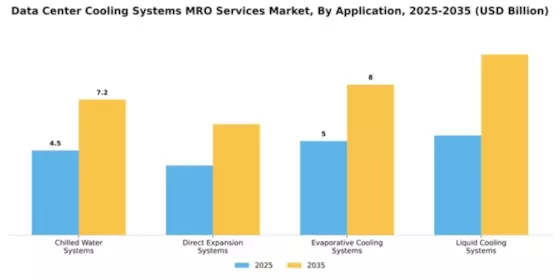
Chilled Water Systems (Dominant) vs. Liquid Cooling Systems (Emerging)
Chilled Water Systems are recognized as the dominant application in the Data Center Cooling Systems MRO Services market, primarily due to their reliable performance and scalability for large data center operations. These systems utilize chilled water to efficiently absorb heat generated by IT equipment, making them ideal for environments with high thermal loads. On the other hand, Liquid Cooling Systems have emerged as a compelling alternative, particularly in high-density configurations where traditional air cooling methods may fall short. Their rapid growth is attributed to their ability to provide effective heat removal while minimizing energy consumption. Both systems cater to distinct customer needs, with Chilled Water Systems preferred for larger installations, while Liquid Cooling Systems are appealing for facilities aiming for energy efficiency and reduced footprint.
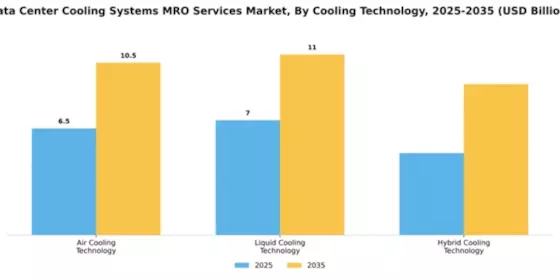
In the Data Center Cooling Systems MRO Services Market, the market share distribution is notably driven by end use applications. Colocation Data Centers lead the segment with a significant share, attributed to their growing importance in hosting services for multiple clients. Meanwhile, Cloud Service Providers are rapidly expanding their share, reflecting the rising adoption of cloud technologies across various industries. Telecommunication Data Centers and Enterprise Data Centers also play key roles, but they are comparatively smaller in market share than the aforementioned segments. Growth trends in this segment are heavily influenced by technological advancements and increased demand for efficient cooling solutions. Colocation Data Centers benefit from the rising need for shared facilities, while Cloud Service Providers experience rapid growth due to the surge in data traffic and digital transformation initiatives. The evolution of industry standards and government regulations promoting energy-efficient cooling solutions further drive innovations and investments in these segments, positioning them for substantial growth in the coming years.
Colocation Data Centers (Dominant) vs. Telecommunication Data Centers (Emerging)
Colocation Data Centers stand as the dominant segment within the Data Center Cooling Systems MRO Services Market, driven by their ability to house servers from multiple clients while simultaneously managing efficient cooling. Their reliance on innovative cooling technologies helps reduce operational costs and energy consumption. Telecommunication Data Centers, emerging as vital players in this market, serve specific needs tied to communication networks and enhanced connectivity. They differ from colocation data centers in their operational focus and equipment demands but still require advanced cooling solutions to manage the heat generated from dense networking equipment. As the telecommunications sector grows in response to increased data usage and 5G deployment, the need for effective cooling solutions in telecommunication data centers is expected to rise significantly.
In the Data Center Cooling Systems MRO Services market, maintenance services hold a considerable share, owing to the need for consistent operational efficiency and reliability in cooling systems. This segment encompasses planned and preventative maintenance practices that are essential for ensuring system longevity and performance. Installation services, meanwhile, represent a dynamic growth area as data centers increasingly invest in technologically advanced cooling solutions to boost energy efficiency and meet regulatory standards. Together, these services shape the overall functional capabilities of data centers.
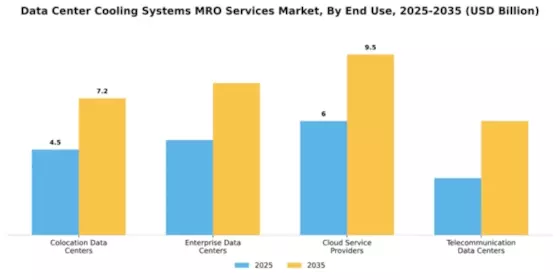
Maintenance Services: Dominant vs. Installation Services: Emerging
Maintenance services play a crucial role in the Data Center Cooling Systems MRO Services Market, marked by their established dominance and vital contribution to system reliability. These services are characterized by routine checks, regular upkeep, and emergency repairs that help prevent system failures. In contrast, installation services are emerging rapidly, driven by the increasing need for innovative cooling technologies in new data center constructions. This segment is characterized by services that emphasize efficient operation and sustainable practices, positioning them as a vital aspect of future advancements in cooling infrastructure.
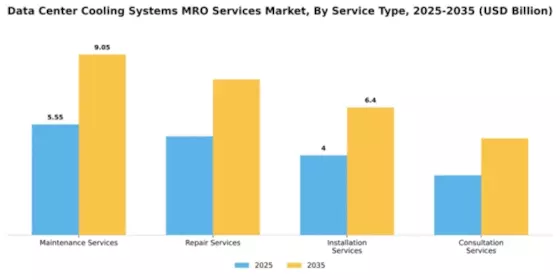
The Data Center Cooling Systems MRO Services Market showcases a dynamic distribution of market share across different cooling technologies. Air Cooling Technology continues to dominate the landscape, leveraging its simplicity and cost-effectiveness. In contrast, Liquid Cooling Technology is gaining prominence, catering to the growing needs of high-density servers, thus carving out a significant market portion for itself.
Air Cooling Technology (Dominant) vs. Liquid Cooling Technology (Emerging)
Air Cooling Technology remains the backbone of cooling solutions in data centers due to its established infrastructure and efficiency in traditional settings. Many facility managers prefer this method for its reliable performance and lower initial investment. On the other hand, Liquid Cooling Technology is emerging rapidly in response to increasing demands for energy efficiency and performance. With the rise of high-performance computing and the complexity of data processing, liquid cooling solutions are becoming pivotal, equipped to handle higher heat loads which air systems cannot efficiently manage.
In the Data Center Cooling Systems MRO Services Market, Modular Cooling Systems hold the largest market share. This is attributed to their scalability, ease of installation, and the rising need for efficient cooling solutions in growing data centers. Conversely, In-Row Cooling Systems are gaining traction and emerging as the fastest-growing segment due to their ability to provide precise cooling where it is needed most, thereby enhancing energy efficiency and optimizing performance. The growth trends in this segment are driven largely by the increasing demand for more energy-efficient cooling systems MRO and advancements in cooling technologies. Modular systems enable data centers to expand without significant infrastructure modifications, while In-Row solutions are favored for their compact design and effectiveness in managing hotspots. Companies are increasingly investing in these technologies as they strive for operational efficiency and lower energy costs, which further fuels the competition between these cooling methods.
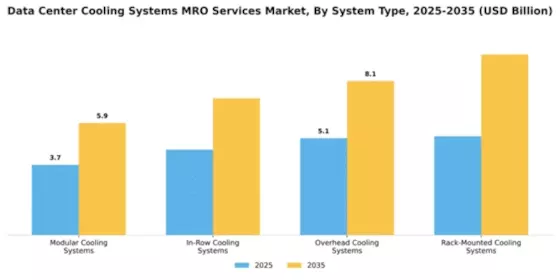
Modular Cooling Systems (Dominant) vs. Rack-Mounted Cooling Systems (Emerging)
Modular Cooling Systems are characterized by their flexibility and capacity to adapt to varying workloads, making them a dominant force in the Data Center Cooling Systems MRO Services Market. These systems can be implemented quickly and scaled efficiently, aligning well with the rapid expansion of data centers. In contrast, Rack-Mounted Cooling Systems are seen as an emerging solution, particularly in environments where space is at a premium. These systems are designed to fit within the data center racks themselves, offering localized cooling without occupying additional floor space. While not as widely adopted as modular systems, they are gaining popularity due to their ability to address specific cooling needs and their lower upfront installation costs.
Get more detailed insights about Data Center Cooling Systems MRO Services Market Request Free Sample
North America leads the Data Center Cooling Systems MRO Services Market, holding a significant share of 9.25 billion. The region's growth is driven by the increasing demand for efficient cooling solutions due to the rising number of data centers and stringent regulations on energy efficiency. Additionally, advancements in technology and the push for sustainable practices are further propelling market expansion. The competitive landscape is robust, with key players like Schneider Electric, Vertiv, and Emerson Electric dominating the market. The U.S. is the primary contributor, supported by a strong infrastructure and investment in data center facilities. The presence of major companies ensures continuous innovation and improvement in cooling technologies, solidifying North America's position as a market leader.
Europe's Data Center Cooling Systems MRO Services Market is valued at 4.8 billion, reflecting a growing demand for advanced cooling solutions. The region is witnessing a surge in data center establishments, driven by digital transformation and the need for energy-efficient systems. Regulatory frameworks promoting sustainability and energy efficiency are also significant growth catalysts, encouraging investments in innovative cooling technologies. Leading countries like Germany, the UK, and France are at the forefront of this market, with a competitive landscape featuring companies such as Rittal and Airedale International. The European market is characterized by a focus on eco-friendly solutions, with key players adapting to regulatory demands and consumer preferences for sustainable practices. The European Commission emphasizes the importance of energy efficiency in data centers, stating that "energy efficiency is crucial for achieving climate goals."
The Asia-Pacific region is experiencing rapid growth in the Data Center Cooling Systems MRO Services Market, valued at 3.5 billion. This growth is fueled by the increasing digitalization and the expansion of cloud services across countries like China, India, and Japan. The demand for efficient cooling solutions is rising as data centers proliferate, driven by the need for reliable and energy-efficient operations. Regulatory support for energy conservation is also a key factor in this growth. China and Japan are leading the market, with significant investments in data center infrastructure. Companies like Mitsubishi Electric and Daikin Industries are prominent players, focusing on innovative cooling technologies. The competitive landscape is evolving, with local and international firms vying for market share, ensuring a dynamic environment for growth and development in the region.
The Middle East and Africa region is valued at 1.95 billion in the Data Center Cooling Systems MRO Services Market, showcasing potential for growth despite unique challenges. The increasing demand for data centers, driven by digital transformation and cloud computing, is a significant growth driver. However, the region faces challenges such as high energy costs and regulatory hurdles that can impact market expansion. Countries like the UAE and South Africa are leading the way, with investments in data center infrastructure. The competitive landscape includes both local and international players, focusing on innovative cooling solutions tailored to the region's climate. The market is evolving, with a growing emphasis on energy-efficient technologies to address environmental concerns and regulatory requirements.
The Data Center Cooling Systems MRO Services Market is currently characterized by a dynamic competitive landscape, driven by the increasing demand for efficient cooling solutions in data centers. Key players are focusing on innovation, sustainability, and digital transformation to enhance their market positions. Companies such as Schneider Electric (FR), Vertiv (US), and Emerson Electric (US) are at the forefront, leveraging their technological expertise and extensive service networks to cater to the evolving needs of data center operators. Schneider Electric (FR) emphasizes its commitment to sustainability and energy efficiency, while Vertiv (US) focuses on enhancing its service offerings through strategic partnerships and acquisitions, thereby shaping a competitive environment that prioritizes advanced cooling technologies and operational efficiency.In terms of business tactics, companies are increasingly localizing manufacturing and optimizing supply chains to respond swiftly to market demands. The market structure appears moderately fragmented, with several players vying for market share. However, the collective influence of major companies like Rittal (DE) and Airedale International (GB) is notable, as they contribute to a competitive atmosphere that encourages innovation and responsiveness to customer needs.In November Schneider Electric (FR) announced a partnership with a leading cloud service provider to develop a new line of energy-efficient cooling solutions tailored for hyperscale data centers. This strategic move is likely to enhance Schneider's market presence and align with the growing trend towards sustainable data center operations. The collaboration underscores the importance of integrating advanced cooling technologies with cloud infrastructure, potentially setting a new standard in the industry.In October Vertiv (US) launched a new AI-driven cooling management system designed to optimize energy consumption in data centers. This initiative reflects Vertiv's commitment to leveraging artificial intelligence to enhance operational efficiency and reduce costs for clients. The introduction of such innovative solutions may position Vertiv as a leader in the market, particularly as data centers increasingly seek to minimize their environmental impact while maximizing performance.In September Emerson Electric (US) expanded its service capabilities by acquiring a regional cooling solutions provider. This acquisition is expected to bolster Emerson's service portfolio and enhance its ability to deliver comprehensive MRO services across various regions. By integrating local expertise with its global reach, Emerson is likely to strengthen its competitive edge in the market, catering to the specific needs of diverse customer segments.As of December the competitive trends in the Data Center Cooling Systems MRO Services Market are increasingly defined by digitalization, sustainability, and the integration of AI technologies. Strategic alliances are becoming more prevalent, as companies recognize the value of collaboration in driving innovation and enhancing service delivery. The shift from price-based competition to a focus on technological advancement and supply chain reliability is evident, suggesting that future competitive differentiation will hinge on the ability to innovate and adapt to the rapidly changing landscape.
The Data Center Cooling Systems MRO Services Market is projected to grow at a 4.71% CAGR from 2025 to 2035, driven by increasing data center demands and energy efficiency regulations.
New opportunities lie in:
By 2035, the market is expected to be robust, driven by innovation and sustainability initiatives.
| MARKET SIZE 2024 | 18.5(USD Billion) |
| MARKET SIZE 2025 | 19.37(USD Billion) |
| MARKET SIZE 2035 | 30.7(USD Billion) |
| COMPOUND ANNUAL GROWTH RATE (CAGR) | 4.71% (2025 - 2035) |
| REPORT COVERAGE | Revenue Forecast, Competitive Landscape, Growth Factors, and Trends |
| BASE YEAR | 2024 |
| Market Forecast Period | 2025 - 2035 |
| Historical Data | 2019 - 2024 |
| Market Forecast Units | USD Billion |
| Key Companies Profiled | Schneider Electric (FR), Vertiv (US), Emerson Electric (US), Rittal (DE), Airedale International (GB), Stulz (DE), CoolIT Systems (CA), Mitsubishi Electric (JP), Daikin Industries (JP) |
| Segments Covered | Application, End Use, Service Type, Cooling Technology, System Type |
| Key Market Opportunities | Integration of advanced cooling technologies enhances efficiency in the Data Center Cooling Systems MRO Services Market. |
| Key Market Dynamics | Rising demand for energy-efficient cooling solutions drives innovation and competition in Data Center Cooling Systems MRO Services. |
| Countries Covered | North America, Europe, APAC, South America, MEA |
The projected market valuation is expected to reach 30.7 USD Billion by 2035.
The overall market valuation was 18.5 USD Billion in 2024.
The expected CAGR for the market during this period is 4.71%.
Key players include Schneider Electric, Vertiv, Emerson Electric, Rittal, and Airedale International.
Chilled Water Systems are projected to generate revenues of 7.2 USD Billion by 2035.
Liquid Cooling Systems are expected to be valued at 9.6 USD Billion by 2035.
Maintenance Services are anticipated to reach revenues of 9.05 USD Billion by 2035.
The market size for Cloud Service Providers is expected to reach 9.5 USD Billion by 2035.
Air Cooling Technology is projected to generate revenues of 10.5 USD Billion by 2035.
Modular Cooling Systems are expected to be valued at 5.9 USD Billion by 2035.



Kindly complete the form below to receive a free sample of this Report

“This is really good guys. Excellent work on a tight deadline. I will continue to use you going forward and recommend you to others. Nice job”


“Thanks. It’s been a pleasure working with you, please use me as reference with any other Intel employees.”


“Thanks for sending the report it gives us a good global view of the Betaïne market.”


“Thank you, this will be very helpful for OQS.”


“We found the report very insightful! we found your research firm very helpful. I'm sending this email to secure our future business.”


“I am very pleased with how market segments have been defined in a relevant way for my purposes (such as "Portable Freezers & refrigerators" and "last-mile"). In general the report is well structured. Thanks very much for your efforts.”


“I have been reading the first document or the study, ,the Global HVAC and FP market report 2021 till 2026. Must say, good info! I have not gone in depth at all parts, but got a good indication of the data inside!”


“We got the report in time, we really thank you for your support in this process. I also thank to all of your team as they did a great job.”


“The Automotive 48V ECU Components Procurement Intelligence Study” was a complex project, but the Market Research Future (MRFR) team handled it with quality, agility, and customer-centricity. They delivered all requested data on time and within the agreed scope. The team, including Shubhendra Anand and Rahul Gotadki, was always readily available to clarify questions and swiftly implement necessary adjustments, driving the project to a successful conclusion within a very demanding timeframe.
I would also like to specifically commend Akshay Agarwal for his responsiveness and support at every stage—from our initial inquiry on May 6th through to final delivery on June 18th. His dedication made the entire process seamless.”



