×
Request Free Sample ×

Kindly complete the form below to receive a free sample of this Report

* Please use a valid business email

Leading companies partner with us for data-driven Insights

clients tt-cursor
Hero Background

Data Center Service Market

ID: MRFR/ICT/1857-HCR
100 Pages
Aarti Dhapte
October 2025

Data Center Service Market Research Report: By Service Type (Cloud Services, Colocation Services, Managed Services, Professional Services), By End User (Small and Medium Enterprises, Large Enterprises, Government Organizations, Telecommunication Providers), By Deployment Type (On-Premises, Off-Premises, Hybrid), By Location Type (Data Centers, Edge Data Centers, Micro Data Centers) and By Regional (North America, Europe, South America, Asia Pacific, Middle East and Africa) - Forecast to 2035.

Share:
Download PDF ×

We do not share your information with anyone. However, we may send you emails based on your report interest from time to time. You may contact us at any time to opt-out.

Data Center Service Market Infographic
Purchase Options

Data Center Service Market Summary

As per MRFR analysis, the Data Center Service Market was estimated at 117027.97 USD Billion in 2024. The Data Center Service industry is projected to grow from 137709.18 USD Billion in 2025 to 700963.07 USD Billion by 2035, exhibiting a compound annual growth rate (CAGR) of 17.67 during the forecast period 2025 - 2035.

Key Market Trends & Highlights

The Data Center Service Market is poised for robust growth driven by technological advancements and evolving consumer demands.

  • Cloud migration continues to accelerate, particularly in North America, as businesses seek scalable solutions.
  • The integration of AI and automation is transforming service delivery, enhancing efficiency across the Asia-Pacific region.
  • Sustainability initiatives are gaining traction, with companies increasingly prioritizing eco-friendly data center operations.
  • Rising demand for data storage and the growth of e-commerce are key drivers propelling the market forward.

Market Size & Forecast

2024 Market Size 117027.97 (USD Billion)
2035 Market Size 700963.07 (USD Billion)
CAGR (2025 - 2035) 17.67%

Major Players

Amazon Web Services (US), Microsoft Azure (US), Google Cloud (US), IBM (US), Alibaba Cloud (CN), Oracle (US), DigitalOcean (US), Equinix (US), NTT Communications (JP)

Data Center Service Market Trends

The Data Center Service Market is currently experiencing a transformative phase, driven by the increasing demand for cloud computing and digital services. Organizations are progressively migrating their operations to cloud-based platforms, which necessitates robust data center solutions. This shift appears to be fueled by the need for enhanced scalability, flexibility, and cost efficiency. As businesses seek to optimize their IT infrastructure, the reliance on data centers for storage, processing, and management of vast amounts of data is becoming more pronounced. Furthermore, the growing emphasis on data security and compliance is prompting companies to invest in advanced data center services that ensure the protection of sensitive information. In addition, the Data Center Service Market is witnessing a surge in the adoption of innovative technologies such as artificial intelligence and machine learning. These advancements are likely to enhance operational efficiency and improve resource management within data centers. Moreover, the increasing focus on sustainability and energy efficiency is shaping the market landscape, as organizations strive to reduce their carbon footprint. Consequently, service providers are exploring eco-friendly solutions and energy-efficient designs to meet the evolving demands of their clients. Overall, the Data Center Service Market appears poised for continued growth, driven by technological advancements and changing business needs.

Cloud Migration Acceleration

The trend of migrating to cloud-based solutions is gaining momentum, as businesses seek to leverage the benefits of scalability and flexibility. This shift is prompting data center service providers to enhance their offerings to accommodate the growing demand for cloud services.

Integration of AI and Automation

The incorporation of artificial intelligence and automation technologies is transforming operations within data centers. This trend suggests that service providers are increasingly focusing on optimizing resource management and improving operational efficiency through intelligent systems.

Sustainability Initiatives

There is a notable emphasis on sustainability within the Data Center Service Market. Organizations are prioritizing energy-efficient solutions and eco-friendly practices, indicating a shift towards greener operations and a commitment to reducing environmental impact.

Data Center Service Market Drivers

Sustainability Initiatives

Sustainability has emerged as a key driver in the Global Data Center Service Market Industry, as organizations increasingly prioritize environmentally friendly practices. Data centers are adopting energy-efficient technologies and renewable energy sources to reduce their carbon footprint. This commitment to sustainability not only aligns with corporate social responsibility goals but also meets the growing demand from consumers for eco-conscious services. As a result, data centers are likely to invest in green technologies, enhancing their appeal in a competitive market. The focus on sustainability is expected to play a crucial role in shaping the future of data center services, influencing investment decisions and operational strategies.

Technological Advancements

Technological advancements are a fundamental driver of the Global Data Center Service Market Industry, as innovations in hardware and software continue to transform data center operations. The integration of cutting-edge technologies, such as virtualization, automation, and artificial intelligence, enhances efficiency and reduces operational costs. These advancements enable data centers to optimize resource allocation and improve service delivery. As organizations seek to leverage these technologies for competitive advantage, the demand for advanced data center services is likely to increase. This trend underscores the importance of continuous investment in technology to maintain relevance in a rapidly evolving market.

Market Trends and Projections

The Global Data Center Service Market Industry is characterized by several key trends and projections that shape its future landscape. As of 2024, the market value stands at 55.7 USD Billion, with expectations to maintain this figure through 2035. Despite a projected CAGR of 0.0% for the period from 2025 to 2035, the market remains resilient, driven by ongoing demand for data center services. Factors such as cloud adoption, data security concerns, and technological advancements contribute to this stability. The market's trajectory suggests a period of consolidation and adaptation, as service providers align their offerings with evolving customer needs.

Growth of IoT and Edge Computing

The proliferation of Internet of Things (IoT) devices and the emergence of edge computing are reshaping the Global Data Center Service Market Industry. As more devices connect to the internet, the need for localized data processing becomes critical. Edge computing reduces latency and enhances performance, prompting data centers to adapt their infrastructures accordingly. This shift is expected to drive innovation and investment in data center services, as organizations seek to optimize their operations. The market's resilience is evident, with projections indicating a steady value of 55.7 USD Billion from 2024 to 2035, despite a CAGR of 0.0% for the period between 2025 and 2035.

Increased Focus on Data Security

Data security remains a paramount concern for organizations globally, significantly influencing the Global Data Center Service Market Industry. With the rise of cyber threats and stringent regulatory requirements, businesses are compelled to invest in robust data protection measures. Data centers are adapting by implementing advanced security protocols and compliance frameworks to safeguard sensitive information. This heightened focus on security not only enhances customer trust but also drives demand for specialized data center services. As a result, the market is expected to maintain its value at 55.7 USD Billion through 2035, indicating a stable investment in security solutions within data centers.

Rising Demand for Cloud Services

The Global Data Center Service Market Industry experiences a notable surge in demand for cloud services, driven by businesses seeking scalable and flexible IT solutions. As organizations increasingly migrate to cloud platforms, data centers are evolving to accommodate this shift. In 2024, the market is projected to reach 55.7 USD Billion, reflecting the growing reliance on cloud infrastructure. This trend is likely to continue as enterprises prioritize agility and cost-effectiveness in their operations. The integration of advanced technologies, such as artificial intelligence and machine learning, further enhances the capabilities of data centers, making them indispensable in the digital landscape.

Market Segment Insights

By Service Type: Cloud Services (Largest) vs. Managed Services (Fastest-Growing)

In the Data Center Service Market, the service type segment showcases significant diversity, with cloud services dominating the landscape. This service type commands the largest market share, driven by increasing digital transformation efforts among businesses. Managed services follow as a strong contender, reflecting a considerable portion of the market as organizations seek external expertise to enhance operational efficiency. Colocation services and disaster recovery services also contribute to this segment, albeit with smaller shares. The diverse service offerings cater to a wide range of customer needs, paving the way for ongoing competition and innovation. Growth trends within the Data Center Service Market reveal a sharp increase in demand for cloud services, reflecting organizations' desire for scalable and flexible solutions. Managed services are emerging rapidly as enterprises prefer outsourcing their IT management to focus on core functionalities. Factors such as technological advancements, the rise of remote work, and increased reliance on digital platforms act as key drivers for this segment's growth, shaping the future landscape of data center services.

Cloud Services (Dominant) vs. Managed Services (Emerging)

Cloud services are characterized by their ability to offer scalable infrastructure, allowing businesses to manage workloads efficiently without significant investments in physical hardware. This segment has become dominant due to the widespread adoption of public, private, and hybrid cloud models, which provide flexibility and cost-effectiveness. On the other hand, managed services are emerging as organizations increasingly recognize the value of leveraging third-party expertise for IT management. This shift is driven by the need for improved security, compliance, and operational efficiency. Both segments are pivotal in the Data Center Service Market, with cloud services solidifying their place at the forefront while managed services continue to gain traction as businesses seek comprehensive solutions.

By End User: IT and Telecommunications (Largest) vs. Healthcare (Fastest-Growing)

In the Data Center Service Market, the IT and Telecommunications sector represents the largest share, driven by the increasing demand for cloud computing, data storage, and connectivity solutions. The BFSI sector also contributes significantly, capitalizing on the need for secure and efficient data handling alongside government requirements. The healthcare sector emerges as a fast-growing segment, propelled by the digital transformation in health services and telemedicine expansion, which require advanced data management solutions. As organizations continue to adopt digital transformation strategies, the growth of data generation and usage across various industries fuels the Data Center Service Market. IT and Telecommunications lead due to the Market Research Future need for robust infrastructure, while the healthcare sector evolves rapidly, capitalizing on AI, electronic health records, and telehealth services. The BFSI segment maintains steady growth driven by stringent regulations, enhancing data security, and interoperability. The government sector too plays a crucial role by promoting initiatives supporting cloud adoption and data privacy.

IT and Telecommunications: Dominant vs. Healthcare: Emerging

The IT and Telecommunications segment is the dominant player in the Data Center Service Market, benefiting from a robust infrastructure that supports vast data traffic and complex operations. This sector leverages cutting-edge technologies to enhance efficiency and scalability, meeting the ever-growing demands for cloud services, big data analytics, and connectivity. On the other hand, the Healthcare segment is emerging rapidly, characterized by significant investments in technology adoption and data-driven solutions. Driven by the integration of telemedicine, electronic health records, and patient management systems, healthcare organizations are prioritizing data security and accessibility. This duality positions IT and Telecommunications as the backbone of data services while healthcare accelerates its need for innovative data center solutions.

By Deployment Type: Cloud (Largest) vs. Hybrid (Fastest-Growing)

In the Data Center Service Market, the deployment type segment reveals a competitive landscape dominated by cloud solutions. Cloud deployment has carved out a significant market share as organizations increasingly embrace its flexibility, scalability, and cost-effectiveness. Contrarily, the hybrid deployment model, which combines both on-premises and cloud resources, is rapidly gaining traction, indicating a shift in preference among enterprises looking for customized infrastructure solutions. On-premises deployment continues to hold a steady share, primarily favored by organizations with stringent compliance and security requirements. The growth trends for these deployment types show a clear trajectory towards cloud adoption as businesses are drawn to the benefits it offers, such as reduced infrastructure management costs and ease of access. The hybrid model is witnessing accelerated growth due to its ability to provide a balanced approach, meeting the demands for both data sovereignty and cloud scalability. Such trends are further fueled by advancements in cloud technology and increasing investments from key players in the market, positioning the hybrid model as a leading choice for enterprises seeking flexibility and resilience.

Cloud (Dominant) vs. Hybrid (Emerging)

The cloud deployment model stands out as the dominant force in the Data Center Service Market, primarily due to its ability to offer on-demand resources and a pay-as-you-go billing model that significantly reduces capital expenditure for organizations. Cloud services, characterized by high availability and simplified disaster recovery options, cater to diverse business needs, making them a preferred choice for many sectors. On the other hand, the hybrid deployment model is emerging as a significant player in the market. By allowing businesses to connect their on-premises infrastructure with cloud resources, it provides an adaptable solution that addresses both legacy system integration and new cloud technologies. As enterprises navigate their digital transformation journeys, hybrid deployment supports seamless data flow and enhanced operational efficiency, positioning it as a critical component in modern data center strategies.

By Data Center Type: Enterprise Data Centers (Largest) vs. Hyperscale Data Centers (Fastest-Growing)

In the Data Center Service Market, the distribution of market share among data center types reveals that Enterprise Data Centers hold the largest share, primarily due to their established presence and comprehensive service offerings tailored for specific organizational needs. Colocation Data Centers follow, providing strategic advantages to businesses looking to optimize cost and efficiency without the overhead of full ownership. Hyperscale Data Centers, while smaller in market share relative to Enterprises, are rapidly gaining traction, driven by the increasing demand for scalable cloud solutions and the growth of tech giants.

Colocation Data Centers (Dominant) vs. Hyperscale Data Centers (Emerging)

Colocation Data Centers have emerged as dominant players in the Data Center Service Market, offering businesses flexibility and significant cost efficiencies through shared infrastructure. These centers enable multiple companies to lease space, which is particularly appealing to small and medium-sized enterprises. In contrast, Hyperscale Data Centers are seen as an emerging segment, tailored more towards hyper-connected businesses and large IT enterprises who require extensive scaling capabilities. Both types possess unique market positions: while Colocation Data Centers prioritize customer-centric services and cost-sharing benefits, Hyperscale Data Centers focus on delivering vast computational power and efficiency, emphasizing automation and large-scale data processing.

By Infrastructure Type: Power Management (Largest) vs. Cooling Systems (Fastest-Growing)

In the Data Center Service Market, Power Management represents the largest segment, dominating the market share due to the essential nature of energy management in data centers. Effective power management systems ensure efficient energy use and reliability, making this segment critical for operational success. Following closely, Cooling Systems are the fastest-growing segment, driven by the increasing need to manage heat generated by high-density IT equipment. Their importance in maintaining optimal performance and prolonging equipment life has positioned them as a significant focus for investment and innovation. With the ongoing digital transformation, data centers are evolving, and so are their operational demands. The growth of cloud computing, big data, and IoT is propelling the investment in cooling technologies, especially in regions with increased temperatures. The trend towards energy efficiency and sustainability is also driving innovations in power management, leading to the adoption of advanced technologies like AI for predictive maintenance and operations. Overall, these segments are poised to evolve, catering to the future needs of data center operations.

Cooling Systems: Air Cooling (Dominant) vs. Liquid Cooling (Emerging)

In the realm of Cooling Systems within the Data Center Service Market, Air Cooling continues to be the dominant approach, primarily due to its established methodologies and lower initial costs. Many data centers utilize traditional air cooling techniques such as raised floors and CRAH (Computer Room Air Handler) units. However, Liquid Cooling is emerging as a significant alternative, especially as data processing demands heighten. Liquid cooling solutions offer superior efficiency and thermal management, which is paramount for high-performing data centers. This growth is propelled by the increasing adoption of high-density computing equipment and the need for more efficient cooling methods to counterbalance the limitations of air cooling systems. As data centers strive for improved sustainability, organizations are considering how liquid cooling’s efficiency can lead to reduced energy consumption and enhanced performance.

Get more detailed insights about Data Center Service Market

Regional Insights

North America : Leading Market Innovators

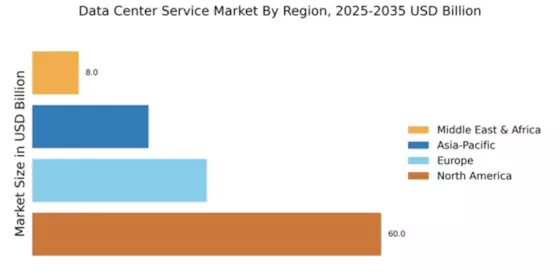
North America continues to lead the Data Center Service Market, holding a significant market share of 58.51% as of 2024. The region's growth is driven by increasing demand for cloud services, data storage, and enhanced cybersecurity measures. Regulatory support, particularly from government initiatives promoting digital infrastructure, further catalyzes this growth. The rise of remote work and digital transformation across industries has also fueled demand for robust data center solutions. The competitive landscape in North America is characterized by the presence of major players such as Amazon Web Services, Microsoft Azure, and Google Cloud. These companies are investing heavily in expanding their data center capabilities to meet the growing needs of businesses. The U.S. remains the leading country in this sector, with significant contributions from Canada and Mexico, ensuring a diverse and competitive market environment.

Europe : Emerging Digital Landscape

Europe's Data Center Service Market is poised for growth, currently holding a market share of 30.0%. The region benefits from stringent data protection regulations, such as GDPR, which drive demand for compliant data center solutions. Additionally, the push for sustainability and energy efficiency in data centers is becoming a key focus, with many countries investing in green technologies. The increasing reliance on cloud computing and digital services is further propelling market expansion across Europe. Leading countries in this region include Germany, the UK, and France, which are home to numerous data center operators and service providers. The competitive landscape features key players like IBM and Oracle, who are enhancing their service offerings to cater to the evolving needs of businesses. The presence of robust infrastructure and a skilled workforce supports the growth of data center services in Europe.

Asia-Pacific : Rapidly Growing Market

The Asia-Pacific region is witnessing rapid growth in the Data Center Service Market, with a market share of 24.0%. This growth is fueled by increasing internet penetration, the rise of e-commerce, and the demand for cloud services. Countries in this region are investing heavily in digital infrastructure, supported by government initiatives aimed at enhancing connectivity and technological advancement. The focus on data localization and compliance with local regulations is also shaping market dynamics in Asia-Pacific. Key players in this region include Alibaba Cloud and NTT Communications, which are expanding their footprints to meet the growing demand. Countries like China, Japan, and India are leading the charge, with significant investments in data center facilities. The competitive landscape is evolving, with both local and international players vying for market share, ensuring a dynamic environment for data center services.

Middle East and Africa : Emerging Market Potential

The Middle East and Africa (MEA) region is gradually emerging in the Data Center Service Market, currently holding a market share of 4.46%. The growth is driven by increasing digital transformation initiatives and investments in IT infrastructure. Governments in the region are focusing on enhancing connectivity and promoting smart city projects, which are expected to boost demand for data center services. The rise of cloud computing and the need for data security are also key factors contributing to market growth in MEA. Leading countries in this region include the UAE and South Africa, where significant investments are being made in data center facilities. The competitive landscape is characterized by a mix of local and international players, with companies like Equinix establishing a presence to tap into the growing market. As the region continues to develop its digital infrastructure, opportunities for data center services are expected to expand significantly.

Key Players and Competitive Insights

The Data Center Service Market is currently characterized by intense competition and rapid evolution, driven by the increasing demand for cloud computing, data storage, and digital transformation. Major players such as Amazon Web Services (US), Microsoft Azure (US), and Google Cloud (US) are at the forefront, leveraging their extensive infrastructure and technological capabilities to capture market share. These companies are strategically positioned to innovate continuously, focusing on enhancing service offerings, expanding their global footprint, and forming strategic partnerships to bolster their competitive edge. Their collective strategies not only shape the competitive landscape but also set benchmarks for operational excellence and customer service in the industry.

Key business tactics employed by these companies include optimizing supply chains and localizing services to meet regional demands. The market appears moderately fragmented, with a mix of established giants and emerging players vying for dominance. The influence of key players is substantial, as they drive trends in service delivery, pricing models, and technological advancements, thereby shaping the overall market structure.

In November 2025, Amazon Web Services (US) announced the launch of its new data center in Brazil, aimed at enhancing its service capabilities in South America. This strategic move is significant as it not only expands AWS's geographical reach but also positions the company to better serve the growing demand for cloud services in the region, potentially increasing its market share and customer base.

In October 2025, Microsoft Azure (US) unveiled a partnership with a leading telecommunications provider to enhance its edge computing capabilities. This collaboration is crucial as it allows Microsoft to leverage the telecommunications infrastructure to deliver faster and more reliable services, thereby improving customer satisfaction and operational efficiency. Such partnerships are indicative of a broader trend towards integrating telecommunications and cloud services, which may redefine service delivery in the market.

In September 2025, Google Cloud (US) made headlines by acquiring a prominent AI startup, aiming to bolster its machine learning and data analytics capabilities. This acquisition is likely to enhance Google Cloud's service offerings, enabling it to provide more sophisticated data solutions to its clients. The integration of AI into data center services is becoming increasingly vital, as companies seek to harness data for strategic decision-making and operational improvements.

As of December 2025, the competitive trends in the Data Center Service Market are heavily influenced by digitalization, sustainability initiatives, and the integration of AI technologies. Strategic alliances are becoming more prevalent, as companies recognize the need to collaborate to stay ahead in a rapidly changing environment. Looking forward, competitive differentiation is expected to evolve, with a shift from price-based competition towards innovation, technological advancements, and supply chain reliability. This transition underscores the importance of agility and responsiveness in meeting customer needs in an increasingly complex market.

Key Companies in the Data Center Service Market market include

Industry Developments

In recent developments within the Global Data Center Service Market, several key players have made significant strides. In April 2023, Amazon Web Services expanded its data center infrastructure, enhancing its service capabilities globally. Meanwhile, Microsoft reported a substantial increase in market valuation due to its Azure cloud services, reflecting the growing demand for data center services. Additionally, in January 2023, IBM announced a strategic partnership with Oracle to deliver hybrid cloud services, combining their expertise to meet client needs more effectively. Notably, in August 2022, Rackspace Technology integrated with DigitalOcean's platform, optimizing service delivery and expanding market reach.

Merger and acquisition activity remains a focus; for example, in September 2023, Equinix acquired a data center service provider in Europe to enhance its global footprint. In the past few years, increasing reliance on cloud solutions and the push for sustainable practices have transformed the market landscape, driving innovations and investments from major companies like Alibaba Cloud and Cisco Systems. As companies adapt to evolving market demands, the global data center service market is projected to continue its upward trajectory, fueled by growing digitalization and data consumption.

Future Outlook

Data Center Service Market Future Outlook

The Data Center Service Market is projected to grow at a 17.67% CAGR from 2024 to 2035, driven by increasing cloud adoption, data security needs, and energy efficiency demands.

New opportunities lie in:

  • Expansion of edge computing services in urban areas
  • Development of AI-driven data management solutions
  • Investment in sustainable energy sources for data centers

By 2035, the market is expected to be robust, driven by innovation and strategic investments.

Market Segmentation

Data Center Service Market End User Outlook

  • IT and Telecommunications
  • BFSI
  • Healthcare
  • Government

Data Center Service Market Service Type Outlook

  • Colocation Services
  • Managed Services
  • Cloud Services
  • Disaster Recovery Services

Data Center Service Market Deployment Type Outlook

  • On-Premises
  • Hybrid
  • Cloud

Data Center Service Market Data Center Type Outlook

  • Enterprise Data Centers
  • Colocation Data Centers
  • Hyperscale Data Centers

Data Center Service Market Infrastructure Type Outlook

  • Power Management
  • Cooling Systems
  • Networking Equipment
  • Storage Systems

Report Scope

MARKET SIZE 2024 117027.97(USD Billion)
MARKET SIZE 2025 137709.18(USD Billion)
MARKET SIZE 2035 700963.07(USD Billion)
COMPOUND ANNUAL GROWTH RATE (CAGR) 17.67% (2024 - 2035)
REPORT COVERAGE Revenue Forecast, Competitive Landscape, Growth Factors, and Trends
BASE YEAR 2024
Market Forecast Period 2025 - 2035
Historical Data 2019 - 2024
Market Forecast Units USD Billion
Key Companies Profiled Amazon Web Services (US), Microsoft Azure (US), Google Cloud (US), IBM (US), Alibaba Cloud (CN), Oracle (US), DigitalOcean (US), Equinix (US), NTT Communications (JP)
Segments Covered Service Type, End User, Deployment Type, Data Center Type, Infrastructure Type
Key Market Opportunities Integration of artificial intelligence and machine learning in Data Center Service Market operations.
Key Market Dynamics Rising demand for sustainable data center solutions drives innovation and competition among service providers.
Countries Covered North America, Europe, APAC, South America, MEA

Market Highlights

Author
Aarti Dhapte
Team Lead - Research

She holds an experience of about 6+ years in Market Research and Business Consulting, working under the spectrum of Information Communication Technology, Telecommunications and Semiconductor domains. Aarti conceptualizes and implements a scalable business strategy and provides strategic leadership to the clients. Her expertise lies in market estimation, competitive intelligence, pipeline analysis, customer assessment, etc.

Leave a Comment

FAQs

What is the expected market size of the Global Data Center Service Market by 2024?

The Global Data Center Service Market is expected to be valued at 60.45 USD Billion by the year 2024.

What is the projected market size of the Global Data Center Service Market by 2035?

By 2035, the Global Data Center Service Market is anticipated to reach a valuation of 150.0 USD Billion.

What is the expected CAGR for the Global Data Center Service Market from 2025 to 2035?

The Global Data Center Service Market is expected to achieve a CAGR of 8.61% during the forecast period from 2025 to 2035.

Which region holds the largest market share in the Global Data Center Service Market for 2024?

North America is projected to hold the largest market share, valued at 25.5 USD Billion in 2024.

What market size is expected for the Cloud Services segment in 2035?

The Cloud Services segment of the Global Data Center Service Market is expected to be valued at 60.0 USD Billion by 2035.

What are the expected market values for Colocation Services in 2024 and 2035?

Colocation Services are expected to be valued at 15.3 USD Billion in 2024 and 37.5 USD Billion in 2035.

What are the expected market values for Managed Services in 2024 and 2035?

Managed Services are projected to reach 12.0 USD Billion in 2024 and 30.0 USD Billion in 2035.

Who are the key competitors in the Global Data Center Service Market?

Major players include Alibaba Cloud, IBM, Rackspace, Google, and Amazon Web Services among others.

What is the market size expected for the APAC region in 2035?

The APAC region is expected to reach a market size of 40.0 USD Billion by 2035.

What potential challenges could impact the Global Data Center Service Market?

Challenges may include evolving technology demands, regulatory changes, and increasing competition among key players.

Download Free Sample

Kindly complete the form below to receive a free sample of this Report

Compare Licence

×
Features License Type
Single User Multiuser License Enterprise User
Price $4,950 $5,950 $7,250
Maximum User Access Limit 1 User Upto 10 Users Unrestricted Access Throughout the Organization
Free Customization
Direct Access to Analyst
Deliverable Format
Platform Access
Discount on Next Purchase 10% 15% 15%
Printable Versions