Data Warehouse as a Service Market Summary
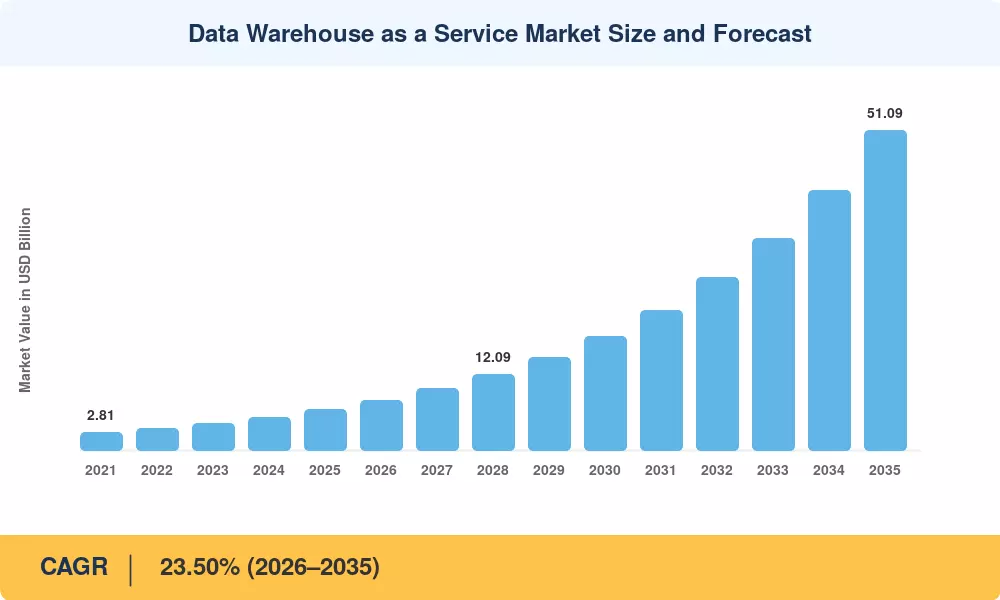
The Data Warehouse as a Service Market reached an estimated USD 6.52 billion in 2025 and is projected to climb from USD 7.93 billion in 2026 to USD 51.09 billion by 2035, registering a CAGR of 23.50% across the forecast window. Two catalysts stand behind this trajectory: enterprises migrating legacy on-premise data infrastructure to cloud-native stacks, and the explosion of AI-driven analytics that demand elastic, high-concurrency compute layers. Global cloud infrastructure spending surpassed USD 300 billion in 2024 [2], and a meaningful slice of that investment now flows into serverless data warehouse for scalable analytics platforms that decouple storage from compute.
The transformation underway is structural. Enterprises are retiring rigid, appliance-based warehouses — think Teradata and Netezza on-premise clusters — in favor of cloud-hosted enterprise data warehousing platforms built on columnar data storage for fast query performance. ELT pipelines for cloud data warehouse loading have replaced traditional ETL workflows, letting teams ingest raw data first and transform it inside the warehouse itself. Gartner estimates that by 2027 more than 75% of enterprise analytics workloads will run on cloud data platforms, a shift underwritten by pay-as-you-go pricing and near-zero capacity planning overhead.
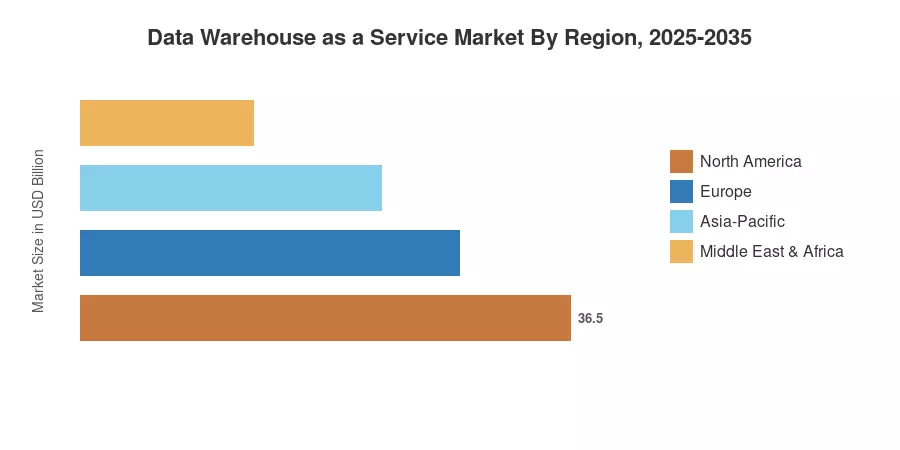
North America commands roughly 36.10% of the Data Warehouse as a Service Market, propelled by hyperscaler headquarters, mature cloud adoption, and a deep bench of analytics talent. Asia-Pacific is the fastest-growing region at a 25.90% CAGR through 2035, fueled by digital-transformation mandates in India, China, and Southeast Asia Europe holds the second-largest share near 27%, driven by GDPR-era data governance modernization and accelerating public-cloud procurement across the Nordics and DACH economies. The next decade will be defined by convergence — data warehouses, data lakes, and real-time streaming merging into unified lakehouse architectures that reshape the competitive landscape of the Data Warehouse as a Service Market.
Key Report Takeaways
• By Deployment Model
- Public-cloud deployments held approximately 60.50% of the Data Warehouse as a Service Market share in 2025, reflecting the dominance of hyperscaler ecosystems
- Hybrid and multi-cloud architectures are forecast to register a 25.70% CAGR through 2035, as enterprises pursue portability and Snowflake and Google BigQuery DWaaS comparison analyses guide procurement decisions
• By Enterprise Size
- Large corporations accounted for roughly 57.40% of the Data Warehouse as a Service Market in 2025
- SMEs are expected to expand at a 27.50% CAGR to 2035, driven by serverless data warehouse for scalable analytics offerings that eliminate upfront capacity commitments
• By End-User Industry
- BFSI captured around 22.60% of revenue in 2025, anchored by fraud-detection and regulatory-reporting workloads requiring columnar data storage for fast query performance
- Healthcare and life sciences are projected to grow at a 24.40% CAGR, fueled by precision-medicine data consolidation
• By Region
- North America commanded 36.10% of 2025 revenue
- Asia-Pacific is pacing the fastest at a 25.90% CAGR through 2035
Market sizing draws on bottom-up revenue modeling across cloud-hosted enterprise data warehousing vendor filings, hyperscaler segment disclosures, and validated third-party databases. Historical values (2021–2024) are actuals; 2025 is the calibrated base year; 2026–2035 values follow a 23.50% CAGR trajectory with year-level smoothing applied.





















.webp?v=1784724420)
