Decorative Laminates Market (2026 - 2035)

Decorative Laminates Market Research Report Information by Type (Low-Pressure Laminates and High-Pressure Laminates), Application (Furniture and Cabinets, Flooring and Wall Panels) and Region (North America, Europe, Asia-Pacific, Latin America and Middle East & Africa) - Forecast till 2035
ID: MRFR/CnM/1743-HCR
111 Pages
Chitranshi Jaiswal
Last Updated: June 26, 2026
Decorative Laminates Market
Market Size
Forecast Period2026-2035
CAGR (2026-2035)3.25%
2025 Market SizeUSD 9.21 billion
2035 Market SizeUSD 12.68 billion
Key Players
Wilsonart International
Greenlam Industries
Formica Group
Merino Industries
Kronospan
Century Plyboards
Opportunities
  • Digital Printing and Mass Customization Programs
  • Emerging Market Residential Construction
  • Antibacterial and Functional Surface Laminates

Decorative Laminates Market Summary

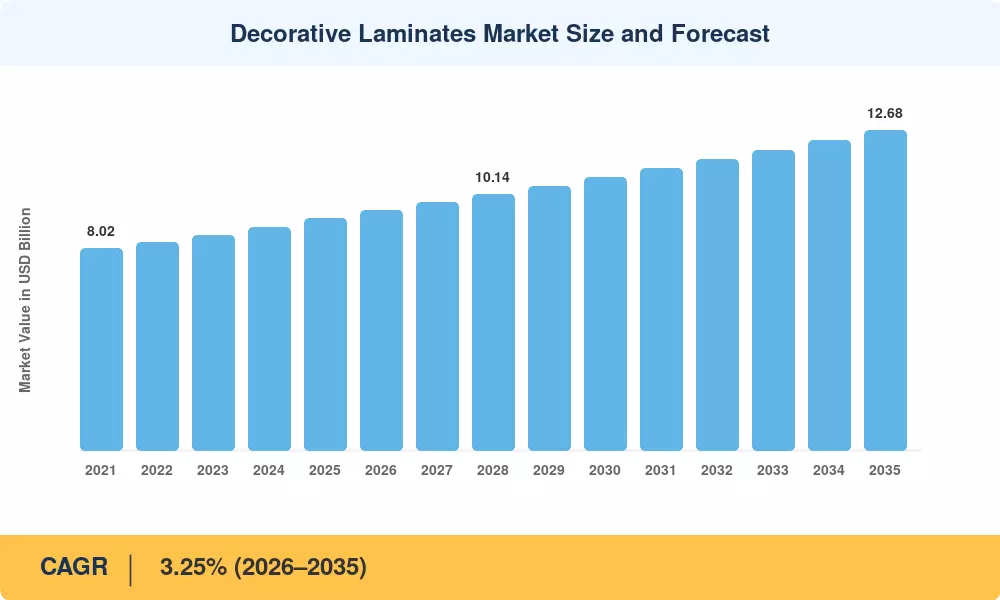
The global Decorative Laminates Market was valued at USD 9.21 billion in 2025 and is projected to reach USD 9.51 billion in 2026 before climbing to USD 12.68 billion by 2035, expanding at a CAGR of 3.25% during the 2026–2035 forecast window. Two forces anchor this trajectory: aggressive urbanization targets set by India's Pradhan Mantri Awas Yojana housing program, which aims to deliver 20 million urban housing units by 2028 [1], and tightening formaldehyde-emission ceilings across the European Union under the revised Construction Products Regulation [2]. Together, these policy catalysts are pulling investment into both residential surfacing and industrial compliance upgrades across converter facilities. The Decorative Laminates Market is transitioning from analog to digital at the production floor level.

Digital printing and emboss-in-register press lines are superseding conventional rotogravure equipment as they reduce tooling changeover costs by 40-60% and accommodate short-run bespoke décor programs increasingly demanded by contract decorators [3]. Overlay paper that offers an ultra-realistic reproduction of wood and stone is taking market share from standard kraft-core construction and exacting a price premium of 12 to 18% per sheet, thanks to its better visual authenticity. The global capital spending on high-pressure laminates manufacturing lines surpassed USD 1.3 billion in 2024, a clear indicator of the converters’ confidence in continued demand [4].


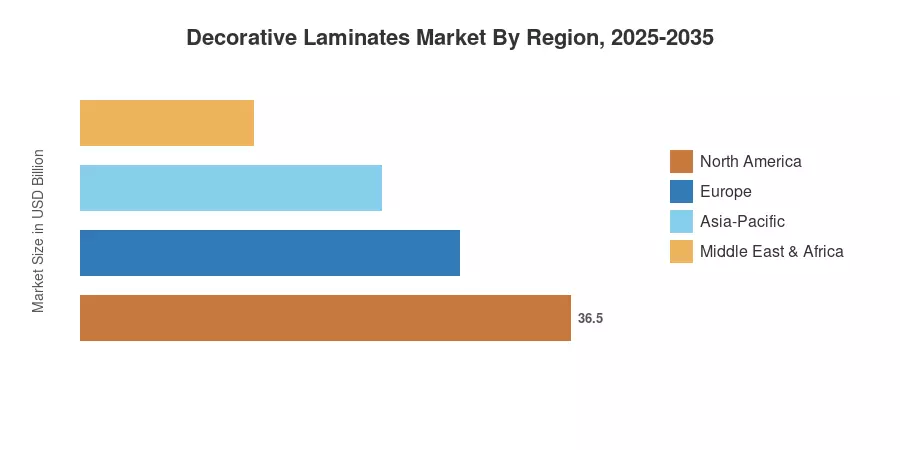
Asia-Pacific is the largest market for decorative laminates and accounts for almost 41.0% of the worldwide revenue, driven by home building in China, India and ASEAN countries. The Middle East & Africa region is the fastest expanding geography at a CAGR of 3.77% through 2035, fuelled by hospitality mega-projects in Saudi Arabia and the UAE. Europe has the second biggest share at roughly 25.5%, with investment in renovations and strict emissions rules aiding replacement cycles. The Decorative Laminates Market will see an upsurge in specification activity across both new-build and retrofit channels, owing to the wider adoption of modular building methods and prefabricated interior systems around the globe.


Key Report Takeaways

• By Raw Material

  • Plastic resin commanded a 43.8% share of the Decorative Laminates Market in 2025, anchored by its cost efficiency and broad compatibility with printing technologies.
  • Overlays are expanding at the fastest pace among raw material segments, registering a projected CAGR of 3.70% through 2035 as demand for photorealistic surface textures intensifies.

• By Application

  • Furniture accounted for 49.4% of the Decorative Laminates Market revenue in 2025, driven by residential fit-out programs across Asia-Pacific.
  • Wall panels are forecast to grow at a 3.47% CAGR to 2035, reflecting commercial interior renovation cycles in North America and Europe.

• By End-User Industry

  • The residential segment represented 57.4% of the Decorative Laminates Market in 2025, underpinned by government-backed affordable housing schemes.
  • Non-residential end users are projected to record a 3.89% CAGR through 2035 as hospitality, healthcare, and education infrastructure investment accelerates.

• By Geography

  • Asia-Pacific held the largest regional share at 41.0% in 2025, led by construction activity in China and India.
  • The Middle East & Africa region is expected to post the highest CAGR of 3.77% through the forecast period, fueled by mega-project pipelines.


Decorative Laminates Market Size and Forecast (2021–2035)

The market sizing methodology is a combination of bottom-up revenue modelling from converter shipments and top-down cross-validation with trade flow data from UN Comtrade and national building material organizations. Historical data is obtained from audited annual reports and customs databases. Forecast statistics are based on a calibrated 3.25% CAGR applied to the confirmed 2025 base.
Decorative Laminates Market Size and Forecast
Our Impact
Enabled $4.3B Revenue Impact for Fortune 500 and Leading Multinationals
Partnering with 2000+ Global Organizations Each Year
30K+ Citations by Top-Tier Firms in the Industry

Driver Impact Analysis

Driver ~% Impact on CAGR Geographic Relevance Impact Timeline
Urbanization and residential construction ~25–30% Asia-Pacific, MEA Long-term (≥4 yr)
Renovation and remodeling spending ~15–20% North America, Europe Medium-term (2–4 yr)
Formaldehyde-emission regulations ~10–15% Europe, North America Short-term (≤2 yr)
Digital printing press adoption ~10–15% Global Medium-term (2–4 yr)
Modular and prefabricated furniture growth ~8–12% Asia-Pacific, Europe Medium-term (2–4 yr)
Hospitality and commercial expansion ~5–10% MEA, Asia-Pacific Long-term (≥4 yr)
Green building certification mandates ~5–8% Global Long-term (≥4 yr)


Urbanization and Residential Construction

Asia-Pacific and Middle Eastern governments are spending heavily to house rapidly growing urban populations. India's PMAY-Urban program alone sanctioned over 11.8 million dwelling units by March 2024, each requiring interior surfacing materials for kitchens, wardrobes, and partition walls [1]. China's 14th Five-Year Plan earmarked RMB 5.3 trillion for urban renewal through 2025, generating persistent pull-through demand for laminate sheets consumed in mass-market furniture and cabinetry [10]. This construction pipeline represents the single largest volume driver for the Decorative Laminates Market over the next decade.

Renovation and Remodeling in Mature Economies

The U.S. Joint Center for Housing Studies projects residential renovation spending to exceed USD 450 billion annually by 2027, with kitchen and bath refits accounting for roughly 35% of that outlay [6]. European renovation rates are also climbing under the EU Renovation Wave strategy, which targets a doubling of annual energy renovation rates by 2030. Because laminate surfaces are a cost-effective way to refresh dated interiors without full structural work, the Decorative Laminates Market benefits directly from each remodeling cycle.

Tightening Formaldehyde-Emission Standards

The European Commission's revised Construction Products Regulation caps formaldehyde emissions at E0.5 levels for indoor building materials, pushing converters to reformulate resin systems and adopt ultra-low-emission adhesives [2]. California's CARB Phase II already enforces similar thresholds in North America. These regulatory floors raise the technical barrier to entry and reward established producers who have already invested in compliant impregnation lines, consolidating share among quality-oriented converters.

Digital Printing Technology Adoption

Digital inkjet presses now achieve 1,200 dpi resolution on décor paper at line speeds above 60 meters per minute, enabling economic batch sizes as small as 500 sheets [3]. This capability lets designers iterate on custom patterns for boutique hotel chains and corporate interiors without the six-figure plate investment rotogravure demands. Adoption rates among mid-tier converters in India and Southeast Asia are climbing at roughly 18–22% annually, creating a ripple effect across the Decorative Laminates Market supply chain [11].


Restraints Impact Analysis

The restraint estimates below are directional indicators of headwind magnitude. They do not subtract mechanically from the headline CAGR and reflect qualitative expert triangulation alongside trade data analysis.

Restraint ~% Negative Impact on CAGR Geographic Relevance Impact Timeline
Substitution from LVT and engineered stone -15–20% North America, Europe Medium-term (2–4 yr)
Raw material price volatility (resin, paper) -10–15% Global Short-term (≤2 yr)
Anti-dumping duties on décor paper -8–12% Europe, Asia-Pacific Short-term (≤2 yr)
Environmental scrutiny of plastic resin content -5–10% Europe, North America Long-term (≥4 yr)
Competition from natural wood and stone -5–8% North America, Europe Long-term (≥4 yr)


Substitution Pressure from LVT and Engineered Stone

Luxury vinyl tile shipments in North America grew 9.4% year-on-year in 2024, eroding laminate flooring's share in residential ground-cover applications [12]. Engineered quartz surfaces are similarly displacing laminate countertops at the premium end of the kitchen and bath segment. For the Decorative Laminates Market, this substitution channel compresses pricing power in horizontal-surface categories and pushes converters to differentiate through tactile texture innovation and antibacterial coatings.

Raw Material Price Volatility

Phenol and melamine resin prices swung by 18–25% between Q1 2023 and Q4 2024, driven by upstream petrochemical feedstock fluctuations and energy-cost pass-throughs in Europe [13]. Decorative base papers, which account for 15–20% of converter input costs, experienced a parallel 12% price increase as pulp markets tightened. These input cost oscillations squeeze converter margins and create uncertainty in contract pricing for large-scale commercial projects.

Anti-Dumping Duties Disrupting Supply Chains

The European Commission imposed definitive anti-dumping duties of up to 35.8% on Chinese decorative paper imports in 2023, disrupting established procurement channels for EU-based converters [14]. This trade barrier forced rapid vertical integration, with several mid-sized European laminators investing EUR 50–80 million to internalize impregnation capacity. While the duties protect domestic paper producers, they raise conversion costs and compress the Decorative Laminates Market growth trajectory in Europe over the near term.


Decorative Laminates Market Opportunities

Digital Printing and Mass Customization Programs

Short-run digital printing opens a direct channel between interior designers and laminate converters, bypassing the catalogue-only model that has governed décor selection for decades. Converters offering cloud-based design portals can capture 20–30% price premiums on bespoke runs, transforming a commodity product into a specification-driven service.

Emerging Market Residential Construction

Sub-Saharan Africa and South Asia collectively face a housing deficit exceeding 100 million units, according to World Bank estimates [17]. As governments deploy affordable-housing finance mechanisms, demand for cost-effective interior surfaces will scale dramatically. The Decorative Laminates Market is well-positioned to serve this deficit because laminates offer a durable, low-maintenance finish at a fraction of natural stone costs.

Antibacterial and Functional Surface Laminates

Post-pandemic hygiene awareness has sustained demand for antimicrobial and fingerprint-resistant laminate surfaces in healthcare, education, and food-service environments. Silver-ion and copper-infused overlay technologies now achieve ISO 22196–certified bacterial reduction rates above 99.9%, creating a differentiated product tier that commands 25–35% premiums over standard décor grades [18].

Sustainable and Recycled-Content Laminates

Circular-economy regulations in the EU and South Korea are incentivizing producers to incorporate post-consumer recycled kraft and bio-based resins into core layers. Early movers offering Environmental Product Declarations (EPDs) gain preferential specification in LEED- and BREEAM-certified projects, adding a measurable green premium to their pricing architecture [9].

Data-Driven Design Platforms and New Business Models

Cloud-connected configurators that let end consumers visualize textured laminates on their own room photos before ordering are shortening specification cycles from weeks to hours. Subscription-based sample-kit services and AI-driven trend forecasting tools offer converters recurring revenue streams beyond sheet sales, creating a platform-economics layer atop traditional distribution.


Decorative Laminates Market Future Outlook

Smart Surfaces and IoT-Enabled Laminates

Embedded near-field communication (NFC) chips and conductive ink layers are transforming passive decorative surfaces into interactive touch points for retail displays, hotel check-in counters, and smart-home control panels. Pilot lines in Germany and Japan have demonstrated NFC-laminate integration at marginal cost increases below EUR 0.40 per square meter, suggesting commercial viability by 2028 [19].

Circular Economy and Bio-Resin Transition

The EU Ecodesign for Sustainable Products Regulation will likely mandate minimum recycled-content thresholds for interior building materials before 2030. Converters investing now in lignin-based and cashew-nutshell-liquid resins will hold a first-mover advantage when these mandates take effect. Life-cycle assessment data from early adopters show a 30–40% reduction in embodied carbon per square meter compared to conventional phenol-formaldehyde systems [15].

Prefabrication and Off-Site Construction Integration

Off-site construction methods are gaining policy support across the UK, Singapore, and Australia, where labor shortages and quality-control imperatives favor factory-finished interior modules. Laminates pre-bonded to lightweight honeycomb cores ship as ready-to-install panels, cutting on-site labor by an estimated 35% [7]. This shift redefines the Decorative Laminates Market channel structure, moving procurement from site-level contractors to centralized module fabricators.

ESG Reporting and Transparent Supply Chains

Institutional investors and corporate tenants are demanding Environmental, Social, and Governance (ESG) disclosure from building-material suppliers. Converters that publish verified EPDs and maintain chain-of-custody certifications for wood substrates will increasingly qualify for specification in LEED v5 and WELL-certified projects, which collectively represent over USD 4 trillion in global construction value [9].


Decorative Laminates Market Segmentation

By Raw Material

Segment Key Metric Primary Demand Driver
Plastic Resin 43.8% share (2025) Cost efficiency and printing compatibility
Overlays 3.70% CAGR (2026–2035) Photorealistic texture demand
Adhesives USD 0.74 billion (2025) Regulatory shift to low-VOC formulations
Wood Substrate 21.3% share (2025) Structural core requirements
Other Raw Materials 2.91% CAGR (2026–2035) Specialty fire-retardant additives


Plastic resin remains the backbone of the Decorative Laminates Market raw material mix because melamine and phenolic resins deliver the durability, moisture resistance, and surface hardness that end users expect at mainstream price points. Converters consume roughly 1.2 million metric tonnes of melamine-formaldehyde resin annually, with Asian producers accounting for the majority of global supply [13].

Overlays are the fastest-growing raw material category, driven by interior designers' appetite for ultra-realistic wood-grain and stone-finish reproductions. Advanced electron-beam–cured overlays achieve abrasion-resistance ratings exceeding AC5, enabling their use in high-traffic commercial flooring where traditional décor papers would degrade prematurely [3].

By Application

Segment Key Metric Primary Demand Driver
Furniture 49.4% share (2025) Modular kitchen and wardrobe proliferation
Cabinets USD 1.62 billion (2025) Kitchen and bath renovation cycles
Flooring 12.7% share (2025) Cost advantage over hardwood
Wall Panels 3.47% CAGR (2026–2035) Commercial interior upgrade spend
Other Applications 5.1% share (2025) Doors, partitions, countertops


Furniture dominates the Decorative Laminates Market application landscape because the global shift from carpenter-assembled to factory-produced modular units concentrates laminate consumption into organized manufacturing channels. India's modular furniture penetration has climbed from roughly 8% in 2019 to an estimated 18% in 2025, and each percentage point of penetration gain translates into substantial incremental sheet demand [7].

Wall panels represent the fastest-expanding application category as commercial tenants and hospitality operators favor laminate cladding for rapid interior refresh without structural alteration. A typical mid-rise hotel renovation consumes 1,500–2,500 square meters of wall-panel laminate per floor, making hospitality a high-volume procurement channel [8].

By End-User Industry

Segment Key Metric Primary Demand Driver
Residential 57.4% share (2025) Affordable housing and renovation
Non-Residential 3.89% CAGR (2026–2035) Hospitality, healthcare, education, CapEx
Transportation USD 0.38 billion (2025) Rail and marine interior paneling


Residential end users drive more than half of global laminate consumption, reflecting the material's alignment with mass-market affordability and ease of installation. Government housing subsidies in India, Brazil, and Saudi Arabia channel public spending directly into interior finishing materials, sustaining residential demand even during broader economic slowdowns [1].

Non-residential is the fastest-growing end-user category within the Decorative Laminates Market. Hospitals, schools, and retail chains specify laminates for their hygienic surface properties, scuff resistance, and lifecycle cost advantage over painted drywall or natural stone cladding. Healthcare facility construction in the U.S. alone is projected to exceed USD 60 billion in cumulative spending between 2026 and 2030 [18].


Regional Market Share Analysis

Region Key Metric Primary Investment Themes
Asia-Pacific 41.0% share (2025) Mass housing, modular furniture manufacturing
Europe 25.5% share (2025) Renovation wave, emission compliance
North America USD 2.03 billion (2025) Kitchen/bath remodeling, commercial fit-out
South America 3.41% CAGR (2026–2035) Affordable housing programs
Middle East & Africa 3.77% CAGR (2026–2035) Hospitality mega-projects, urban diversification

The Decorative Laminates Market exhibits distinct regional demand profiles shaped by construction cycles, trade policies, and consumer preference for surface aesthetics. Asia-Pacific remains the volume anchor, while the Middle East & Africa is emerging as the fastest-growing frontier.


North America

Country Key Metric Key Driver
United States 72.4% of regional revenue Residential remodeling and commercial interiors
Canada USD 0.31 billion (2025) Multi-family housing starts
Mexico 3.58% CAGR (2026–2035) Nearshoring-driven industrial construction


The United States accounts for the vast majority of North American laminate consumption, anchored by a remodeling market that exceeds USD 450 billion annually [6]. Canadian demand is concentrated in multi-family residential projects across Toronto, Vancouver, and Montreal, while Mexico's manufacturing corridor expansion—driven by nearshoring from Asia—fuels new demand for commercial interior surfacing.

Europe

Country Key Metric Key Driver
Germany 22.1% of regional revenue Kitchen furniture manufacturing hub
United Kingdom USD 0.39 billion (2025) Social housing retrofit programs
France 3.30% CAGR (2026–2035) Renovation fiscal incentives
Italy 14.8% of regional revenue Design-led furniture export sector
Spain USD 0.18 billion (2025) Tourism-driven hospitality refurbishment
Nordic Countries 3.28% CAGR (2026–2035) Sustainable building mandates
Russia 6.2% of regional revenue Domestic import-substitution policies
Rest of Europe USD 0.24 billion (2025) Varied residential programs


Germany's kitchen and furniture manufacturing cluster around Ostwestfalen-Lippe drives concentrated laminate procurement, while the UK's social housing retrofit pipeline generates steady demand for cost-efficient wall and cabinet resurfacing. The EU Renovation Wave strategy targets 35 million building-unit renovations by 2030, sustaining laminate pull-through across the continent [2].

Asia-Pacific

Country Key Metric Key Driver
China 36.7% of regional revenue Urban renewal and modular kitchen adoption
India 3.92% CAGR (2026–2035) Affordable housing and organized retail fit-out
Japan USD 0.41 billion (2025) Seismic-resilient prefab housing
South Korea 8.9% of regional revenue Compact apartment interior upgrades
ASEAN 3.85% CAGR (2026–2035) Hospitality infrastructure and urbanization
Rest of Asia-Pacific USD 0.19 billion (2025) General construction growth


China and India together generate more than half of the Asia-Pacific laminate demand. India's organized laminate industry has grown at nearly double the GDP rate over the past five years, propelled by the shift from carpenter-built to factory-made modular furniture [1]. ASEAN nations—particularly Vietnam, Indonesia, and Thailand—are scaling domestic converter capacity to reduce import dependency and serve their expanding middle-class housing sectors.

South America

Country Key Metric Key Driver
Brazil 64.3% of regional revenue Social housing (Minha Casa Minha Vida)
Argentina USD 0.06 billion (2025) Urban apartment fit-out
Rest of South America 3.52% CAGR (2026–2035) Infrastructure diversification


Brazil's Minha Casa Minha Vida program restarted at an accelerated pace in 2023 with a target of 2 million housing units by 2026, directly pulling laminate sheet demand into affordable kitchen and wardrobe segments [17]. Argentina's market remains constrained by macroeconomic volatility but retains a stable replacement cycle in urban apartment refurbishment.

Middle East & Africa

Country Key Metric Key Driver
Saudi Arabia 31.5% of regional revenue Vision 2030 giga-projects
UAE USD 0.09 billion (2025) Expo legacy and hospitality pipeline
South Africa 18.4% of regional revenue Social infrastructure investment
Egypt 3.91% CAGR (2026–2035) New Administrative Capital fit-out
Rest of MEA USD 0.07 billion (2025) General urbanization


Saudi Arabia's Vision 2030 giga-projects—including NEOM, The Red Sea, and Diriyah Gate—are generating unprecedented surfacing-material demand across hospitality, retail, and residential verticals [8]. Egypt's New Administrative Capital, east of Cairo, has entered interior finishing phases, pulling laminate orders for thousands of government and commercial buildings simultaneously.


Decorative Laminates Market By Region, 2025-2035

Competitive Benchmarking

The Decorative Laminates Market is moderately concentrated with an estimated top-five market share of 28–36%. The Herfindahl-Hirschman Index remains in the 600–900 range, reflecting a fairly fragmented environment with regional champions and a few global platform companies. Competitive distinction is built on the size of the décor library, the capability to use digital printing, distribution reach and sustainability credentials.

Company Est. Revenue Share Range Key Offerings Strategic Positioning
Wilsonart International ~7–10% HPL, TFL, quartz surfaces, digital décor Vertically integrated North American leader
Greenlam Industries ~5–8% HPL, decorative veneers, compact panels Largest Asian exporter with 100+ country reach
Formica Group ~5–7% HPL, solid surface, door skins Heritage brand with a global manufacturing footprint
Merino Industries ~4–6% HPL, pre-lam particle board, exterior cladding Strong Indian domestic network
Kronospan ~4–6% MDF, particle board, laminate flooring, HPL Integrated European wood-panel giant
Century Plyboards ~3–5% Plywood, HPL, MDF, particle board Indian multi-product building materials platform
Stylam Industries ~2–4% HPL, exterior cladding, anti-bacterial laminates Fast-growing Indian exporter to 80+ countries
Abet Laminati ~2–4% HPL, compact grade, digital print laminates Italian design-led premium positioning
Fundermax GmbH ~2–3% HPL, compact panels, exterior facades Austrian specialist in high-performance exteriors
Trespa International ~1–3% HPL façade panels, interior surfaces Niche leader in architectural cladding solutions


Recent News & Developments

  • Greenlam Industries (September 2023): Commissioned a new 4.2 million–sheet HPL production line at its Nalagarh facility in Himachal Pradesh, increasing total capacity by approximately 18% to serve rising export demand [20].
  • European Commission (July 2024): Published updated guidance under the Construction Products Regulation, tightening indoor formaldehyde-emission limits for laminate products sold within the EU single market, effective January 2026 [2].


Decorative Laminates Market Report Scope

Parameter Details
Market Scope Global Decorative Laminates Market covering raw materials, applications, end-user industries, and five geographic regions
Study Period 2021–2035
CAGR (Forecast) 3.25% (2026–2035)
Market Size — Base Year (2025) USD 9.21 billion
Market Size — Forecast End (2035) USD 12.68 billion
Fastest Growing Segment Non-Residential end-user (3.89% CAGR); Overlays raw material (3.70% CAGR)
Companies Profiled 10 (Wilsonart, Greenlam, Formica, Merino, Kronospan, Century, Stylam, Abet, Fundermax, Trespa)
Valuation Currency USD billion


FAQs

What lead time should buyers expect for custom digital-print laminate orders?
Most converters fulfill bespoke digital-print runs within 4–6 weeks, versus 10–12 weeks for traditional rotogravure plates. Rush orders under three weeks typically carry a 15–20% surcharge [3].
How do HPL and LPL differ for commercial specification decisions?
HPL withstands higher abrasion and impact, suiting horizontal countertops and high-traffic surfaces. LPL costs roughly 30% less and performs well on vertical furniture faces in low-wear settings [16].
Which fire-rating certifications matter most for laminate procurement?
Class A or Class 1 ratings under ASTM E84 or EN 13501-1 are mandatory for commercial corridors and public buildings. Buyers should verify independent third-party test certification before specifying [2].
Can decorative laminates be recycled at the end of life?
Thermoset HPL cannot be remelted, though several producers offer take-back programs grinding waste into composite-board filler. Thermoplastic-based laminates are mechanically recyclable through standard plastics streams [15].
What warranty terms are standard for commercial laminate installations?
Leading manufacturers offer 5–10 year commercial warranties covering delamination, fading, and surface wear. Validity typically requires installation by a certified fabricator using approved adhesives [21].
How does post-forming capability influence laminate specification?
Post-formable grades bend around radiused edges without cracking, eliminating visible seams on countertop returns. Specifiers should confirm the minimum bend radius, typically 6–12 mm for standard post-form HPL [12].
Is BIM integration changing how architects specify laminates in the Decorative Laminates Market?
Major producers now supply BIM-ready objects with embedded material data, enabling automated quantity take-off. This reduces specification errors by an estimated 20–25% during design development [19].    
Author
Author
Author Profile
Chitranshi Jaiswal LinkedIn
Team Lead - Research
Chitranshi is a Team Leader in the Chemicals & Materials (CnM) and Energy & Power (EnP) domains, with 6+ years of experience in market research. She leads and mentors teams to deliver cross-domain projects that equip clients with actionable insights and growth strategies. She is skilled in market estimation, forecasting, competitive benchmarking, and both primary & secondary research, enabling her to turn complex data into decision-ready insights. An engineer and MBA professional, she combines technical expertise with strategic acumen to solve dynamic market challenges. Chitranshi has successfully managed projects that support market entry, investment planning, and competitive positioning, while building strong client relationships. Certified in Advanced Excel & Power BI she leverages data-driven approaches to ensure accuracy, clarity, and impactful outcomes.

Research Approach

Research Methodology on Decorative Laminates Market

Introduction

The study examines the decorative laminates market concerning global trends and macroeconomic parameters. It also analyzes the key trends, growth drivers, and restraining factors for the market. The research includes a detailed scenario analysis of the market, a demand-side analysis and an industry chain analysis. Apart from these, price trends and competition analysis are also conducted to provide an in-depth analysis of the industry.

Research Methodology

The research methodology used in this study is a combination of primary and secondary approaches. Primary sources of data include surveys, interviews and focus groups conducted with key stakeholders and industry specialists. The sources of secondary data include industry databases, industry reports and news, government and industry associations, white papers, and industry-journal literature.

Data Collection and Assumption

Data collection is done using primary and secondary sources. Primary data is obtained primarily through interviews and surveys of key industry experts, designers, manufacturers, and suppliers. Secondary data sources include industry databases, trade publications, magazines and journals, industry reports, and internet resources. The data collected is then analyzed by evaluating market trends and demand-supply dynamics.

Technical Parameters

In this study, qualitative research techniques including interviews and focus group discussions are used to gain insights into the major parameters influencing the decorative laminates market. Quantitative research techniques are also used to estimate market size and growth. The analysis is conducted on a regional-level basis for the prediction of market segments, cost and pricing, and trade.

Analysis

The analysis conducted for this study includes a detailed analysis of market trends and industry dynamics at both a global and regional level. The market is segmented based on product type and end-use application. The factors driving the demand for decorative laminates, such as increasing consumer preference and technological advancements, are studied. The factors restraining the market growth have also been studied. Both SWOT analysis and Porter’s Five Forces are conducted to gain an in-depth understanding of the market.

Validation

Validation of the data is done using various industry tools and techniques such as market trends and forecasts, historical trends, competitive landscape analysis, and competitor market share analysis. Furthermore, to validate the findings, a focused group discussion is conducted with key industry experts, leading designers, and suppliers to assess their opinion and validation of the proposed study. The opinion of these experts is also considered for validating the findings and results of the study.

Conclusion

The research report “Decorative Laminates Market” provides an in-depth analysis of the market and discusses the factors driving and restraining the market. The research report also highlights the opportunities and challenges faced by the industry and provides a holistic outlook on the prospects and growth potential of the market.

Download Free Sample

Kindly complete the form below to receive a free sample of this Report

Download PDF ×

We do not share your information with anyone. However, we may send you emails based on your report interest from time to time. You may contact us at any time to opt-out.