Dicalcium Phosphate Market
Dicalcium Phosphate Market Summary
As per Market Research Future analysis, the Dicalcium Phosphate Market Size was estimated at 0.9568 USD Billion in 2024. The Dicalcium Phosphate industry is projected to grow from USD 1.01 Billion in 2025 to USD 1.743 Billion by 2035, exhibiting a compound annual growth rate (CAGR) of 5.6% during the forecast period 2025 - 2035
Key Market Trends & Highlights
The Dicalcium Phosphate Market is poised for growth driven by diverse applications and regional dynamics.
- North America remains the largest market for Dicalcium Phosphate Market, primarily due to its extensive use in animal nutrition.
- Asia-Pacific is emerging as the fastest-growing region, fueled by increasing demand for food and beverage applications.
- The Phosphoric Acid segment dominates the market, while the Hydrochloric Acid segment is witnessing rapid growth.
- Key market drivers include the rising demand in the food industry and the expansion of fertilizer applications.
Market Size & Forecast
| 2024 Market Size | 0.9568 (USD Billion) |
| 2035 Market Size | 1.743 (USD Billion) |
| CAGR (2025 - 2035) | 5.6% |
Major Players
Nutrien Ltd (CA), OCP Group (MA), Yara International (NO), Mosaic Company (US), PhosAgro (RU), Tata Chemicals (IN), ICL Group (IL), Jordan Phosphate Mines Company (JO), KEMAPCO (JO)
Dicalcium Phosphate Market Trends
The Dicalcium Phosphate Market is currently experiencing a notable transformation, driven by various factors that influence its demand and supply dynamics. This compound, primarily utilized in the food and pharmaceutical industries, is gaining traction due to its essential role in animal nutrition and dietary supplements. As consumers become increasingly health-conscious, the need for high-quality nutritional products is on the rise. Consequently, manufacturers are focusing on enhancing the quality and bioavailability of dicalcium phosphate to meet these evolving consumer preferences. Furthermore, the growing trend towards organic and natural products is likely to shape the market landscape, as stakeholders seek to align with sustainable practices. In addition to the health and wellness trend, the Dicalcium Phosphate Market is also witnessing advancements in production technologies. Innovations in manufacturing processes are expected to improve efficiency and reduce costs, thereby making dicalcium phosphate more accessible to a broader range of industries. Moreover, regulatory frameworks are evolving, which may impact the market by introducing new standards for product quality and safety. As the market continues to adapt to these changes, it appears poised for growth, with potential opportunities emerging in various sectors, including agriculture and food processing. Overall, the Dicalcium Phosphate Market is navigating a complex landscape, characterized by shifting consumer demands and technological advancements that could redefine its future trajectory.
Rising Demand in Animal Nutrition
The Dicalcium Phosphate Market is witnessing an increase in demand from the animal nutrition sector. As livestock producers seek to enhance the nutritional value of feed, dicalcium phosphate serves as a vital source of calcium and phosphorus, essential for animal growth and health. This trend is likely to continue as the global population grows, necessitating more efficient food production systems.
Focus on Sustainable Practices
There is a growing emphasis on sustainability within the Dicalcium Phosphate Market. Stakeholders are increasingly adopting eco-friendly production methods and sourcing raw materials responsibly. This shift towards sustainability not only meets consumer expectations but also aligns with global initiatives aimed at reducing environmental impact.
Technological Advancements in Production
Innovations in production technologies are reshaping the Dicalcium Phosphate Market. Enhanced manufacturing processes are improving efficiency and reducing costs, making dicalcium phosphate more accessible. These advancements may also lead to higher quality products, catering to the evolving needs of various industries.
Dicalcium Phosphate Market Drivers
Increasing Use in Food Industry
The Dicalcium Phosphate Market is experiencing a notable increase in demand from the food sector. This compound serves as a food additive, enhancing nutritional value and acting as a leavening agent. The food industry is projected to grow at a compound annual growth rate of approximately 4.5% over the next few years, which could significantly boost the demand for dicalcium phosphate. As consumers become more health-conscious, the need for fortified foods is likely to rise, thereby driving the market further. Additionally, the regulatory frameworks surrounding food safety and nutritional labeling are becoming more stringent, which may compel manufacturers to incorporate dicalcium phosphate into their products to meet these standards.
Expansion in Fertilizer Applications
The Dicalcium Phosphate Market is also witnessing growth due to its application in fertilizers. As agricultural practices evolve, there is an increasing emphasis on soil health and nutrient management. Dicalcium phosphate is recognized for its role in enhancing soil fertility and crop yield. The fertilizer segment is expected to grow at a rate of around 5% annually, driven by the rising global population and the consequent demand for food production. This trend suggests that dicalcium phosphate will play a crucial role in sustainable agriculture, as it provides essential nutrients to plants while minimizing environmental impact. The integration of dicalcium phosphate in fertilizers aligns with the broader movement towards sustainable farming practices.
Rising Demand in Pet Food Production
The Dicalcium Phosphate Market is benefiting from the increasing demand for high-quality pet food. As pet ownership rises, consumers are seeking nutritious options for their pets, leading to a surge in the pet food market. Dicalcium phosphate is often included in pet food formulations to provide essential minerals, particularly calcium and phosphorus, which are vital for pet health. The pet food industry is projected to grow at a rate of approximately 6% per year, indicating a robust market for dicalcium phosphate as a key ingredient. This trend highlights the importance of dicalcium phosphate in meeting the nutritional needs of pets, thereby driving its demand in the market.
Growth in Pharmaceutical Applications
The Dicalcium Phosphate Market is also expanding due to its applications in the pharmaceutical sector. Dicalcium phosphate is utilized as an excipient in tablet formulations, providing essential properties such as binding and disintegration. The pharmaceutical industry is expected to grow at a compound annual growth rate of around 4% in the coming years, which may enhance the demand for dicalcium phosphate. As the focus on drug formulation and delivery systems intensifies, the role of dicalcium phosphate as a reliable excipient becomes increasingly significant. This growth in the pharmaceutical sector could provide a substantial boost to the dicalcium phosphate market, reflecting its versatility and importance in various applications.
Emerging Markets and Economic Development
The Dicalcium Phosphate Market is poised for growth due to the economic development in emerging markets. As these economies expand, there is a rising demand for various industrial applications, including animal feed, food additives, and fertilizers. The increasing disposable income in these regions is likely to lead to higher consumption of products containing dicalcium phosphate. Furthermore, the agricultural sector in emerging markets is evolving, with a greater focus on improving crop yields and livestock health. This trend suggests that the demand for dicalcium phosphate will continue to rise, driven by both industrial and agricultural needs, thereby presenting opportunities for market players.
Market Segment Insights
By Production Method: Phosphoric Acid (Largest) vs. Hydrochloric Acid (Fastest-Growing)
The Dicalcium Phosphate Market exhibits a distinct distribution of market share among its production methods. Phosphoric Acid remains the dominant player, leveraging its established application in the agricultural sector for animal feed and fertilizers. Its extensive use has garnered a significant portion of the market, while Hydrochloric Acid, although smaller in share, is gaining traction, appealing to niche markets based on cost-effectiveness and specific application needs. As more manufacturers explore diverse methods, the competitive landscape is reshaping, leading to innovative formulations in the segment. Looking ahead, the growth trends indicate a promising trajectory for Hydrochloric Acid, driven by its increasing adoption in specialized applications. The push for sustainability in agriculture and the need for efficient nutrient delivery are key drivers contributing to its upward growth. Meanwhile, advancements in production technology and strategic collaborations among key industry players are anticipated to enhance the adoption of Hydrochloric Acid further, cementing its status as the fastest-growing production method within the Dicalcium Phosphate Market.
Phosphoric Acid (Dominant) vs. Hydrochloric Acid (Emerging)
Phosphoric Acid stands out as the dominant production method in the Dicalcium Phosphate Market. It enjoys widespread acceptance due to its effectiveness, reliability, and established supply chains. The large-scale production and integration with various agricultural applications bolster its market position significantly. In contrast, Hydrochloric Acid is emerging as a noteworthy alternative, primarily due to its cost advantages and versatility in specialty applications. As demand for tailored fertilizers and feed additives rises, Hydrochloric Acid's growth potential is being recognized by manufacturers seeking to innovate. This shift towards Hydrochloric Acid reflects a broader trend toward diversification in production methods within the market, as stakeholders aim to meet evolving consumer needs.
By End-Use: Animal Feed (Largest) vs. Food & Beverage (Fastest-Growing)
In the Dicalcium Phosphate Market, the Animal Feed segment holds the largest share as it is extensively utilized for replenishing phosphorus in animal diets, crucial for livestock growth and productivity. Following closely is the Food & Beverage segment, which is experiencing rapid growth due to the increasing demand for nutritional enhancements in processed foods, reflecting a shift towards healthier consumer choices. The Pharmaceuticals and Agriculture segments also play essential roles, albeit with smaller shares, as they cater to specific health and agricultural applications.
Animal Feed (Dominant) vs. Food & Beverage (Emerging)
The Animal Feed segment of the Dicalcium Phosphate Market is characterized by its substantial reliance on the livestock industry, ensuring a steady demand driven by the need for high-quality feed supplements. This segment is widely regarded as dominant due to its established market presence and historical usage in various forms of animal nutrition. In contrast, the Food & Beverage segment is emerging rapidly, fueled by trends towards clean label products and nutritional fortifications. Innovations in food formulations and a growing focus on dietary phosphate sources are contributing to the segment's acceleration, making it a notable area for investment and development.
Regional Insights
North America : Agricultural Innovation Leader
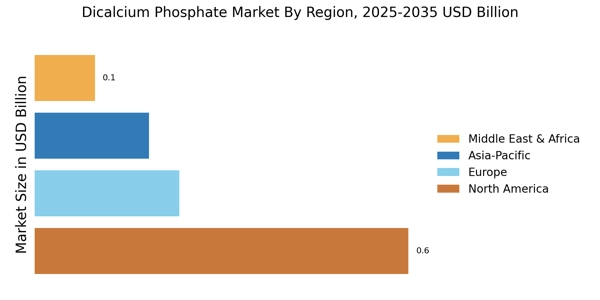
North America is witnessing robust growth in the Dicalcium Phosphate Market, driven by increasing demand in the agricultural sector, particularly in animal feed and fertilizers. The U.S. holds the largest market share at approximately 65%, followed by Canada at around 20%. Regulatory support for sustainable agricultural practices is further propelling market growth, with initiatives aimed at enhancing nutrient efficiency in farming. The competitive landscape is characterized by major players such as Nutrien Ltd and Mosaic Company, which dominate the market with their extensive distribution networks and innovative product offerings. The presence of these key players, along with a focus on research and development, is fostering a dynamic environment for Dicalcium Phosphate Market production. The region's commitment to agricultural advancements ensures a steady demand for high-quality phosphate products.
Europe : Sustainable Agriculture Focus
Europe is emerging as a significant player in the Dicalcium Phosphate Market, driven by stringent regulations promoting sustainable agricultural practices. The region's market share is approximately 25%, with Germany and France being the largest contributors, holding around 10% and 8% respectively. The European Union's Green Deal and Farm to Fork strategy are key regulatory catalysts, encouraging the use of organic fertilizers and enhancing nutrient recycling in agriculture. Leading countries in Europe are investing in innovative solutions to meet the growing demand for sustainable fertilizers. Key players like Yara International and ICL Group are at the forefront, leveraging advanced technologies to produce high-quality Dicalcium Phosphate Market. The competitive landscape is evolving, with a focus on eco-friendly practices and compliance with EU regulations, ensuring a sustainable future for the agricultural sector.
Asia-Pacific : Emerging Market Potential
Asia-Pacific is witnessing rapid growth in the Dicalcium Phosphate Market, driven by increasing agricultural activities and rising livestock production. The region holds a market share of approximately 20%, with China and India being the largest markets, accounting for around 12% and 5% respectively. The growing population and rising income levels are fueling demand for animal protein, thereby increasing the need for high-quality feed additives like Dicalcium Phosphate Market. The competitive landscape in Asia-Pacific is characterized by the presence of key players such as Tata Chemicals and PhosAgro, which are expanding their operations to meet the rising demand. The region is also seeing investments in research and development to enhance production efficiency and product quality. As governments focus on improving food security, the Dicalcium Phosphate Market is poised for significant growth in the coming years.
Middle East and Africa : Resource-Rich Opportunities
The Middle East and Africa region is gradually emerging in the Dicalcium Phosphate Market, driven by increasing investments in agriculture and livestock sectors. The market share is estimated at around 10%, with countries like South Africa and Morocco leading the way, holding approximately 4% and 3% respectively. The region's focus on enhancing food security and agricultural productivity is a key driver for the demand for phosphate fertilizers. Key players such as OCP Group and Jordan Phosphate Mines Company are pivotal in shaping the market landscape, leveraging local resources to meet the growing demand. The competitive environment is evolving, with an emphasis on sustainable practices and partnerships to enhance production capabilities. As agricultural investments continue to rise, the Dicalcium Phosphate Market in this region is expected to expand significantly.
Key Players and Competitive Insights
In August Nutrien Ltd (Canada) announced a partnership with a leading agricultural technology firm to develop precision agriculture solutions aimed at optimizing fertilizer application. This strategic move is likely to enhance Nutrien's product offerings and strengthen its position in the market by addressing the growing demand for sustainable farming practices. The collaboration may also facilitate the integration of advanced analytics into their operations, potentially leading to improved customer satisfaction and loyalty.
In September OCP Group (Morocco) launched a new initiative focused on sustainable phosphate mining practices, which includes the implementation of advanced technologies to minimize environmental impact. This initiative not only aligns with global sustainability trends but also positions OCP as a leader in responsible sourcing, potentially attracting environmentally conscious customers and partners. The strategic importance of this move lies in its ability to enhance OCP's brand reputation while addressing regulatory pressures related to environmental sustainability.
In October Yara International (Norway) unveiled a new digital platform designed to provide farmers with real-time data on soil health and nutrient requirements. This platform is expected to revolutionize how farmers approach fertilization, thereby increasing Yara's competitive edge in the market. The strategic importance of this development lies in its potential to foster deeper customer relationships and drive sales through enhanced service offerings.
As of October current competitive trends in the Dicalcium Phosphate Market are increasingly defined by digitalization, sustainability, and the integration of artificial intelligence. Strategic alliances are becoming more prevalent, as companies recognize the need to collaborate in order to innovate and meet evolving customer demands. Looking ahead, competitive differentiation is likely to shift from traditional price-based competition to a focus on innovation, technology, and supply chain reliability, as companies strive to create unique value propositions that resonate with a more discerning customer base.
Key Companies in the Dicalcium Phosphate Market include
Industry Developments
December 2021: Apollo Health Ventures, a leading player in dicalcium phosphate manufacturing, has disclosed the final finishing of its second venture fund to develop a portfolio of data-driven health tech and biotechnology ventures focused on expanding human healthspan. The venture's Fund II effectively raised over USD180 million to invest in externally sourced deals and venture creation, and the latest fund is supported by Apollo's existing international investor base and the latest experienced and well-known investors.
November 2017: EuroChem Group AG declared the authority initiation of its new auxiliary in Bulgaria, known as EuroChem Agro Bulgaria. This move was required to extend its dispersion impression in the country and generally in the south of Eastern Europe.
Future Outlook
Dicalcium Phosphate Market Future Outlook
The Dicalcium Phosphate Market is projected to grow at a 5.6% CAGR from 2025 to 2035, driven by increasing demand in the food and pharmaceutical sectors.
New opportunities lie in:
- Expansion into emerging markets with tailored product offerings. Development of sustainable production methods to reduce costs. Strategic partnerships with key players in the animal feed industry.
By 2035, the Dicalcium Phosphate Market is expected to achieve robust growth and enhanced market positioning.
Market Segmentation
Dicalcium Phosphate Market End-Use Outlook
- Food & Beverage
- Animal Feed
- Pharmaceutical
- Agriculture
- Others
Dicalcium Phosphate Market Production Method Outlook
- Phosphoric Acid
- Hydrochloric Acid
Report Scope
| MARKET SIZE 2024 | 0.9568(USD Billion) |
| MARKET SIZE 2025 | 1.01(USD Billion) |
| MARKET SIZE 2035 | 1.743(USD Billion) |
| COMPOUND ANNUAL GROWTH RATE (CAGR) | 5.6% (2025 - 2035) |
| REPORT COVERAGE | Revenue Forecast, Competitive Landscape, Growth Factors, and Trends |
| BASE YEAR | 2024 |
| Market Forecast Period | 2025 - 2035 |
| Historical Data | 2019 - 2024 |
| Market Forecast Units | USD Billion |
| Key Companies Profiled | Nutrien Ltd (CA), OCP Group (MA), Yara International (NO), Mosaic Company (US), PhosAgro (RU), Tata Chemicals (IN), ICL Group (IL), Jordan Phosphate Mines Company (JO), KEMAPCO (JO) |
| Segments Covered | Production Method, End-Use, Region |
| Key Market Opportunities | Growing demand for sustainable animal feed ingredients drives innovation in the Dicalcium Phosphate Market. |
| Key Market Dynamics | Rising demand for animal feed and fertilizers drives competition and innovation in the Dicalcium Phosphate Market. |
| Countries Covered | North America, Europe, APAC, South America, MEA |
Market Highlights
FAQs
What is the current valuation of the Dicalcium Phosphate Market?
The Dicalcium Phosphate Market was valued at 0.9568 USD Billion in 2024.
What is the projected market valuation for Dicalcium Phosphate by 2035?
The market is projected to reach 1.743 USD Billion by 2035.
What is the expected CAGR for the Dicalcium Phosphate Market during the forecast period?
The expected CAGR for the Dicalcium Phosphate Market from 2025 to 2035 is 5.6%.
Which companies are considered key players in the Dicalcium Phosphate Market?
Key players include Nutrien Ltd, OCP Group, Yara International, and Mosaic Company.
What are the primary production methods for Dicalcium Phosphate?
The primary production methods include Phosphoric Acid and Hydrochloric Acid, with valuations of 0.4784 and 0.8664 USD Billion respectively.
How does the Dicalcium Phosphate Market segment by end-use?
The market segments by end-use include Food & Beverage, Animal Feed, Pharmaceutical, and Agriculture, with varying valuations.
What was the valuation of the Animal Feed segment in 2024?
What is the projected growth for the Food & Beverage segment by 2035?
How does the Dicalcium Phosphate Market contribute to the agriculture sector?
What are the future prospects for the Pharmaceutical segment in the Dicalcium Phosphate Market?
Research Approach
Secondary Research
The secondary research process involved comprehensive analysis of regulatory databases, industry publications, chemical manufacturing reports, and authoritative agricultural and food safety organizations. Key sources included the US Food & Drug Administration (FDA), European Food Safety Authority (EFSA), Food and Agriculture Organization (FAO), United States Department of Agriculture (USDA), European Commission Directorate-General for Agriculture and Rural Development, Animal and Plant Health Inspection Service (APHIS), Environmental Protection Agency (EPA), European Chemicals Agency (ECHA), US Geological Survey (USGS) Mineral Commodity Summaries, International Fertilizer Association (IFA), European Feed Manufacturers' Federation (FEFAC), American Feed Industry Association (AFIA), World Health Organization (WHO) Food Additives Series, Codex Alimentarius Commission, National Agricultural Statistics Service (NASS), Eurostat Agricultural Statistics, and national agricultural ministry reports from key markets.
Production statistics, regulatory approval data, additive safety studies, agricultural trends, and market landscape analysis for phosphoric acid-based and hydrochloric acid-based production methods across food & beverage, animal feed, pharmaceutical, and agricultural applications were gathered from these sources.
Primary Research
In order to gather both qualitative and quantitative insights, supply-side and demand-side stakeholders were interviewed during the primary research phase. Supply-side sources included CEOs, VPs of Manufacturing, regulatory affairs heads, and commercial directors from dicalcium phosphate producers, phosphate mining firms, and chemical processors. Demand-side sources comprised procurement directors from animal feed manufacturers, food & beverage formulators, pharmaceutical excipient buyers, and agricultural fertilizer distributors, along with quality assurance managers from nutrition companies and regulatory compliance officers from end-use industries. Primary research validated market segmentation, confirmed production capacity expansion timetables, and gathered information on raw material sourcing patterns, pricing tactics, and regulatory compliance dynamics.
Primary Respondent Breakdown:
By Designation: C-level Primaries (32%), Director Level (31%), Others (37%)
By Region: North America (32%), Europe (30%), Asia-Pacific (28%), Rest of World (10%)
Market Size Estimation
Global market valuation was calculated using revenue mapping and production volume research. The methods included:
Identification of 40+ significant manufacturers in North America, Europe, Asia-Pacific, and Latin America
Product mapping between phosphoric acid-based and hydrochloric acid-based manufacturing methods End-use segmentation includes food & beverage, animal feed, medicinal, agricultural, and other industrial applications
Analysis of reported and estimated yearly revenues specific to dicalcium phosphate portfolios
Coverage of manufacturers with 70-75% of global market share in 2024
Extrapolation employing bottom-up (production volume × ASP by region/application) and top-down (manufacturer revenue validation) methodologies to derive segment-specific values
Kindly complete the form below to receive a free sample of this Report
Customer Stories
“This is really good guys. Excellent work on a tight deadline. I will continue to use you going forward and recommend you to others. Nice job”
“Thanks. It’s been a pleasure working with you, please use me as reference with any other Intel employees.”
“Thanks for sending the report it gives us a good global view of the Betaïne market.”
“Thank you, this will be very helpful for OQS.”
“We found the report very insightful! we found your research firm very helpful. I'm sending this email to secure our future business.”
“I am very pleased with how market segments have been defined in a relevant way for my purposes (such as "Portable Freezers & refrigerators" and "last-mile"). In general the report is well structured. Thanks very much for your efforts.”
“I have been reading the first document or the study, ,the Global HVAC and FP market report 2021 till 2026. Must say, good info! I have not gone in depth at all parts, but got a good indication of the data inside!”
“We got the report in time, we really thank you for your support in this process. I also thank to all of your team as they did a great job.”