Diethylene Glycol (DEG) Market

Key Players: SABIC, Dow Inc., Shell plc, Sinopec, Reliance Industries, INEOS Group, Huntsman Corporation, LyondellBasell Industries

Diethylene Glycol (DEG) Market

Diethylene Glycol Market Research Report Information by Application (Plasticizer, Personal Care, Chemical Intermediates, & Polyester Resins), End-Use Industries (Building and Construction, Plastics, Paints and Coatings, & Polymers), and Region—Forecast till 2035
ID: MRFR/CnM/1181-HCR
116 Pages
Priya Nagrale
Last Updated: June 22, 2026

Diethylene Glycol (DEG) Market Summary

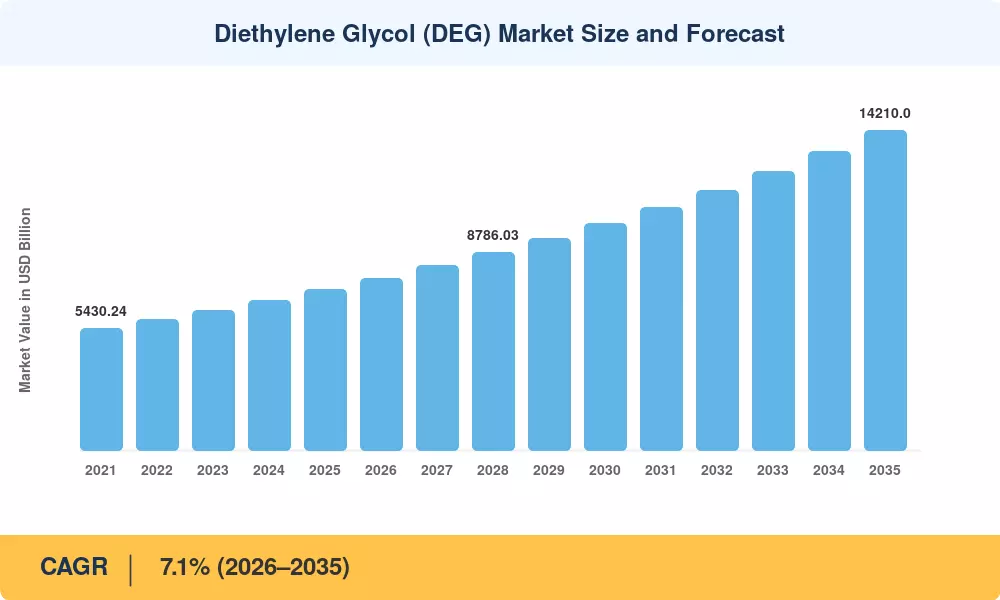
The Diethylene Glycol Market reached an estimated USD 7,150 million in 2025 and is projected to grow from USD 7,660 million in 2026 to USD 14,210 million by 2035, registering a CAGR of 7.1% during the forecast period (2026–2035). This growth trajectory reflects persistent demand for industrial glycol chemicals across construction, automotive, and packaging sectors. Government-backed infrastructure spending in Asia-Pacific—where China's 14th Five-Year Plan earmarks over USD 1.3 trillion for urbanization projects [1]—has created a structural demand floor for polyester resin materials and plasticizer chemicals that feed directly into the Diethylene Glycol Market pipeline.

A quiet but significant shift is reshaping the industrial solvent landscape. Legacy solvent formulations with higher toxicity profiles are gradually giving way to refined glycol ether materials and bio-based chemical intermediates that deliver comparable performance with improved safety margins. The European Chemicals Agency's (ECHA) revised REACH guidelines have accelerated reformulation timelines, pushing producers of antifreeze compounds and unsaturated polyester resins to invest in cleaner process technologies [2]. BASF alone committed EUR 780 million between 2023 and 2027 toward sustainable chemical processing upgrades across its Ludwigshafen complex [3].

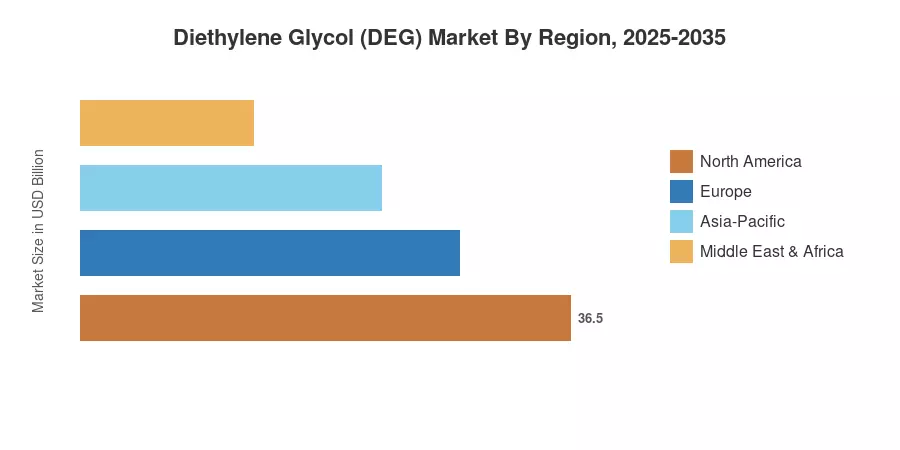
Asia-Pacific commands roughly 48% of the Diethylene Glycol Market, anchored by China and India's combined petrochemical output. The region also leads growth projections with a CAGR of 8.3% through 2035, driven by booming textile and plastics manufacturing. North America holds the second-largest share at approximately 22%, supported by shale-gas feedstock advantages that keep production costs competitive for plasticizer chemicals and related glycol derivatives. As decarbonization mandates tighten globally, the Diethylene Glycol Market stands at an inflection point where sustainability compliance will separate market leaders from laggards.


Key Report Takeaways

• By Application

  • Chemical intermediates account for approximately 34% of total Diethylene Glycol Market revenue, fueled by downstream demand in PET resin and textile fiber production
  • Plasticizer chemicals applications are expanding at a CAGR of 7.8%, the fastest among all application segments, reflecting rising flexible PVC consumption in construction
  • Personal care applications contributed roughly USD 930 million in 2025, as glycol ether materials gained traction in cosmetics formulation

• By End-User Industry

  • The plastics industry represents the dominant end-user within the Diethylene Glycol Market, holding a 38% share, driven by unsaturated polyester resins and packaging demand
  • Paints and coatings end-users are growing at 7.5% CAGR through 2035, supported by infrastructure buildout across emerging economies

• By Region

  • Asia-Pacific leads with 48% of the global Diethylene Glycol Market value, driven by China's petrochemical expansion and India's industrial solvent consumption
  • North America captures roughly USD 1,570 million in 2025, underpinned by cost-efficient ethylene oxide feedstock from shale gas operations
  • South America registers the second-fastest regional CAGR at 6.8%, as Brazil's agrochemical sector increasingly uses industrial glycol chemicals


Market Size and Forecast (2021–2035)

The market sizing methodology combines bottom-up plant capacity analysis with top-down demand modeling. Historical data (2021–2024) draws on disclosed production volumes from major chemical intermediates producers, cross-referenced with trade flow data from UN Comtrade and national customs records. Forecast projections (2026–2035) apply regression-adjusted demand curves incorporating GDP growth, construction output indices, and downstream polyester resin materials consumption trends across 35 countries.
Diethylene Glycol (DEG) Market Size and Forecast
Our Impact
Enabled $4.3B Revenue Impact for Fortune 500 and Leading Multinationals
Partnering with 2000+ Global Organizations Each Year
30K+ Citations by Top-Tier Firms in the Industry

Driver Impact Analysis

Driver ~% Impact on CAGR Geographic Relevance Impact Timeline
Construction boom in emerging economies +1.8% Asia-Pacific, South America Short-term (≤2 yr)
Rising PET resin and textile fiber demand +1.5% Asia-Pacific, Europe Medium-term (2–4 yr)
Growth in paints and coatings consumption +1.1% Global Medium-term (2–4 yr)
Expansion of automotive antifreeze applications +0.8% North America, Europe Short-term (≤2 yr)
Increased use of chemical intermediates in agrochemicals +0.7% South America, Asia-Pacific Long-term (≥4 yr)
Capacity expansions by major petrochemical producers +0.6% Middle East, Asia-Pacific Long-term (≥4 yr)
Bio-based glycol adoption in personal care formulations +0.4% Europe, North America Long-term (≥4 yr)


Construction and Infrastructure Expansion in Emerging Economies

China's urbanization rate is projected to reach 70% by 2030, while India's Smart Cities Mission has channeled over USD 30 billion into infrastructure modernization since 2015 [1]. Both programs drive demand for unsaturated polyester resins used in construction composites and for antifreeze compounds deployed in HVAC systems. The Diethylene Glycol Market benefits directly from these spending cycles, as DEG serves as a critical feedstock for polyester resin materials consumed in pipes, panels, and insulation products. Southeast Asian nations—Vietnam, Indonesia, and the Philippines—are replicating similar urbanization patterns, adding secondary demand nodes that reinforce Asia-Pacific's dominance.

Surging Demand for PET Resin and Textile Fibers

Approximately 82 million metric tons of PET resin were manufactured globally in 2024, with polyester fibres making up between 35 and 40 percent of all textile fibres produced globally. The diethylene glycol market is fundamentally related to the production of textiles and packaging because DEG is a crucial chemical intermediary in the polycondensation process that creates PET. Under the PLI (Production Linked Incentive) program, India's textile exports alone are expected to exceed USD 100 billion by 2030, sustaining increased use of industrial glycol chemicals and related processing fluids.


Paints and Coatings Industry Growth

In 2024, the world's paints and coatings industry utilized more than 46 billion liters of product, with glycol ether compounds accounting for an increasing proportion of solvent systems [8]. In 2024, the demand for architectural coatings in the Asia-Pacific increased by about 5% year over year due to residential building. DEG-based solvents are preferred components in waterborne coating formulations due to their favourable evaporation rates and film-forming qualities. The market for refined plasticizer chemicals made from diethylene glycol is growing due to regulatory changes in North America and Europe that favor low-VOC coatings.


Automotive Antifreeze and Coolant Applications

The global automotive fleet surpassed 1.5 billion vehicles in 2024, and engine coolant replacement cycles generate recurring demand for antifreeze compounds formulated with DEG [9]. Electric vehicle thermal management systems also use glycol-based coolants to regulate battery temperatures, opening a new demand channel. North America and Europe collectively consume over 2.1 million tons of glycol-based antifreeze products annually, ensuring the Diethylene Glycol Market maintains a stable baseline even amid economic downturns.


Restraints Impact Analysis

The restraint impact percentages below represent estimated drag on the overall CAGR and are directional rather than precisely additive. Each estimate reflects scenario modeling across regulatory, commodity, and substitution risk factors.

Restraint ~% Impact on CAGR Geographic Relevance Impact Timeline
Toxicity-related regulatory restrictions on DEG –0.9% Europe, North America Short-term (≤2 yr)
Volatile ethylene oxide raw material prices –0.7% Global Medium-term (2–4 yr)
Substitution risk from propylene glycol alternatives –0.5% North America, Europe Long-term (≥4 yr)
Supply chain disruption and logistics bottlenecks –0.4% Global Short-term (≤2 yr)
Tightening environmental discharge regulations –0.3% Asia-Pacific, Europe Medium-term (2–4 yr)


Toxicity Regulations and Usage Restrictions

DEG's acute toxicity profile has drawn sustained regulatory scrutiny. The European Chemicals Agency classifies DEG under CLP Regulation as harmful if swallowed, and the U.S. FDA enforces strict maximum residue limits in pharmaceutical and food-contact applications [13]. These restrictions compress the addressable Diethylene Glycol Market by excluding high-margin end uses. Compliance costs for manufacturers—including reformulation R&D, labeling, and monitoring—add an estimated 3–5% to operating expenses, disproportionately affecting smaller producers of industrial glycol chemicals.

Ethylene Oxide Feedstock Price Volatility

Ethylene oxide, the primary raw material for DEG production, experienced price swings of ±18% in 2023–2024 due to fluctuating crude oil markets and planned refinery turnarounds [14]. Since feedstock accounts for 55–65% of DEG production costs, these oscillations directly compress margins across the chemical intermediates value chain. Producers lacking long-term supply contracts or backward-integrated ethylene crackers face the highest exposure, which discourages capacity investment and constrains the pace of Diethylene Glycol Market expansion.

Substitution Pressure from Propylene Glycol

In food, pharmaceutical, and personal care applications, propylene glycol has a regulatory advantage over DEG due to its GRAS (Generally Recognized as Safe) designation. Formulators of topical, oral, and consumer-facing formulations are increasingly considering propylene glycol as a direct alternative solvent and humectant as consumer brands place a higher priority on ingredient clarity. The decline of the personal care and specialty chemical markets is a significant long-term obstacle, even if DEG still has cost benefits in large-volume industrial applications like the manufacturing of plasticizer chemicals.


Diethylene Glycol (DEG) Market Opportunities

Expansion of PET Recycling and Circular Economy Initiatives

Global PET recycling rates remain below 30%, presenting a substantial growth opportunity for chemical intermediates used in recycled PET (rPET) production. The EU's Single-Use Plastics Directive mandates 25% recycled content in PET bottles by 2025 and 30% by 2030, creating guaranteed demand for polyester resin materials processing chemicals. DEG plays a role in glycolysis-based PET depolymerization processes, positioning the Diethylene Glycol Market to capture value from circular economy investments.

Bio-Based DEG Development

The development of bio-based glycols from renewable plant-based feedstocks has been shown to be commercially feasible by biochemical pioneers, creating sustainable secondary streams for the production of bio-based DEG. For bio-derived glycol ether products with proven sustainability credentials, European personal care firms are prepared to spend 12–18% more. Participants in the diethylene glycol market who are prepared to invest in green feedstock pathways can increase their margins thanks to this premium positioning.


Emerging Market Industrialization in Southeast Asia and Africa

Vietnam's manufacturing GDP grew 7.4% in 2024, while Ethiopia's industrial park program has attracted over USD 1.5 billion in textile and plastics FDI since 2020. These emerging industrial hubs consume growing volumes of industrial glycol chemicals, antifreeze compounds, and plasticizer chemicals, but lack domestic production capacity. Market incumbents can establish distribution networks and technical service centers to capture early-mover advantages in these high-growth corridors.

Digital Supply Chain and Data Monetization

Major DEG producers are deploying IoT-enabled logistics platforms that track chemical processing fluids from the plant gate to the end-user facility. These platforms generate supply chain visibility data that can be monetized through subscription-based analytics services. Companies offering real-time inventory optimization and predictive demand forecasting for unsaturated polyester resins and related chemical intermediates can differentiate beyond commodity pricing in the Diethylene Glycol Market.

Wind Energy Composite Materials Demand

Global wind energy capacity additions reached 117 GW in 2024, and turbine blades rely heavily on polyester resin materials for structural integrity. Each megawatt of installed wind capacity consumes approximately 8–12 tons of composite resins. As offshore wind deployment accelerates—particularly in Europe and Asia-Pacific—the Diethylene Glycol Market stands to benefit from a sustained structural demand driver independent of traditional construction cycles.


Diethylene Glycol (DEG) Market Future Outlook

Sustainability Mandates and Green Chemistry Transition

The chemical industry's decarbonization trajectory will reshape the Diethylene Glycol Market over the next decade. The IEA's Net Zero Emissions scenario calls for a 20% reduction in petrochemical process emissions by 2030, compelling DEG producers to invest in carbon capture, renewable energy integration, and bio-based feedstocks [18]. Companies that achieve verified Scope 1 and 2 emission reductions will gain preferential supplier status with ESG-conscious end-users in the personal care and automotive sectors that increasingly audit glycol ether materials sourcing.

Digital Manufacturing and Process Optimization

AI-driven process control is reducing DEG production waste by 8–12% in pilot implementations at major chemical intermediates plants [19]. Predictive maintenance algorithms deployed across cracker and glycol reactor systems are cutting unplanned downtime by 15–20%, directly improving asset utilization. Over the forecast period, the Diethylene Glycol Market will increasingly reward producers that integrate digital twins, real-time quality monitoring, and automated supply chain orchestration into their operating models.

Infrastructure Supercycle and Construction Materials Demand

The World Bank estimates that developing economies need USD 2.7 trillion annually in infrastructure investment through 2030 to meet climate and development goals [20]. Construction composites, waterproofing membranes, and architectural coatings all depend on polyester resin materials and plasticizer chemicals derived from DEG. This infrastructure supercycle provides a multi-decade demand foundation for the Diethylene Glycol Market, particularly as India, ASEAN, and Sub-Saharan Africa urbanize at historically unprecedented rates.

Supply Chain Regionalization and Feedstock Diversification

Geopolitical tensions and pandemic-era disruptions have accelerated supply chain regionalization in the chemical industry. New ethylene oxide-to-DEG capacity is being commissioned not only in traditional hubs (Gulf Coast, Jubail, Zhejiang) but also in India's Paradip corridor and Vietnam's Ba Ria–Vung Tau complex. This geographic diversification of industrial glycol chemicals production will moderate price volatility and improve supply security for downstream consumers of antifreeze compounds and chemical processing fluids through 2035.


Diethylene Glycol (DEG) Market Segmentation

By Application

Segment Key Metric Primary Demand Driver
Chemical Intermediates ~34% market share PET resin and polyester fiber manufacturing
Plasticizers CAGR of 7.8% Flexible PVC consumption in construction and packaging
Personal Care ~USD 930 Million (2025) Cosmetic humectants and glycol ether materials formulation
Lubricant ~11% market share Industrial machinery and metalworking fluid applications
Other Applications (Solvent, etc.) CAGR of 6.3% General-purpose industrial solvent products


Chemical intermediates represent the backbone of the Diethylene Glycol Market by application. DEG's role in the polycondensation step of PET production makes it structurally indispensable to the packaging and textile value chains. Global PET demand is projected to grow at 4.5% annually through 2030, pulling chemical intermediates consumption upward in lockstep. China and India account for over 60% of global polyester fiber output, concentrating demand for unsaturated polyester resins and associated glycol feedstocks in the Asia-Pacific.

The plasticizer chemicals segment is the fastest-growing application category, driven by expanding flexible PVC use in construction membranes, cable insulation, and flooring. DEG-based plasticizers offer favorable compatibility and volatility profiles compared to phthalate alternatives facing regulatory phase-outs in Europe and North America. As REACH and TSCA restrictions tighten, formulators of plasticizer chemicals are reformulating around DEG-derived esters, reinforcing this application's growth premium within the Diethylene Glycol Market.

By End-User Industry

Segment Key Metric Primary Demand Driver
Plastics ~38% market share PET packaging and polyester resin materials demand
Paints and Coatings CAGR of 7.5% Architectural and industrial coatings expansion
Agrochemicals ~USD 680 Million (2025) Solvent and carrier fluid in herbicide formulations
Cosmetic and Personal Care ~10% market share Humectant and glycol ether materials in skincare
Other End-user Industries (Textiles, Oil and Gas, etc.) CAGR of 6.5% Diverse industrial glycol chemicals applications


The plastics industry's dominance among Diethylene Glycol Market end-users reflects the sheer scale of global PET and polyester output. Packaging applications—beverage bottles, food containers, thermoformed trays—consume DEG as a chain modifier that improves resin clarity and impact resistance. The sector's continued growth trajectory is reinforced by single-use packaging demand in emerging markets and the rPET recycling wave in developed economies, both of which sustain consumption of industrial glycol chemicals.

Paints and coatings rank as the fastest-growing end-user segment, benefiting from robust construction activity and automotive OEM refinish demand. DEG-based solvents and coalescents are gaining share in waterborne formulations that replace high-VOC traditional systems. The Diethylene Glycol Market sees this segment as particularly resilient to economic cycles because maintenance and renovation coating demand provides a countercyclical buffer alongside new-build activity.


Regional Market Share Analysis

Region Key Metric Primary Investment Themes
Asia-Pacific ~48% market share Petrochemical capacity expansion; textile and construction booms
North America ~22% market share Shale-gas feedstock advantage; automotive antifreeze compounds
Europe CAGR of 5.9% Regulatory-driven reformulation; bio-based glycol ether materials
South America CAGR of 6.8% Agrochemical growth; industrial glycol chemicals adoption
Middle East & Africa ~USD 570 Million (2025) Feedstock-rich capacity additions; downstream integration
Total USD 7,150 Million (2025)

The Diethylene Glycol Market exhibits a concentrated regional profile, with Asia-Pacific and North America collectively accounting for roughly 70% of global demand. Regional consumption patterns reflect local industrial structure—petrochemical processing hubs, construction activity levels, and automotive fleet composition all shape demand for industrial glycol chemicals and downstream derivatives.


North America

Country Key Metric Key Driver
US ~72% of regional share Shale-derived ethylene oxide cost advantage
Canada CAGR of 5.4% Oil sands chemical processing fluids demand
Mexico ~USD 125 Million (2025) Automotive and plasticizer chemicals manufacturing growth


The United States dominates North America's Diethylene Glycol Market share due to its integrated ethylene oxide production base in the Gulf Coast corridor. Dow's Freeport and Plaquemine complexes alone supply a significant portion of regional DEG output. Canada's oil sands operations consume antifreeze compounds and industrial solvent products in extraction and processing, while Mexico's expanding automotive sector drives demand for polyester resin materials used in interior trim and coatings.

Europe

Country Key Metric Key Driver
Germany ~26% of regional share Automotive coatings and chemical intermediates production
UK CAGR of 5.5% Construction sector recovery and personal care formulations
France ~USD 145 Million (2025) Agrochemicals and paints demand
Italy ~12% of regional share Textile and plasticizer chemicals manufacturing
Spain CAGR of 5.8% Construction-led polyester resin materials consumption
Nordic Countries ~USD 85 Million (2025) Wind energy composites and sustainability-driven reformulation
Russia ~9% of regional share Antifreeze compounds for cold-climate automotive fleet
Rest of Europe CAGR of 5.3% Diversified industrial applications


Europe's Diethylene Glycol Market is shaped by REACH compliance timelines that push manufacturers toward refined glycol ether materials with improved toxicological profiles. Germany's automotive OEMs remain the largest single source of regional demand, consuming DEG-based coatings, coolants, and plasticizer chemicals across their supply chains. The EU Green Deal's renovation wave initiative—targeting 35 million buildings by 2030—underpins long-term demand for construction-grade unsaturated polyester resins.

Asia-Pacific

Country Key Metric Key Driver
China ~58% of regional share Massive petrochemical capacity; textile and PET resin output
India CAGR of 9.2% PLI-driven textile expansion; infrastructure modernization
Japan ~USD 320 Million (2025) Automotive and electronics-grade chemical intermediates
South Korea ~7% of regional share Petrochemical exports and polyester resin materials production
ASEAN CAGR of 8.6% Manufacturing FDI inflows; construction of industrial glycol chemicals capacity
Rest of Asia-Pacific ~USD 180 Million (2025) Diversified early-stage industrialization


Asia-Pacific's commanding position in the Diethylene Glycol Market rests on China's integrated ethylene-to-DEG production chain, where Sinopec and PetroChina operate world-scale crackers. India's rapid growth reflects dual tailwinds: the PLI scheme targeting USD 100 billion in textile exports by 2030 and the National Infrastructure Pipeline allocating USD 1.4 trillion to construction projects through 2025 [1]. ASEAN nations—particularly Vietnam and Indonesia—are attracting chemical intermediates manufacturing investment as global supply chains diversify away from single-country concentration.

South America

Country Key Metric Key Driver
Brazil ~62% of regional share Agrochemicals and plastics manufacturing
Argentina CAGR of 6.4% Agricultural chemical processing and antifreeze compounds
Rest of South America ~USD 90 Million (2025) Mining chemicals and emerging polyester resin materials demand


Brazil anchors South America's Diethylene Glycol Market through its large agrochemical production base, where DEG serves as a solvent and chemical intermediate in herbicide and pesticide formulations. The country's Braskem-led bio-chemicals corridor in Rio Grande do Sul is also pioneering bio-based routes to industrial glycol chemicals, potentially reshaping the regional supply landscape by the early 2030s.

Middle East & Africa

Country Key Metric Key Driver
Saudi Arabia ~38% of regional share SABIC-led downstream integration from ethylene oxide
UAE CAGR of 7.3% Construction boom and chemical processing fluids demand
South Africa ~USD 65 Million (2025) Mining and automotive antifreeze compounds
Egypt CAGR of 6.9% Textile manufacturing and plasticizer chemicals imports
Rest of MEA ~22% of regional share Emerging infrastructure and industrial solvent products demand


The Middle East's feedstock-cost advantages give producers like SABIC and Equate competitive positioning in global DEG export markets. Saudi Arabia's Vision 2030 downstream diversification strategy has spurred the construction of new glycol production trains at Jubail and Yanbu industrial cities. Africa's Diethylene Glycol Market contribution remains modest but is growing, with Egypt and South Africa leading regional consumption of unsaturated polyester resins and antifreeze compounds.


Diethylene Glycol (DEG) Market By Region, 2025-2035

Competitive Benchmarking

The Diethylene Glycol Market exhibits low concentration, with the top five players holding an estimated 32–38% combined revenue share. The Herfindahl-Hirschman Index (HHI) sits below 800, confirming a fragmented competitive structure. Market entry barriers center on ethylene oxide feedstock access and integrated cracker-to-glycol production chains rather than proprietary technology, which means regional producers compete effectively in domestic markets while multinationals dominate cross-border trade in chemical intermediates.

Company Est. Revenue Share Range Key Offerings for Diethylene Glycol Market Strategic Positioning
SABIC ~8–11% DEG, MEG, triethylene glycol, polyester resin materials Feedstock-integrated Middle East producer with global distribution
Dow Inc. ~7–10% DEG, ethylene glycol, glycol ether materials, performance solvents Technology leader with a Gulf Coast and European production base
Shell plc ~5–8% DEG, MEG, industrial solvent products Upstream-integrated energy major with chemicals diversification
Sinopec ~6–9% DEG, MEG, PET-grade glycols, chemical intermediates China's largest producer; domestic market dominance
Reliance Industries ~4–7% DEG, MEG, polyester fibers, plasticizer chemicals India's integrated refinery-to-chemicals platform
INEOS Group ~3–5% Ethylene oxide derivatives, antifreeze compounds, glycol ether materials European leader with Köln and Antwerp production hubs
Huntsman Corporation ~3–5% Performance glycols, polyurethane chemical intermediates Specialty-focused portfolio with differentiated margins
LyondellBasell Industries ~2–4% Ethylene oxide, DEG, and industrial glycol chemicals Integrated olefins and polyolefins with glycol co-production
Indian Oil Corporation ~2–4% DEG, MEG, petrochemical processing fluids Indian state-backed producer expanding downstream integration
Formosa Plastics Group ~2–4% DEG, PVC resins, unsaturated polyester resins, plasticizer chemicals Taiwan-headquartered, with US Gulf Coast and Asian capacity


Recent News & Developments

  • SABIC (March 2025): Announced completion of a 200,000-ton-per-year glycol expansion at Jubail Industrial City, increasing Middle East DEG export capacity and reinforcing the company's position in the Diethylene Glycol Market [11]


  • Sinopec (November 2024): Commissioned a new 500,000-ton ethylene oxide unit at Maoming Petrochemical, expanding chemical intermediates output, including DEG for domestic and export markets [21]


  • European Chemicals Agency (June 2024): Published updated harmonized classification guidance for DEG under CLP Regulation, tightening labeling requirements for antifreeze compounds containing >10% diethylene glycol [13]
  • Huntsman Corporation (April 2024): Acquired a specialty glycol blending facility in Jurong Island, Singapore, expanding Asia-Pacific distribution of plasticizer chemicals and industrial solvent products [23]
  • Indian Oil Corporation (February 2024): Began trial production at its Paradip refinery-integrated glycol unit, targeting 120,000 tons of annual DEG capacity to serve India's growing Diethylene Glycol Market demand [24]
  • LyondellBasell (October 2023): Announced a USD 340 million circular economy investment at its Wesseling, Germany site, including glycol recycling infrastructure for unsaturated polyester resins waste streams [25]


Diethylene Glycol (DEG) Market Report Scope

Parameter Detail
Market Scope Global Diethylene Glycol Market Segmented by Application, End-User Industry, and Geography
Study Period 2021–2035
CAGR (Forecast Period) 7.1% (2026–2035)
Market Size — 2025 (Base Year) USD 7,150 Million
Market Size — 2035 (Forecast End) USD 14,210 Million
Fastest Growing Segment Plasticizers (Application); Paints and Coatings (End-User)
Companies Profiled SABIC, Dow Inc., Shell plc, Sinopec, Reliance Industries, INEOS, Huntsman, LyondellBasell, Indian Oil Corporation, Formosa Plastics
Valuation Currency USD Million


FAQs

How does the ethylene oxide feedstock sourcing strategy affect DEG procurement costs?

Buyers sourcing from shale-gas-advantaged Gulf Coast producers typically secure 10–15% lower feedstock-linked pricing than those relying on naphtha-based Asian suppliers. Long-term supply agreements with integrated ethylene oxide producers reduce exposure to spot market volatility [14].

What quality certifications should procurement teams verify when selecting DEG suppliers for personal care applications?

Suppliers must hold ISO 9001 and REACH registration, with COA (Certificate of Analysis) confirming purity ≥99.0% and heavy metal content below 1 ppm. FDA compliance documentation is essential for any cosmetic-grade glycol ether materials [13].

How do DEG-based plasticizers compare to phthalate alternatives in flexible PVC compounding?

DEG-derived plasticizers deliver comparable flexibility and thermal stability at 8–12% lower material cost versus DINP phthalate alternatives. They also avoid the endocrine-disruptor classification that restricts phthalate use in EU consumer products [15].

What role does DEG play in the glycolysis recycling process for PET waste?

DEG serves as a reactive solvent in glycolysis depolymerization, breaking PET chains into bis(2-hydroxyethyl) terephthalate monomers. This chemical recycling route recovers 85–92% of monomer value from post-consumer PET waste [7].

Which storage and handling protocols are critical to maintaining DEG quality during transport?

DEG requires stainless steel or lined carbon steel storage at 15–40°C with nitrogen blanketing to prevent moisture absorption. Dedicated ISO tank containers with heating coils ensure viscosity compliance during cold-weather transport

How are Middle Eastern DEG producers positioned relative to Asian competitors on total delivered cost?

Saudi and Kuwaiti producers hold a 12–18% delivered-cost advantage to European destinations versus Chinese exporters, driven by lower ethane feedstock costs and shorter shipping routes via the Suez Canal [11].

What emerging regulatory risks should investors in the Diethylene Glycol Market monitor over the next five years?

ECHA's ongoing substance evaluation of DEG under CoRAP may trigger additional classification restrictions by 2027. California's Proposition 65 listing review and China's updated GB standards for glycol purity also pose compliance cost risks [13].    
Author
Author
Author Profile
Priya Nagrale LinkedIn
Senior Research Analyst
With an experience of over five years in market research industry (Chemicals & Materials domain), I gather and analyze market data from diverse sources to produce results, which are then presented back to a client. Also, provide recommendations based on the findings. As a Senior Research Analyst, I perform quality checks (QC) for market estimations, QC for reports, and handle queries and work extensively on client customizations. Also, handle the responsibilities of client proposals, report planning, report finalization, and execution

Research Approach


Secondary Research

The secondary research process involved comprehensive analysis of aviation regulatory databases, peer-reviewed aerospace journals, technical publications, and authoritative aviation organizations. Key sources included the Federal Aviation Administration (FAA), European Union Aviation Safety Agency (EASA), International Civil Aviation Organization (ICAO), International Air Transport Association (IATA), National Business Aviation Association (NBAA), General Aviation Manufacturers Association (GAMA), NASA Aviation Safety Reporting System, DOT Bureau of Transportation Statistics, Eurostat Transport Database, Flight Safety Foundation, Royal Aeronautical Society, Society of Automotive Engineers (SAE International), and national civil aviation authority reports from key markets. These sources served to gather regulatory compliance data, safety statistics, adoption trends, technological advancements, and market landscape analysis for portable EFBs, installed EFBs, commercial aviation applications, and military platforms.


Primary Research

Qualitative and quantitative insights were obtained by interviewing supply-side and demand-side stakeholders during the primary research process. The supply-side sources consisted of CEOs, VPs of Engineering, regulatory certification leaders, and commercial directors from aerospace OEMs, aviation software developers, and EFB manufacturers. Airline flight operations directors, chief pilots, aviation safety managers, procurement leads from commercial airlines, military aviation program managers, and regulatory compliance officers from airlines and charter operators constituted demand-side sources. Market segmentation was verified, product certification timelines were verified, and insights regarding operational adoption patterns, pricing strategies, and regulatory compliance dynamics were obtained through primary research.

Primary Respondent Breakdown:

• By Designation: C-level Primaries (32%), Director Level (31%), Others (37%)

• By Region: North America (32%), Europe (29%), Asia-Pacific (31%), Rest of World (8%)


Market Size Estimation

Global market valuation was derived through revenue mapping and aircraft fleet analysis. The methodology included:

• The identification of over 50 prominent EFB manufacturers and software providers in North America, Europe, Asia-Pacific, and Latin America

• Product mapping across hardware, software, installed EFB, and portable EFB categories

• Examination of annual revenues that are specific to EFB portfolios, as reported and modeled

• In 2024, the coverage of manufacturers will account for 70-75% of the global market share

• Extrapolation using bottom-up (aircraft fleet × EFB penetration × ASP by region) and top-down (manufacturer revenue validation) approaches to derive segment-specific valuations

Download Free Sample

Kindly complete the form below to receive a free sample of this Report

Download PDF ×

We do not share your information with anyone. However, we may send you emails based on your report interest from time to time. You may contact us at any time to opt-out.
















