Diethylene Glycol (DEG) Market

ID: MRFR/CnM/1181-HCR
116 Pages
Priya Nagrale
Last Updated: June 22, 2026
Diethylene Glycol Market Research Report Information by Application (Plasticizer, Personal Care, Chemical Intermediates, & Polyester Resins), End-Use Industries (Building and Construction, Plastics, Paints and Coatings, & Polymers), and Region—Forecast till 2035
Download PDF ×

We do not share your information with anyone. However, we may send you emails based on your report interest from time to time. You may contact us at any time to opt-out.

  1. 1 Market Overview |
    1. 1.1 Study Assumptions & Market Definition |
    2. 1.2 Scope of the Study |
    3. 1.3 Research Methodology
  2. 2 Market Summary & Key Takeaways
  3. 3 Market Dynamics |
    1. 3.1 Market Drivers Analysis | |
      1. 3.1.1 Construction Boom in Emerging Economies | |
      2. 3.1.2 Surging Demand for PET Resin and Textile Fibers | |
      3. 3.1.3 Paints and Coatings Industry Growth | |
      4. 3.1.4 Automotive Antifreeze and Coolant Applications | |
      5. 3.1.5 Increased Use of Chemical Intermediates in Agrochemicals | |
      6. 3.1.6 Capacity Expansions by Major Petrochemical Producers | |
      7. 3.1.7 Bio-Based Glycol Adoption in Personal Care Formulations |
    2. 3.2 Market Restraints Analysis | |
      1. 3.2.1 Toxicity-Related Regulatory Restrictions on DEG | |
      2. 3.2.2 Ethylene Oxide Feedstock Price Volatility | |
      3. 3.2.3 Substitution Pressure from Propylene Glycol | |
      4. 3.2.4 Supply Chain Disruption and Logistics Bottlenecks | |
      5. 3.2.5 Tightening Environmental Discharge Regulations |
    3. 3.3 Market Opportunity Analysis | |
      1. 3.3.1 Expansion of PET Recycling and Circular Economy Initiatives | |
      2. 3.3.2 Bio-Based DEG Development | |
      3. 3.3.3 Emerging Market Industrialization in Southeast Asia and Africa | |
      4. 3.3.4 Digital Supply Chain and Data Monetization | |
      5. 3.3.5 Wind Energy Composite Materials Demand |
    4. 3.4 Industry Value Chain Analysis |
    5. 3.5 Porter's Five Forces Analysis
  4. 4 Global Diethylene Glycol Market Size & Forecast (2021–2035) |
    1. 4.1 Historical Market Size (2021–2025) |
    2. 4.2 Current & Forecast Market Size (2026–2035) |
    3. 4.3 Market Size by Revenue (USD Million) |
    4. 4.4 Year-over-Year Growth Analysis
  5. 5 Segmentation Analysis |
    1. 5.1 By Application | |
      1. 5.1.1 Chemical Intermediates | |
      2. 5.1.2 Plasticizers | |
      3. 5.1.3 Personal Care | |
      4. 5.1.4 Lubricant | |
      5. 5.1.5 Other Applications (Solvent, etc.) |
    2. 5.2 By End-User Industry | |
      1. 5.2.1 Plastics | |
      2. 5.2.2 Paints and Coatings | |
      3. 5.2.3 Agrochemicals | |
      4. 5.2.4 Cosmetic and Personal Care | |
      5. 5.2.5 Other End-User Industries (Textiles, Oil and Gas, etc.)
  6. 6 Regional Analysis |
    1. 6.1 North America | |
      1. 6.1.1 United States | |
      2. 6.1.2 Canada | |
      3. 6.1.3 Mexico |
    2. 6.2 Europe | |
      1. 6.2.1 Germany | |
      2. 6.2.2 United Kingdom | |
      3. 6.2.3 France | |
      4. 6.2.4 Italy | |
      5. 6.2.5 Spain | |
      6. 6.2.6 Nordic Countries | |
      7. 6.2.7 Russia | |
      8. 6.2.8 Rest of Europe |
    3. 6.3 Asia-Pacific | |
      1. 6.3.1 China | |
      2. 6.3.2 India | |
      3. 6.3.3 Japan | |
      4. 6.3.4 South Korea | |
      5. 6.3.5 ASEAN | |
      6. 6.3.6 Rest of Asia-Pacific |
    4. 6.4 South America | |
      1. 6.4.1 Brazil | |
      2. 6.4.2 Argentina | |
      3. 6.4.3 Rest of South America |
    5. 6.5 Middle East & Africa | |
      1. 6.5.1 Saudi Arabia | |
      2. 6.5.2 UAE | |
      3. 6.5.3 South Africa | |
      4. 6.5.4 Egypt | |
      5. 6.5.5 Rest of MEA
  7. 7 Competitive Landscape |
    1. 7.1 Market Share Analysis (2025) |
    2. 7.2 Competitive Benchmarking Matrix |
    3. 7.3 Company Profiles | |
      1. 7.3.1 SABIC | |
      2. 7.3.2 Dow Inc. | |
      3. 7.3.3 Shell plc | |
      4. 7.3.4 Sinopec | |
      5. 7.3.5 Reliance Industries | |
      6. 7.3.6 INEOS Group | |
      7. 7.3.7 Huntsman Corporation | |
      8. 7.3.8 LyondellBasell Industries | |
      9. 7.3.9 Indian Oil Corporation | |
      10. 7.3.10 Formosa Plastics Group
  8. 8 Future Outlook & Strategic Recommendations (2026–2035) |
    1. 8.1 Sustainability Mandates and Green Chemistry Transition |
    2. 8.2 Digital Manufacturing and Process Optimization |
    3. 8.3 Infrastructure Supercycle and Construction Materials Demand |
    4. 8.4 Supply Chain Regionalization and Feedstock Diversification
  9. 9 Recent Developments & News
  10. 10 Frequently Asked Questions (FAQs)
  11. 11 Report Scope & Methodology |
    1. 11.1 Study Period & Base Year |
    2. 11.2 Data Sources & Citations |
    3. 11.3 Abbreviations
  12. 12 LIST OF TABLES |
  13. TABLE 1 Global Diethylene Glycol Market Size & Forecast, by Revenue (USD Million), 2021–2035 |
  14. TABLE 2 Global Diethylene Glycol Market – Year-over-Year Growth Analysis, 2021–2035 |
  15. TABLE 3 Global Diethylene Glycol Market – Driver Impact Analysis |
  16. TABLE 4 Global Diethylene Glycol Market – Restraint Impact Analysis |
  17. TABLE 5 Global Diethylene Glycol Market Size, by Application, 2021–2035 (USD Million) |
  18. TABLE 6 Global Diethylene Glycol Market Size, by End-User Industry, 2021–2035 (USD Million) |
  19. TABLE 7 Global Diethylene Glycol Market Size, by Region, 2021–2035 (USD Million) |
  20. TABLE 8 North America Diethylene Glycol Market Size, by Country, 2021–2035 (USD Million) |
  21. TABLE 9 Europe Diethylene Glycol Market Size, by Country, 2021–2035 (USD Million) |
  22. TABLE 10 Asia-Pacific Diethylene Glycol Market Size, by Country, 2021–2035 (USD Million) |
  23. TABLE 11 South America Diethylene Glycol Market Size, by Country, 2021–2035 (USD Million) |
  24. TABLE 12 Middle East & Africa Diethylene Glycol Market Size, by Country, 2021–2035 (USD Million) |
  25. TABLE 13 Competitive Benchmarking Matrix – Global Diethylene Glycol Market, 2025 |
  26. TABLE 14 Company Profiles – Key Players, Global Diethylene Glycol Market |
  27. TABLE 15 Recent Developments & Strategic Announcements, 2023–2025 |
  28. TABLE 16 North America Diethylene Glycol Market Size, by Application, 2021–2035 (USD Million) |
  29. TABLE 17 North America Diethylene Glycol Market Size, by End-User Industry, 2021–2035 (USD Million) |
  30. TABLE 18 Europe Diethylene Glycol Market Size, by Application, 2021–2035 (USD Million) |
  31. TABLE 19 Europe Diethylene Glycol Market Size, by End-User Industry, 2021–2035 (USD Million) |
  32. TABLE 20 Asia-Pacific Diethylene Glycol Market Size, by Application, 2021–2035 (USD Million) |
  33. TABLE 21 Asia-Pacific Diethylene Glycol Market Size, by End-User Industry, 2021–2035 (USD Million) |
  34. TABLE 22 South America Diethylene Glycol Market Size, by Application, 2021–2035 (USD Million) |
  35. TABLE 23 South America Diethylene Glycol Market Size, by End-User Industry, 2021–2035 (USD Million) |
  36. TABLE 24 Middle East & Africa Diethylene Glycol Market Size, by Application, 2021–2035 (USD Million) |
  37. TABLE 25 Middle East & Africa Diethylene Glycol Market Size, by End-User Industry, 2021–2035 (USD Million) |
  38. TABLE 26 Report Scope & Methodology Summary |
  39. TABLE 27 Detailed Sources and Citations
  40. 13 LIST OF FIGURES |
  41. FIGURE 1 Global Diethylene Glycol Market Dynamics (Drivers, Restraints, Opportunities) |
  42. FIGURE 2 Industry Value Chain Analysis – Diethylene Glycol Market |
  43. FIGURE 3 Porter's Five Forces Analysis – Diethylene Glycol Market |
  44. FIGURE 4 Global Diethylene Glycol Market Size Trend & Forecast (USD Million), 2021–2035 |
  45. FIGURE 5 Global Diethylene Glycol Market Share, by Application, 2025 (%) |
  46. FIGURE 6 Global Diethylene Glycol Market Share, by End-User Industry, 2025 (%) |
  47. FIGURE 7 Global Diethylene Glycol Market Share, by Region, 2025 (%) |
  48. FIGURE 8 North America Diethylene Glycol Market Size Trend (USD Million), 2021–2035 |
  49. FIGURE 9 Europe Diethylene Glycol Market Size Trend (USD Million), 2021–2035 |
  50. FIGURE 10 Asia-Pacific Diethylene Glycol Market Size Trend (USD Million), 2021–2035 |
  51. FIGURE 11 South America Diethylene Glycol Market Size Trend (USD Million), 2021–2035 |
  52. FIGURE 12 Middle East & Africa Diethylene Glycol Market Size Trend (USD Million), 2021–2035 |
  53. FIGURE 13 Competitive Landscape – Market Share of Top 10 Players, 2025 (%)

Segmentation Quick Reference

DimensionSub-SegmentsDominant SegmentFastest Growing Segment
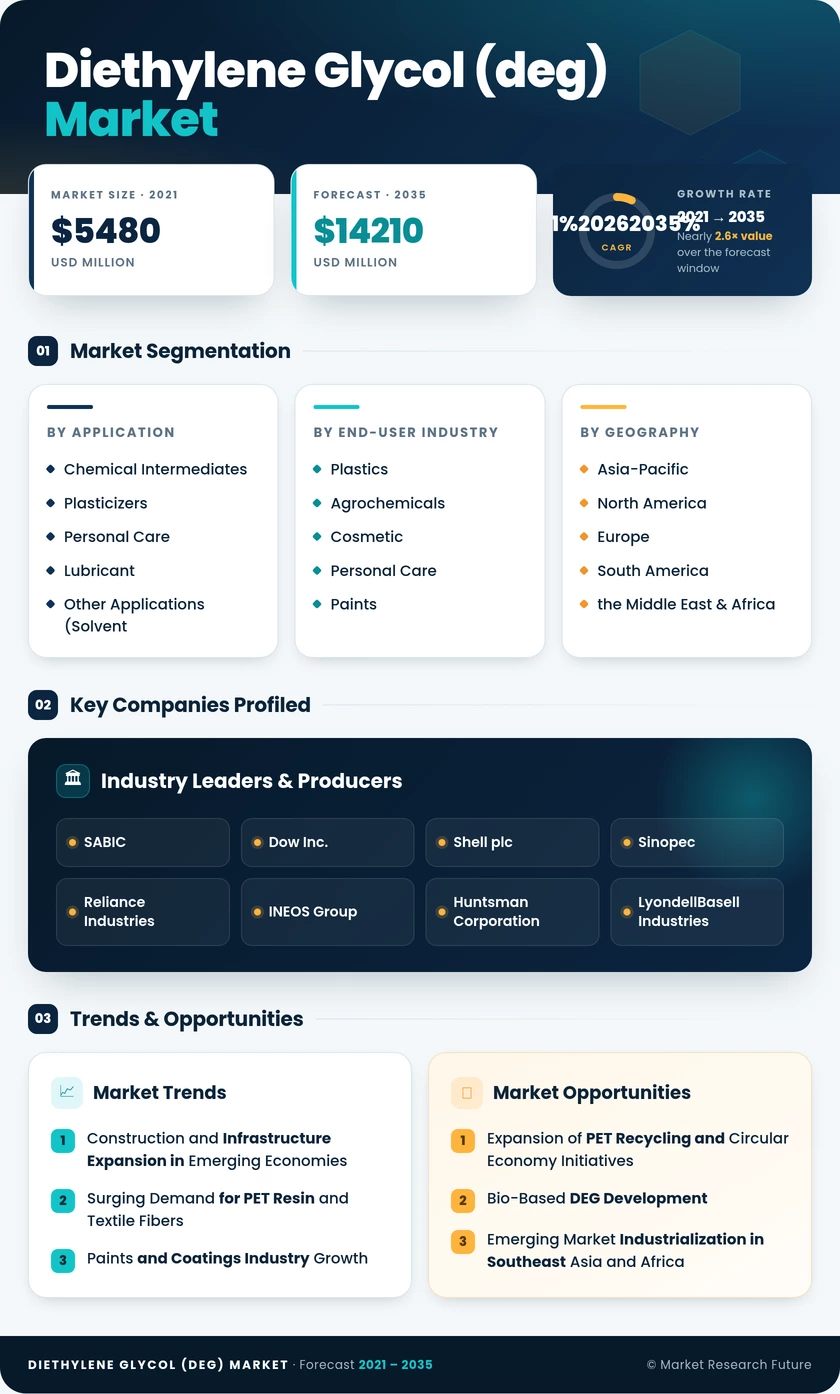
By ApplicationChemical Intermediates, Plasticizers, Personal Care, Lubricant, Other Applications (Solvent, etc.)Chemical IntermediatesPlasticizers
By End-User IndustryPlastics, Agrochemicals, Cosmetic and Personal Care, Paints and Coatings, Other End-User Industries (Textiles, Oil and Gas, etc.)PlasticsPaints and Coatings
By GeographyAsia-Pacific, North America, Europe, South America, the Middle East & AfricaAsia-PacificAsia-Pacific


Market Segmentation Overview

By Application

Sub-SegmentKey Trend
Chemical IntermediatesRising PET and polyester fiber output is driving sustained DEG demand as a processing input
PlasticizersRegulatory phase-out of phthalates redirecting formulators toward DEG-based plasticizer alternatives
Personal CareGrowing consumer preference for glycol-based humectants in skincare and hair care formulations
LubricantStable industrial machinery maintenance cycles supporting steady lubricant-grade DEG consumption
Other Applications (Solvent, etc.)General-purpose solvent demand in coatings, inks, and cleaning products


The application landscape reflects DEG's versatility as both a reactive chemical intermediate and a functional additive. Chemical intermediates consumption dominates due to structural linkage with global PET resin output, while plasticizers represent the fastest-growing application as regulatory shifts create substitution-driven demand.

By End-User Industry

Sub-SegmentKey Trend
PlasticsPET packaging growth and polyester fiber expansion are sustaining a dominant end-user position
AgrochemicalsDEG is used as a solvent and carrier fluid in herbicide and pesticide formulations
Cosmetic and Personal CareClean-label trends driving demand for high-purity glycol ingredients
Paints and CoatingsWaterborne coating transition increasing consumption of DEG-based coalescents and solvents
Other End-User Industries (Textiles, Oil and Gas, etc.)Textile dyeing auxiliaries and oilfield chemical applications provide a diversified demand


End-user segmentation highlights the plastics industry's outsized influence on DEG consumption patterns. Paints and coatings are emerging as the fastest-growing end-user segment, driven by construction-led architectural coatings demand and regulatory-driven transitions toward low-VOC formulation systems.