Request Free Sample ×

Kindly complete the form below to receive a free sample of this Report

* Please use a valid business email

Leading companies partner with us for data-driven Insights

clients tt-cursor
Hero Background

Digital Banking Platform Market

ID: MRFR/BS/33443-HCR
200 Pages
Aarti Dhapte
Last Updated: May 27, 2026
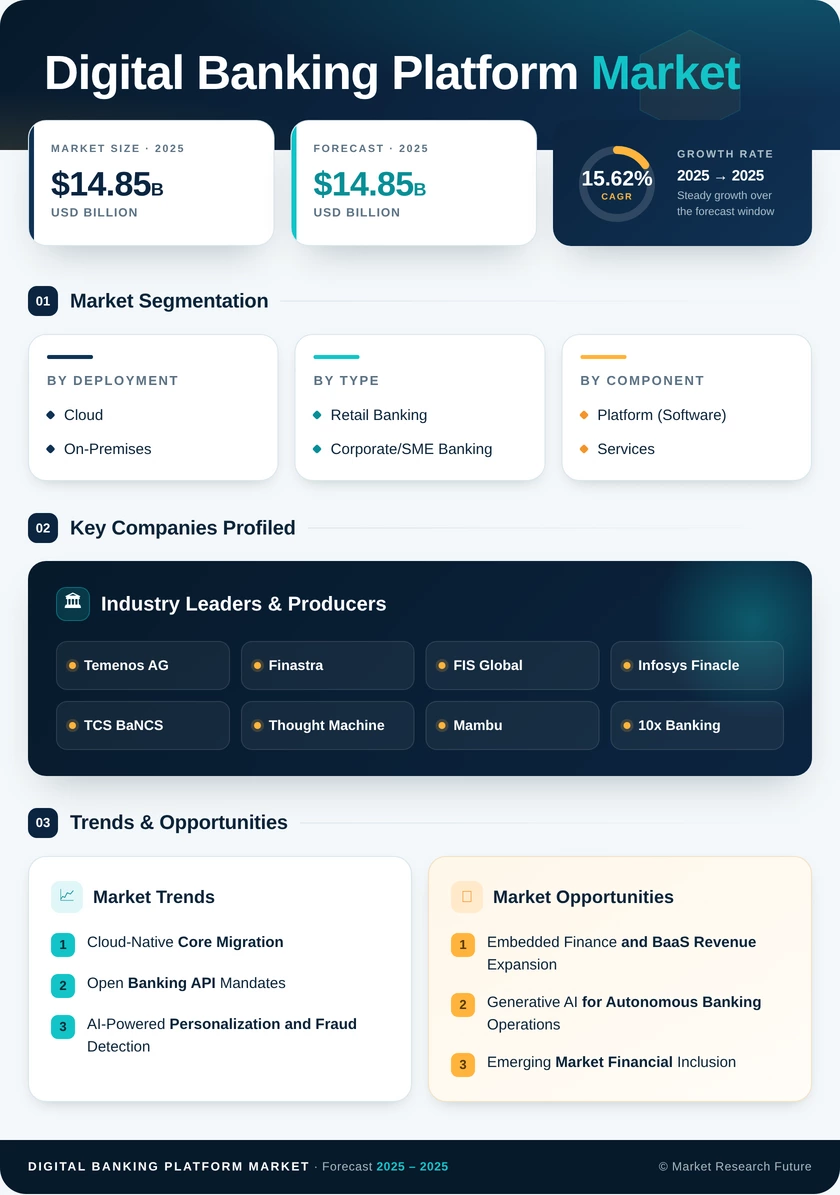
Digital Banking Platform Market Size, Share and Research Report By Deployment Type (Cloud-based, On-premises, Hybrid), By Component (Platform, Services, Solutions), By End User (Banks, Credit Unions, Non-Banking Financial Institutions), By Application (Personal Banking, Corporate Banking, Investment Banking) and By Regional (North America, Europe, South America, Asia Pacific, Middle East and Africa) - Industry Forecast Till 2035
Download PDF ×

We do not share your information with anyone. However, we may send you emails based on your report interest from time to time. You may contact us at any time to opt-out.

  1. 1 Market Overview |
    1. 1.1 Study Assumptions & Market Definition |
    2. 1.2 Scope of the Study |
    3. 1.3 Research Methodology
  2. 2 Market Summary & Key Takeaways
  3. 3 Market Dynamics |
    1. 3.1 Market Drivers Analysis | |
      1. 3.1.1 Cloud-Native Core Migration Mandates | |
      2. 3.1.2 Open Banking API Regulatory Frameworks | |
      3. 3.1.3 AI-Powered Digital Banking Personalization | |
      4. 3.1.4 Mobile-First Banking and Financial Inclusion | |
      5. 3.1.5 Digital Onboarding and eKYC Regulations | |
      6. 3.1.6 Embedded Finance and BaaS Expansion | |
      7. 3.1.7 Real-Time Payments Infrastructure Buildout |
    2. 3.2 Market Restraints Analysis | |
      1. 3.2.1 AML/KYC Compliance Cost Escalation | |
      2. 3.2.2 Vendor Lock-In and Migration Complexity | |
      3. 3.2.3 Data Sovereignty and Localization Mandates | |
      4. 3.2.4 Cybersecurity Threat Escalation | |
      5. 3.2.5 Talent Scarcity in Cloud-Native Engineering |
    3. 3.3 Market Opportunity Analysis | |
      1. 3.3.1 Embedded Finance and BaaS Revenue Expansion | |
      2. 3.3.2 Generative AI for Autonomous Banking Operations | |
      3. 3.3.3 Emerging Market Financial Inclusion | |
      4. 3.3.4 Data Monetization Through Personalization Engines | |
      5. 3.3.5 Real-Time Payments as a Platform Differentiator |
    4. 3.4 Industry Value Chain Analysis |
    5. 3.5 Porter's Five Forces Analysis
  4. 4 Global Digital Banking Platform Market Size & Forecast (2021–2035) |
    1. 4.1 Historical Market Size (2021–2025) |
    2. 4.2 Current & Forecast Market Size (2026–2035) |
    3. 4.3 Market Size by Revenue (USD Billion) |
    4. 4.4 Year-over-Year Growth Analysis
  5. 5 Segmentation Analysis |
    1. 5.1 By Deployment | |
      1. 5.1.1 Cloud | |
      2. 5.1.2 On-Premises |
    2. 5.2 By Banking Type | |
      1. 5.2.1 Retail Banking | |
      2. 5.2.2 Corporate/SME Banking |
    3. 5.3 By Component | |
      1. 5.3.1 Platform (Software) | |
      2. 5.3.2 Services |
    4. 5.4 By Service Model | |
      1. 5.4.1 SaaS Subscription | |
      2. 5.4.2 Licensed | |
      3. 5.4.3 Banking-as-a-Service (BaaS) |
    5. 5.5 By Access Mode | |
      1. 5.5.1 Mobile Banking | |
      2. 5.5.2 Online/Web Banking
  6. 6 Regional Analysis |
    1. 6.1 North America | |
      1. 6.1.1 United States | |
      2. 6.1.2 Canada | |
      3. 6.1.3 Mexico |
    2. 6.2 Europe | |
      1. 6.2.1 Germany | |
      2. 6.2.2 United Kingdom | |
      3. 6.2.3 France | |
      4. 6.2.4 Italy | |
      5. 6.2.5 Spain | |
      6. 6.2.6 Nordic Countries | |
      7. 6.2.7 Russia | |
      8. 6.2.8 Rest of Europe |
    3. 6.3 Asia-Pacific | |
      1. 6.3.1 China | |
      2. 6.3.2 India | |
      3. 6.3.3 Japan | |
      4. 6.3.4 South Korea | |
      5. 6.3.5 ASEAN | |
      6. 6.3.6 Rest of Asia-Pacific |
    4. 6.4 South America | |
      1. 6.4.1 Brazil | |
      2. 6.4.2 Argentina | |
      3. 6.4.3 Rest of South America |
    5. 6.5 Middle East & Africa | |
      1. 6.5.1 Saudi Arabia | |
      2. 6.5.2 UAE | |
      3. 6.5.3 South Africa | |
      4. 6.5.4 Egypt | |
      5. 6.5.5 Rest of MEA
  7. 7 Competitive Landscape |
    1. 7.1 Market Share Analysis (2025) |
    2. 7.2 Competitive Benchmarking Matrix |
    3. 7.3 Company Profiles | |
      1. 7.3.1 Temenos AG | |
      2. 7.3.2 Finastra | |
      3. 7.3.3 FIS Global | |
      4. 7.3.4 Infosys Finacle | |
      5. 7.3.5 TCS BaNCS | |
      6. 7.3.6 Thought Machine | |
      7. 7.3.7 Mambu | |
      8. 7.3.8 10x Banking | |
      9. 7.3.9 Backbase | |
      10. 7.3.10 Oracle Financial Services
  8. 8 Future Outlook & Strategic Recommendations (2026–2035) |
    1. 8.1 Autonomous Finance and Agentic AI (2026–2029) |
    2. 8.2 Platform Economics and Marketplace Banking (2027–2031) |
    3. 8.3 Regulatory Convergence and Global Interoperability (2028–2033) |
    4. 8.4 Sustainability-Linked Banking and ESG Data Integration (2030–2035)
  9. 9 Recent Developments & News
  10. 10 Frequently Asked Questions (FAQs)
  11. 11 Report Scope & Methodology |
    1. 11.1 Study Period & Base Year |
    2. 11.2 Data Sources & Citations |
    3. 11.3 Abbreviations
  12. 1 LIST OF TABLES
  13. 2 LIST OF FIGURES

Segmentation Quick Reference

DimensionSub-SegmentsDominant SegmentFastest Growing Segment
DeploymentCloud, On-PremisesCloudOn-Premises (by CAGR)
Banking TypeRetail Banking, Corporate/SME BankingRetail BankingCorporate/SME Banking
ComponentPlatform (Software), ServicesPlatform (Software)Services
Service ModelSaaS Subscription, Licensed, Banking-as-a-Service (BaaS)SaaS SubscriptionBanking-as-a-Service (BaaS)
Access ModeMobile Banking, Online/Web BankingOnline/Web BankingMobile Banking


Market Segmentation Overview

By Deployment

Sub-SegmentKey Trend
CloudMigration from on-premises to multi-cloud and hybrid-cloud architectures accelerates as hyperscalers invest in banking-grade compliance certifications
On-PremisesRetains relevance in data-sovereign jurisdictions; gradual shift toward private-cloud-on-premises hybrid models


Cloud deployment continues to reshape the digital banking platform market as banks seek operational agility, reduced infrastructure overhead, and faster innovation cycles through cloud-native digital banking core platforms.

By Banking Type

Sub-SegmentKey Trend
Retail BankingNeobank competition forces incumbents to upgrade digital channels, digital onboarding, and eKYC for banking, and personalization engines
Corporate/SME BankingTreasury management digitization and API-based supply chain finance create high-growth opportunities


Retail banking drives the majority of the digital banking platform market revenue today, but corporate/SME banking is the fastest-growing segment as enterprises demand real-time cash visibility and automated multi-bank connectivity.

By Component

Sub-SegmentKey Trend
Platform (Software)Core processing, engagement layers, and analytics modules form the technology backbone
ServicesImplementation, managed services, and consulting grow as migration complexity increases


Platform software dominates by value, while services expand at the highest rate due to the specialized expertise required for cloud-native digital banking core platforms migration and ongoing optimization.

By Service Model

Sub-SegmentKey Trend
SaaS SubscriptionPredictable opex model gains preference among Tier 2 and Tier 3 banks
LicensedOn-premises perpetual licensing persists in large Tier 1 institutions with deep customization needs
Banking-as-a-Service (BaaS)Non-bank brands embed financial services through open banking API for digital financial services; fastest-growing model


BaaS represents the most disruptive service model in the digital banking platform market, enabling any brand with distribution reach to offer banking products without a full banking license.

By Access Mode

Sub-SegmentKey Trend
Mobile BankingSmartphone-first consumer behavior and biometric authentication drive the fastest channel growth
Online/Web BankingDesktop-centric workflows remain dominant in corporate banking; gradual convergence with mobile UX


Mobile banking is reshaping user expectations across the digital banking platform market, with AI-powered digital banking personalization and biometric-secured transactions becoming standard features in mobile-first platform architectures.