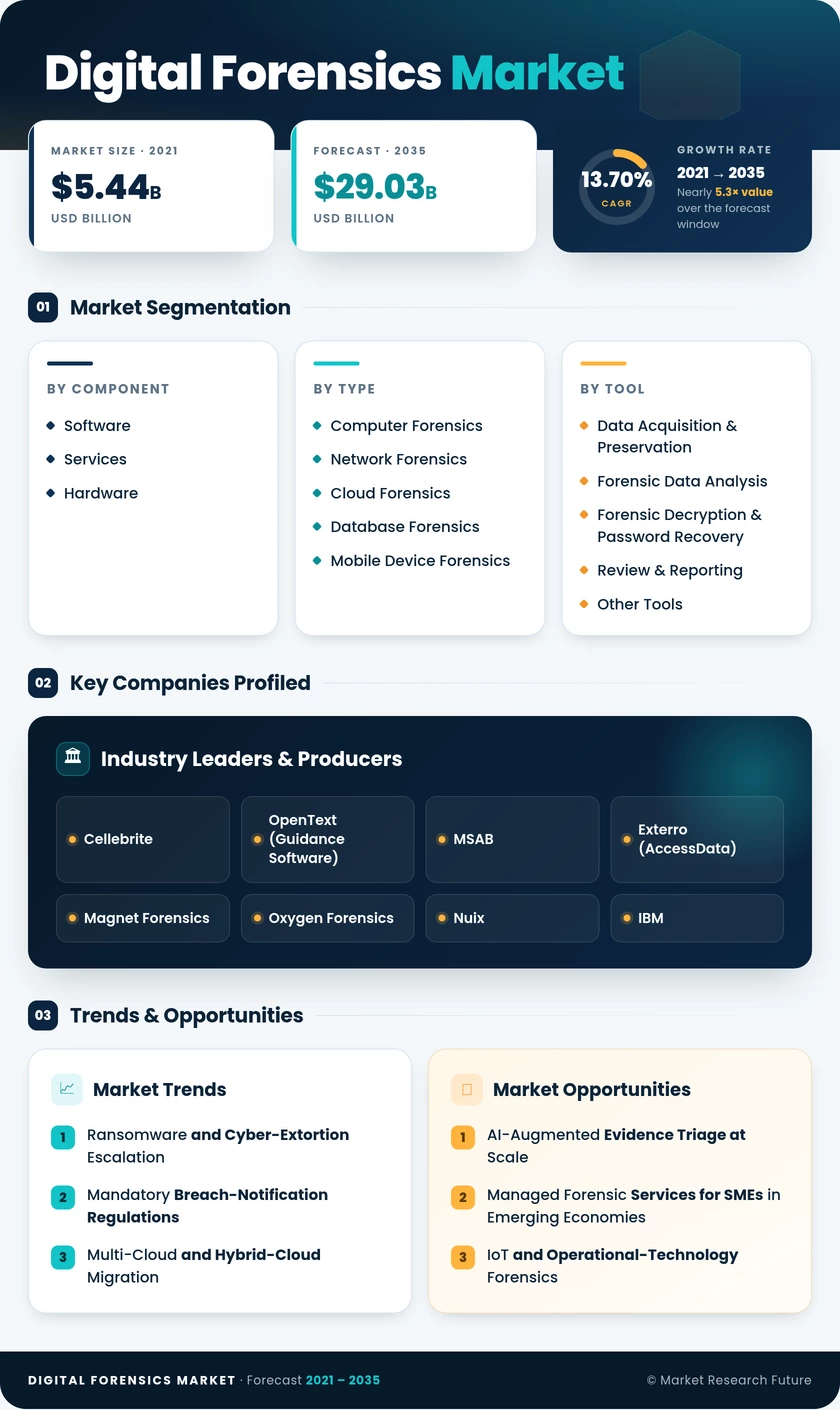
Segmentation Quick Reference
| Dimension | Sub-Segments | Dominant Segment | Fastest Growing Segment |
| Component | Software, Services, Hardware | Software | Services |
| Type | Computer Forensics, Network Forensics, Cloud Forensics, Database Forensics, Mobile Device Forensics, Other Types | Computer Forensics | Cloud Forensics |
| Tool | Data Acquisition & Preservation, Forensic Data Analysis, Forensic Decryption & Password Recovery, Review & Reporting, Other Tools | Data Acquisition & Preservation | Forensic Decryption & Password Recovery |
| Organization Size | Large Enterprises, Small & Medium Enterprises | Large Enterprises | Small & Medium Enterprises |
| End-User Vertical | Government & Law Enforcement, BFSI, Digital Forensics Market, IT & Telecom, Education, Other Verticals | Government & Law Enforcement | Digital Forensics Market |
| Geography | North America, Europe, Asia-Pacific, South America, Middle East & Africa | North America | Asia-Pacific |
Market Segmentation Overview
By Component
| Sub-Segment | Key Trend |
| Software | Shift from perpetual licenses to cloud-delivered SaaS forensic platforms |
| Services | Managed investigation retainers, replacing ad hoc engagement models |
| Hardware | Portable acquisition devices incorporating NVMe and USB4 interfaces |
Software dominates the component mix as vendors consolidate acquisition, analysis, and reporting into unified cloud platforms. Managed services are gaining rapid traction among organizations that lack in-house certified forensic examiners and prefer outcome-based pricing.
By Type
| Sub-Segment | Key Trend |
| Computer Forensics | Continued relevance for law-enforcement criminal caseloads |
| Network Forensics | Deep packet inspection integrated with NDR platforms |
| Cloud Forensics | Multi-cloud evidence collection across AWS, Azure, and GCP |
| Database Forensics | Insider-threat detection and data-integrity verification |
| Mobile Device Forensics | Advanced extraction from encrypted and locked devices |
| Other Types | Emerging IoT and OT forensic methodologies |
Computer forensics remains the largest type segment, while cloud forensics is expanding fastest as enterprise workloads migrate away from on-premises infrastructure and traditional imaging techniques become inadequate.
By Tool
| Sub-Segment | Key Trend |
| Data Acquisition & Preservation | Real-time evidence capture with blockchain-anchored integrity logs |
| Forensic Data Analysis | AI-powered timeline reconstruction and anomaly detection |
| Forensic Decryption & Password Recovery | GPU-accelerated decryption for full-disk and file-level encryption |
| Review & Reporting | Automated court-ready report generation |
| Other Tools | Specialized tools for SCADA/ICS environments |
Data acquisition and preservation tools lead due to their foundational role in every investigation workflow. Forensic decryption is accelerating as ubiquitous encryption makes password recovery a prerequisite for evidence access.
By Organization Size
| Sub-Segment | Key Trend |
| Large Enterprises | In-house forensic labs with dedicated examiner teams |
| Small & Medium Enterprises | Outsourced forensic services driven by cyber-insurance mandates |
Large enterprises invest heavily in proprietary forensic infrastructure, while SMEs increasingly rely on managed-service providers to meet compliance and insurance requirements at predictable monthly costs.
By End-User Vertical
| Sub-Segment | Key Trend |
| Government & Law Enforcement | Expanding cybercrime units and digital evidence laboratories |
| BFSI | Real-time fraud investigation and regulatory compliance |
| Digital Forensics Market | Breach investigation mandated by HIPAA/HITECH |
| IT & Telecom | Service-provider incident response and SLA compliance |
| Education | Student-data protection under FERPA and international equivalents |
| Other Verticals | Retail, energy, and manufacturing OT forensics adoption |
Government and law enforcement remain the largest vertical, while healthcare is accelerating fastest due to the sharp rise in patient-data breaches and tightening regulatory scrutiny worldwide.