Digital Forensics Market Summary
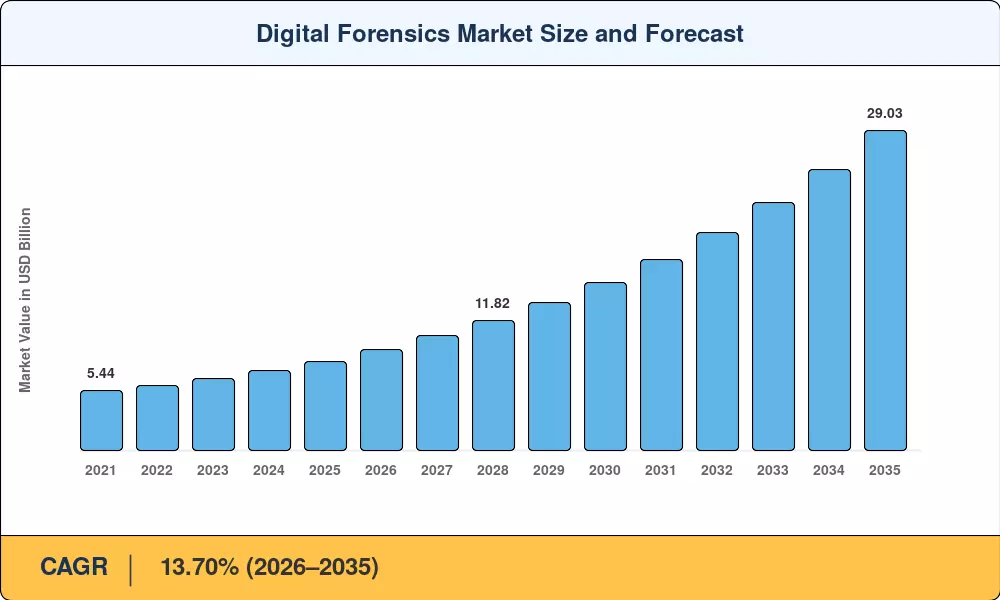
The Digital Forensics Market reached an estimated USD 8.11 Billion in 2025 and is projected to climb from USD 9.14 Billion in 2026 to USD 29.03 Billion by 2035, expanding at a 13.70% CAGR during the forecast period. Two forces are shaping this trajectory: first, mandatory breach-notification timelines under frameworks such as the EU's NIS2 Directive (72-hour reporting) and the U.S. SEC cyber-disclosure rule are compelling enterprises to invest in rapid evidence-capture platforms [1]. Second, the explosion of ransomware attacks — costing organizations an estimated USD 265 Billion globally by 2031 according to sources [2] — has turned forensic readiness from a compliance checkbox into a board-level priority.
The technology landscape is shifting decisively from legacy on-premises forensic toolkits toward cloud-native platforms that can ingest container logs, serverless execution traces, and volatile memory images from multi-cloud environments. Vendors integrating forensic data-lake connectors into extended detection and response (XDR) architectures are displacing point solutions, and enterprises are migrating from one-time tool purchases to outcome-based managed-service retainers. estimates that over 60% of digital evidence collected by 2028 will originate from cloud or hybrid infrastructure rather than physical endpoints [3].
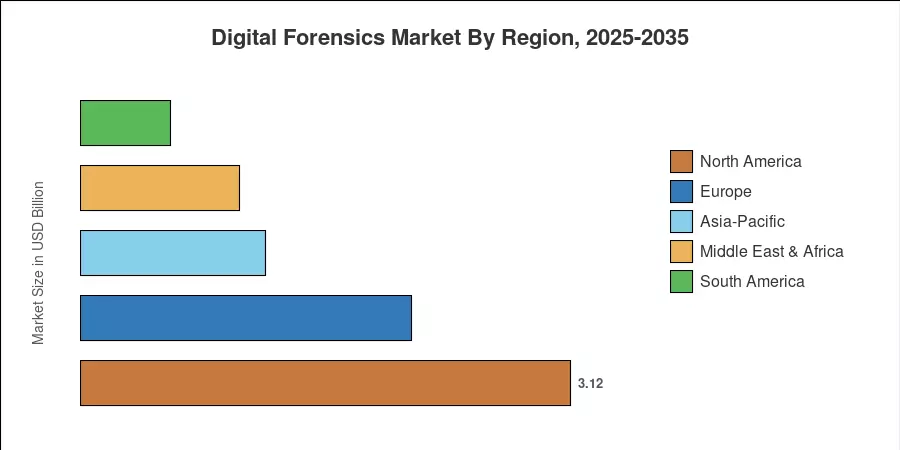
North America commands the largest share of the Digital Forensics Market at approximately 38.5% of 2025 revenue, driven by federal investment in cybercrime task forces and a dense concentration of forensic technology vendors. Asia-Pacific is the fastest-growing region, forecast to register a 14.6% CAGR through 2035 as digitization programs in India, China, and ASEAN nations expand attack surfaces — and therefore forensic demand. Europe follows as the second-largest region, contributing roughly 26% of global spend, underpinned by GDPR enforcement and cross-border digital evidence sharing under the e-Evidence Regulation [4]. The next decade will see the Digital Forensics Market increasingly converge with AI-driven threat intelligence, creating a unified evidence-to-action pipeline.
Key Report Takeaways
• By Component
- Software accounted for roughly 51% of the Digital Forensics Market in 2025, reflecting sustained demand for automated evidence analysis engines.
- Managed forensic services are projected to reach a 14.3% CAGR through 2035 as organizations outsource complex investigations to specialist providers.
• By Type
- Computer forensics represented about 30% of total market revenue in 2025, anchored by law-enforcement caseloads.
- Cloud forensics is the fastest-expanding type within the Digital Forensics Market, growing at a 14.8% CAGR to 2035.
• By End-User Vertical
- Government and law-enforcement agencies led end-user spending with approximately 39% of 2025 revenue.
- Healthcare is the fastest-growing vertical at an estimated 13.5% CAGR, propelled by HIPAA audit requirements and rising patient-data breaches.
• By Region
- North America captured 38.5% of 2025 revenue in the Digital Forensics Market.
- Asia-Pacific is forecast to post the highest regional CAGR of 14.6% through 2035.
Market Size and Forecast (2021–2035)
Market Research Future employs a bottom-up revenue model aggregating vendor disclosures, government procurement records, and end-user spending surveys across 35 countries. Historical data (2021–2024) relies on audited financials and tracker databases, while forecast-period projections (2026–2035) apply segment-level growth assumptions validated against macroeconomic and regulatory catalysts.