Request Free Sample ×

Kindly complete the form below to receive a free sample of this Report

* Please use a valid business email

Leading companies partner with us for data-driven Insights

clients tt-cursor
Hero Background

Digital Marketing Software Market

ID: MRFR/ICT/3507-CR
100 Pages
Aarti Dhapte
Last Updated: June 01, 2026
Digital Marketing Software Market Size, Share and Research Report: By Type (Interaction Systems, Data & Analytics System, Content Production & Management, Management & Administration-Oriented Apps), By Application (Retail, Manufacturing, BFSI, High Tech & IT, Media & Entertainment, Others) - Industry Forecast to 2035
Download PDF ×

We do not share your information with anyone. However, we may send you emails based on your report interest from time to time. You may contact us at any time to opt-out.

  1. 1 Market Overview |
    1. 1.1 Study Assumptions & Market Definition |
    2. 1.2 Scope of the Study |
    3. 1.3 Research Methodology
  2. 2 Market Summary & Key Takeaways
  3. 3 Market Dynamics |
    1. 3.1 Market Drivers Analysis | |
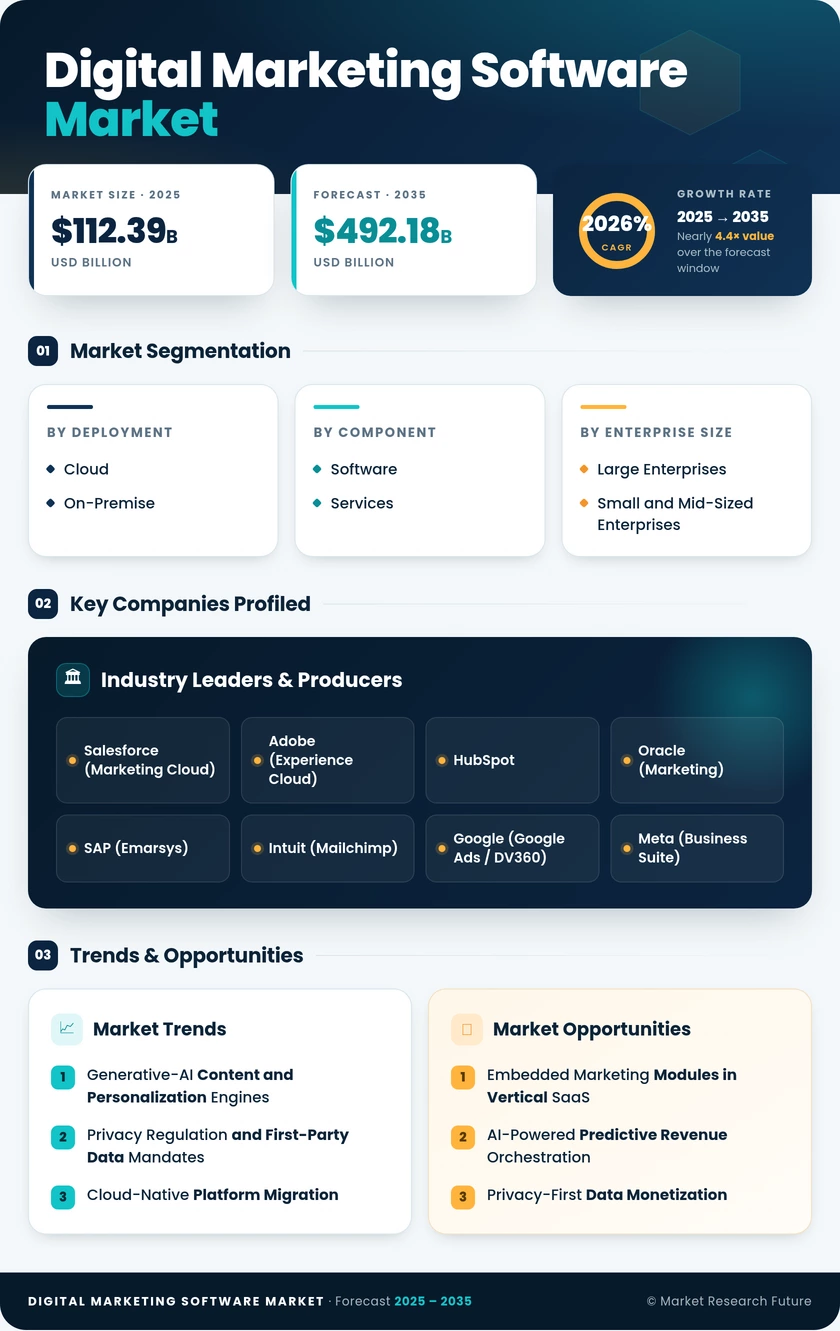
      1. 3.1.1 Generative-AI Content and Personalization Engines | |
      2. 3.1.2 Privacy Regulation and First-Party Data Mandates | |
      3. 3.1.3 Cloud-Native Platform Migration | |
      4. 3.1.4 SME Self-Serve and Usage-Based Pricing | |
      5. 3.1.5 Convergence of CRM-Commerce-Payment Stacks | |
      6. 3.1.6 Mobile-First Commerce Growth in Emerging Markets | |
      7. 3.1.7 Programmatic and Connected-TV Ad-Spend Expansion |
    2. 3.2 Market Restraints Analysis | |
      1. 3.2.1 Data-Privacy Compliance Complexity | |
      2. 3.2.2 Integration Fatigue and Martech Sprawl | |
      3. 3.2.3 Talent Shortage in Data Analytics and AI Operations | |
      4. 3.2.4 Ad-Fraud and Brand-Safety Concerns | |
      5. 3.2.5 Vendor Lock-In and Switching Costs |
    3. 3.3 Market Opportunity Analysis | |
      1. 3.3.1 Embedded Marketing Modules in Vertical SaaS | |
      2. 3.3.2 AI-Powered Predictive Revenue Orchestration | |
      3. 3.3.3 Privacy-First Data Monetization | |
      4. 3.3.4 Emerging-Market Mobile Commerce Expansion | |
      5. 3.3.5 Connected-TV and Audio Programmatic Advertising |
    4. 3.4 Industry Value Chain Analysis |
    5. 3.5 Porter's Five Forces Analysis
  4. 4 Global Digital Marketing Software Market Size & Forecast (2021–2035) |
    1. 4.1 Historical Market Size (2021–2025) |
    2. 4.2 Current & Forecast Market Size (2026–2035) |
    3. 4.3 Market Size by Revenue (USD Billion) |
    4. 4.4 Year-over-Year Growth Analysis
  5. 5 Segmentation Analysis |
    1. 5.1 By Deployment | |
      1. 5.1.1 Cloud | |
      2. 5.1.2 On-Premise |
    2. 5.2 By Component | |
      1. 5.2.1 Software | |
      2. 5.2.2 Services |
    3. 5.3 By Enterprise Size | |
      1. 5.3.1 Large Enterprises | |
      2. 5.3.2 Small and Mid-Sized Enterprises |
    4. 5.4 By End-User Industry | |
      1. 5.4.1 Retail & E-Commerce | |
      2. 5.4.2 Healthcare & Life Sciences | |
      3. 5.4.3 IT & Telecom | |
      4. 5.4.4 Media & Entertainment | |
      5. 5.4.5 BFSI | |
      6. 5.4.6 Others (Education, Government, Non-Profit)
  6. 6 Regional Analysis |
    1. 6.1 North America | |
      1. 6.1.1 United States | |
      2. 6.1.2 Canada | |
      3. 6.1.3 Mexico |
    2. 6.2 Europe | |
      1. 6.2.1 Germany | |
      2. 6.2.2 United Kingdom | |
      3. 6.2.3 France | |
      4. 6.2.4 Italy | |
      5. 6.2.5 Spain | |
      6. 6.2.6 Nordic Countries | |
      7. 6.2.7 Russia | |
      8. 6.2.8 Rest of Europe |
    3. 6.3 Asia-Pacific | |
      1. 6.3.1 China | |
      2. 6.3.2 India | |
      3. 6.3.3 Japan | |
      4. 6.3.4 South Korea | |
      5. 6.3.5 ASEAN | |
      6. 6.3.6 Rest of Asia-Pacific |
    4. 6.4 South America | |
      1. 6.4.1 Brazil | |
      2. 6.4.2 Argentina | |
      3. 6.4.3 Rest of South America |
    5. 6.5 Middle East & Africa | |
      1. 6.5.1 Saudi Arabia | |
      2. 6.5.2 UAE | |
      3. 6.5.3 South Africa | |
      4. 6.5.4 Egypt | |
      5. 6.5.5 Rest of MEA
  7. 7 Competitive Landscape |
    1. 7.1 Market Share Analysis (2025) |
    2. 7.2 Competitive Benchmarking Matrix |
    3. 7.3 Company Profiles | |
      1. 7.3.1 Salesforce (Marketing Cloud) | |
      2. 7.3.2 Adobe (Experience Cloud) | |
      3. 7.3.3 HubSpot | |
      4. 7.3.4 Oracle (Marketing) | |
      5. 7.3.5 SAP (Emarsys) | |
      6. 7.3.6 Intuit (Mailchimp) | |
      7. 7.3.7 Google (Google Ads / DV360) | |
      8. 7.3.8 Meta (Business Suite) | |
      9. 7.3.9 Zoho (Marketing Plus) | |
      10. 7.3.10 Brevo
  8. 8 Future Outlook & Strategic Recommendations (2026–2035) |
    1. 8.1 AI-Autonomous Marketing Operations |
    2. 8.2 Platform Consolidation and Super-Suite Economics |
    3. 8.3 Privacy-Centric Advertising Infrastructure |
    4. 8.4 Edge-Compute Personalization and Real-Time Decisioning
  9. 9 Recent Developments & News
  10. 10 Frequently Asked Questions (FAQs)
  11. 11 Report Scope & Methodology |
    1. 11.1 Study Period & Base Year |
    2. 11.2 Data Sources & Citations |
    3. 11.3 Abbreviations
  12. 12 LIST OF TABLES |
  13. TABLE 1 Global Digital Marketing Software Market Size & Forecast, by Revenue (USD Billion), 2021–2035 |
  14. TABLE 2 Global Digital Marketing Software Market — Year-over-Year Growth Analysis, 2021–2035 |
  15. TABLE 3 Driver Impact Analysis — Digital Marketing Software Market, 2026–2035 |
  16. TABLE 4 Restraint Impact Analysis — Digital Marketing Software Market, 2026–2035 |
  17. TABLE 5 Regional Market Share Summary — Digital Marketing Software Market, 2025 |
  18. TABLE 6 North America Digital Marketing Software Market Size, by Country, 2021–2035 (USD Billion) |
  19. TABLE 7 Europe Digital Marketing Software Market Size, by Country, 2021–2035 (USD Billion) |
  20. TABLE 8 Asia-Pacific Digital Marketing Software Market Size, by Country, 2021–2035 (USD Billion) |
  21. TABLE 9 South America Digital Marketing Software Market Size, by Country, 2021–2035 (USD Billion) |
  22. TABLE 10 Middle East & Africa Digital Marketing Software Market Size, by Country, 2021–2035 (USD Billion) |
  23. TABLE 11 Global Digital Marketing Software Market Size, by Deployment, 2021–2035 (USD Billion) |
  24. TABLE 12 Global Digital Marketing Software Market Size, by Component, 2021–2035 (USD Billion) |
  25. TABLE 13 Global Digital Marketing Software Market Size, by Enterprise Size, 2021–2035 (USD Billion) |
  26. TABLE 14 Global Digital Marketing Software Market Size, by End-User Industry, 2021–2035 (USD Billion) |
  27. TABLE 15 Competitive Benchmarking Matrix — Digital Marketing Software Market, 2025 |
  28. TABLE 16 Company Profiles — Key Players, Digital Marketing Software Market |
  29. TABLE 17 Recent Developments & Strategic Announcements, 2023–2025 |
  30. TABLE 18 Report Scope & Methodology Summary |
  31. TABLE 19 Detailed Sources and Citations |
  32. TABLE 20 North America Digital Marketing Software Market Size, by Deployment, 2021–2035 (USD Billion) |
  33. TABLE 21 North America Digital Marketing Software Market Size, by Component, 2021–2035 (USD Billion) |
  34. TABLE 22 North America Digital Marketing Software Market Size, by Enterprise Size, 2021–2035 (USD Billion) |
  35. TABLE 23 North America Digital Marketing Software Market Size, by End-User Industry, 2021–2035 (USD Billion) |
  36. TABLE 24 Europe Digital Marketing Software Market Size, by Deployment, 2021–2035 (USD Billion) |
  37. TABLE 25 Europe Digital Marketing Software Market Size, by Component, 2021–2035 (USD Billion) |
  38. TABLE 26 Europe Digital Marketing Software Market Size, by Enterprise Size, 2021–2035 (USD Billion) |
  39. TABLE 27 Europe Digital Marketing Software Market Size, by End-User Industry, 2021–2035 (USD Billion) |
  40. TABLE 28 Asia-Pacific Digital Marketing Software Market Size, by Deployment, 2021–2035 (USD Billion) |
  41. TABLE 29 Asia-Pacific Digital Marketing Software Market Size, by Component, 2021–2035 (USD Billion) |
  42. TABLE 30 Asia-Pacific Digital Marketing Software Market Size, by Enterprise Size, 2021–2035 (USD Billion) |
  43. TABLE 31 Asia-Pacific Digital Marketing Software Market Size, by End-User Industry, 2021–2035 (USD Billion) |
  44. TABLE 32 South America Digital Marketing Software Market Size, by Deployment, 2021–2035 (USD Billion) |
  45. TABLE 33 South America Digital Marketing Software Market Size, by Component, 2021–2035 (USD Billion) |
  46. TABLE 34 South America Digital Marketing Software Market Size, by Enterprise Size, 2021–2035 (USD Billion) |
  47. TABLE 35 South America Digital Marketing Software Market Size, by End-User Industry, 2021–2035 (USD Billion) |
  48. TABLE 36 Middle East & Africa Digital Marketing Software Market Size, by Deployment, 2021–2035 (USD Billion) |
  49. TABLE 37 Middle East & Africa Digital Marketing Software Market Size, by Component, 2021–2035 (USD Billion) |
  50. TABLE 38 Middle East & Africa Digital Marketing Software Market Size, by Enterprise Size, 2021–2035 (USD Billion) |
  51. TABLE 39 Middle East & Africa Digital Marketing Software Market Size, by End-User Industry, 2021–2035 (USD Billion)
  52. 13 LIST OF FIGURES |
  53. FIGURE 1 Digital Marketing Software Market Dynamics — Drivers, Restraints, Opportunities |
  54. FIGURE 2 Industry Value Chain Analysis — Digital Marketing Software Market |
  55. FIGURE 3 Porter's Five Forces Analysis — Digital Marketing Software Market |
  56. FIGURE 4 Global Digital Marketing Software Market Size Trend (USD Billion), 2021–2035 |
  57. FIGURE 5 Digital Marketing Software Market Share, by Deployment, 2025 (%) |
  58. FIGURE 6 Digital Marketing Software Market Share, by Component, 2025 (%) |
  59. FIGURE 7 Digital Marketing Software Market Share, by Enterprise Size, 2025 (%) |
  60. FIGURE 8 Digital Marketing Software Market Share, by End-User Industry, 2025 (%) |
  61. FIGURE 9 Digital Marketing Software Market Share, by Region, 2025 (%) |
  62. FIGURE 10 North America Digital Marketing Software Market Size Trend (USD Billion), 2021–2035 |
  63. FIGURE 11 Europe Digital Marketing Software Market Size Trend (USD Billion), 2021–2035 |
  64. FIGURE 12 Asia-Pacific Digital Marketing Software Market Size Trend (USD Billion), 2021–2035 |
  65. FIGURE 13 South America Digital Marketing Software Market Size Trend (USD Billion), 2021–2035 |
  66. FIGURE 14 Middle East & Africa Digital Marketing Software Market Size Trend (USD Billion), 2021–2035 |
  67. FIGURE 15 Competitive Landscape — Market Share Distribution, 2025

Segmentation Quick Reference

Dimension Sub-Segments Dominant Segment Fastest Growing Segment
Deployment Cloud, On-Premise Cloud Cloud
Component Software, Services Software Services
Enterprise Size Large Enterprises, Small and Mid-Sized Enterprises Large Enterprises Small and Mid-Sized Enterprises
End-User Industry Retail & E-Commerce, Healthcare & Life Sciences, IT & Telecom, Media & Entertainment, BFSI, Others Retail & E-Commerce Healthcare & Life Sciences
Geography North America, Europe, Asia-Pacific, South America, Middle East & Africa North America Asia-Pacific


Market Segmentation Overview

By Deployment

Sub-Segment Key Trend
Cloud Dominant delivery model; accelerated by OpEx preference, AI-readiness, and self-serve provisioning
On-Premise Retained by regulated industries (banking, defense, healthcare) requiring data-sovereignty compliance


Cloud deployment continues to widen its lead as marketing teams demand elastic scalability for real-time campaign execution, AI model inference, and cross-channel data unification. On-premise solutions serve a niche but durable segment where regulatory mandates prohibit data leaving sovereign infrastructure.

By Component

Sub-Segment Key Trend
Software Encompasses campaign platforms, CDPs, content management, SEO SEM software, and programmatic DSPs
Services Fastest-growing component; includes implementation, managed services, training, and consulting


Software remains the revenue backbone, but services are closing the gap as enterprises recognize that technology alone does not drive ROI — integration, change management, and ongoing optimization are critical to extracting value from marketing automation tools investments.

By Enterprise Size

Sub-Segment Key Trend
Large Enterprises Complex omnichannel orchestration across brands, geographies, and compliance regimes
Small and Mid-Sized Enterprises Fastest growth driven by freemium models, usage-based billing, and self-serve onboarding


Large enterprises allocate the majority of absolute spend, but SMEs are reshaping vendor strategies. Platforms that offer low-friction onboarding and transparent pricing capture disproportionate growth in emerging markets.

By End-User Industry

Sub-Segment Key Trend
Retail & E-Commerce Largest vertical; retail-media networks and unified loyalty programs driving spend
Healthcare & Life Sciences Fastest-growing vertical; regulatory easing permits broader digital patient and HCP engagement
IT & Telecom Developer marketing and product-led growth funnels increasing platform adoption
Media & Entertainment Streaming subscriber acquisition and content-syndication campaigns expanding budgets
BFSI Open-banking personalization and cross-sell engines fueling digital campaign management investment
Others Education, government, and non-profit sectors adopting digital outreach at scale


Retail and e-commerce anchors the largest share due to high transaction volumes and the rapid buildout of retail-media networks. Healthcare and life sciences is the breakout vertical as compliance frameworks evolve to permit richer digital engagement with patients and professionals.

By Geography

Sub-Segment Key Trend
North America Largest region; driven by programmatic adtech dominance and enterprise AI adoption
Europe GDPR and DMA compliance driving consent-management and omnichannel tool investment
Asia-Pacific Fastest growth; mobile-first commerce, super-app ecosystems, and vernacular content
South America Social-commerce growth led by Brazil's Pix ecosystem and regional retail-media platforms
Middle East & Africa Digital-government programs and high smartphone penetration fueling adoption


Regional dynamics reflect divergent maturity levels — North America leads in sophisticated programmatic and AI-driven orchestration, while Asia-Pacific is scaling rapidly through mobile-native digital campaign management architectures built around super-app commerce ecosystems.