×
Request Free Sample ×

Kindly complete the form below to receive a free sample of this Report

* Please use a valid business email

Leading companies partner with us for data-driven Insights

clients tt-cursor
Hero Background

Digital Photography Market

ID: MRFR/ICT/26939-HCR
128 Pages
Aarti Dhapte
October 2025

Digital Photography Market Research Report: By Camera Type (Digital Single-Lens Reflex (DSLR) Cameras, Mirrorless Cameras, Compact Cameras, Action Cameras, Drone Cameras), By Lens Type (Interchangeable Lenses, Fixed Lenses, Prime Lenses, Zoom Lenses, Telephoto Lenses, Wide-Angle Lenses), By Sensor Type (Full-Frame CMOS Sensors, APS-C CMOS Sensors, Micro Four Thirds Sensors, 1-Inch Sensors, CCD Sensors), By Image Stabilization (In-Body Image Stabilization, Lens-Based Image Stabilization, Dual Image Stabilization) - Forecast to 2035.

Share:
Download PDF ×

We do not share your information with anyone. However, we may send you emails based on your report interest from time to time. You may contact us at any time to opt-out.

Digital Photography Market Infographic
Purchase Options

Digital Photography Market Summary

As per MRFR analysis, the Digital Photography Market Size was estimated at 21.89 USD Billion in 2024. The Digital Photography industry is projected to grow from 22.53 USD Billion in 2025 to 30.08 USD Billion by 2035, exhibiting a compound annual growth rate (CAGR) of 2.93 during the forecast period 2025 - 2035.

Key Market Trends & Highlights

The Digital Photography Market is experiencing a transformative shift driven by technological advancements and changing consumer preferences.

  • Smartphones continue to dominate the digital photography landscape, reshaping consumer expectations and usage patterns.
  • AI integration is enhancing image quality and user experience, making photography more accessible to a broader audience.
  • In North America, the DSLR camera segment remains the largest, while the Asia-Pacific region witnesses rapid growth in mirrorless camera adoption.
  • Technological advancements and the influence of social media are key drivers, fueling demand for interchangeable lenses and zoom lenses in the market.

Market Size & Forecast

2024 Market Size 21.89 (USD Billion)
2035 Market Size 30.08 (USD Billion)
CAGR (2025 - 2035) 2.93%

Major Players

Canon (JP), Nikon (JP), Sony (JP), Fujifilm (JP), Panasonic (JP), Olympus (JP), GoPro (US), Samsung (KR), Leica (DE)

Digital Photography Market Trends

The Digital Photography Market is currently experiencing a dynamic evolution, driven by advancements in technology and shifting consumer preferences. The proliferation of smartphones equipped with high-quality cameras has transformed the landscape, making photography more accessible to the general public. This trend appears to be fostering a culture of instant sharing and social media engagement, where images are not merely captured but also curated and disseminated across various platforms. Furthermore, the rise of artificial intelligence in image processing and editing tools suggests a potential enhancement in user experience, allowing even amateur photographers to produce professional-quality images with relative ease. In addition to technological advancements, the Digital Photography Market is witnessing a growing interest in sustainability and eco-friendly practices. Consumers are increasingly aware of the environmental impact of their purchases, leading to a demand for products that align with their values. This shift may encourage manufacturers to innovate and develop more sustainable materials and processes. As the market continues to evolve, it is likely that these trends will shape the future of photography, influencing both consumer behavior and industry standards.

Smartphone Dominance

The prevalence of smartphones with advanced camera capabilities is reshaping the Digital Photography Market. Consumers are increasingly opting for mobile devices over traditional cameras, leading to a shift in how photography is approached and shared.

AI Integration

The incorporation of artificial intelligence in photography tools is enhancing the creative process. AI-driven features in editing software and camera systems are simplifying complex tasks, making high-quality photography more accessible to a broader audience.

Sustainability Focus

A growing emphasis on sustainability is influencing consumer choices within the Digital Photography Market. As awareness of environmental issues rises, there is a notable demand for eco-friendly products and practices, prompting manufacturers to adapt accordingly.

Digital Photography Market Drivers

Social Media Influence

The rise of social media platforms has profoundly impacted the Digital Photography Market. As individuals increasingly share their photographic content on platforms like Instagram and TikTok, the demand for high-quality images has surged. This trend encourages consumers to invest in better cameras and accessories to enhance their online presence. Furthermore, the proliferation of user-generated content has led to a greater appreciation for photography as an art form, driving sales in the digital photography sector. Market data suggests that the number of active social media users is expected to surpass 4.5 billion by 2026, creating a substantial audience for photography-related products and services.

Growing E-commerce Sector

The Digital Photography Market is benefiting from the expansion of the e-commerce sector, which facilitates the purchase of photography equipment and accessories. Online platforms provide consumers with easy access to a wide range of products, from cameras to lenses and editing software. This convenience has led to increased sales, as consumers can compare prices and read reviews before making a purchase. Recent statistics indicate that e-commerce sales in the photography segment are projected to grow by 15% annually, reflecting a shift in consumer behavior towards online shopping. This trend is likely to continue, further propelling the digital photography market.

Technological Advancements

The Digital Photography Market is experiencing rapid technological advancements that enhance image quality and user experience. Innovations such as mirrorless cameras, high-resolution sensors, and advanced image processing algorithms are driving consumer interest. For instance, the introduction of 8K video capabilities in cameras has expanded the market, appealing to both amateur and professional photographers. Additionally, the integration of connectivity features like Wi-Fi and Bluetooth allows for seamless sharing and editing of images, further boosting market growth. According to recent data, the market for digital cameras is projected to reach USD 20 billion by 2026, indicating a robust demand driven by these technological improvements.

Educational Initiatives and Workshops

The Digital Photography Market is also influenced by educational initiatives and workshops aimed at enhancing photography skills among enthusiasts and professionals. As more individuals seek to improve their photography techniques, there is a growing demand for courses and training programs. This trend not only fosters a deeper appreciation for photography but also drives sales of cameras and accessories as participants invest in better equipment. Data suggests that the number of photography workshops and online courses has increased by over 30% in recent years, indicating a robust interest in learning and skill development within the digital photography sector.

Increased Demand for Content Creation

The Digital Photography Market is witnessing a surge in demand for content creation, driven by businesses and individuals seeking to enhance their visual storytelling. As brands recognize the importance of high-quality imagery for marketing and advertising, the need for professional photography equipment has escalated. This trend is particularly evident in sectors such as fashion, food, and travel, where compelling visuals are essential for engagement. Market analysis indicates that the content creation industry is expected to grow significantly, with a projected increase in spending on photography-related services and products, thereby bolstering the digital photography market.
Market Segment Insights

By Camera Type: Digital Single-Lens Reflex (DSLR) Cameras (Largest) vs. Mirrorless Cameras (Fastest-Growing)

In the Digital Photography Market, the distribution of market share among different camera types reveals notable dynamics. Digital Single-Lens Reflex (DSLR) Cameras dominate the segment due to their established presence and loyal user base. Meanwhile, Mirrorless Cameras continue to gain traction, appealing to photography enthusiasts with their compact design and advanced technology features. Other segments, such as Compact Cameras, Action Cameras, and Drone Cameras, hold smaller shares but cater to specific consumer needs, enhancing the overall diversity of the market. Recent trends indicate a shift towards Mirrorless Cameras as the fastest-growing segment, driven by technological advancements that offer improved performance and usability. Factors such as the rise of social media and the demand for high-quality images have propelled these cameras into the spotlight. Action Cameras and Drone Cameras are also seeing increased interest due to their niche capabilities, providing unique solutions for adventure and aerial photography, respectively.

Digital Single-Lens Reflex (DSLR) Cameras (Dominant) vs. Mirrorless Cameras (Emerging)

The Digital Single-Lens Reflex (DSLR) Cameras stand as the dominant force within the Digital Photography Market, characterized by their robust builds and optical viewfinders, appealing mainly to professionals and serious amateurs. Their established reputation and extensive range of compatible lenses cement their position. Conversely, Mirrorless Cameras are an emerging force, leading the charge in innovation with lighter bodies and faster shooting capabilities. These cameras leverage digital displays and interchangeable lenses to maximize versatility, gaining popularity among younger photographers and content creators who value portability without sacrificing quality. The competition between these two segments highlights the evolving preferences of consumers as they seek the best balance between performance, size, and convenience.

By Lens Type: Interchangeable Lenses (Largest) vs. Zoom Lenses (Fastest-Growing)

In the Digital Photography Market, the lens segment is diverse, with interchangeable lenses holding the largest market share due to their versatility and ability to enhance image quality for various photography styles. Fixed lenses, while popular for their simplicity, command a smaller share owing to limited use in professional settings. Prime lenses, known for their superior optical quality, have a steady demand, whereas zoom lenses are increasingly preferred for their convenience in varying focal lengths. Telephoto and wide-angle lenses also play significant roles, catering to niche markets within the industry.

Interchangeable Lenses (Dominant) vs. Zoom Lenses (Emerging)

Interchangeable lenses are the dominant force in the Digital Photography Market, providing photographers with the flexibility to adapt to different shooting conditions and creative demands. They encompass a wide range of types, from prime to zoom lenses, catering to both amateur and professional photographers. The versatility of interchangeable lenses appeals to a broad user demographic, from casual shooters to seasoned professionals seeking high-quality results. On the other hand, zoom lenses are recognized as the emerging trend, offering convenience and multi-functionality in a single lens. Their ability to cover a range of focal lengths makes them increasingly favored, particularly among travel and event photographers who require adaptability without the burden of carrying multiple lenses.

By Sensor Type: Full-Frame CMOS Sensors (Largest) vs. APS-C CMOS Sensors (Fastest-Growing)

In the Digital Photography Market, Full-Frame CMOS Sensors hold the largest share, appealing to high-end professionals and enthusiasts seeking superior image quality and performance. Meanwhile, APS-C CMOS Sensors are witnessing rapid growth, driven by their balance between performance and affordability, making them increasingly popular among emerging photographers. Micro Four Thirds Sensors, although smaller in market share, also cater to a niche audience appreciative of lightweight systems. The trend continues with 1-Inch Sensors appealing to compact camera manufacturers, while CCD Sensors, once the standard, are gradually declining in market presence as CMOS technology takes precedence.

Full-Frame CMOS Sensors (Dominant) vs. APS-C CMOS Sensors (Emerging)

Full-Frame CMOS Sensors dominate the Digital Photography Market due to their exceptional image quality, enhanced low-light performance, and wider depth of field, appealing to professionals who require the best performance from their equipment. They provide a larger sensor area, allowing for a greater dynamic range and detail in the photographs. In contrast, APS-C CMOS Sensors represent an emerging yet significant segment, offering a compelling blend of quality and cost-effectiveness. They are smaller and more affordable than full-frame sensors while still delivering impressive performance, thus attracting a growing demographic of enthusiasts and semi-professionals. As advancements in technology continue, both segments are expected to innovate further, catering to diverse consumer needs.

By Image Stabilization: In-Body Image Stabilization (Largest) vs. Lens-Based Image Stabilization (Fastest-Growing)

The Digital Photography Market is significantly influenced by various image stabilization technologies, with In-Body Image Stabilization (IBIS) taking the lead in market share. This segment has established itself as the preferred option for many photographers due to its ability to stabilize the image directly within the camera body, providing versatile and effective solutions for both still and video capture. Meanwhile, Lens-Based Image Stabilization is becoming increasingly popular, offering specific advantages for certain lenses, which allows it to capture a growing market share as photographers look for tailored solutions for specific shooting scenarios. The growth of these segments is driven by advancements in camera technologies, increasing demand for high-quality imagery, and the rise in content creation across social media platforms. As consumers continue to seek enhanced photographic experiences, IBIS retains dominance due to its inherent versatility, while the Lens-Based segment is swiftly adapting to meet rising needs, marking it as the fastest-growing option. The emphasis on premium, multi-functional equipment is further fueling these growth trends, establishing a competitive landscape in the digital photography market.

In-Body Image Stabilization (Dominant) vs. Lens-Based Image Stabilization (Emerging)

In-Body Image Stabilization (IBIS) is widely recognized as the dominant technology in the image stabilization landscape of the Digital Photography Market. Its integration into camera bodies allows for broader lens compatibility, making it an attractive option for photographers seeking versatility and performance in various environments. IBIS enhances shooting capabilities in low-light conditions and reduces camera shake effectively, appealing to both amateur and professional photographers alike. In contrast, Lens-Based Image Stabilization serves as an emerging technology that caters specifically to certain lenses, optimizing performance in those contexts. While it traditionally lagged behind IBIS, advancements in lens technology and the increasing recognition of its unique advantages for specific use cases have contributed to its rising popularity, positioning it as a crucial player in the market.

By Additional Features: Wi-Fi Connectivity (Largest) vs. Bluetooth Connectivity (Fastest-Growing)

In the Digital Photography Market, Wi-Fi Connectivity currently holds the largest share among additional features, driven by its increasing importance in enabling instant sharing and social media integration. As photographers and consumers demand seamless connectivity to smartphones and other devices, Wi-Fi functionality has become a standard feature in new camera models. Meanwhile, Bluetooth Connectivity, while smaller in market share, has emerged as the fastest-growing segment due to its low power consumption and the convenience it offers in pairing with remote controls and wireless accessories.

Connectivity: Wi-Fi (Dominant) vs. Bluetooth (Emerging)

Wi-Fi Connectivity remains the dominant feature in the Digital Photography Market as it enhances user experience by allowing photographers to quickly upload images or stream videos. The convenience of sharing content instantly to social media or cloud services is a key driver behind its adoption. Conversely, Bluetooth Connectivity is emerging rapidly, primarily favored for its ability to connect cameras with smartphones or remote devices without draining battery life. This makes it attractive for users who value longer shooting times and ease of access to additional features without complicated setups. The combination of these connectivity options is enhancing the versatility of digital cameras, appealing to both amateur and professional photographers.

Get more detailed insights about Digital Photography Market

Regional Insights

North America : Digital Innovation Leader

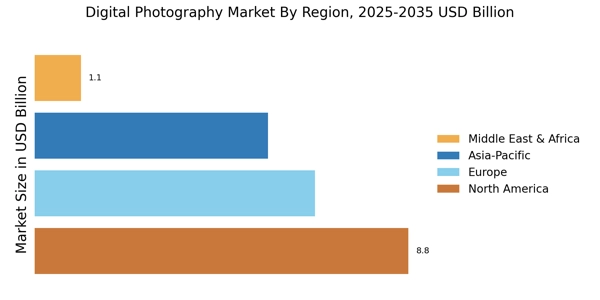
North America is the largest market for digital photography, holding approximately 40% of the global share. The region's growth is driven by technological advancements, increasing consumer demand for high-quality imaging, and a robust e-commerce landscape. Regulatory support for digital content creation and distribution further fuels this growth, making it a key player in the global market. The United States and Canada are the leading countries in this region, with major players like Canon, Nikon, and GoPro establishing a strong presence. The competitive landscape is characterized by continuous innovation and product diversification, catering to both professional and amateur photographers. The demand for mirrorless cameras and high-resolution imaging devices is particularly strong, reflecting changing consumer preferences.

Europe : Cultural Hub for Photography

Europe is the second-largest market for digital photography, accounting for around 30% of the global market share. The region benefits from a rich cultural heritage that drives demand for photography in both professional and personal contexts. Regulatory initiatives promoting digital literacy and content creation are also contributing to market growth, alongside increasing smartphone penetration and social media usage. Leading countries in Europe include Germany, the UK, and France, where brands like Leica and Fujifilm are well-established. The competitive landscape is marked by a mix of traditional camera manufacturers and emerging tech companies focusing on innovative imaging solutions. The presence of numerous photography festivals and exhibitions further stimulates interest and investment in the sector.

Asia-Pacific : Rapid Growth and Adoption

Asia-Pacific is witnessing rapid growth in the digital photography market, holding approximately 25% of the global share. The region's expansion is driven by increasing disposable incomes, a growing middle class, and a surge in social media usage. Countries like China and India are leading this growth, supported by favorable government policies promoting technology adoption and digital content creation. China is the largest market in the region, with significant contributions from local brands alongside international players like Sony and Panasonic. The competitive landscape is evolving, with a focus on affordable yet high-quality imaging solutions. The rise of smartphone photography is also influencing market dynamics, pushing traditional camera manufacturers to innovate and adapt to changing consumer preferences.

Middle East and Africa : Emerging Market Potential

The Middle East and Africa (MEA) region is an emerging market for digital photography, accounting for about 5% of the global share. The growth is driven by increasing urbanization, rising disposable incomes, and a growing interest in photography as a hobby and profession. Government initiatives aimed at boosting tourism and cultural events are also contributing to the demand for high-quality imaging solutions. Leading countries in this region include South Africa and the UAE, where there is a growing presence of both local and international brands. The competitive landscape is characterized by a mix of traditional camera manufacturers and new entrants focusing on innovative products. The region's unique cultural diversity also presents opportunities for niche markets in photography, catering to various consumer needs.

Digital Photography Market Regional Image

Key Players and Competitive Insights

Major players in Digital Photography Market industry are constantly striving to gain a competitive edge by investing in research and development, forming strategic partnerships and expanding their product portfolios. Leading Digital Photography Market players are also focusing on providing innovative features and technologies to cater to the evolving needs of consumers. The Digital Photography Market is characterized by intense competition, with key players vying for market share through aggressive marketing strategies, product differentiation, and technological advancements.

Digital Photography Market development is driven by the increasing popularity of digital photography, the growing demand for high-quality images and the advancements in camera technology.A leading company in the Digital Photography Market is Canon. Canon is a  leader in the imaging and optical industry, offering a wide range of digital cameras, lenses, printers and other imaging solutions. The company has a strong brand reputation and a loyal customer base. Canon is known for its innovative camera designs, high-quality optics and advanced features. The company has a wide distribution network and a strong presence in both professional and consumer markets.

Canon is committed to research and development, and it invests heavily in developing new technologies and products.A competitor of Canon is Nikon. Nikon is another leading company in the Digital Photography Market. The company is well-known for its high-quality cameras, lenses and accessories. Nikon has a strong brand reputation and a loyal customer base. The company is known for its innovative camera designs, advanced features and excellent image quality. Nikon has a wide distribution network and a strong presence in both professional and consumer markets.

Nikon is committed to research and development, and it invests heavily in developing new technologies and products.


Key Companies in the Digital Photography Market market include

Industry Developments

The digital photography market is projected to reach USD 26.8 billion by 2032, exhibiting a CAGR of 2.93% during the forecast period. Recent advancements in camera technology, such as the integration of artificial intelligence (AI) and the development of mirrorless cameras, are driving market growth. Furthermore, the increasing popularity of social media platforms and the growing demand for high-quality images in various applications, such as e-commerce and advertising, are contributing to market expansion.

Key players in the market include Canon, Nikon, Sony, Fujifilm and Panasonic, among others. Strategic partnerships and acquisitions are prevalent in the industry, with companies seeking to strengthen their market position and expand their product offerings. Sustainability initiatives are also gaining traction, with manufacturers focusing on reducing the environmental impact of their operations and products.


Future Outlook

Digital Photography Market Future Outlook

The Digital Photography Market is projected to grow at a 2.93% CAGR from 2024 to 2035, driven by technological advancements, increasing consumer demand, and the rise of social media.

New opportunities lie in:

  • Development of AI-driven photo editing software for professionals.
  • Expansion of subscription-based cloud storage solutions for photographers.
  • Integration of augmented reality features in digital cameras for enhanced user experience.

By 2035, the Digital Photography Market is expected to be robust, reflecting steady growth and innovation.

Market Segmentation

Digital Photography Market Lens Type Outlook

  • Interchangeable Lenses
  • Fixed Lenses
  • Prime Lenses
  • Zoom Lenses
  • Telephoto Lenses
  • Wide-Angle Lenses

Digital Photography Market Camera Type Outlook

  • Digital Single-Lens Reflex (DSLR) Cameras
  • Mirrorless Cameras
  • Compact Cameras
  • Action Cameras
  • Drone Cameras

Digital Photography Market Sensor Type Outlook

  • Full-Frame CMOS Sensors
  • APS-C CMOS Sensors
  • Micro Four Thirds Sensors
  • 1-Inch Sensors
  • CCD Sensors

Digital Photography Market Additional Features Outlook

  • Wi-Fi Connectivity
  • Bluetooth Connectivity
  • GPS Tracking
  • Built-In Flash
  • Articulating LCD Screens

Digital Photography Market Image Stabilization Outlook

  • In-Body Image Stabilization
  • Lens-Based Image Stabilization
  • Dual Image Stabilization

Report Scope

MARKET SIZE 202421.89(USD Billion)
MARKET SIZE 202522.53(USD Billion)
MARKET SIZE 203530.08(USD Billion)
COMPOUND ANNUAL GROWTH RATE (CAGR)2.93% (2024 - 2035)
REPORT COVERAGERevenue Forecast, Competitive Landscape, Growth Factors, and Trends
BASE YEAR2024
Market Forecast Period2025 - 2035
Historical Data2019 - 2024
Market Forecast UnitsUSD Billion
Key Companies ProfiledMarket analysis in progress
Segments CoveredMarket segmentation analysis in progress
Key Market OpportunitiesIntegration of artificial intelligence in image processing enhances user experience in the Digital Photography Market.
Key Market DynamicsTechnological advancements and evolving consumer preferences drive innovation and competition in the digital photography market.
Countries CoveredNorth America, Europe, APAC, South America, MEA

Leave a Comment

FAQs

What is the current valuation of the Digital Photography Market in 2025?

The Digital Photography Market is valued at approximately 21.89 USD Billion in 2024.

What is the projected market size for the Digital Photography Market by 2035?

The market is expected to reach a valuation of 30.08 USD Billion by 2035.

What is the expected CAGR for the Digital Photography Market during the forecast period 2025 - 2035?

The anticipated CAGR for the Digital Photography Market during the forecast period is 2.93%.

Which camera type segment shows the highest growth potential in the Digital Photography Market?

The Digital Single-Lens Reflex (DSLR) Cameras segment is projected to grow from 8.0 to 10.0 USD Billion.

How do mirrorless cameras perform in the Digital Photography Market?

Mirrorless Cameras are expected to increase from 6.0 to 8.0 USD Billion, indicating a positive trend.

What is the market outlook for interchangeable lenses in the Digital Photography Market?

Interchangeable Lenses are projected to grow from 5.0 to 7.0 USD Billion, reflecting strong demand.

Which image stabilization technology is anticipated to dominate the market?

Lens-Based Image Stabilization is expected to grow from 8.0 to 11.0 USD Billion, suggesting its leading position.

What are the expected trends in sensor types within the Digital Photography Market?

Full-Frame CMOS Sensors are projected to increase from 5.0 to 7.0 USD Billion, indicating a shift towards higher quality imaging.

How do additional features like Wi-Fi and Bluetooth connectivity impact the market?

Wi-Fi Connectivity is expected to grow from 3.0 to 4.0 USD Billion, highlighting the importance of connectivity in consumer preferences.

Download Free Sample

Kindly complete the form below to receive a free sample of this Report

Compare Licence

×
Features License Type
Single User Multiuser License Enterprise User
Price $4,950 $5,950 $7,250
Maximum User Access Limit 1 User Upto 10 Users Unrestricted Access Throughout the Organization
Free Customization
Direct Access to Analyst
Deliverable Format
Platform Access
Discount on Next Purchase 10% 15% 15%
Printable Versions