Digital Signage Media Player Market (2026 - 2035)

Digital Signage Media Player Market Size, Share and Research Report By Component (Hardware, Software), By Product (Entry-Level, Advanced-Level, Enterprise-Level), By Connectivity (Wired, Wireless), By Application (Retail, Hospitality, Corporate, Transportation, Education, Government) and By Regional (North America, Europe, South America, Asia Pacific, Middle East and Africa) - Industry Forecast to 2035.
ID: MRFR/ICT/26690-HCR
100 Pages
Ankit Gupta, Aarti Dhapte
Last Updated: June 22, 2026
Digital Signage Media Player Market
Market Size
Forecast Period2026-2035
CAGR (2026-2035)9.5%
2025 Market SizeUSD 2.28 Billion
2035 Market SizeUSD 5.66 Billion
Key Players
BrightSign LLC
Samsung Electronics
LG Electronics
Intel Corporation
Advantech Co., Ltd.
IAdea Corporation
Opportunities
  • AI-Powered Audience Analytics and Content Optimization
  • Programmatic Digital-Out-of-Home (DOOH) Advertising
  • Emerging-Market Retail and Transit Expansion

Digital Signage Media Player Market Summary

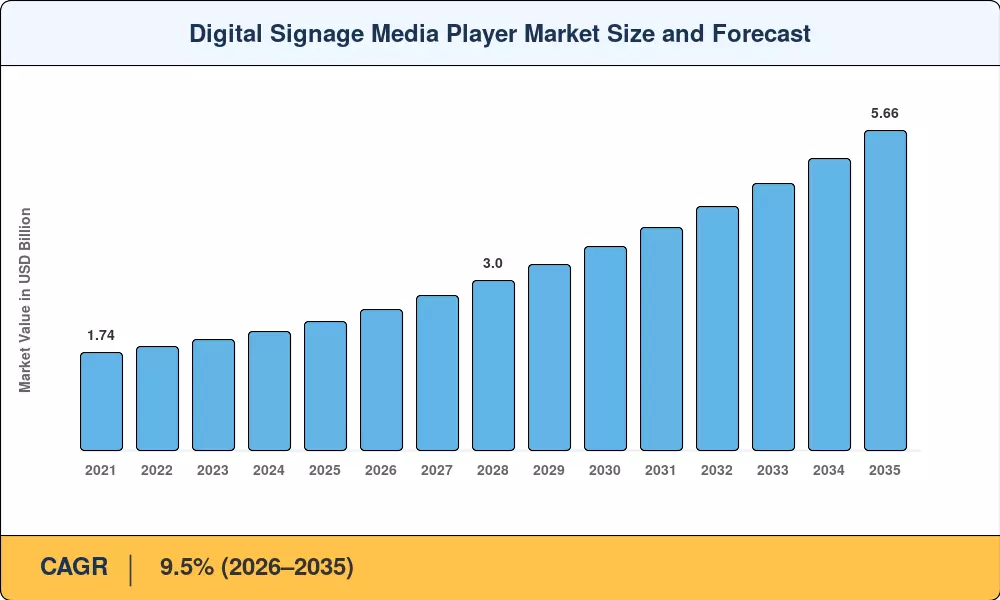
The digital signage media player market reached USD 2.28 billion in 2025, with the forecast period beginning at USD 2.50 billion in 2026 and climbing to USD 5.66 billion by 2035 at a 9.5% CAGR. Two catalysts are accelerating demand: first, retail and transportation operators are under pressure to deliver personalized, data-driven content at the screen level — a shift that demands dedicated media processing hardware and cloud-managed software. Second, government-backed smart-city programs across Asia, Europe, and North America are channeling billions into connected public-information infrastructure, pulling digital signage deployments into transit stations, municipal buildings, and urban wayfinding networks [1].

The technology transformation reshaping the digital signage media player market centers on the migration from legacy PC-based playback systems to compact System-on-Chip (SoC) and ARM-based appliances. These next-generation players integrate 4K and 8K decoding, on-device AI for content triggering, and Wi-Fi 6/6E connectivity into fanless enclosures that fit behind commercial displays. Major display OEMs are embedding playback silicon directly into panels, compressing the value chain and forcing standalone player vendors to compete on software ecosystems, analytics dashboards, and cybersecurity features [2].

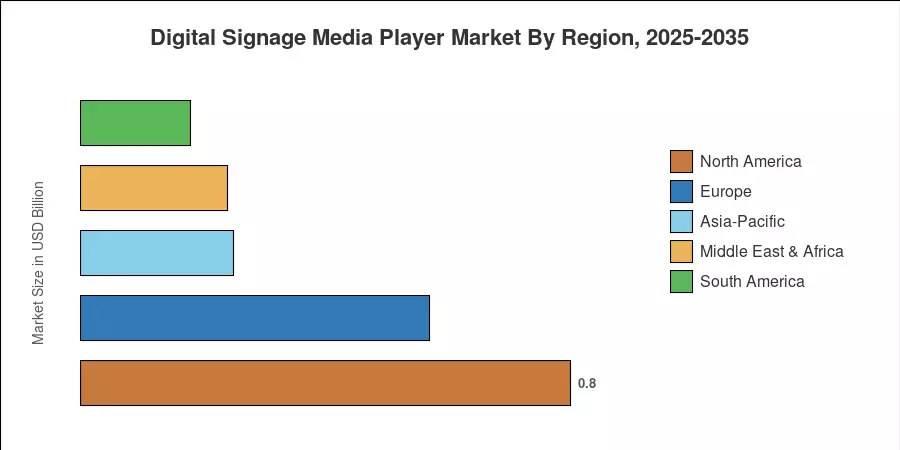
North America commands roughly 35.1% of the digital signage media player market, driven by mature retail chains and corporate campus digitization. Asia-Pacific exhibits the fastest growth trajectory at an 11.1% CAGR, fueled by China's and India's rapid expansion of transit and retail signage networks. Europe holds the second-largest share at approximately 25.0%, with strong demand from hospitality and government verticals. As edge-AI capabilities mature and panel prices continue to fall, the addressable base is widening to small and mid-sized enterprises that previously relied on static signage.


Key Report Takeaways

• By Component

  • Hardware accounted for 65.8% of the digital signage media player market in 2025, reflecting the installed base of standalone players and SoC modules.
  • Software platforms are expanding at a 10.8% CAGR through 2035, driven by recurring SaaS licensing and cloud-based content management.

• By Product

  • Advanced-level units captured 43.1% of revenue in 2025, serving mid-tier retail and corporate deployments.
  • Enterprise-level solutions are projected to grow at an 11.0% CAGR as large organizations adopt centralized, analytics-rich platforms.

• By Application

  • Retail held 33.8% of the digital signage media player market size in 2025, reflecting point-of-purchase and in-store engagement spending.
  • Transportation is rising at a 10.3% CAGR through 2035, accelerated by airport and rail station modernization programs.

• By Region

  • North America commanded 35.1% of revenue in 2025, led by U.S. retail and corporate verticals.
  • Asia-Pacific exhibits the top CAGR at 11.1%, propelled by smart-city infrastructure rollouts in China and India.


Market Size and Forecast (2021–2035)

Market Research Future employs a blended methodology combining bottom-up revenue tracking of media player shipments, software subscription billings, and top-down validation against macroeconomic indicators, including commercial construction activity, retail capex cycles, and public-infrastructure budgets. Historical figures (2021–2024) reflect audited shipment data; forecast values (2026–2035) apply a calibrated 9.5% CAGR anchored to the 2025 base year.
Digital Signage Media Player Market Size and Forecast
Our Impact
Enabled $4.3B Revenue Impact for Fortune 500 and Leading Multinationals
Partnering with 2000+ Global Organizations Each Year
30K+ Citations by Top-Tier Firms in the Industry

Driver Impact Analysis

Driver ~% Impact on CAGR Geographic Relevance Impact Timeline
Retail media network proliferation +1.8% North America, Europe Short-term (≤2 yr)
Smart-city and transit digitization programs +1.5% Asia-Pacific, MEA Medium-term (2–4 yr)
SoC and ARM-based hardware miniaturization +1.4% Global Short-term (≤2 yr)
Cloud-native CMS and SaaS licensing shift +1.2% North America, Europe Medium-term (2–4 yr)
Falling LED/LCD commercial panel prices +1.0% Asia-Pacific, South America Long-term (≥4 yr)
On-device AI for content personalization +0.9% North America, APAC Medium-term (2–4 yr)
DOOH programmatic advertising integration +0.7% Global Long-term (≥4 yr)


Retail Media Network Proliferation

Retailers are channeling an estimated USD 45 billion globally, with media players sitting at the heart of point-of-purchase networks that serve targeted advertising content [9]. U.S. grocery and big-box chains are deploying digital end-cap displays at a rate that doubled between 2023 and 2025, creating a pull-through effect for advanced-level media players capable of real-time ad insertion. The digital signage media player market benefits directly because each retail media installation requires dedicated playback hardware and a software subscription for content scheduling and audience analytics.

Smart-City and Transit Digitization Programs

China's "New Infrastructure" initiative earmarked over USD 1.4 trillion for digital urban systems between 2020 and 2025, and a meaningful share flows into passenger-information displays across metro, rail, and bus-rapid-transit networks [1]. India's Smart Cities Mission has commissioned digital signage deployments in over 100 cities, while the EU's Connecting Europe Facility funds interoperable transit-information systems. These public-sector programs generate multi-year procurement cycles that sustain demand for ruggedized, high-brightness media players with cellular and Wi-Fi connectivity.

SoC and ARM-Based Hardware Miniaturization

The transition from x86-based media players to ARM and SoC architectures has led to a reduction in device power consumption by around 60% and a reduction in form factors to credit-card sizes [2]. Qualcomm, MediaTek, and Samsung’s Tizen-based SoC architectures can decode 4K at 60 fps within a 10-watt envelope, enabling display-integrated players that eliminate extra casings. This transition reduces the total cost of ownership and democratizes the digital signage media player market for small company adopters who have found standalone hardware cost-prohibitive in the past.

Cloud-Native CMS and SaaS Licensing Shift

In 2025, over 38% of new digital signage media player market software revenue will be from cloud-hosted content management solutions charged on a per-screen-per-month basis [11]. This SaaS model reduces initial costs, speeds up deployment times, and generates sticky recurring revenue for vendors. Scala, Signagelive, and Broadsign now have API-first frameworks that hook into retail analytics stacks, corporate communications solutions, and programmatic ad exchanges.

Restraints Impact Analysis

The restraint impact percentages below represent directional drag estimates on the market's growth trajectory and are not directly subtracted from the headline CAGR.

Restraint ~% Impact on CAGR Geographic Relevance Impact Timeline
Content security and cybersecurity vulnerabilities –0.8% Global Short-term (≤2 yr)
Display OEM vertical integration –0.7% North America, APAC Medium-term (2–4 yr)
Fragmented CMS interoperability standards –0.5% Europe, APAC Long-term (≥4 yr)
High upfront costs for enterprise-grade systems –0.4% South America, MEA Medium-term (2–4 yr)
Skilled workforce shortages for deployment and maintenance –0.3% Global Long-term (≥4 yr)


Content Security and Cybersecurity Vulnerabilities

Networked media players present an expanding attack surface, with at least 12 documented firmware exploits affecting commercial signage players reported between 2023 and 2025 [18]. Ransomware incidents targeting DOOH networks in the U.S. and UK have caused multi-day content blackouts, eroding operator confidence. The digital signage media player market faces headwinds as enterprise buyers increasingly require FIPS 140-2 validated encryption and zero-trust network architectures.

Display OEM Vertical Integration

Samsung, LG, and other panel manufacturers are embedding SoC-based media players directly into their commercial display lines, bundling playback hardware with proprietary CMS software [2]. This vertical integration compresses standalone player vendors' addressable market and forces price competition.

Fragmented CMS Interoperability

The absence of a common standard for content exchange causes compatibility issues for operators having multi-vendor signage estates mixing hardware and software from multiple manufacturers [19]. SMIL adoption is spotty, and proprietary APIs confine users within single-vendor ecosystems. This fragmentation increases integration costs and hampers large-scale deployments, especially in Europe, where cross-border transit companies need to be interoperable across national borders.

Digital Signage Media Player Market Opportunities

AI-Powered Audience Analytics and Content Optimization

On-device computer vision chipsets — now costing under USD 15 per unit — enable media players to detect audience demographics, dwell time, and attention metrics without transmitting video to the cloud [13]. The digital signage media player market stands to capture incremental software-subscription revenue as analytics modules become a standard upsell tier.

Programmatic Digital-Out-of-Home (DOOH) Advertising

Every programmatic screen requires a media player capable of real-time ad decisioning and proof-of-play reporting [14]. This creates a high-margin aftermarket opportunity for player vendors who integrate SSP (supply-side platform) connectors and impression-verification sensors directly into their hardware-software stacks.

Emerging-Market Retail and Transit Expansion

Africa and Southeast Asia are building more than 15,000 commercial retail outlets and 200 mass-transit stations a year, many of which are greenfield sites developed with digital signage from the ground up [15]. The market opportunity for digital signage media players in these places is driven by the need for ruggedized, cost-optimized players that are tolerant to high ambient temperatures, voltage fluctuations, and low bandwidth. Vendors with cellular-first connectivity and offline caching modes will be competitively positioned.


Data Monetization Through Screen-Level Insights

Operators are discovering that aggregated, anonymized audience-interaction data from signage networks carries standalone commercial value. Quick-service restaurant chains and pharmacy retailers have begun licensing footfall-pattern data to CPG brands for trademark marketing optimization.

Interactive and Touch-Enabled Signage Deployments

Wayfinding kiosks, self-service ordering terminals, and interactive product catalogs require media players with multi-touch input processing and sensor fusion capabilities. The hospitality and healthcare sectors are early adopters, with hotel chains deploying lobby concierge screens and hospitals installing patient-check-in kiosks at a rate exceeding 12% annual growth [20].


Digital Signage Media Player Market Future Outlook

Edge AI and Autonomous Content Operations

By 2030, an estimated 60% of new media player shipments will embed dedicated neural-processing units capable of running audience-detection and content-optimization models entirely on-device [13]. This eliminates cloud-round-trip latency, reduces bandwidth costs, and enables privacy-compliant analytics in jurisdictions with strict data-localization requirements.

Platform Economics and Recurring-Revenue Models

Hardware margins in the digital signage media player market are compressing toward 15–18% as SoC commoditization accelerates [2]. Vendors are pivoting to platform-economics models where the player is sold at or near cost and revenue is captured through per-screen CMS subscriptions, analytics add-ons, and programmatic ad-revenue shares. This mirrors the transition seen in the smartphone industry and will favor vendors with strong software engineering capabilities and large installed bases.

Sustainability and Circular-Economy Pressures

The European Union's Ecodesign for Sustainable Products Regulation, effective from 2026, will impose repairability and recyclability requirements on commercial electronic devices including media players [19]. Vendors will need to design modular enclosures with field-replaceable compute modules and publish environmental product declarations. Asia-Pacific regulators are expected to follow with similar frameworks by 2030, creating a global push toward lower-power, longer-lifecycle devices.

Convergence with IoT and Building Management Systems

Commercial building owners are applying digital signage media player market infrastructure to unified IoT platforms that handle HVAC, lighting, access control, and tenant communications from a single dashboard. The Building Automation and Control Systems (BACS) industry is expected to exceed USD 120 billion by 2032, providing a pull-through opportunity for media players that support BACnet, MQTT, and other building-protocol interfaces [20].


Digital Signage Media Player Market Segmentation

By Component

Segment Key Metric Primary Demand Driver
Hardware 65.8% share (2025) SoC player shipments, display-integrated modules
Software 10.8% CAGR (2026–2035) Cloud CMS subscriptions, analytics platforms


Hardware continues to anchor the digital signage media player market, though its share is gradually declining as software subscription revenues scale. Standalone SoC-based players, HDMI compute sticks, and display-integrated modules collectively form the hardware segment. The software segment — encompassing CMS platforms, device-management agents, and analytics dashboards — is growing nearly 1.3 percentage points faster than the market average as operators shift from perpetual licenses to SaaS billing.

By Product

Segment Key Metric Primary Demand Driver
Entry-Level USD 0.42 Billion (2025) SMB adoption, single-screen deployments
Advanced-Level 43.1% share (2025) Multi-zone playback, retail chains
Enterprise-Level 11.0% CAGR (2026–2035) Centralized management, analytics-rich deployments


Advanced-level players dominate revenue because they strike the price-performance balance that mid-tier retail and corporate buyers require — supporting multi-zone 4K playback, scheduled content updates, and basic audience metrics. Enterprise-level solutions are the fastest-growing tier in the digital signage media player market, offering redundant storage, failover clustering, remote firmware orchestration, and API integration with enterprise IT ecosystems.

By Connectivity

Segment Key Metric Primary Demand Driver
Wired USD 0.85 Billion (2025) Corporate environments requiring low-latency reliability
Wireless 12.2% CAGR (2026–2035) Wi-Fi 6/6E, cellular LTE/5G field deployments


Wireless connectivity is the fastest-growing segment in the digital signage media player market, driven by the impracticality of running Ethernet cables outdoors to totems, transit shelters, and pop-up retail environments. Wi-Fi 6E and 5G cellular modules now deliver the throughput required for uncompressed 4K content streaming, reducing dependence on wired backhaul.

By Application

Segment Key Metric Primary Demand Driver
Retail 33.8% share (2025) POP displays, digital shelf labels, and menu boards
Hospitality USD 0.27 Billion (2025) Lobby screens, concierge kiosks
Corporate 9.1% CAGR (2026–2035) Meeting-room signage, employee comms
Transportation 10.3% CAGR (2026–2035) Airport FIDS, metro PIDs
Education USD 0.14 Billion (2025) Campus wayfinding, lecture-hall displays
Government 9.8% CAGR (2026–2035) Public information displays, civic buildings


Retail remains the largest application vertical in the digital signage media player market, with quick-service restaurants, grocery chains, and fashion retailers investing in dynamic promotional displays that can be updated centrally in real time. Transportation is the fastest-growing application, as airports and rail operators upgrade legacy flight and passenger-information displays to networked media-player-driven systems capable of multilingual content, emergency messaging, and integration with operations databases.


Regional Market Share Analysis

Region Key Metric Primary Investment Themes
North America 35.1% share (2025) Retail media networks, corporate AV modernization
Europe 25.0% share (2025) Transit information systems, hospitality digitization
Asia-Pacific 11.1% CAGR (2026–2035) Smart-city programs, retail chain expansion
South America USD 0.18 Billion (2025) Banking branch digitization, retail kiosks
Middle East & Africa 10.4% CAGR (2026–2035) Mega-event infrastructure, airport modernization
Total USD 2.28 Billion (2025)

The digital signage media player market exhibits distinct regional dynamics shaped by retail maturity, public-infrastructure investment, and technology-adoption curves.


North America

Country Key Metric Key Driver
United States 72.5% of regional share Retail media, corporate campus signage
Canada 8.8% CAGR Smart-building codes and transit upgrades
Mexico USD 0.04 Billion (2025) Banking and QSR digital menu board rollouts


The United States drives the bulk of North American demand, with retail chains, QSR operators, and corporate facilities representing the top three end-user categories. Canada is investing in transit-hub signage as cities like Toronto and Vancouver modernize their metro systems, while Mexico's banking sector is digitizing branch networks with interactive kiosk-based signage players.

Europe

Country Key Metric Key Driver
Germany 22.4% of regional share Automotive showroom digitization, transit
United Kingdom 9.2% CAGR Retail high-street modernization
France USD 0.07 Billion (2025) SNCF and metro passenger-information systems
Italy 7.8% CAGR Hospitality and tourism signage
Spain USD 0.04 Billion (2025) Airport and rail upgrades
Nordic Countries 8.5% CAGR Smart-building and government facilities
Russia USD 0.03 Billion (2025) Metro and retail expansion
Rest of Europe 18.0% of regional share Mixed commercial applications


Europe's digital signage media player market is anchored by Germany's industrial-grade deployments in automotive retail and transit environments. The UK leads in retail-chain signage density, with major grocery and fashion brands refreshing legacy poster networks with cloud-managed players. France's national rail operator, SNCF, and Paris metro authority are mid-cycle in a multi-year passenger-information upgrade program that favors ruggedized, wide-temperature-range media players.

Asia-Pacific

Country Key Metric Key Driver
China 38.2% of regional share Smart-city mandate, retail chain scale
India 13.5% CAGR Smart Cities Mission, transit digitization
Japan USD 0.08 Billion (2025) Convenience-store and transit signage
South Korea 10.8% CAGR 5G-connected digital displays
ASEAN USD 0.05 Billion (2025) Airport and hospitality expansion
Rest of Asia-Pacific 9.7% CAGR Emerging commercial signage adoption


Asia-Pacific is the fastest-growing region in the digital signage media player market, propelled by China's massive transit-signage build-out and India's government-backed Smart Cities Mission. South Korea's 5G infrastructure enables real-time content streaming to ultra-high-resolution outdoor displays, while Japan's dense convenience-store and rail networks sustain steady replacement-cycle demand.

South America

Country Key Metric Key Driver
Brazil 58.0% of regional share Banking, QSR, and retail kiosks
Argentina 9.0% CAGR Retail modernization
Rest of South America USD 0.03 Billion (2025) Early-stage commercial adoption


Brazil dominates South American demand, with digital menu boards for QSR chains and self-service banking kiosks driving media player procurement. Argentina's retail sector is digitizing more slowly due to macroeconomic constraints, but growth rates remain attractive as currency stabilization improves import economics for signage hardware.

Middle East & Africa

Country Key Metric Key Driver
Saudi Arabia 32.0% of regional share NEOM and Vision 2030 mega-projects
UAE 10.8% CAGR Airport expansion, hospitality
South Africa USD 0.02 Billion (2025) Retail chain modernization
Egypt 11.2% CAGR New Administrative Capital infrastructure
Rest of MEA 24.0% of regional share Airport and government signage


Saudi Arabia's Vision 2030 and the NEOM mega-city project are channeling significant infrastructure investment into connected public displays, creating a high-value procurement pipeline for the digital signage media player market. The UAE benefits from Dubai and Abu Dhabi airport expansions, where passenger-flow management screens require enterprise-grade players with 24/7 uptime ratings.


Digital Signage Media Player Market By Region, 2025-2035

Competitive Benchmarking

The digital signage media player market exhibits medium concentration, with the top five vendors collectively holding an estimated 38–45% revenue share. The competitive field includes dedicated media-player specialists, display OEMs with embedded-player strategies, and semiconductor companies offering turnkey reference designs. An approximate Herfindahl-Hirschman Index (HHI) of 650–800 indicates a moderately fragmented landscape where no single vendor dominates beyond a 12% share.

Company Est. Revenue Share Range Key Offerings Strategic Positioning
BrightSign LLC ~10–12% XT, XD, and LS series players; BrightAuthor:connected CMS Market leader in dedicated players; strong channel partner ecosystem
Samsung Electronics ~8–10% Tizen-based SoC Smart Signage platform Vertical integration — display + embedded player + MagicINFO CMS
LG Electronics ~6–8% webOS Signage platform, commercial displays with SoC Display-integrated strategy targeting hospitality and retail
Intel Corporation ~5–7% NUC Compute Elements, SDM reference designs Chipset supplier and reference-design provider for OEM partners
Advantech Co., Ltd. ~4–6% DS-series fanless players, WISE-PaaS IoT platform Industrial-grade hardware for transit, outdoor, and harsh environments
IAdea Corporation ~3–5% XMP and MBR series players Enterprise CMS integration; strong in corporate and education
Giada Technology ~3–4% DN73, DN74 OPS players OPS (Open Pluggable Specification) specialist; cost-competitive
Sharp NEC Display Solutions ~3–4% MediaPlayer series, NaViSet management Legacy NEC install base; bundled display-player solutions
STRATACACHE (Scala) ~2–4% Scala Enterprise CMS, player appliances Software-led platform; analytics and programmatic DOOH focus
Leyard / Planar ~2–3% DirectLight LED with integrated players LED video-wall specialist; embedded playback for control rooms


Recent News & Developments

  • BrightSign (January 2025): Officially announced a significant change to its hardware service terms by introducing an unmatched, standard five-year warranty across its entire lineup of solid-state digital signage media players, significantly lowering long-term total cost of ownership benchmarks for enterprise network fleets.
  • Samsung Electronics (January 2026): Debuted its glasses-free 3D Spatial Signage display series alongside the global rollout of its AI Studio content creation application within the cloud-native Samsung VXT management platform, allowing operators to automatically upscale and distribute shadow-detailed spatial video loops without relying on third-party design tools.
  • Intel Corporation (March 2024): Partnered with commercial hardware builders to distribute slot-in solutions utilizing the Intel Smart Display Module (SDM) architecture, allowing panel builders like Sharp to slip compact, fanless computing blocks featuring hybrid-core efficiency directly into professional display screens.
  • STRATACACHE / Scala (June 2024): Formally finalized the acquisition of Ontario-based digital out-of-home media and signage specialist Dot2Dot Communications, integrating the provider's Ad Manager platform with Scala CMS and Walkbase audience insights to expand programmatic monetization across high-volume retail environments.

Digital Signage Media Player Market Report Scope

Parameter Detail
Market Scope Global digital signage media player market covering hardware (standalone players, SoC modules, OPS devices) and software (CMS, analytics, device management)
Study Period 2021–2035
CAGR 9.5% (2026–2035)
Base Year Market Size USD 2.28 Billion (2025)
Forecast Endpoint USD 5.66 Billion (2035)
Fastest Growing Segment Enterprise-Level (by product); Wireless (by connectivity)
Fastest Growing Region Asia-Pacific
Companies Profiled 10 (BrightSign, Samsung, LG, Intel, Advantech, IAdea, Giada, Sharp NEC, STRATACACHE/Scala, Leyard/Planar)
Valuation Currency USD Billion


FAQs

How do SoC-embedded displays affect standalone media player purchase decisions?
SoC-embedded panels reduce hardware counts but typically lack the processing headroom and I/O flexibility of standalone players. Buyers running multi-zone 4K layouts, external sensor integrations, or enterprise CMS platforms still favor dedicated devices [2].
What cybersecurity certifications should buyers require when procuring media players for regulated environments?
Look for TPM 2.0 hardware encryption, FIPS 140-2 validation, and SOC 2 Type II compliance from the CMS provider. Players deployed in healthcare or financial settings should also support 802.1X network authentication [18].
How does the shift to SaaS-based CMS licensing change the total cost of ownership over a five-year deployment?
SaaS models lower initial capital outlay by 30–40% but generate cumulative subscription fees that may exceed perpetual-license costs by year four. Operators should model five-year TCO inclusive of updates and support [11].
What role does the digital signage media player market play in programmatic DOOH advertising ecosystems?
Media players serve as the execution layer, receiving real-time ad-insertion commands from SSPs and recording proof-of-play data. Players without built-in ad-decisioning engines require middleware, adding latency and cost [14].
Which connectivity standard is best suited for outdoor digital signage deployments in areas without wired infrastructure?
5G or LTE Cat-M cellular modules provide the most reliable outdoor connectivity, supporting 4K streaming with failover to cached content during signal drops. Wi-Fi 6E works well in campus environments with existing access points [8].
How are sustainability regulations influencing digital signage media player market hardware design choices?
The EU's Ecodesign Regulation is pushing vendors toward modular enclosures with field-replaceable compute modules, lower standby power draw, and published carbon-footprint declarations. Expect similar mandates in Asia-Pacific by 2030 [19].
What integration protocols matter most when connecting media players to building management systems?
BACnet, MQTT, and RESTful APIs are the primary protocols enabling signage players to receive triggers from BMS platforms for emergency messaging, occupancy-based content, and energy-status dashboards [20].    
Author
Author
Author Profile
Ankit Gupta LinkedIn
Team Lead - Research
Ankit Gupta is a seasoned market intelligence and strategic research professional with over six plus years of experience in the ICT and Semiconductor industries. With academic roots in Telecom, Marketing, and Electronics, he blends technical insight with business strategy. Ankit has led 200+ projects, including work for Fortune 500 clients like Microsoft and Rio Tinto, covering market sizing, tech forecasting, and go-to-market strategies. Known for bridging engineering and enterprise decision-making, his insights support growth, innovation, and investment planning across diverse technology markets.
Co-Author
Co-Author Profile
Aarti Dhapte LinkedIn
AVP - Research
A consulting professional focused on helping businesses navigate complex markets through structured research and strategic insights. I partner with clients to solve high-impact business problems across market entry strategy, competitive intelligence, and opportunity assessment. Over the course of my experience, I have led and contributed to 100+ market research and consulting engagements, delivering insights across multiple industries and geographies, and supporting strategic decisions linked to $500M+ market opportunities. My core expertise lies in building robust market sizing, forecasting, and commercial models (top-down and bottom-up), alongside deep-dive competitive and industry analysis. I have played a key role in shaping go-to-market strategies, investment cases, and growth roadmaps, enabling clients to make confident, data-backed decisions in dynamic markets.
Download Free Sample

Kindly complete the form below to receive a free sample of this Report

Download PDF ×

We do not share your information with anyone. However, we may send you emails based on your report interest from time to time. You may contact us at any time to opt-out.