Request Free Sample ×

Kindly complete the form below to receive a free sample of this Report

* Please use a valid business email

Leading companies partner with us for data-driven Insights

clients tt-cursor
Hero Background

Digital Transformation Market

ID: MRFR/ICT/7213-HCR
111 Pages
Apoorva Priyadarshi
Last Updated: May 27, 2026
Digital Transformation Market Size, Share and Trends Analysis Report By Technology (Cloud Computing, Artificial Intelligence, Internet of Things, Big Data Analytics, Blockchain), By Service Type (Consulting Services, Implementation Services, Training Services, Support and Maintenance Services), By Deployment Type (On-Premises, Cloud-Based, Hybrid), By End Use (Retail, Healthcare, Financial Services, Telecommunications, Manufacturing) and By Regional (North America, Europe, South America, Asia Pacific, Middle East and Africa) - Forecast to 2035
Download PDF ×

We do not share your information with anyone. However, we may send you emails based on your report interest from time to time. You may contact us at any time to opt-out.

  1. 1 Market Overview |
    1. 1.1 Study Assumptions & Market Definition |
    2. 1.2 Scope of the Study |
    3. 1.3 Research Methodology
  2. 2 Market Summary & Key Takeaways
  3. 3 Market Dynamics |
    1. 3.1 Market Drivers Analysis | |
      1. 3.1.1 Enterprise AI & Generative-AI Integration | |
      2. 3.1.2 Cloud-First & Multi-Cloud Strategies | |
      3. 3.1.3 Sovereign-AI & Data-Localization Mandates | |
      4. 3.1.4 ESG & Regulatory Compliance Digitization | |
      5. 3.1.5 5G-IoT Convergence in Operations | |
      6. 3.1.6 Low-Code/No-Code Platform Democratization | |
      7. 3.1.7 Quantum-Safe Cryptography Migration |
    2. 3.2 Market Restraints Analysis | |
      1. 3.2.1 Legacy-System Integration Complexity | |
      2. 3.2.2 Cybersecurity & Data-Privacy Risks | |
      3. 3.2.3 Talent Shortage in AI & Cloud Engineering | |
      4. 3.2.4 Budget Constraints for SMEs | |
      5. 3.2.5 Regulatory Fragmentation Across Jurisdictions |
    3. 3.3 Market Opportunity Analysis | |
      1. 3.3.1 Industry-Cloud Platforms | |
      2. 3.3.2 Agentic AI & Autonomous Operations | |
      3. 3.3.3 Emerging-Market Digitization in Africa & Southeast Asia | |
      4. 3.3.4 Data Monetization & Embedded Analytics | |
      5. 3.3.5 Quantum-Ready Security & Post-Quantum Cryptography |
    4. 3.4 Industry Value Chain Analysis |
    5. 3.5 Porter's Five Forces Analysis
  4. 4 Global Digital Transformation Market Size & Forecast (2021–2035) |
    1. 4.1 Historical Market Size (2021–2025) |
    2. 4.2 Current & Forecast Market Size (2026–2035) |
    3. 4.3 Market Size by Revenue (USD Trillion) |
    4. 4.4 Year-over-Year Growth Analysis
  5. 5 Segmentation Analysis |
    1. 5.1 By Technology | |
      1. 5.1.1 AI and ML | |
      2. 5.1.2 Extended Reality (VR/AR) | |
      3. 5.1.3 IoT and Edge Computing | |
      4. 5.1.4 Blockchain and DLT | |
      5. 5.1.5 RPA and Process Automation | |
      6. 5.1.6 Others (Analytics, Low-Code) |
    2. 5.2 By Deployment Model | |
      1. 5.2.1 Cloud | |
      2. 5.2.2 On-Premises | |
      3. 5.2.3 Hybrid |
    3. 5.3 By Organization Size | |
      1. 5.3.1 Large Enterprises | |
      2. 5.3.2 Small and Medium Enterprises (SMEs) |
    4. 5.4 By Industry Vertical | |
      1. 5.4.1 BFSI | |
      2. 5.4.2 Healthcare & Life Sciences | |
      3. 5.4.3 Manufacturing & Industrial | |
      4. 5.4.4 Retail & E-Commerce | |
      5. 5.4.5 Government & Public Sector | |
      6. 5.4.6 Others (Energy, Telecom, Education)
  6. 6 Regional Analysis |
    1. 6.1 North America | |
      1. 6.1.1 United States | |
      2. 6.1.2 Canada | |
      3. 6.1.3 Mexico |
    2. 6.2 Europe | |
      1. 6.2.1 Germany | |
      2. 6.2.2 United Kingdom | |
      3. 6.2.3 France | |
      4. 6.2.4 Italy | |
      5. 6.2.5 Spain | |
      6. 6.2.6 Nordic Countries | |
      7. 6.2.7 Russia | |
      8. 6.2.8 Rest of Europe |
    3. 6.3 Asia-Pacific | |
      1. 6.3.1 China | |
      2. 6.3.2 India | |
      3. 6.3.3 Japan | |
      4. 6.3.4 South Korea | |
      5. 6.3.5 ASEAN | |
      6. 6.3.6 Rest of Asia-Pacific |
    4. 6.4 South America | |
      1. 6.4.1 Brazil | |
      2. 6.4.2 Argentina | |
      3. 6.4.3 Rest of South America |
    5. 6.5 Middle East & Africa | |
      1. 6.5.1 Saudi Arabia | |
      2. 6.5.2 UAE | |
      3. 6.5.3 South Africa | |
      4. 6.5.4 Egypt | |
      5. 6.5.5 Rest of MEA
  7. 7 Competitive Landscape |
    1. 7.1 Market Share Analysis (2025) |
    2. 7.2 Competitive Benchmarking Matrix |
    3. 7.3 Company Profiles | |
      1. 7.3.1 Microsoft | |
      2. 7.3.2 Alphabet (Google) | |
      3. 7.3.3 Amazon Web Services | |
      4. 7.3.4 IBM | |
      5. 7.3.5 Salesforce | |
      6. 7.3.6 SAP | |
      7. 7.3.7 Accenture | |
      8. 7.3.8 Oracle | |
      9. 7.3.9 Infosys | |
      10. 7.3.10 Wipro
  8. 8 Future Outlook & Strategic Recommendations (2026–2035) |
    1. 8.1 Agentic AI & Autonomous Enterprise Operations |
    2. 8.2 Platform Economics & Industry-Cloud Consolidation |
    3. 8.3 Sustainability-Linked Digital Infrastructure |
    4. 8.4 Quantum-Ready Security & Cryptographic Migration
  9. 9 Recent Developments & News
  10. 10 Frequently Asked Questions (FAQs)
  11. 11 Report Scope & Methodology |
    1. 11.1 Study Period & Base Year |
    2. 11.2 Data Sources & Citations |
    3. 11.3 Abbreviations
  12. 12 LIST OF TABLES |
  13. TABLE 1 Global Digital Transformation Market Size & Forecast, by Revenue (USD Trillion), 2021–2035 |
  14. TABLE 2 Global Digital Transformation Market – Year-over-Year Growth Analysis, 2021–2035 |
  15. TABLE 3 Global Digital Transformation Market – Driver Impact Analysis |
  16. TABLE 4 Global Digital Transformation Market – Restraint Impact Analysis |
  17. TABLE 5 Global Digital Transformation Market Size, by Technology, 2021–2035 |
  18. TABLE 6 Global Digital Transformation Market Size, by Deployment Model, 2021–2035 |
  19. TABLE 7 Global Digital Transformation Market Size, by Organization Size, 2021–2035 |
  20. TABLE 8 Global Digital Transformation Market Size, by Industry Vertical, 2021–2035 |
  21. TABLE 9 Global Digital Transformation Market Size, by Region, 2021–2035 |
  22. TABLE 10 North America Digital Transformation Market Size, by Country, 2021–2035 |
  23. TABLE 11 Europe Digital Transformation Market Size, by Country, 2021–2035 |
  24. TABLE 12 Asia-Pacific Digital Transformation Market Size, by Country, 2021–2035 |
  25. TABLE 13 South America Digital Transformation Market Size, by Country, 2021–2035 |
  26. TABLE 14 Middle East & Africa Digital Transformation Market Size, by Country, 2021–2035 |
  27. TABLE 15 Competitive Benchmarking Matrix – Global Digital Transformation Market, 2025 |
  28. TABLE 16 Company Profiles – Key Players, Global Digital Transformation Market |
  29. TABLE 17 Recent Developments & Strategic Announcements, 2024–2025 |
  30. TABLE 18 Report Scope & Methodology Summary |
  31. TABLE 19 Detailed Sources and Citations
  32. 13 LIST OF FIGURES |
  33. FIGURE 1 Global Digital Transformation Market Dynamics (Drivers, Restraints, Opportunities) |
  34. FIGURE 2 Industry Value Chain Analysis — Digital Transformation Market |
  35. FIGURE 3 Porter's Five Forces Analysis — Digital Transformation Market |
  36. FIGURE 4 Global Digital Transformation Market Size Trend (USD Trillion), 2021–2035 |
  37. FIGURE 5 Digital Transformation Market Share, by Technology, 2025 |
  38. FIGURE 6 Digital Transformation Market Share, by Deployment Model, 2025 |
  39. FIGURE 7 Digital Transformation Market Share, by Organization Size, 2025 |
  40. FIGURE 8 Digital Transformation Market Share, by Industry Vertical, 2025 |
  41. FIGURE 9 Digital Transformation Market Share, by Region, 2025 |
  42. FIGURE 10 North America Digital Transformation Market Size, by Country, 2025 |
  43. FIGURE 11 Europe Digital Transformation Market Size, by Country, 2025 |
  44. FIGURE 12 Asia-Pacific Digital Transformation Market Size, by Country, 2025 |
  45. FIGURE 13 South America Digital Transformation Market Size, by Country, 2025 |
  46. FIGURE 14 Middle East & Africa Digital Transformation Market Size, by Country, 2025 |
  47. FIGURE 15 Competitive Landscape — Market Share Analysis, 2025

Segmentation Quick Reference

DimensionSub-SegmentsDominant SegmentFastest Growing Segment
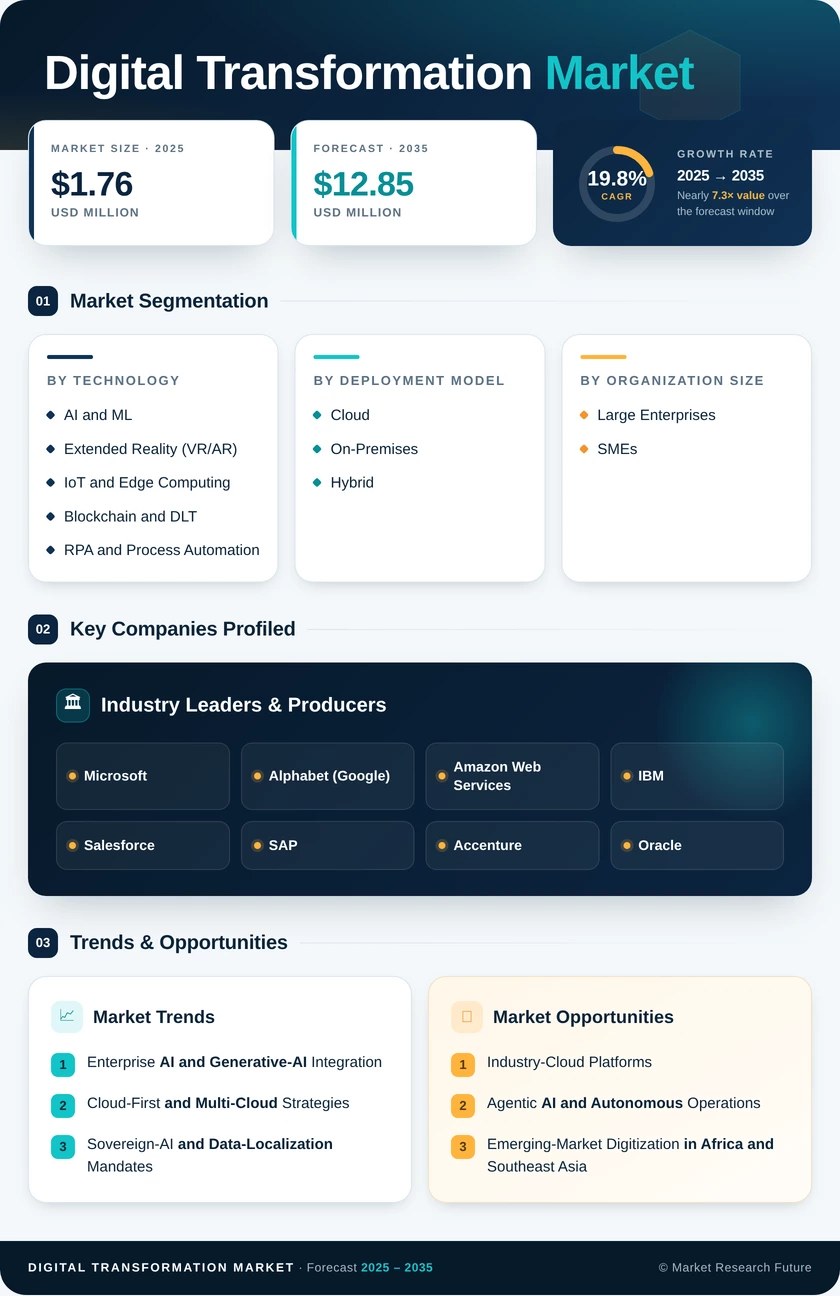
TechnologyAI and ML; Extended Reality (VR/AR); IoT and Edge Computing; Blockchain and DLT; RPA and Process Automation; OthersAI and MLExtended Reality (VR/AR)
Deployment ModelCloud; On-Premises; HybridCloudHybrid
Organization SizeLarge Enterprises; Small and Medium Enterprises (SMEs)Large EnterprisesSMEs
Industry VerticalBFSI; Healthcare & Life Sciences; Manufacturing & Industrial; Retail & E-Commerce; Government & Public Sector; OthersBFSIHealthcare & Life Sciences
GeographyNorth America; Europe; Asia-Pacific; South America; Middle East & AfricaNorth AmericaAsia-Pacific


Market Segmentation Overview

By Technology

Sub-SegmentKey Trend
AI and MLGenerative-AI co-pilots embedded across enterprise workflows
Extended Reality (VR/AR)Digital-twin simulation for manufacturing and surgical training
IoT and Edge Computing5G-enabled real-time operational-technology convergence
Blockchain and DLTSupply-chain provenance and tokenized-asset settlement
RPA and Process AutomationIntelligent automation bridging legacy and cloud systems
Others (Analytics, Low-Code)Citizen-developer platforms expanding application ownership


AI and ML remains the technology backbone of the Digital Transformation Market, with generative-AI capabilities increasingly bundled into cloud-platform subscriptions rather than procured as standalone tools.

By Deployment Model

Sub-SegmentKey Trend
CloudMulti-cloud and FinOps-driven optimization strategies
On-PremisesData-sovereignty and defense-sector classified workloads
HybridPhased migration of latency-sensitive and regulated applications


Cloud deployments dominate by share, but hybrid architectures are growing fastest as enterprises execute IT modernization and legacy system migration in controlled phases.

By Organization Size

Sub-SegmentKey Trend
Large EnterprisesAI-at-scale initiatives with global compliance orchestration
SMEsLow-code/SaaS-led digital-first operating model adoption


Large enterprises account for the majority of spending, while SMEs represent the fastest-expanding segment as platform economics lower the cost of entry.

By Industry Vertical

Sub-SegmentKey Trend
BFSIOpen-banking APIs, real-time payments, AML-AI compliance
Healthcare & Life SciencesEHR modernization, AI diagnostics, telehealth expansion
Manufacturing & IndustrialSmart-factory MES digitization, predictive maintenance
Retail & E-CommerceOmnichannel personalization, AI-powered recommendation engines
Government & Public SectorDigital identity, e-government portals, citizen-service automation
Others (Energy, Telecom, Education)Grid digitization, 5G network slicing, EdTech platforms


BFSI leads by revenue share, driven by regulatory mandates and consumer-experience competition. Healthcare is the fastest-growing vertical as clinical-data interoperability regulations expand globally.

By Geography

Sub-SegmentKey Trend
North AmericaFederal cloud-smart mandates and hyperscaler CAPEX concentration
EuropeCSRD compliance, sovereign-cloud initiatives, Digital Decade targets
Asia-PacificNational digital-ID programmes, 5G-IoT industrial convergence
South AmericaFintech-driven digitization, IDB-funded e-government expansion
Middle East & AfricaSmart-city sovereign-wealth investments, oil-to-digital diversification


North America leads by share, while Asia-Pacific registers the highest growth rate, fueled by large-scale government-backed digitization programmes across India, China, and ASEAN markets.