Request Free Sample ×

Kindly complete the form below to receive a free sample of this Report

* Please use a valid business email

Leading companies partner with us for data-driven Insights

clients tt-cursor
Hero Background

Digital Trust Market

ID: MRFR/ICT/20389-HCR
128 Pages
Kiran Jinkalwad, Aarti Dhapte
Last Updated: May 25, 2026
Digital Trust Market Size, Share and Research Report: By End User (Finance and Banking, Healthcare, Government, And Others), By Solution Type (Data Verification, Authentication, ID Authentication, Fraud Prevention, Compliance, And Others), By Deployment Modal (On-Premises, Cloud-Based, And Hybrid), By Organization Size (Large Enterprise, Small Business And Others), By Digital Identity Type (Centralized Identity, Decentralized Identity And Federated Identity), And By Region (North America, Europe, Asia-Pacific, And Rest Of The World) –Market Forecast Till 2035.
Download PDF ×

We do not share your information with anyone. However, we may send you emails based on your report interest from time to time. You may contact us at any time to opt-out.

Market Summary

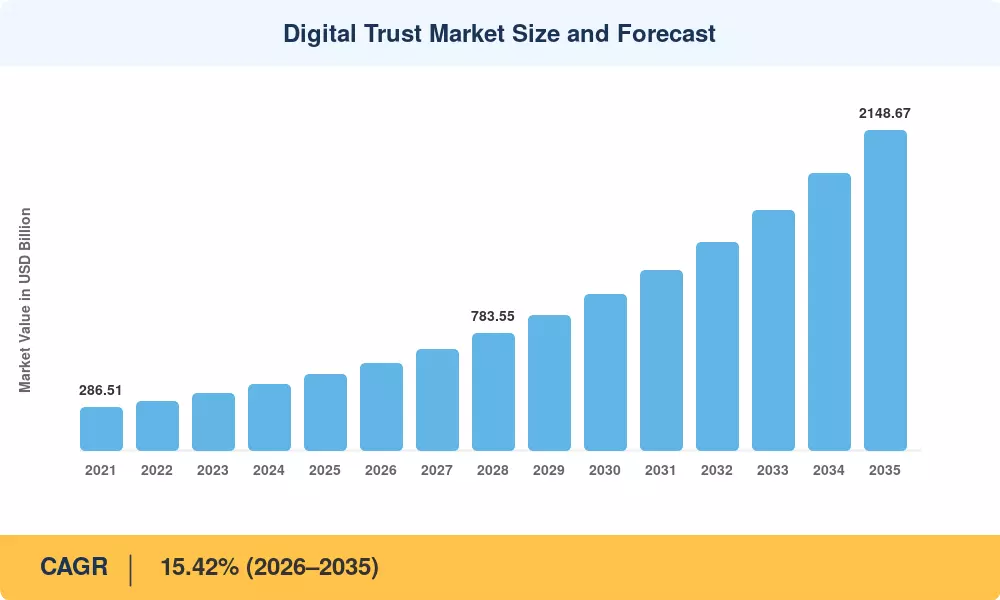
The Digital Trust Market reached an estimated USD 508.52 Billion in 2025 and is projected to grow from USD 590.14 Billion in 2026 to USD 2,148.67 Billion by 2035, registering a CAGR of 15.42% during the forecast period (2026–2035). This acceleration is anchored in a regulatory groundswell — the EU's Digital Operational Resilience Act (DORA) enforcement timeline and the U.S. SEC's four-business-day cyber-disclosure mandate have made identity-centric controls a boardroom imperative [1]. Enterprise spending on cybersecurity compliance for digital trust surpassed USD 68 Billion globally in 2024, reflecting how deeply governance mandates now shape procurement cycles.

Legacy perimeter-based security architectures are giving way to continuous authentication frameworks built around a zero-trust security framework for enterprises. Over 78% of breaches in 2024 involved compromised credentials, pushing organizations toward public key infrastructure PKI for digital trust and passwordless access models [2]. Cloud migration has consolidated identity providers, and AI-powered threat detection is reshaping vendor roadmaps — Gartner estimates that 60% of large enterprises will have adopted ML-driven identity analytics by 2027. The Digital Trust Market is evolving from point-product procurement to platform-led managed services integrating threat intelligence, digital signature and certificate authority trust issuance and automated compliance reporting.

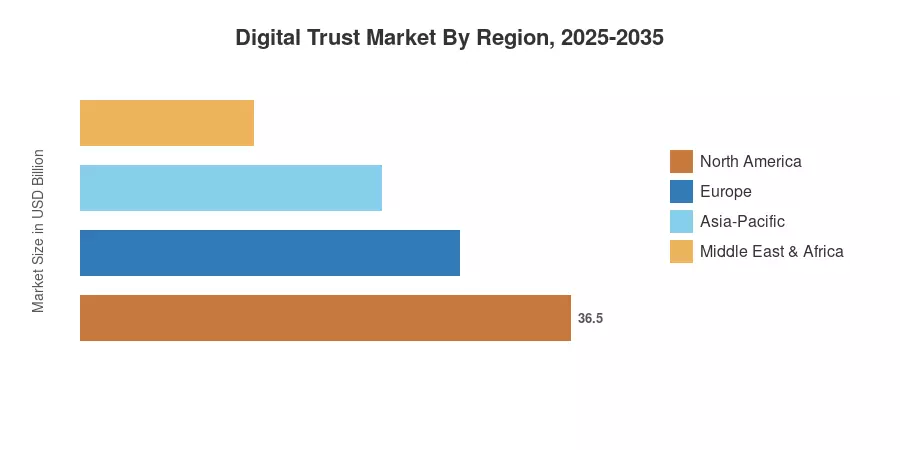
North America commands roughly 41% of the global Digital Trust Market revenue, driven by mature regulatory frameworks and Fortune 500 security budgets. Asia-Pacific stands as the fastest-growing region with a CAGR exceeding 16.3%, propelled by India's Digital Personal Data Protection Act and China's expanding cybersecurity standards regime [4]. Europe holds the second-largest share at approximately 27%, underpinned by GDPR enforcement momentum and the eIDAS 2.0 digital identity wallet rollout. As blockchain-based digital trust verification gains enterprise traction and quantum-safe cryptography moves from labs to production, the Digital Trust Market is poised for sustained double-digit expansion through 2035.

Key Report Takeaways

• By Component

  • Solutions captured approximately 62% of Digital Trust Market revenue in 2025, reflecting strong demand for integrated identity platforms and public key infrastructure PKI for digital trust deployments
  • Services are advancing at a 16.18% CAGR through 2035, as managed security offerings that bundle cybersecurity compliance for digital trust with threat intelligence gain traction among mid-market buyers

• By Deployment Mode

  • Cloud-based deployments commanded over USD 375 Billion of the 2025 Digital Trust Market spending, driven by hybrid-workforce identity orchestration needs
  • On-premises solutions continue to serve regulated verticals requiring data sovereignty, particularly government and defense environments

• By Organization Size

  • Large enterprises accounted for a 15.07% CAGR through the forecast period, scaling a zero-trust security framework for enterprises across distributed cloud estates
  • Small and medium-sized enterprises are the fastest-adopting cohort at a 16.05% CAGR, fueled by affordable SaaS-delivered digital signature and certificate authority trust solutions

• By End-User Industry

  • BFSI led with approximately 35% of the 2025 Digital Trust Market demand, reflecting stringent KYC/AML identity verification mandates
  • Retail and e-commerce is the quickest-growing vertical, driven by consumer-facing digital identity and blockchain-based digital trust verification for supply-chain provenance

• By Region

  • North America captured the largest share of the Digital Trust Market in 2025, underpinned by federal zero-trust mandates and enterprise cloud maturity
  • Asia-Pacific is scaling at a 16.32% CAGR, with India, China, and ASEAN markets channeling billions into national digital identity frameworks

MRFR's proprietary sizing framework triangulates bottom-up vendor revenue tracking, top-down TAM modeling, and primary interviews with 120+ CISOs and identity-security procurement leads across 14 countries. Historical figures (2021–2024) use reported spending; the 2025 base year blends actuals with Q4 estimates; and 2026–2035 values apply the calibrated 15.42% CAGR adjusted for adoption-curve inflection points.
Market Size Chart
Our Impact
Enabled $4.3B Revenue Impact for Fortune 500 and Leading Multinationals
Partnering with 2000+ Global Organizations Each Year
30K+ Citations by Top-Tier Firms in the Industry
 

Driver Impact Analysis

Driver ~% Impact on CAGR Geographic Relevance Impact Timeline
Surge in credential-based breaches ~18% Global Short-term (≤2 yr)
Zero-trust government mandates ~16% North America, Europe Short-term (≤2 yr)
Cloud identity consolidation ~15% Global Medium-term (2–4 yr)
AI-powered threat detection ~14% North America, APAC Medium-term (2–4 yr)
Privacy regulation proliferation ~13% Europe, APAC, LATAM Long-term (≥4 yr)
Quantum computing cryptographic risk ~12% Global Long-term (≥4 yr)
Digital identity wallet programs ~12% Europe, India Medium-term (2–4 yr)


Credential-Based Breach Escalation

IBM's 2024 Cost of a Data Breach report pegged the average breach cost at USD 4.88 Million, with stolen-credential incidents costing 15% more and taking 292 days to contain [2]. This economic reality has turned continuous authentication from a CISO wish-list item into a procurement line item, directly lifting the Digital Trust Market. Organizations are replacing static passwords with phishing-resistant FIDO2 tokens and certificate-based access, accelerating demand for public key infrastructure PKI for digital trust across financial services, healthcare, and government verticals.

Government Zero-Trust Mandates

The U.S. Executive Order 14028 and OMB Memorandum M-22-09 require all federal agencies to adopt zero-trust architectures by fiscal year 2027, representing a procurement pipeline exceeding USD 9.5 Billion [7]. Parallel mandates in the UK (National Cyber Strategy 2.0) and Australia (Essential Eight Maturity Model) have created a global policy cascade. These directives compel agencies and their supply-chain partners to deploy zero-trust security framework for enterprises, establishing a demand floor that insulates the Digital Trust Market from cyclical budget cuts.

Cloud Identity Consolidation

As enterprises operate across an average of 3.4 public cloud platforms, identity sprawl has become a critical attack surface. Platform vendors are responding with converged identity-governance suites that merge IAM, privileged access, and digital signature and certificate authority trust into a single control planes. Microsoft's Entra platform alone added 45 Million paid seats in 2024, while CrowdStrike and Zscaler expanded their identity-threat-detection modules, pulling mid-market buyers into the Digital Trust Market at accelerating rates.

AI-Powered Threat Intelligence

Artificial intelligence now underpins both attack and defense strategies. Deepfake-enabled social engineering rose 300% between 2022 and 2024, prompting enterprises to deploy ML-based identity-verification tools that cross-reference behavioral biometrics, device telemetry, and credential graphs in real time [8]. Vendors like Ping Identity, Okta, and SailPoint have embedded AI copilots into their platforms, driving upsell revenue and expanding the addressable scope of cybersecurity compliance for digital trust solutions.

Restraints Impact Analysis

These restraint estimates represent directional headwinds on the Digital Trust Market's growth trajectory. They should not be subtracted from the CAGR directly but understood as factors that temper adoption velocity in specific segments or geographies.

Restraint ~% Drag on CAGR Geographic Relevance Impact Timeline
Integration complexity with legacy IT ~–6% Global Medium-term (2–4 yr)
Skilled workforce shortage ~–5% Global Long-term (≥4 yr)
Data-sovereignty fragmentation ~–4% Europe, APAC Medium-term (2–4 yr)
Vendor lock-in concerns ~–3% North America Short-term (≤2 yr)
High initial deployment costs ~–3% Emerging Markets Short-term (≤2 yr)


Legacy IT Integration Complexity

Many organizations operate heterogeneous environments spanning mainframe-era directories, on-premises Active Directory forests, and multiple SaaS identity providers. Integrating a zero-trust security framework for enterprises across these layers demands middleware, custom connectors, and months of testing — Gartner estimates that 40% of zero-trust projects exceed their original timeline by six months or more. This friction slows deal cycles in the Digital Trust Market, particularly in healthcare and government sectors, where compliance validation adds further delay.

Cybersecurity Talent Gap

ISC² reports a global cybersecurity workforce gap of 3.4 Million professionals as of 2024 [14]. Identity and access management specialists command premium salaries, and many mid-market firms cannot staff dedicated trust-architecture teams. The shortage pushes organizations toward managed services — partially offsetting the restraint — but it constrains the pace at which enterprises can design, deploy, and operate public key infrastructure PKI for digital trust at scale, limiting near-term Digital Trust Market expansion in talent-scarce regions.

Data-Sovereignty Fragmentation

Cross-border data flows underpin global identity verification, yet jurisdictions are erecting conflicting localization requirements. India's DPDP Act, China's PIPL, and the EU's GDPR impose different consent, storage, and transfer rules, forcing vendors to maintain multiple data residency configurations [15]. This fragmentation raises deployment costs for multinational Digital Trust Market solutions and delays blockchain-based digital trust verification interoperability standards.

Opportunities

Decentralized Identity and Self-Sovereign Credentials

The W3C Verifiable Credentials standard, and the EU’s eIDAS 2.0 digital identity wallet effort are building a new trust layer independent of centralized identity suppliers [9]. By 2030, the EU might have 500 million digital wallets supported by governments, which would create need for infrastructure to issue, verify and revoke them. Vendors who implement digital signature and certificate authority trust into wallet ecosystems can exploit a fast-growing niche in the Digital Trust Market

Quantum-Safe Cryptography Migration

In August 2024, NIST announced the first post-quantum cryptography standards, kicking off a migration cycle that will touch every certificate, key store, and encrypted channel [10]. The crypto-agility challenge for enterprises is growing – taking inventory of billions of certificates and migrating public key infrastructure PKI for digital trust to lattice-based algorithms. The early adopters of quantum-safe PKI tooling can secure multi-year migration contracts worth billions, establishing them at the core of the next upgrade wave of the Digital Trust Market

Emerging-Market Digital Public Infrastructure

India’s Aadhaar-linked identity stack has handled over 100 Billion authentications, and comparable digital-public-infrastructure models are spreading in Brazil (GOV.BR), Indonesia (INA Digital) and Nigeria (NIN) [4]. These programs require identity-proofing, certificate authority and cybersecurity compliance for digital trust at population scale, generating new prospects for global vendors ready to localize pricing and cooperate with sovereign cloud operators

AI-Driven Trust-as-a-Service Monetization

Managed security vendors are bundling identity analytics, automated threat response and compliance dashboards into subscription-based trust-as-a-service products. Gartner predicts that by 2028, 30% of enterprise identity spend would be transacted through outcome-based service contracts, rather than traditional licenses. This model democratizes the access to advanced zero-trust security framework for organizations and unlocks the SME segment of the Digital Trust Market at scale

Supply-Chain Trust and Software Bill of Materials

The U.S. Cyber Safety Review Board and EU Cyber Resilience Act mandate software-bill-of-materials (SBOM) attestation and provenance verification [17]. Blockchain-based digital trust verification of software provenance is emerging as the default compliance mechanism, creating new revenue streams for vendors that integrate SBOM signing, artifact attestation, and code-integrity checks into CI/CD pipelines.

Future Outlook

AI-Native Identity Orchestration

By 2030, identity platforms will shift from rule-based access policies to AI-native orchestration engines that evaluate contextual risk signals — device posture, behavioral biometrics, geolocation anomalies, and credential-graph intelligence — in real time [8]. This transformation will compress mean-time-to-detect for identity-based attacks from days to seconds, fundamentally changing how organizations procure cybersecurity compliance for digital trust. The Digital Trust Market will see platform vendors embed generative-AI copilots for policy authoring, access reviews, and incident triage.

Decentralized and Self-Sovereign Identity at Scale

The convergence of W3C Verifiable Credentials, eIDAS 2.0 wallets, and mobile-driver-license standards will create an interoperable decentralized identity layer by 2032 [9]. Digital signature and certificate authority trust models will evolve from centralized hierarchies to peer-issued credential graphs anchored in distributed ledgers. This shift will redistribute revenue within the Digital Trust Market — away from monolithic IdP platforms and toward credential-issuance, wallet-management, and revocation-registry infrastructure.

Quantum-Safe Cryptography Transition

NIST's post-quantum standards (ML-KEM, ML-DSA) will trigger a decade-long migration affecting every certificate, TLS endpoint, and code-signing workflow [10]. Public key infrastructure PKI for digital trust vendors that offer crypto-agility tooling — automated certificate discovery, algorithm-swap orchestration, and hybrid-mode operation — will capture premium migration contracts. The Digital Trust Market's PKI segment alone could double by 2033 as organizations inventory and replace vulnerable asymmetric keys.

Regulatory Convergence and Continuous Compliance

The patchwork of GDPR, DORA, DPDP, PIPL, LGPD, and sector-specific mandates is pushing vendors toward unified compliance-automation platforms [1]. By 2035, continuous compliance — where policy posture is monitored and attested in real time rather than through periodic audits — will become the default operating model. Blockchain-based digital trust verification of audit trails and zero-trust security framework for enterprises telemetry will converge into integrated GRC dashboards, expanding the Digital Trust Market's addressable scope beyond identity into broader digital governance.


Market Segmentation

By Component

Segment Key Metric Primary Demand Driver
Solutions ~62% of 2025 revenue Integrated IAM platform consolidation
Services 16.18% CAGR (2026–2035) Managed detection, response, and compliance outsourcing


Solutions dominate the Digital Trust Market because enterprises increasingly prefer unified platforms that consolidate identity governance, privileged access, and digital signature and certificate authority trust into single procurement decisions. Vendors like Microsoft, Okta, and CyberArk have expanded their platform footprints through acquisitions, raising switching costs and reinforcing solution-segment stickiness.

Services represent the fastest-growing component as organizations — particularly SMEs — lack the in-house expertise to deploy and operate zero-trust security framework for enterprises. Managed trust-as-a-service offerings that bundle threat intelligence, automated incident response, and cybersecurity compliance for digital trust reporting are growing at roughly 16% annually, reshaping how the mid-market participates in the Digital Trust Market.

By Deployment Mode

Segment Key Metric Primary Demand Driver
Cloud-Based USD 375.29 Billion (2025) Hybrid-workforce identity orchestration
On-Premises ~26% of 2025 revenue Data-sovereignty mandates in regulated verticals


Cloud-based deployments command the lion's share of the Digital Trust Market, reflecting how identity infrastructure follows workloads into public and hybrid clouds. The shift to cloud-native public key infrastructure PKI for digital trust — where certificate lifecycle management runs as a SaaS service — has been particularly pronounced in financial services and technology sectors. On-premises retains relevance in defense, intelligence, and select healthcare environments where data-residency requirements preclude cloud processing.

By Organization Size

Segment Key Metric Primary Demand Driver
Large Enterprises ~67% of 2025 share Multi-cloud identity sprawl; board-level risk mandates
Small and Medium-Sized Enterprises 16.05% CAGR (2026–2035) SaaS-delivered identity solutions; affordable managed services


Large enterprises remain the Digital Trust Market's revenue anchor, spending heavily on platform licenses, professional services, and custom integrations for zero-trust security framework for enterprises. SMEs, however, represent the growth engine — SaaS pricing models and channel-partner ecosystems have lowered the entry barrier, enabling mid-market firms to adopt digital signature and certificate authority trust capabilities that were previously accessible only to large organizations.

By End-User Industry

Segment Key Metric Primary Demand Driver
BFSI ~35% of 2025 demand KYC/AML identity verification; open-banking APIs
Healthcare 15.83% CAGR HIPAA identity assurance; telehealth expansion
IT and Telecommunications USD 68.65 Billion (2025) DevSecOps identity; API-gateway trust
Government and Public Sector ~14% of 2025 demand Federal zero-trust mandates; national digital ID
Retail and E-Commerce 16.24% CAGR Consumer identity; blockchain-based digital trust verification for supply chain
Others USD 38.14 Billion (2025) Education, energy, manufacturing identity programs


BFSI anchors the Digital Trust Market because financial regulators worldwide require strong customer authentication, transaction signing, and real-time fraud detection — all of which depend on robust public key infrastructure PKI for digital trust. Retail and e-commerce is the fastest-growing vertical as brands deploy consumer-facing decentralized identity, loyalty-linked trust tokens, and supply-chain provenance powered by blockchain-based digital trust verification.

Regional Market Share Analysis

Region Key Metric Primary Investment Themes
North America ~41% of 2025 revenue Federal zero-trust mandates; cloud IAM consolidation
Europe ~27% of 2025 revenue eIDAS 2.0; GDPR enforcement; DORA compliance
Asia-Pacific 16.32% CAGR (2026–2035) National digital ID; data-localization laws
South America USD 27.46 Billion (2025) GOV.BR identity; fintech-led KYC
Middle East & Africa USD 17.74 Billion (2025) Smart-city identity layers; Vision 2030 programs
Total USD 508.52 Billion (2025)

The Digital Trust Market exhibits a clear three-tier regional hierarchy, with North America and Europe forming the mature core, Asia-Pacific scaling rapidly, and South America and the Middle East & Africa emerging as frontier growth zones. Regional spending patterns reflect regulatory maturity, cloud-adoption rates, and the pace of national digital identity programs.


North America

Country Key Metric Key Driver
United States ~82% of regional revenue OMB M-22-09 zero-trust mandate [7]
Canada 15.78% CAGR Pan-Canadian Trust Framework [18]
Mexico USD 5.93 Billion (2025) Fintech identity compliance (Ley Fintech)


The U.S. dominates the Digital Trust Market in North America, with federal civilian and defense agencies alone committing over USD 9 Billion to zero-trust modernization by 2027 [7]. Canada's Digital Ambition strategy and Pan-Canadian Trust Framework are accelerating public key infrastructure PKI for digital trust adoption across provincial health systems, while Mexico's growing fintech sector requires robust digital signature and certificate authority trust for regulatory compliance.

Europe

Country Key Metric Key Driver
Germany ~22% of regional share BSI IT-Grundschutz; automotive supply-chain security
United Kingdom 15.64% CAGR UK Digital Identity and Attributes Trust Framework [19]
France USD 16.82 Billion (2025) ANSSI certification; SecNumCloud
Italy ~9% of regional share SPID digital identity; AgID directives
Spain 15.29% CAGR EU Recovery Fund digitalization mandates
Nordic Countries USD 10.14 Billion (2025) BankID ecosystems; high digital literacy
Russia ~4% of regional share Sovereign internet policies; GOST crypto
Rest of Europe 14.87% CAGR Varied EU Digital Decade targets


Europe's Digital Trust Market is shaped by the regulatory triad of GDPR, DORA, and eIDAS 2.0. Germany's industrial base demands supply-chain cybersecurity compliance for digital trust across automotive and manufacturing verticals. The UK's post-Brexit identity-trust framework and France's SecNumCloud sovereign-cloud certification are creating parallel but interoperable trust ecosystems, sustaining demand for blockchain-based digital trust verification standards.

Asia-Pacific

Country Key Metric Key Driver
China ~34% of regional share PIPL enforcement; MLPS 2.0 cybersecurity standards
India 17.24% CAGR DPDP Act; Aadhaar-linked identity stack [4]
Japan USD 14.27 Billion (2025) My Number card expansion; Society 5.0
South Korea ~11% of regional share K-Digital New Deal; zero-trust guidelines
ASEAN 16.89% CAGR ASEAN Digital Framework Agreement
Rest of Asia-Pacific USD 7.64 Billion (2025) Australia's Essential Eight; NZ digital ID


Asia-Pacific represents the fastest-growing frontier for the Digital Trust Market. India's DPDP Act and Digital Personal Data Protection rules are driving a compliance-led identity-security buildout, while China's Multi-Level Protection Scheme 2.0 compels enterprises to adopt zero-trust security framework for enterprises across critical infrastructure. Japan and South Korea are investing heavily in national digital identity cards, expanding the addressable base for public key infrastructure PKI for digital trust solutions.

South America

Country Key Metric Key Driver
Brazil ~58% of regional share GOV.BR identity; LGPD enforcement
Argentina 14.68% CAGR Digital signature regulation (Ley 25.506)
Rest of South America USD 4.39 Billion (2025) Fintech-led KYC expansion


Brazil's GOV.BR digital identity platform has enrolled over 160 Million citizens, driving demand for certificate authority infrastructure and cybersecurity compliance for digital trust across government and banking. Argentina's long-standing digital signature legislation provides a regulatory foundation for Digital Trust Market growth in the Southern Cone.

Middle East & Africa

Country Key Metric Key Driver
Saudi Arabia ~29% of regional share Vision 2030 smart-city digital identity
UAE 15.52% CAGR UAE Pass national identity; TDRA cybersecurity
South Africa USD 2.84 Billion (2025) POPIA enforcement; banking KYC
Egypt 14.41% CAGR National digital transformation strategy
Rest of MEA ~22% of regional share Africa CDC health identity; GCC fintech


Saudi Arabia's NEOM and smart-city initiatives require population-scale identity layers, positioning the Kingdom as the largest Digital Trust Market in the MEA region. The UAE's national digital identity program (UAE Pass) and TDRA cybersecurity standards are accelerating the adoption of a zero-trust security framework for enterprises across government and financial services.


Regional Market Share

Competitive Benchmarking

The Digital Trust Market exhibits low-to-moderate concentration, with an estimated HHI below 600 and the top five vendors collectively holding roughly 28–35% of global revenue. The landscape is fragmented across identity-governance specialists, cloud-platform incumbents, PKI certificate authorities, and managed-security providers. M&A activity has intensified — Thales acquired Imperva, CrowdStrike expanded its identity-protection module, and private-equity firms have taken positions in mid-tier PKI vendors — signaling consolidation ahead.

Company Est. Revenue Share Range Key Offerings for Digital Trust Market Strategic Positioning
Microsoft ~7–10% Entra ID (Azure AD), Intune, Defender for Identity Platform incumbent leveraging cloud-OS integration
Okta ~4–6% Workforce Identity Cloud, Customer Identity Cloud Pure-play identity leader; developer ecosystem
CyberArk ~3–5% Privileged Access Manager, Identity Security Intelligence Privileged-access specialist expanding to workforce IAM
Thales Group ~3–5% CipherTrust, SafeNet, Luna HSMs Hardware-rooted trust and quantum-safe PKI
DigiCert ~2–4% TLS/SSL certificates, IoT device identity, PKI platform Certificate authority with IoT-scale issuance
Entrust ~2–4% PKI-as-a-Service, digital signing, identity verification PKI and credential management for government
Ping Identity ~2–3% PingOne, DaVinci orchestration API-centric identity orchestration
SailPoint ~2–3% Identity Security Cloud, AI-driven access governance Identity governance and administration leader
CrowdStrike ~2–3% Falcon Identity Protection, ITDR Endpoint-to-identity threat detection
Palo Alto Networks ~2–3% Prisma Access, ZTNA 2.0, Cortex XSIAM Network-to-identity zero-trust convergence
 

Recent News & Developments

  • Microsoft (March 2025): Launched Entra Verified ID support for eIDAS 2.0 wallet credentials, enabling cross-border digital signature and certificate authority trust interoperability across EU member states [20].
  • Okta (January 2025): Acquired Spera Security to bolster identity-threat-detection capabilities, strengthening its cybersecurity compliance for digital trust portfolio for enterprise customers [21].
  • CyberArk (November 2024): Completed integration of Venafi's machine-identity platform, creating the industry's broadest public key infrastructure PKI for digital trust offering for both human and non-human identities [22].
  • DigiCert (September 2024): Released its PQC-ready certificate platform supporting ML-KEM and ML-DSA algorithms, positioning as a first mover in quantum-safe Digital Trust Market infrastructure [10].
  • NIST (August 2024): Finalized three post-quantum cryptographic standards (FIPS 203, 204, 205), triggering enterprise migration planning across the Digital Trust Market [10].
  • European Commission (February 2024): Published implementing acts for eIDAS 2.0 digital identity wallets, setting a 2026 member-state deployment deadline and accelerating blockchain-based digital trust verification standards [9].
  • CrowdStrike (June 2024): Expanded Falcon Identity Protection with AI-powered lateral-movement detection, deepening its zero-trust security framework for enterprises integration with SIEM platforms [23].

Report Scope

Parameter Detail
Market Scope Digital Trust Market — identity governance, access management, PKI, digital signing, trust services, managed security
Study Period 2021–2035
CAGR 15.42% (2026–2035)
Market Size — 2025 (Base Year) USD 508.52 Billion
Market Size — 2035 (Endpoint) USD 2,148.67 Billion
Fastest Growing Segment Services (by component); Retail & E-Commerce (by end user); Asia-Pacific (by region)
Companies Profiled Microsoft, Okta, CyberArk, Thales, DigiCert, Entrust, Ping Identity, SailPoint, CrowdStrike, Palo Alto Networks
Valuation Currency USD Billion
CAGR Driver Disclaimer Impact percentages in Sections 4–5 are directional influence estimates, not additive components of the headline CAGR


FAQs

How does zero-trust architecture differ from traditional perimeter security in enterprise procurement decisions?

Zero-trust eliminates implicit trust by verifying every user and device per request, while perimeter security trusts anything inside the firewall. Procurement shifts from point-product firewalls to integrated identity platforms covering the full Digital Trust Market stack.

What role does public key infrastructure PKI for digital trust play in IoT device authentication?

PKI assigns unique certificates to each device, enabling mutual TLS authentication at scale. This ensures only authorized endpoints communicate within industrial and healthcare IoT networks [22].

How are digital signature and certificate authority trust models evolving with eIDAS 2.0?

eIDAS 2.0 mandates qualified electronic signatures via government-issued digital wallets, shifting certificate authority revenue from browser-trust hierarchies to wallet-credential issuance ecosystems across the Digital Trust Market [9].

What compliance challenges do multinational enterprises face when deploying cybersecurity compliance for digital trust across jurisdictions?

Conflicting data-localization rules under GDPR, PIPL, and DPDP force separate identity-data residency configurations per region. This raises deployment costs and delays Digital Trust Market rollouts by 6–12 months on average [15].

How does blockchain-based digital trust verification improve software supply-chain security?

Blockchain creates immutable audit trails for SBOM attestation, enabling downstream consumers to verify code provenance without trusting a single authority. Adoption is accelerating under U.S. NTIA and EU CRA mandates [17].

What pricing models are emerging for managed Digital Trust Market services targeting SMEs?

Outcome-based pricing ties fees to metrics like authentication volume or compliance-posture scores rather than flat licenses. This model lowers entry barriers and drives the 16% services-segment CAGR.

How should enterprises prioritize quantum-safe cryptography migration within their Digital Trust Market roadmap?

Start with a certificate inventory and risk-rank by data sensitivity, then pilot hybrid-mode PKI that supports both classical and post-quantum algorithms simultaneously. NIST recommends completing critical migrations by 2030 [10].

Author
Author
Author Profile
Kiran Jinkalwad LinkedIn
Research Associate Level - II
Kiran Jinkalwad brings over four years of experience in market research, specializing in the ICT and Semiconductor sectors. She has worked on 50+ projects, including custom studies for companies like Microsoft and Huawei, addressing complex business challenges. With a background in Electronics and Telecommunication, Kiran excels in market estimation, forecasting, and strategic analysis. His sharp analytical skills and industry knowledge consistently deliver actionable insights for diverse clients.
Co-Author
Co-Author Profile
Aarti Dhapte LinkedIn
AVP - Research
A consulting professional focused on helping businesses navigate complex markets through structured research and strategic insights. I partner with clients to solve high-impact business problems across market entry strategy, competitive intelligence, and opportunity assessment. Over the course of my experience, I have led and contributed to 100+ market research and consulting engagements, delivering insights across multiple industries and geographies, and supporting strategic decisions linked to $500M+ market opportunities. My core expertise lies in building robust market sizing, forecasting, and commercial models (top-down and bottom-up), alongside deep-dive competitive and industry analysis. I have played a key role in shaping go-to-market strategies, investment cases, and growth roadmaps, enabling clients to make confident, data-backed decisions in dynamic markets.

Research Approach


Secondary Research

The secondary research process involved comprehensive analysis of regulatory databases, cybersecurity frameworks, peer-reviewed technology journals, industry publications, and authoritative government organizations. Key sources included the National Institute of Standards and Technology (NIST), European Union Agency for Cybersecurity (ENISA), International Organization for Standardization (ISO), Internet Engineering Task Force (IETF), World Economic Forum (WEF) Centre for Cybersecurity, European Commission Digital Strategy, US Department of Homeland Security (DHS) Cybersecurity and Infrastructure Security Agency (CISA), Federal Trade Commission (FTC) Privacy and Identity Protection, European Data Protection Board (EDPB), Asia-Pacific Economic Cooperation (APEC) Cross-Border Privacy Rules, International Telecommunication Union (ITU), Organization for Economic Co-operation and Development (OECD) Digital Economy Policy, and national cybersecurity agency reports from key markets.

Regulatory compliance data, cybersecurity incident statistics, digital identity adoption trends, data protection framework analysis, and market landscape assessment for identity verification platforms, fraud prevention systems, authentication solutions, and compliance management technologies were gathered from these sources.


Primary Research

In order to gather both qualitative and quantitative insights, supply-side and demand-side stakeholders were interviewed during the primary research process. CEOs, CTOs, VPs of cybersecurity product development, chief information security officers (CISOs), and heads of digital identity solutions from identity management companies, cybersecurity vendors, and blockchain technology companies were examples of supply-side sources. Chief information officers (CIOs), IT security directors, risk management directors, compliance officers from banking and financial institutions, healthcare organizations, government agencies, and enterprise IT procurement leads from large and midmarket businesses were examples of demand-side sources. Market segmentation, product development roadmaps, technology adoption trends, security investment priorities, compliance implementation tactics, and vendor selection criteria were all confirmed by primary research.

Primary Respondent Breakdown:

By Designation: C-level Primaries (32%), Director Level (31%), Others (37%)

By Region: North America (38%), Europe (29%), Asia-Pacific (26%), Rest of World (7%)


Market Size Estimation

Revenue mapping and solution deployment analysis were used to get the global market valuation. The methodology comprised:

Finding more than fifty major technology suppliers in North America, Europe, Asia-Pacific, and Latin America

Product mapping between identity verification systems, fraud prevention platforms, data verification services, compliance management tools, and authentication solutions

Examination of stated and projected yearly income for portfolios of digital trust solutions

Coverage of suppliers accounting for 75–80% of the worldwide market in 2024

Extrapolation to obtain segment-specific valuations utilizing top-down (vendor revenue validation) and bottom-up (deployment volume × ASP by area and organization size) methods

Download Free Sample

Kindly complete the form below to receive a free sample of this Report