×
Request Free Sample ×

Kindly complete the form below to receive a free sample of this Report

* Please use a valid business email

Leading companies partner with us for data-driven Insights

clients tt-cursor
Hero Background

Digital Utility Market

ID: MRFR/SEM/2796-HCR
100 Pages
Shubham Munde
October 2025

Digital Utility Market Research Report Information By Component (Hardware, Software, and Services), By Deployment Type (On-Premises, Cloud, and Hybrid), By End-Users (Residential, Commercial, and Retail), And By Region (North America, Europe, Asia-Pacific, And Rest Of The World) –Industry Forecast Till 2035

Share:
Download PDF ×

We do not share your information with anyone. However, we may send you emails based on your report interest from time to time. You may contact us at any time to opt-out.

Digital Utility Market Infographic
Purchase Options

Digital Utility Market Summary

As per MRFR analysis, the Digital Utility Market Size was estimated at 102275.6 USD Million in 2024. The Digital Utility industry is projected to grow from 114571.2 USD Million in 2025 to 356541.11 USD Million by 2035, exhibiting a compound annual growth rate (CAGR) of 12.02 during the forecast period 2025 - 2035.

Key Market Trends & Highlights

The Digital Utility Market is poised for transformative growth driven by technological advancements and evolving consumer expectations.

  • The integration of smart grids is reshaping the landscape of energy distribution in North America, enhancing efficiency and reliability.
  • Customer engagement strategies are becoming increasingly vital, particularly in the residential segment, which remains the largest market.
  • The adoption of renewable energy solutions is accelerating in the Asia-Pacific region, reflecting a shift towards sustainable energy practices.
  • Key market drivers include the integration of advanced technologies and regulatory support, which are fueling growth in both smart grid and energy management system segments.

Market Size & Forecast

2024 Market Size 102275.6 (USD Million)
2035 Market Size 356541.11 (USD Million)
CAGR (2025 - 2035) 12.02%

Major Players

Siemens (DE), Schneider Electric (FR), General Electric (US), IBM (US), Honeywell (US), Cisco Systems (US), Oracle (US), ABB (CH), Eaton (US)

Digital Utility Market Trends

The Digital Utility Market is currently experiencing a transformative phase, driven by advancements in technology and a growing emphasis on sustainability. Utilities are increasingly adopting digital solutions to enhance operational efficiency, improve customer engagement, and facilitate the integration of renewable energy sources. This shift towards digitalization is not merely a trend but appears to be a fundamental change in how utilities operate and interact with consumers. The rise of smart grids, data analytics, and Internet of Things (IoT) technologies is reshaping the landscape, enabling utilities to optimize resource management and deliver more personalized services. Moreover, the focus on sustainability is prompting utilities to invest in innovative solutions that reduce carbon footprints and promote energy conservation. As consumers become more environmentally conscious, utilities are likely to respond by offering green energy options and implementing programs that encourage energy efficiency. This evolving market landscape suggests that the Digital Utility Market will continue to grow, driven by technological advancements and a commitment to sustainable practices. The interplay between technology and environmental responsibility is expected to shape the future of utilities, creating opportunities for growth and innovation.

Integration of Smart Grids

The integration of smart grids is revolutionizing the Digital Utility Market by enabling real-time monitoring and management of energy distribution. This technology allows utilities to respond swiftly to fluctuations in demand and supply, enhancing reliability and efficiency.

Emphasis on Customer Engagement

Utilities are increasingly focusing on customer engagement through digital platforms. Enhanced communication channels and personalized services are fostering stronger relationships between utilities and consumers, leading to improved satisfaction and loyalty.

Adoption of Renewable Energy Solutions

The Digital Utility Market is witnessing a notable shift towards renewable energy solutions. Utilities are investing in solar, wind, and other sustainable sources, aligning their operations with global sustainability goals and responding to consumer demand for cleaner energy.

Digital Utility Market Drivers

Technological Advancements

The Global Digital Utility Market Industry is experiencing rapid technological advancements that enhance operational efficiency and customer engagement. Innovations such as smart grids, IoT devices, and AI-driven analytics are transforming traditional utility operations. For instance, the integration of smart meters allows utilities to monitor consumption in real-time, leading to improved demand response strategies. This shift not only optimizes resource allocation but also fosters customer satisfaction through personalized services. As these technologies proliferate, the market is projected to reach 235.94 USD Billion in 2024, indicating a robust growth trajectory fueled by ongoing digital transformation.

Market Segment Insights

By Application: Smart Grid (Largest) vs. Energy Management System (Fastest-Growing)

The Digital Utility Market's application segment is dominated by Smart Grid solutions, which provide enhanced energy distribution and management capabilities. This segment holds a significant share of market presence due to the increasing demand for reliable and efficient energy systems. Energy Management Systems are increasingly important, representing a rapidly growing area driven by the need for organizations to optimize energy usage and reduce operational costs. These applications have triggered a shift towards smarter energy solutions.

Smart Grid (Dominant) vs. Demand Response (Emerging)

Smart Grid technologies have become the cornerstone of modern utility infrastructure, offering advanced features such as real-time data analytics and efficient energy distribution. As a dominant player in the Digital Utility Market, the Smart Grid empowers utilities to better manage energy flow, enhance sustainability efforts, and improve grid reliability. Meanwhile, Demand Response is emerging as a vital solution, characterized by its ability to adjust consumer demand in response to supply fluctuations. This application not only aligns with sustainability initiatives but also presents opportunities for cost reduction and enhanced energy efficiency. As utilities and consumers recognize the benefits, Demand Response is poised for substantial growth, complementing the established position of Smart Grid solutions.

By End Use: Residential (Largest) vs. Commercial (Fastest-Growing)

The Digital Utility Market showcases a diverse segment distribution among its end-use applications, with the Residential sector currently holding the largest share. This segment benefits from the increasing demand for smart home solutions and energy management systems, which leverage digital technology to enhance energy efficiency. Following closely, the Commercial segment is rapidly expanding as businesses seek to optimize operational costs through digitization and advanced energy management tools, making it a significant player in the market landscape. As we look toward future growth trends, the Residential segment is expected to continue leading due to rising consumer awareness and the transition to sustainable energy practices. Meanwhile, the Commercial segment is recognized as the fastest-growing sector, driven by businesses’ need for innovative technology solutions that facilitate energy monitoring and data analytics. This shift not only improves energy efficiency but also aligns with sustainability goals, making it a critical area for investment and focus in the coming years.

Residential (Dominant) vs. Industrial (Emerging)

The Residential end-use segment in the Digital Utility Market stands out as the dominant player due to its early adoption of smart technologies and home automation systems. This segment features an array of devices, from smart thermostats to energy-efficient appliances, all contributing to a sustainable living environment. On the other hand, the Industrial sector is emerging as a significant player, primarily due to increased automation and the demand for real-time energy monitoring solutions. Industries are integrating digital utility solutions to optimize energy consumption, reduce operational costs, and comply with regulatory standards. While Residential settings focus on user-friendly applications for everyday consumers, Industrial applications prioritize efficiency and scalability, marking a clear divergence in their respective market strategies.

By Technology: Artificial Intelligence (Largest) vs. Internet of Things (Fastest-Growing)

Within the Digital Utility Market, the distribution of market share among technological segment values reflects the varying levels of adoption and implementation. Artificial Intelligence (AI) stands out as the largest segment, leading the way with its extensive applications in predictive maintenance and smart grid management. Following AI, the Internet of Things (IoT) represents a significant portion of the market, driven by the increasing interconnectedness of devices and systems that enhance operational efficiency and resource management. As we look to the future, growth trends indicate that the Internet of Things will be the fastest-growing segment within the Digital Utility Market. Factors such as the rising demand for real-time data analytics, automation, and improved energy efficiency are propelling the integration of IoT technologies. Additionally, advancements in cloud computing and AI further augment the capabilities of IoT solutions, fostering innovation and creating new revenue streams for utility companies.

Technology: Artificial Intelligence (Dominant) vs. Internet of Things (Emerging)

In the realm of the Digital Utility Market, Artificial Intelligence (AI) serves as the dominant player, primarily due to its ability to analyze vast datasets and generate actionable insights that optimize utility operations. AI enhances various processes, including demand forecasting, fault detection, and customer engagement, leading to improved service delivery and reduced operational costs. On the other hand, the Internet of Things (IoT) is rapidly emerging, characterized by its capability to connect various physical devices through the internet, enabling seamless data exchange and real-time monitoring. As utilities invest in IoT-based solutions, they benefit from enhanced visibility into system performance and customer consumption patterns. This dynamic interplay between AI and IoT is reshaping how digital utility services are delivered and experienced.

By Service Type: Consulting (Largest) vs. Integration (Fastest-Growing)

In the Digital Utility Market, the service type segment comprises Consulting, Integration, Maintenance, Support, and Training, each playing a vital role in the overall ecosystem. Consulting holds the largest market share, primarily due to its critical nature in providing strategic insights and guidance to utility companies. Integration, while smaller in comparison, is rapidly gaining traction as organizations seek to streamline their operations and adopt new technologies.

Consulting (Dominant) vs. Integration (Emerging)

Consulting services dominate the Digital Utility Market by offering organizations essential expertise to navigate the complexities of energy management and digital transformation. These services encompass strategic planning, risk management, and technology assessments tailored to individual utility needs. On the other hand, Integration services are emerging as a vital component for utilities aiming to connect various operational technologies and systems. This growing trend signifies a shift towards more cohesive and efficient operational frameworks, driven by the increasing adoption of IoT and smart grid technologies.

Get more detailed insights about Digital Utility Market

Regional Insights

North America : Market Leader in Digital Utilities

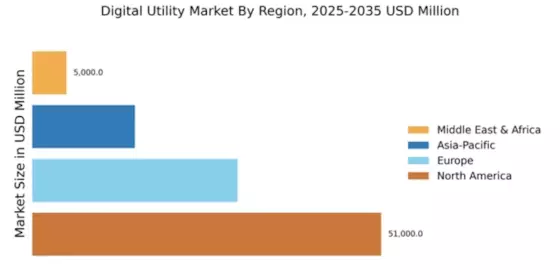
North America is poised to maintain its leadership in the Digital Utility Market, holding a significant market share of 51,000.0. The region's growth is driven by increasing investments in smart grid technologies, regulatory support for renewable energy integration, and a rising demand for energy efficiency solutions. The push for digital transformation in utility operations is further catalyzed by government initiatives aimed at enhancing grid resilience and sustainability. The competitive landscape is characterized by the presence of major players such as General Electric, IBM, and Siemens, which are actively innovating to meet the evolving needs of the market. The U.S. and Canada are leading countries, with substantial investments in digital infrastructure and smart technologies. This competitive environment fosters collaboration among key stakeholders, ensuring a robust ecosystem for digital utility solutions.

Europe : Emerging Digital Utility Hub

Europe is rapidly emerging as a key player in the Digital Utility Market, with a market size of 30,000.0. The region's growth is primarily driven by stringent sustainability regulations, ambitious carbon reduction targets, and a strong push towards renewable energy sources. The European Union's Green Deal and various national policies are catalyzing investments in digital technologies that enhance energy efficiency and grid management, making the region a focal point for innovation in utilities. Leading countries such as Germany, France, and the UK are at the forefront of this transformation, supported by major companies like Schneider Electric and ABB. The competitive landscape is marked by a strong emphasis on partnerships and collaborations to develop cutting-edge solutions. As Europe continues to prioritize digitalization in utilities, the market is expected to expand significantly, driven by both regulatory frameworks and technological advancements.

Asia-Pacific : Rapid Growth in Digital Solutions

The Asia-Pacific region is witnessing rapid growth in the Digital Utility Market, with a market size of 15,000.0. This growth is fueled by increasing urbanization, rising energy demands, and government initiatives promoting smart grid technologies. Countries like China and India are investing heavily in digital infrastructure to enhance energy efficiency and reliability, supported by favorable regulatory frameworks that encourage innovation in utility management. China is leading the charge, with significant investments from state-owned enterprises and private players alike. The competitive landscape features key players such as Cisco Systems and Oracle, which are providing advanced digital solutions tailored to the region's unique challenges. As the demand for sustainable energy solutions continues to rise, the Asia-Pacific market is expected to expand, driven by both technological advancements and regulatory support.

Middle East and Africa : Emerging Market Potential

The Middle East and Africa region is gradually emerging in the Digital Utility Market, with a market size of 5,000.0. The growth is primarily driven by increasing investments in energy infrastructure, coupled with a growing emphasis on sustainability and digital transformation. Governments are recognizing the importance of modernizing utility services to meet the rising energy demands and improve service delivery, leading to a favorable regulatory environment for digital solutions. Countries like South Africa and the UAE are taking the lead in adopting digital utility technologies, supported by key players such as Honeywell and Eaton. The competitive landscape is evolving, with a focus on partnerships and collaborations to enhance service delivery and operational efficiency. As the region continues to invest in digital infrastructure, the potential for growth in the digital utility sector is significant, driven by both local and international investments.

Key Players and Competitive Insights

The Digital Utility Market is currently characterized by a dynamic competitive landscape, driven by the increasing demand for smart grid technologies, renewable energy integration, and enhanced operational efficiencies. Key players such as Siemens (DE), Schneider Electric (FR), and General Electric (US) are strategically positioned to leverage these growth drivers. Siemens (DE) focuses on innovation in digital solutions, particularly in automation and data analytics, which enhances operational efficiency for utility providers. Schneider Electric (FR) emphasizes sustainability and energy management, positioning itself as a leader in eco-friendly solutions. General Electric (US) is heavily investing in digital transformation initiatives, particularly in predictive maintenance and IoT applications, which collectively shape a competitive environment that prioritizes technological advancement and sustainability.

The business tactics employed by these companies include localizing manufacturing to reduce costs and optimize supply chains, which is particularly relevant in the context of global supply chain disruptions. The market structure appears moderately fragmented, with several players vying for market share, yet the collective influence of major companies like Siemens (DE) and Schneider Electric (FR) suggests a trend towards consolidation through strategic partnerships and acquisitions.

In November 2025, Siemens (DE) announced a partnership with a leading renewable energy firm to develop integrated solutions for smart grids. This collaboration is expected to enhance Siemens' capabilities in managing distributed energy resources, thereby solidifying its market position. The strategic importance of this partnership lies in its potential to accelerate the transition towards sustainable energy systems, aligning with global decarbonization goals.

In October 2025, Schneider Electric (FR) launched a new digital platform aimed at optimizing energy consumption for industrial clients. This platform utilizes advanced analytics and AI to provide real-time insights, enabling businesses to reduce energy costs and improve sustainability metrics. The launch signifies Schneider Electric's commitment to innovation and its strategic focus on providing value-added services to its customers, which is crucial in a competitive market.

In September 2025, General Electric (US) unveiled a new suite of IoT solutions designed to enhance grid reliability and efficiency. This initiative is particularly significant as it addresses the growing need for utilities to manage complex energy systems effectively. By integrating IoT technologies, General Electric (US) aims to provide utilities with the tools necessary to optimize operations and respond to real-time data, thereby reinforcing its competitive edge.

As of December 2025, the Digital Utility Market is witnessing trends that emphasize digitalization, sustainability, and AI integration. Strategic alliances among key players are increasingly shaping the competitive landscape, fostering innovation and collaboration. The shift from price-based competition to a focus on technological differentiation and supply chain reliability is evident. Moving forward, companies that prioritize innovation and sustainable practices are likely to emerge as leaders in this evolving market.

Key Companies in the Digital Utility Market market include

Industry Developments

  • Q2 2024: Siemens launches new digital grid software to accelerate utility decarbonization Siemens announced the launch of its new digital grid software suite designed to help utilities manage distributed energy resources and accelerate the transition to cleaner energy. The platform integrates real-time data analytics and AI to optimize grid operations.
  • Q2 2024: GE Vernova and Microsoft partner to deliver advanced digital utility solutions GE Vernova and Microsoft announced a strategic partnership to co-develop cloud-based digital utility solutions, leveraging Microsoft Azure and GE’s GridOS platform to enhance grid reliability and support renewable integration for utility customers.
  • Q2 2024: Oracle Energy and Water launches new AI-powered customer engagement platform for utilities Oracle Energy and Water introduced a new AI-powered platform aimed at improving customer engagement and operational efficiency for utility companies, offering predictive analytics and personalized digital experiences.
  • Q3 2024: Schneider Electric acquires AutoGrid to expand digital utility capabilities Schneider Electric completed the acquisition of AutoGrid, a provider of AI-driven grid optimization software, to strengthen its digital utility offerings and support utilities in managing distributed energy resources.
  • Q3 2024: Enel X secures major contract to digitize grid infrastructure in Brazil Enel X won a significant contract to deploy its digital grid management solutions across several Brazilian utilities, aiming to improve grid reliability and enable advanced demand response capabilities.
  • Q3 2024: Siemens Energy appoints new Chief Digital Officer to lead utility transformation Siemens Energy announced the appointment of a new Chief Digital Officer, tasked with accelerating the company’s digital transformation initiatives in the utility sector and expanding its portfolio of digital solutions.
  • Q4 2024: Hitachi Energy launches Lumada Asset Performance Management for utilities Hitachi Energy introduced Lumada Asset Performance Management, a new digital platform that uses AI and IoT to help utilities monitor and optimize asset health, reduce downtime, and improve operational efficiency.
  • Q4 2024: ABB unveils new digital substation platform for North American utilities ABB launched a next-generation digital substation platform designed for North American utilities, featuring advanced cybersecurity, real-time monitoring, and integration with renewable energy sources.
  • Q1 2025: Itron and AWS announce partnership to accelerate digital utility transformation Itron and Amazon Web Services (AWS) formed a partnership to deliver scalable, cloud-based digital utility solutions, enabling utilities to leverage IoT and advanced analytics for grid modernization.
  • Q1 2025: National Grid launches digital twin project for UK electricity network National Grid announced the launch of a digital twin initiative for the UK’s electricity network, aiming to enhance grid planning, resilience, and integration of renewable energy through advanced simulation and data analytics.
  • Q2 2025: E.ON invests €200 million in digital utility innovation hub E.ON announced a €200 million investment to establish a digital innovation hub focused on developing new technologies for smart grids, customer engagement, and energy efficiency in the utility sector.
  • Q2 2025: Siemens and Accenture expand alliance to deliver digital utility services in Asia-Pacific Siemens and Accenture expanded their alliance to provide comprehensive digital utility services across the Asia-Pacific region, targeting grid modernization and digital transformation projects for regional utilities.

Future Outlook

Digital Utility Market Future Outlook

The Digital Utility Market is projected to grow at 12.02% CAGR from 2024 to 2035, driven by technological advancements, regulatory support, and increasing demand for sustainable solutions.

New opportunities lie in:

  • Integration of AI-driven predictive maintenance systems
  • Development of blockchain-based energy trading platforms
  • Expansion of smart grid technologies for enhanced efficiency

By 2035, the Digital Utility Market is expected to be robust, driven by innovation and strategic investments.

Market Segmentation

Digital Utility Market End Use Outlook

  • Residential
  • Commercial
  • Industrial
  • Utility
  • Government

Digital Utility Market Technology Outlook

  • Cloud Computing
  • Internet of Things
  • Artificial Intelligence
  • Blockchain
  • Big Data Analytics

Digital Utility Market Application Outlook

  • Smart Grid
  • Energy Management System
  • Demand Response
  • Distributed Energy Resources
  • Advanced Metering Infrastructure

Digital Utility Market Service Type Outlook

  • Consulting
  • Integration
  • Maintenance
  • Support
  • Training

Report Scope

MARKET SIZE 2024102275.6(USD Million)
MARKET SIZE 2025114571.2(USD Million)
MARKET SIZE 2035356541.11(USD Million)
COMPOUND ANNUAL GROWTH RATE (CAGR)12.02% (2024 - 2035)
REPORT COVERAGERevenue Forecast, Competitive Landscape, Growth Factors, and Trends
BASE YEAR2024
Market Forecast Period2025 - 2035
Historical Data2019 - 2024
Market Forecast UnitsUSD Million
Key Companies ProfiledSiemens (DE), Schneider Electric (FR), General Electric (US), IBM (US), Honeywell (US), Cisco Systems (US), Oracle (US), ABB (CH), Eaton (US)
Segments CoveredApplication, End Use, Technology, Service Type
Key Market OpportunitiesIntegration of smart grid technologies enhances efficiency and consumer engagement in the Digital Utility Market.
Key Market DynamicsTechnological advancements drive competitive forces, reshaping consumer behavior and regulatory frameworks in the Digital Utility Market.
Countries CoveredNorth America, Europe, APAC, South America, MEA

Market Highlights

Author
Shubham Munde
Research Analyst Level II

With a technical background in information technology & semiconductors, Shubham has 4.5+ years of experience in market research and analytics with the tasks of data mining, analysis, and project execution. He is the POC for our clients, for their consulting projects running under the ICT/Semiconductor domain. Shubham holds a Bachelor’s in Information and Technology and a Master of Business Administration (MBA). Shubham has executed over 150 research projects for our clients under the brand name Market Research Future in the last 2 years. His core skill is building the research respondent relation for gathering the primary information from industry and market estimation for niche markets. He is having expertise in conducting secondary & primary research, market estimations, market projections, competitive analysis, analysing current market trends and market dynamics, deep-dive analysis on market scenarios, consumer behaviour, technological impact analysis, consulting, analytics, etc. He has worked on fortune 500 companies' syndicate and consulting projects along with several government projects. He has worked on the projects of top tech brands such as IBM, Google, Microsoft, AWS, Meta, Oracle, Cisco Systems, Samsung, Accenture, VMware, Schneider Electric, Dell, HP, Ericsson, and so many others. He has worked on Metaverse, Web 3.0, Zero-Trust security, cyber-security, blockchain, quantum computing, robotics, 5G technology, High-Performance computing, data centers, AI, automation, IT equipment, sensors, semiconductors, consumer electronics and so many tech domain projects.

Leave a Comment

FAQs

How much is the digital utility market?

The Digital Utility Market size was valued at USD 102275.60 billion in 2024.

What is the growth rate of the digital utility market?

The global market is projected to grow at a CAGR of 12.02% during the forecast period, 2025 to 2035.

Which region held the largest digital utility market share?

Europe had the largest share of the global market

Who are the key players in the digital utility market?

The key players in the market are Capgemini SA (France), International Business Machine Corporation (US), Accenture PLC (Ireland), Microsoft Corporation (US), Cognizant Technology Solutions, Corporation (US), Cisco Systems Inc. (US), Oracle Corporation (US), SAP SE (Germany), Siemens AG (Germany), General Electric Company (US), ABB Ltd. (Switzerland).

Which component led the digital utility market?

The hardware category dominated the market in 2022.

Which deployment type had the largest digital utility market share?

The cloud had the largest share of the global market.

Download Free Sample

Kindly complete the form below to receive a free sample of this Report

Compare Licence

×
Features License Type
Single User Multiuser License Enterprise User
Price $4,950 $5,950 $7,250
Maximum User Access Limit 1 User Upto 10 Users Unrestricted Access Throughout the Organization
Free Customization
Direct Access to Analyst
Deliverable Format
Platform Access
Discount on Next Purchase 10% 15% 15%
Printable Versions