×
Request Free Sample ×

Kindly complete the form below to receive a free sample of this Report

* Please use a valid business email

Leading companies partner with us for data-driven Insights

clients tt-cursor
Hero Background

Direct Drive Gearless Wind Turbine Market

ID: MRFR/EnP/39502-HCR
128 Pages
Priya Nagrale
October 2025

Direct Drive Gearless Wind Turbine Market Research Report By Type (Horizontal Axis Wind Turbines, Vertical Axis Wind Turbines), By Component (Generator, Power Converter, Control System, Yaw System), By Installation (Onshore, Offshore), By End Use (Utility, Commercial, Residential) and By Regional (North America, Europe, South America, Asia Pacific, Middle East and Africa) - Forecast to 2035

Share:
Download PDF ×

We do not share your information with anyone. However, we may send you emails based on your report interest from time to time. You may contact us at any time to opt-out.

Direct Drive Gearless Wind Turbine Market Infographic
Purchase Options

Direct Drive Gearless Wind Turbine Market Summary

As per MRFR analysis, the Direct Drive Gearless Wind Turbine Market Size was estimated at 39.41 USD Billion in 2024. The Direct Drive Gearless Wind Turbine industry is projected to grow from 41.85 USD Billion in 2025 to 76.24 USD Billion by 2035, exhibiting a compound annual growth rate (CAGR) of 6.18 during the forecast period 2025 - 2035.

Key Market Trends & Highlights

The Direct Drive Gearless Wind Turbine Market is poised for substantial growth driven by technological advancements and increasing environmental awareness.

  • Technological advancements are enhancing the efficiency and reliability of direct drive gearless wind turbines.
  • North America remains the largest market, while Asia-Pacific is emerging as the fastest-growing region for wind energy solutions.
  • Onshore wind energy generation continues to dominate the market, whereas offshore wind energy generation is experiencing rapid growth.
  • Key market drivers include regulatory support for renewable energy and the increasing demand for clean energy solutions.

Market Size & Forecast

2024 Market Size 39.41 (USD Billion)
2035 Market Size 76.24 (USD Billion)
CAGR (2025 - 2035) 6.18%

Major Players

Siemens Gamesa (ES), GE Renewable Energy (US), Nordex (DE), Vestas Wind Systems (DK), Suzlon Energy (IN), Enercon (DE), MHI Vestas Offshore Wind (DK), Senvion (DE)

Direct Drive Gearless Wind Turbine Market Trends

The Direct Drive Gearless Wind Turbine Market is currently experiencing a notable transformation, driven by advancements in technology and increasing demand for renewable energy sources. This market segment is characterized by its innovative design, which eliminates the need for a gearbox, thereby enhancing efficiency and reducing maintenance costs. As countries strive to meet their renewable energy targets, the adoption of direct drive gearless wind turbines is likely to accelerate, reflecting a broader shift towards sustainable energy solutions. Furthermore, the growing emphasis on reducing carbon emissions and reliance on fossil fuels appears to be propelling investments in this sector, as stakeholders recognize the potential benefits of harnessing wind energy more effectively. In addition to technological advancements, the Direct Drive Gearless Wind Turbine Market is influenced by regulatory frameworks and government incentives aimed at promoting clean energy initiatives. These policies may encourage the deployment of wind energy projects, thereby fostering market growth. Moreover, the increasing awareness of environmental issues among consumers and businesses alike suggests a rising preference for green technologies. As the market evolves, it is essential to monitor these trends closely, as they may shape the future landscape of wind energy generation and its role in the global energy mix.

Technological Advancements

The Direct Drive Gearless Wind Turbine Market is witnessing rapid technological innovations that enhance turbine efficiency and reliability. These advancements may lead to improved energy output and reduced operational costs, making wind energy more competitive against traditional energy sources.

Regulatory Support

Government policies and incentives are playing a crucial role in the growth of the Direct Drive Gearless Wind Turbine Market. Supportive regulations aimed at promoting renewable energy adoption could stimulate investments and facilitate the development of new projects.

Environmental Awareness

There is a growing consciousness regarding environmental sustainability, which is influencing consumer and corporate preferences. This trend may drive demand for direct drive gearless wind turbines, as stakeholders seek to align with eco-friendly practices.

Direct Drive Gearless Wind Turbine Market Drivers

Growing Demand for Renewable Energy

The increasing global emphasis on renewable energy sources drives the Global Direct Drive Gearless Wind Turbine Market Industry. As nations strive to meet their climate goals, the demand for wind energy has surged. In 2024, the market is projected to reach 39.4 USD Billion, reflecting a robust shift towards sustainable energy solutions. Countries like Germany and the United States are investing heavily in wind infrastructure, which further propels the adoption of gearless wind turbines. This trend is expected to continue, as the industry anticipates a compound annual growth rate of 6.18% from 2025 to 2035, potentially reaching 76.2 USD Billion by 2035.

Market Segment Insights

By Application: Onshore Wind Energy Generation (Largest) vs. Offshore Wind Energy Generation (Fastest-Growing)

In the Direct Drive Gearless Wind Turbine Market, the application segmentation showcases a prominent distribution where Onshore Wind Energy Generation takes the lead in terms of market share. This segment has established itself as the backbone of the wind energy sector, leveraging vast land resources and mature infrastructure. Meanwhile, Offshore Wind Energy Generation is rapidly gaining traction, driven by advancements in turbine technology and favorable government policies, marking it as the fastest-growing segment within the market. The growth trends in this segment reflect a shift toward more sustainable energy solutions, with Onshore Wind Energy Generation benefiting from its cost-effectiveness and established market presence. Conversely, Offshore Wind Energy Generation is propelled by the increasing demand for green energy, enhanced energy efficiency, and the reduction of carbon footprints. As more countries recognize the potential of offshore capabilities, investments in this segment are expected to soar, making it a key focus area for future developments.

Onshore Wind Energy Generation (Dominant) vs. Offshore Wind Energy Generation (Emerging)

The Onshore Wind Energy Generation segment has long been recognized as the dominant player within the Direct Drive Gearless Wind Turbine Market. Its advantages include lower setup costs, operational scalability, and the availability of suitable land areas compared to offshore alternatives. This segment benefits from mature technology and a robust support infrastructure, ensuring stable energy production. In contrast, Offshore Wind Energy Generation, while currently emerging, showcases tremendous potential given its capacity for larger installations and higher energy yields due to stronger and more consistent wind patterns at sea. As advancements in turbine design reduce costs and improve deployment logistics, this segment is becoming increasingly attractive for future investment. The synergy between innovations in offshore technology and consumer demand for renewable energy sources positions Offshore Wind Energy Generation as a formidable competitor to its onshore counterpart.

By Technology Type: Permanent Magnet Generator (Largest) vs. Synchronous Generator (Fastest-Growing)

The Direct Drive Gearless Wind Turbine Market is significantly segmented by technology type, with Permanent Magnet Generators holding the largest market share among the three primary technologies. These generators benefit from higher efficiency and lower maintenance costs, making them attractive to wind farm developers. Synchronous Generators, while currently a smaller player, are gaining traction due to advancements in technology that promise enhanced performance and reliability.

Technology: Permanent Magnet Generator (Dominant) vs. Synchronous Generator (Emerging)

Permanent Magnet Generators are known for their high efficiency and reliability, making them the dominant technology in the Direct Drive Gearless Wind Turbine Market. They eliminate the need for a gearbox, reducing mechanical complexity and maintenance requirements, which further enhances their appeal to operators. On the other hand, Synchronous Generators represent an emerging technology that is rapidly evolving. They offer advantages such as improved power quality and the potential for higher output, driven by innovation in materials and design. As the market matures, Synchronous Generators are expected to become more competitive, contributing to the diversity of technology options for wind energy solutions.

By End Use Sector: Utility Scale (Largest) vs. Commercial (Fastest-Growing)

In the Direct Drive Gearless Wind Turbine Market, the end-use sector is prominently dominated by the utility scale segment, reflecting a significant share in overall installations. The utility scale sector benefits from large-scale energy projects, often supported by government incentives and favorable regulatory frameworks, making it a reliable choice for investors and energy providers. Meanwhile, the commercial sector is rapidly gaining momentum in the market, driven by an increasing focus on sustainability and renewable energy requirements. Many businesses are now opting for on-site wind energy solutions to reduce their carbon footprint and energy costs, further contributing to the commercialization of wind technology.

End Use: Utility Scale (Dominant) vs. Commercial (Emerging)

The utility scale segment of the Direct Drive Gearless Wind Turbine Market is characterized by its robust deployment in large wind farms, leveraging economies of scale and advanced technology for optimal efficiency. This segment typically involves turbines with higher capacities, which are ideal for generating significant amounts of energy to be fed into the grid. Conversely, the commercial segment, while still emerging, is increasingly capturing attention as more businesses recognize the benefits of on-site wind energy generation. This includes reductions in operational costs, energy independence, and enhanced corporate sustainability profiles. The shift towards smaller but efficient turbines for commercial applications has positioned this sector for rapid growth, making it a key player in the renewable energy landscape.

By Turbine Size: Large Scale (Largest) vs. Small Scale (Fastest-Growing)

The Direct Drive Gearless Wind Turbine Market exhibits a diverse distribution among its turbine size segments. The large scale segment holds the largest market share, significantly contributing to the overall industry dynamics. This segment is characterized by its ability to generate higher power outputs, making it an attractive choice for utility-scale projects. In contrast, the small scale segment, while currently smaller in market share, is rapidly gaining traction due to increasing interest in decentralized energy generation. As businesses and homeowners seek more sustainable energy solutions, small scale turbines are becoming a viable option, prompting growth in this area.

Large Scale (Dominant) vs. Small Scale (Emerging)

The large scale segment of the Direct Drive Gearless Wind Turbine Market remains dominant due to its established presence and efficiency in generating substantial amounts of electricity. These turbines are typically positioned in optimal locations, leveraging wind resources effectively to ensure high performance. They cater primarily to utility companies and large energy projects. Conversely, the small scale segment is viewed as an emerging player in this market. It is characterized by compact, efficient designs that are ideal for urban settings and residential applications. This segment appeals to individual consumers and small businesses seeking to lower their energy costs and carbon footprints, thereby driving significant growth and innovation in small scale technologies.

By Installation Type: Ground Mounted (Largest) vs. Floating (Fastest-Growing)

In the Direct Drive Gearless Wind Turbine Market, the installation type segment displays distinct shares among its various categories. Ground mounted systems hold the largest share, capitalizing on established technologies and widespread acceptance in both onshore and nearshore wind energy projects. This segment benefits from enhanced stability and ease of maintenance, making it the preferred choice among developers and energy companies. Floating systems, while not yet at par with ground mounted installations, are rapidly gaining traction as an innovative solution for offshore wind energy. Their unique ability to harness wind energy in deeper waters enables access to more robust wind resources, driving interest and investment in this segment. The growth trends within the installation type segment are predominantly driven by technological advancements and increasing energy demands. Ground mounted installations continue to lead the market due to their established infrastructure and cost-effectiveness. Conversely, the floating segment is emerging as the fastest-growing category, driven by the shift towards renewable energy sources and the advancements in floating turbine technology. As project developers seek to maximize energy outputs from offshore resources, floating systems present a viable solution. Furthermore, regulatory support and incentives for renewable energies are fostering an environment for growth in both installation types, with floating systems expected to witness accelerated adoption in the coming years.

Installation Type: Ground Mounted (Dominant) vs. Floating (Emerging)

Ground mounted wind turbines represent the dominant segment within the Direct Drive Gearless Wind Turbine Market, primarily due to their longstanding technology and practicality for various wind farm applications. Their structural foundation on land allows for straightforward assembly and maintenance, making them cost-effective in comparison to alternative systems. Ground mounted turbines have proven efficiency and reliability, serving both smaller community projects and larger utility-scale developments. On the other hand, floating wind turbines represent the emerging segment of the market, capturing interest due to their novel capability to function in deeper ocean waters. These turbines are designed to be anchored to the seabed by tethering systems, thereby maximizing wind resource utilization in areas previously inaccessible to traditional installations. As developments continue and regulatory frameworks evolve, floating technology is poised to reshape the offshore wind landscape.

Get more detailed insights about Direct Drive Gearless Wind Turbine Market

Regional Insights

North America : Growing Renewable Energy Sector

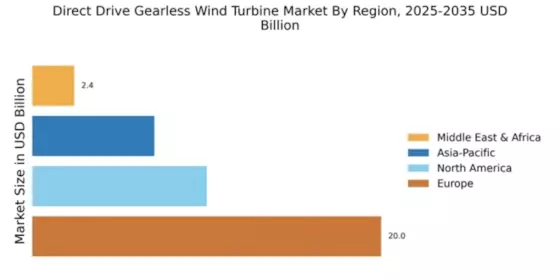
The North American market for Direct Drive Gearless Wind Turbines is projected to reach $10.0 billion by 2025, driven by increasing investments in renewable energy and favorable government policies. The region is witnessing a surge in demand for clean energy solutions, supported by initiatives aimed at reducing carbon emissions and enhancing energy independence. Regulatory frameworks are evolving to promote wind energy, making it a key player in the energy transition. Leading countries in this region include the US and Canada, where major players like GE Renewable Energy and Siemens Gamesa are actively expanding their operations. The competitive landscape is characterized by technological advancements and strategic partnerships aimed at enhancing efficiency and reducing costs. As the market matures, the presence of established companies and new entrants is expected to foster innovation and drive growth.

Europe : Market Leader in Wind Energy

Europe is the largest market for Direct Drive Gearless Wind Turbines, with a projected size of $20.0 billion by 2025. The region's growth is fueled by ambitious renewable energy targets and substantial investments in wind infrastructure. Regulatory support, including subsidies and incentives for clean energy projects, has catalyzed the expansion of wind energy, making it a cornerstone of Europe's energy strategy. Countries like Germany, Denmark, and Spain are at the forefront of this market, hosting key players such as Vestas Wind Systems and Nordex. The competitive landscape is robust, with a mix of established firms and innovative startups driving technological advancements. The presence of a skilled workforce and strong supply chains further enhances Europe's position as a leader in the wind energy sector.

Asia-Pacific : Emerging Market Potential

The Asia-Pacific region is witnessing significant growth in the Direct Drive Gearless Wind Turbine market, projected to reach $7.0 billion by 2025. This growth is driven by increasing energy demands, government initiatives promoting renewable energy, and investments in wind power infrastructure. Countries are setting ambitious targets for renewable energy adoption, which is expected to further boost market dynamics in the coming years. Leading countries in this region include China and India, where companies like Suzlon Energy and Enercon are making substantial contributions. The competitive landscape is evolving, with both domestic and international players vying for market share. As the region continues to invest in renewable technologies, the presence of key players is likely to enhance innovation and drive down costs, making wind energy more accessible.

Middle East and Africa : Untapped Renewable Resources

The Middle East and Africa region is gradually emerging in the Direct Drive Gearless Wind Turbine market, with a projected size of $2.41 billion by 2025. The growth is primarily driven by the need for sustainable energy solutions and the diversification of energy sources. Governments are increasingly recognizing the potential of wind energy as a viable alternative to fossil fuels, leading to supportive policies and investments in renewable projects. Countries like South Africa and Morocco are leading the charge, with initiatives aimed at harnessing wind energy. The competitive landscape is still developing, with a mix of local and international players entering the market. As awareness of renewable energy benefits grows, the region is expected to attract more investments, fostering a conducive environment for growth in the wind energy sector.

Key Players and Competitive Insights

The Direct Drive Gearless Wind Turbine Market is currently characterized by a dynamic competitive landscape, driven by the increasing demand for renewable energy solutions and advancements in turbine technology. Key players such as Siemens Gamesa (ES), GE Renewable Energy (US), and Vestas Wind Systems (DK) are at the forefront, each adopting distinct strategies to enhance their market positioning. Siemens Gamesa (ES) focuses on innovation and sustainability, emphasizing the development of high-efficiency turbines that cater to diverse geographical conditions. Meanwhile, GE Renewable Energy (US) is leveraging its extensive experience in the energy sector to expand its footprint through strategic partnerships and technological advancements. Vestas Wind Systems (DK) is also notable for its commitment to digital transformation, integrating AI and data analytics into its operations to optimize performance and reduce costs. Collectively, these strategies contribute to a competitive environment that is increasingly centered around technological innovation and sustainability.

In terms of business tactics, companies are localizing manufacturing and optimizing supply chains to enhance operational efficiency and reduce costs. The market structure appears moderately fragmented, with several key players exerting influence while also facing competition from emerging firms. This fragmentation allows for a variety of approaches to market entry and expansion, as established companies seek to maintain their competitive edge through strategic initiatives.

In November 2025, Siemens Gamesa (ES) announced a partnership with a leading technology firm to develop next-generation turbine control systems. This collaboration is expected to enhance the efficiency and reliability of their turbines, positioning Siemens Gamesa as a leader in technological innovation within the market. The strategic importance of this partnership lies in its potential to significantly improve operational performance and reduce maintenance costs, thereby attracting more clients in a competitive landscape.

In October 2025, GE Renewable Energy (US) unveiled a new line of direct drive gearless turbines designed specifically for offshore applications. This launch is particularly significant as it aligns with the growing trend towards offshore wind energy, which is anticipated to dominate the market in the coming years. By diversifying its product offerings, GE Renewable Energy is likely to capture a larger share of the offshore segment, enhancing its competitive positioning.

In September 2025, Vestas Wind Systems (DK) completed the acquisition of a smaller turbine manufacturer, which is expected to bolster its production capabilities and expand its market reach. This strategic move not only enhances Vestas's manufacturing capacity but also allows for the integration of innovative technologies from the acquired firm, thereby strengthening its overall product portfolio.

As of December 2025, current competitive trends in the Direct Drive Gearless Wind Turbine Market are heavily influenced by digitalization, sustainability, and the integration of AI technologies. Strategic alliances are increasingly shaping the landscape, enabling companies to pool resources and expertise to drive innovation. Looking ahead, it is likely that competitive differentiation will evolve from traditional price-based competition to a focus on technological advancements, supply chain reliability, and sustainable practices. This shift underscores the importance of innovation as a key driver of success in the market.

Key Companies in the Direct Drive Gearless Wind Turbine Market market include

Industry Developments

Recent developments in the Direct Drive Gearless Wind Turbine Market have shown significant activity among key players such as Siemens Gamesa, Vestas, and General Electric, focusing on innovative technological advancements to enhance efficiency and reduce operational costs. The surge in demand for renewable energy sources has prompted companies like Goldwind and Suzlon to expand their production capabilities, aiming to meet sustainability goals across various regions. Current affairs reflect ongoing partnerships and collaborative projects, particularly in Asia and Europe, where the push for cleaner energy is accelerating investments.

Additionally, mergers and acquisitions are notable, with companies such as EDP Renewables and Enel Green Power eyeing strategic alliances to strengthen their market positions. Growth in the market valuation of these firms has been observed, with notable financial support garnered by firms like Nordex and Innergex Renewable Energy, which have significantly influenced market dynamics. As the sector evolves, the integration of advanced technologies and the establishment of robust supply chains remain critical drivers of growth and competitiveness in the global marketplace for direct drive gearless wind turbines.

Future Outlook

Direct Drive Gearless Wind Turbine Market Future Outlook

The Direct Drive Gearless Wind Turbine Market is projected to grow at a 6.18% CAGR from 2024 to 2035, driven by technological advancements, increasing energy demand, and sustainability initiatives.

New opportunities lie in:

  • Development of integrated energy storage solutions for wind farms.
  • Expansion into emerging markets with tailored financing options.
  • Partnerships with technology firms for advanced predictive maintenance systems.

By 2035, the market is expected to solidify its position as a leader in renewable energy solutions.

Market Segmentation

Direct Drive Gearless Wind Turbine Market Application Outlook

  • Onshore Wind Energy Generation
  • Offshore Wind Energy Generation
  • Hybrid Energy Systems
  • Energy Storage Solutions

Direct Drive Gearless Wind Turbine Market Turbine Size Outlook

  • Small Scale
  • Medium Scale
  • Large Scale

Direct Drive Gearless Wind Turbine Market End Use Sector Outlook

  • Utility Scale
  • Commercial
  • Residential

Direct Drive Gearless Wind Turbine Market Technology Type Outlook

  • Permanent Magnet Generator
  • Synchronous Generator
  • Induction Generator

Direct Drive Gearless Wind Turbine Market Installation Type Outlook

  • Ground Mounted
  • Floating
  • Fixed

Report Scope

MARKET SIZE 202439.41(USD Billion)
MARKET SIZE 202541.85(USD Billion)
MARKET SIZE 203576.24(USD Billion)
COMPOUND ANNUAL GROWTH RATE (CAGR)6.18% (2024 - 2035)
REPORT COVERAGERevenue Forecast, Competitive Landscape, Growth Factors, and Trends
BASE YEAR2024
Market Forecast Period2025 - 2035
Historical Data2019 - 2024
Market Forecast UnitsUSD Billion
Key Companies ProfiledSiemens Gamesa (ES), GE Renewable Energy (US), Nordex (DE), Vestas Wind Systems (DK), Suzlon Energy (IN), Enercon (DE), MHI Vestas Offshore Wind (DK), Senvion (DE)
Segments CoveredApplication, Technology Type, End Use Sector, Turbine Size, Installation Type
Key Market OpportunitiesAdvancements in energy storage technologies enhance the viability of the Direct Drive Gearless Wind Turbine Market.
Key Market DynamicsTechnological advancements and regulatory support drive the adoption of Direct Drive Gearless Wind Turbines in renewable energy markets.
Countries CoveredNorth America, Europe, APAC, South America, MEA

Leave a Comment

FAQs

What is the expected market size of the Direct Drive Gearless Wind Turbine Market in 2034?

The expected market size of the Direct Drive Gearless Wind Turbine Market in 2034 is 71.80 USD Billion.

What is the projected CAGR for the Direct Drive Gearless Wind Turbine Market from 2025 to 2034?

The projected CAGR for the Direct Drive Gearless Wind Turbine Market from 2025 to 2034 is 6.18%.

Which region is anticipated to have the largest market share in the Direct Drive Gearless Wind Turbine Market by 2032?

By 2032, Europe is anticipated to have the largest market share in the Direct Drive Gearless Wind Turbine Market, valued at 20.0 USD Billion.

What is the market value for North America in the Direct Drive Gearless Wind Turbine Market in 2023?

The market value for North America in the Direct Drive Gearless Wind Turbine Market in 2023 is 10.48 USD Billion.

Who are the major players in the Direct Drive Gearless Wind Turbine Market?

Major players in the Direct Drive Gearless Wind Turbine Market include Siemens Gamesa, GE Renewable Energy, Vestas, and Goldwind.

What was the expected market value for Horizontal Axis Wind Turbines in 2032?

The expected market value for Horizontal Axis Wind Turbines in 2032 was 40.0 USD Billion.

What is the expected market growth rate for the APAC region from 2024 to 2032?

The expected market growth rate for the APAC region from 2024 to 2032 is reflected in a market size growth from 8.5 USD Billion to 14.25 USD Billion.

What was the projected market value for Vertical Axis Wind Turbines in 2023?

The projected market value for Vertical Axis Wind Turbines in 2023 was 12.95 USD Billion.

What market trends are driving growth in the Direct Drive Gearless Wind Turbine Market?

Sustainability initiatives and government support for renewable energy sources are key trends driving growth in the Direct Drive Gearless Wind Turbine Market.

What is the predicted value of the South America segment in the Direct Drive Gearless Wind Turbine Market by 2032?

The predicted value of the South America segment in the Direct Drive Gearless Wind Turbine Market by 2032 is 4.5 USD Billion.

Download Free Sample

Kindly complete the form below to receive a free sample of this Report

Compare Licence

×
Features License Type
Single User Multiuser License Enterprise User
Price $4,950 $5,950 $7,250
Maximum User Access Limit 1 User Upto 10 Users Unrestricted Access Throughout the Organization
Free Customization
Direct Access to Analyst
Deliverable Format
Platform Access
Discount on Next Purchase 10% 15% 15%
Printable Versions