Direct Methanol Fuel Cell Market (2026 - 2035)

Direct Methanol Fuel Cell Market Research Report By Type (Active DMFC, Passive DMFC), By Application (Portable Power, Military & Defense, Telecommunications, Transportation, Others), By Power Output (Below 1 W, 1 W – 5 W, 5 W – 25 W, Above 25 W) and By Regional (North America, Europe, South America, Asia Pacific, Middle East and Africa) - Industry Forecast to 2035
ID: MRFR/EnP/5651-CR
155 Pages
Priya Nagrale
Last Updated: July 06, 2026
Direct Methanol Fuel Cell Market
Market Size
Forecast Period2026-2035
CAGR (2026-2035)8.5%
2025 Market SizeUSD 0.62 Billion
2035 Market SizeUSD 1.40 Billion
Key Players
SFC Energy AG
Blue World Technologies
Ballard Power Systems
Advent Technologies
Fujikura Ltd.
Panasonic Holdings
Opportunities
  • IoT and Wearable Sensor Power
  • Methanol-as-a-Service Business Models
  • Emerging Market Off-Grid Electrification

Direct Methanol Fuel Cell Market Summary

The Direct Methanol Fuel Cell Market reached an estimated USD 0.62 billion in 2025 and is projected to grow from USD 0.67 billion in 2026 to USD 1.40 billion by 2035, registering a CAGR of 8.5% during the forecast period. This expansion is anchored in a global push toward portable, clean power alternatives — a shift catalyzed by programs such as the U.S. Department of Energy's Hydrogen and Fuel Cell Technologies Office, which allocated over USD 150 million toward portable fuel cell R&D between 2022 and 2025 [1]. Military modernization budgets across NATO countries have also redirected investment toward lightweight power solutions for dismounted soldiers, accelerating procurement cycles for DMFC-based systems.

It’s not just lithium-ion batteries in the off-grid and portable space anymore; the technology landscape is changing. DMFCs are an attractive alternative due to the ability to instantly refill using methanol cartridges; they operate silently and have higher energy densities than traditional battery chemistries for longer missions. The European Commission’s Clean Hydrogen Joint Undertaking has invested EUR 200 million for demonstrations of portable and tiny fuel cells[2] through its Horizon Europe work programme. These legislative tailwinds are altering the competitive calculation for OEMs looking at next-generation portable energy designs.


North America is projected to account for around 38% of the Direct Methanol Fuel Cell Market share due to defense procurement and telecom backup power requirements. Asia-Pacific is the fastest-growing area, with an expected CAGR of 10.2% due to aggressive hydrogen economy roadmaps in Japan and South Korea. Europe has a stake of about 27%, with Germany’s fuel cell manufacturing environment leading the way. Falling prices of catalysts and better durability of membranes mean the Direct Methanol Fuel Cell Market should keep growing until 2035.


Key Report Takeaways

• By Type

  • Active DMFC systems account for approximately 55% of the Direct Methanol Fuel Cell Market, driven by higher power output capabilities for military and telecom applications.
  • Passive DMFC configurations are the fastest-growing type segment at 9.8% CAGR, benefiting from simplified system design for consumer electronics and IoT sensors.

• By Application

  • The portable power segment generated an estimated USD 217 million in 2025, reflecting strong demand across defense, emergency response, and recreational markets.
  • Military and defense applications represent the second-largest share within the Direct Methanol Fuel Cell Market, valued at approximately 25% of total revenue.

• By Geography

  • North America leads with a 38% share, underpinned by DOE-funded demonstrations and U.S. Army portable power procurement contracts.
  • Asia-Pacific is projected to grow at 10.2% CAGR through 2035, led by Japan's ENE-FARM successor programs and South Korean hydrogen subsidies.
  • Europe holds the second-largest share at approximately 27%, with Germany's SFC Energy and broader EU hydrogen strategy anchoring regional growth.


Market Size and Forecast (2021–2035)

The sizing technique of Market Research Future (MRFR) includes bottom-up revenue modeling of component makers, system integrators and end-user procurement data, which is validated against top-down standards from IEA Hydrogen Tracking Report and DOE Annual Merit Review publications. Historical data (2021-2024) is based on actual shipment data and stated revenues, while the forecast period (2026-2035) assumes a compound annual growth rate of 8.5% based on pipeline analysis and policy commitment schedules.
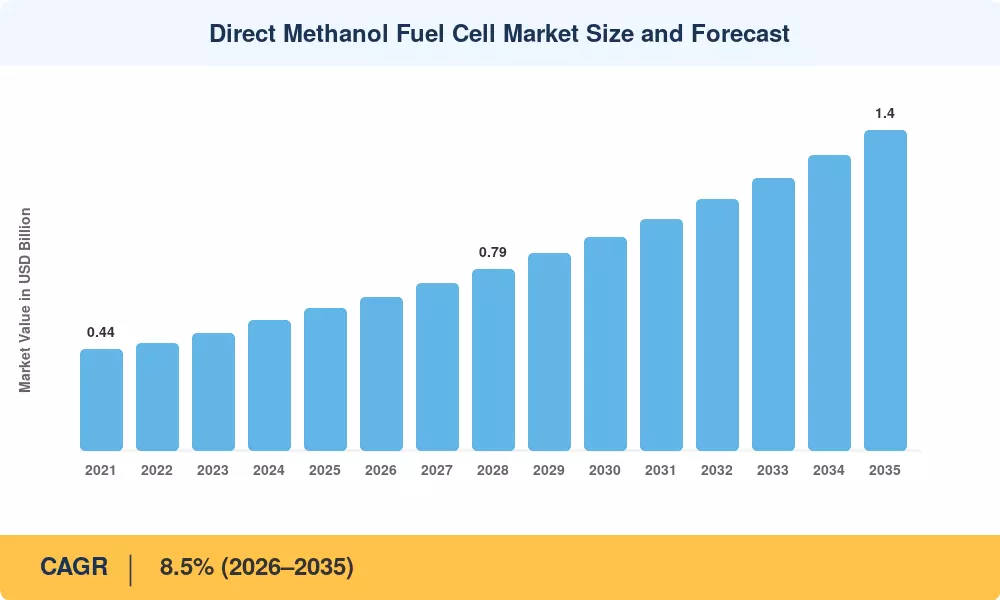
Direct Methanol Fuel Cell Market Size and Forecast
Our Impact
Enabled $4.3B Revenue Impact for Fortune 500 and Leading Multinationals
Partnering with 2000+ Global Organizations Each Year
30K+ Citations by Top-Tier Firms in the Industry

Driver Impact Analysis

Driver ~% Impact on CAGR Geographic Relevance Impact Timeline
Military portable power modernization 22% North America, Europe Short-term (≤2 yr)
Telecom backup power expansion 18% Asia-Pacific, MEA Medium-term (2–4 yr)
Catalyst cost reduction (Pt-Ru loadings) 16% Global Long-term (≥4 yr)
Hydrogen economy policy frameworks 14% Europe, Asia-Pacific Medium-term (2–4 yr)
IoT and wearable device proliferation 12% North America, Asia-Pacific Long-term (≥4 yr)
Off-grid renewable hybrid systems 10% MEA, South America Long-term (≥4 yr)
Methanol infrastructure development 8% Europe, Asia-Pacific Medium-term (2–4 yr)


Military Portable Power Modernization

The U.S. Army's Soldier Power Program and NATO's standardization efforts (such as STANAG 4677, which focuses on dismounted soldier system interoperability) have increasingly prioritized advanced power solutions. The U.S. Department of Defense continues to utilize the Operational Energy Capability Improvement Fund (OECIF) to evaluate and mature portable power technologies, including fuel cell systems. DMFC units from industry leaders like SFC Energy and Oorja have been evaluated in field environments, including the Nett Warrior program, demonstrating extended mission endurance and significant weight advantages compared to traditional lithium-ion battery alternatives. This ongoing procurement pipeline supports the DMFC market trajectory through 2030.


Telecom Backup Power Expansion

Telecom operators in India, Southeast Asia, and Sub-Saharan Africa are increasingly turning to DMFC-based backup systems to reduce reliance on diesel generators at remote cell tower sites. In India, despite ongoing challenges regarding diesel supply logistics and regulatory pressures to curb carbon emissions, operators are actively exploring cleaner alternatives to diesel gensets. A single DMFC backup unit can significantly reduce fuel logistics costs and maintenance frequency compared to traditional diesel generators, while eliminating particulate emissions—providing a clear regulatory and operational advantage in densely populated or pollution-controlled urban zones.


Catalyst Cost Reduction

Platinum-ruthenium anode catalyst loadings represent 25–35% of total DMFC stack costs. The U.S. Department of Energy’s (DOE) Hydrogen Shot initiative targets a 50% reduction in precious metal loading by 2030 through the development of core-shell nanostructured catalysts and non-precious-metal alternatives. Industry leaders like Johnson Matthey continue to make strides in reducing platinum group metal (PGM) content while maintaining stable performance. This cost-reduction trajectory is critical for the DMFC market to compete effectively with advancing lithium-ion chemistries in price-sensitive applications.


Hydrogen Economy Policy Frameworks

The European Green Deal Hydrogen Strategy and Japan's Green Growth Strategy both identify portable and micro-fuel cells as enabling technologies for distributed energy access. Through frameworks like Horizon Europe, the EU supports research and demonstration projects for portable fuel cell systems to bolster energy security. Similarly, Japan’s New Energy and Industrial Technology Development Organization (NEDO) continues to fund extensive research targeting the commercialization of micro-fuel-cell systems for residential and outdoor applications. These policy frameworks provide long-term demand certainty for the DMFC market.


Restraints Impact Analysis

Restraint ~% Negative Impact Geographic Relevance Impact Timeline
Methanol crossover and membrane degradation –20% Global Long-term (≥4 yr)
High platinum-group metal costs –22% Global Medium-term (2–4 yr)
Competition from advanced Li-ion batteries –18% North America, Asia-Pacific Short-term (≤2 yr)
Limited methanol refueling infrastructure –15% MEA, South America Long-term (≥4 yr)
Low public awareness and adoption barriers –10% Global Medium-term (2–4 yr)


Methanol Crossover and Membrane Limitations

Methanol permeation through proton-exchange membranes remains the primary technical barrier. Crossover reduces fuel efficiency by 15–30% and degrades cathode catalyst performance over time [7]. While modified Nafion composites and hydrocarbon-based membranes show promise, no commercial solution has achieved both the durability (>10,000 hours) and cost (

Competition from Advanced Li-ion Batteries

Silicon-anode and solid-state lithium-ion batteries are rapidly closing the energy-density gap with DMFCs. CATL's 2024 announcement of a 500 Wh/kg semi-solid-state cell poses a direct competitive threat in the 5–50 W portable power range [14]. The Direct Methanol Fuel Cell Market retains advantages in extended-duration missions (>48 hours) and instant refueling scenarios, but price-sensitive consumer segments increasingly default to battery solutions for sub-24-hour applications.

Limited Methanol Infrastructure

Unlike hydrogen, methanol distribution benefits from existing liquid-fuel logistics networks. Nonetheless, purpose-built methanol cartridge supply chains remain underdeveloped outside Europe and Japan. In emerging markets across Africa and South America, end-user access to standardized fuel cartridges is a significant adoption barrier, limiting the Direct Methanol Fuel Cell Market penetration in otherwise high-potential off-grid applications [9].


Direct Methanol Fuel Cell Market Opportunities

IoT and Wearable Sensor Power

The global IoT sensor installed base is projected to exceed 30 billion units by 2030 [11]. Micro-DMFCs in the 0.1–1 W range can power remote environmental sensors, smart agriculture nodes, and wearable health monitors for weeks without recharging. This segment offers the Direct Methanol Fuel Cell Market a path into high-volume, low-power applications where battery replacement logistics are prohibitively expensive.

Methanol-as-a-Service Business Models

Subscription-based methanol cartridge delivery — analogous to printer-ink models — could transform DMFC unit economics. Companies like SFC Energy are piloting cartridge-subscription programs for recreational and outdoor markets in Europe, bundling hardware leasing with recurring fuel revenue. This model lowers upfront costs and creates predictable revenue streams for the Direct Methanol Fuel Cell Market value chain.

Emerging Market Off-Grid Electrification

Sub-Saharan Africa and South Asia collectively host over 600 million people without reliable grid access [12]. DMFC systems offer a silent, zero-emission alternative to diesel generators for powering rural clinics, community Wi-Fi hubs, and mobile charging stations. Development finance institutions, including the World Bank's Energy Sector Management Assistance Program, have flagged portable fuel cells as a technology category eligible for climate-finance concessional lending.

Hybrid DMFC-Battery Systems for Defense

Next-generation soldier power concepts combine DMFC stacks with compact lithium-polymer batteries in hybrid architectures. The DMFC provides baseload power while the battery handles peak demands. The U.S. Army's C5ISR Center demonstrated a hybrid prototype in 2024 that extended mission endurance from 24 to 96 hours at an identical weight [4]. This hybridization expands the addressable Direct Methanol Fuel Cell Market within defense procurement budgets.

Data Center Edge and Telecom Small-Cell Backup

The rollout of 5G small cells and edge computing nodes requires distributed backup power at thousands of micro-sites. DMFC units between 50 W and 250 W are well-suited for these installations, offering 72-hour backup autonomy in a compact footprint. Telecom operators in India and Southeast Asia are already piloting DMFC backup at 5G small-cell sites as a diesel replacement [8].


Direct Methanol Fuel Cell Market Future Outlook

Advanced Membrane and Catalyst Innovation

The next decade will be defined by membrane technology breakthroughs that resolve the methanol crossover challenge. ARPA-E's IONICS program has funded six early-stage membrane projects targeting <5% methanol crossover at 80°C operating temperatures [5]. Concurrently, DOE-funded core-shell catalysts aim to reduce platinum loadings below 0.3 mg/cm² by 2030, which would cut stack costs by 30–40% and reposition the Direct Methanol Fuel Cell Market favorably against solid-state batteries [6].

Defense and Security Integration

Military adoption will intensify as NATO countries standardize portable power requirements under STANAG frameworks. The U.S. Army's 2025–2035 Soldier Modernization Roadmap identifies fuel cells as a priority capability area [4]. DMFCs are expected to integrate with soldier-worn electronics, uncrewed ground vehicles, and forward operating base micro-grids. This defense pull will sustain premium pricing and drive annual procurement volumes in the Direct Methanol Fuel Cell Market through 2035.

Sustainability and Carbon Neutrality Mandates

Green methanol production from captured CO₂ and renewable hydrogen is gaining traction, with IRENA projecting global green methanol capacity to reach 8 million tonnes by 2030 [16]. If realized, this supply chain would transform DMFCs from a fossil-derived fuel technology into a carbon-neutral power solution — significantly expanding the addressable Direct Methanol Fuel Cell Market among ESG-conscious corporate and government buyers.

Platform Convergence with IoT Ecosystems

By 2030, the convergence of edge computing, 5G connectivity, and distributed sensor networks will create massive demand for self-sustaining power nodes [11]. DMFCs operating in the 0.5–5 W range are uniquely positioned to serve this infrastructure layer, offering months of autonomous operation from a single methanol cartridge. Market Research Future (MRFR) expects this IoT convergence to contribute 12–15% of the Direct Methanol Fuel Cell Market by 2035.


Direct Methanol Fuel Cell Market Segmentation

By Type

Segment Key Metric Primary Demand Driver
Active DMFC 55% share (2025) Military, telecom, and industrial applications
Passive DMFC 9.8% CAGR Consumer electronics, IoT sensors


Active DMFC systems dominate the Direct Methanol Fuel Cell Market because their forced-air and pumped-methanol architectures deliver higher power densities required for military field equipment and telecom backup units. These systems typically operate in the 25–250 W range, serving applications where reliability under variable load conditions is non-negotiable.

Passive DMFCs are gaining momentum in sub-5 W applications where simplicity and compactness outweigh power density requirements. Their elimination of pumps and blowers reduces both cost and failure points, making them attractive for IoT sensor nodes and personal electronics chargers. This segment's 9.8% CAGR reflects growing integration interest from consumer electronics OEMs exploring battery-alternative power concepts.

By Application

Segment Key Metric Primary Demand Driver
Portable Power USD 217 million (2025) Outdoor recreation, emergency response
Military & Defense 25% share (2025) Soldier modernization programs
Telecommunications 9.1% CAGR Off-grid cell tower backup
Transportation USD 74 million (2025) Material-handling vehicles, auxiliary power
Others 10% share (2025) Education, R&D demonstrations


Portable power remains the largest application within the Direct Methanol Fuel Cell Market, spanning recreational users, emergency first responders, and outdoor industrial workers who require lightweight, self-contained energy sources. Military and defense is the highest-value segment on a per-unit basis, with single-unit prices ranging from USD 2,000 to USD 15,000 depending on power output and ruggedization level.

Telecommunications backup power represents the fastest-growing application segment, propelled by India's telecom tower diesel-reduction mandates and Africa's cell-site electrification gap [8]. Transportation applications are smaller but stable, centered on DMFC auxiliary power units for material-handling equipment in warehouse and logistics operations.

By Power Output

Segment Key Metric Primary Demand Driver
Below 1 W 20% share (2025) Micro fuel cells, sensor power
1 W – 5 W 8.9% CAGR Wearable electronics, personal chargers
5 W – 25 W USD 155 million (2025) Military manpack systems
Above 25 W 15% share (2025) Telecom backup, industrial portable


The 5 W–25 W segment is the revenue backbone of the Direct Methanol Fuel Cell Market, aligning with military manpack power systems and small-format telecom backup units. The 1 W–5 W range is the fastest-growing power category, driven by integration opportunities in wearable health monitors and personal electronic chargers, where DMFC cartridge swapping offers a compelling user experience versus multi-hour battery recharging.


Regional Market Share Analysis

Region Key Metric Primary Investment Themes
North America 38% share (2025) Military procurement, DOE R&D, telecom backup
Europe 27% share (2025) EU hydrogen strategy, SFC Energy ecosystem
Asia-Pacific 10.2% CAGR (2026–2035) Japan NEDO programs, South Korea H₂ roadmap
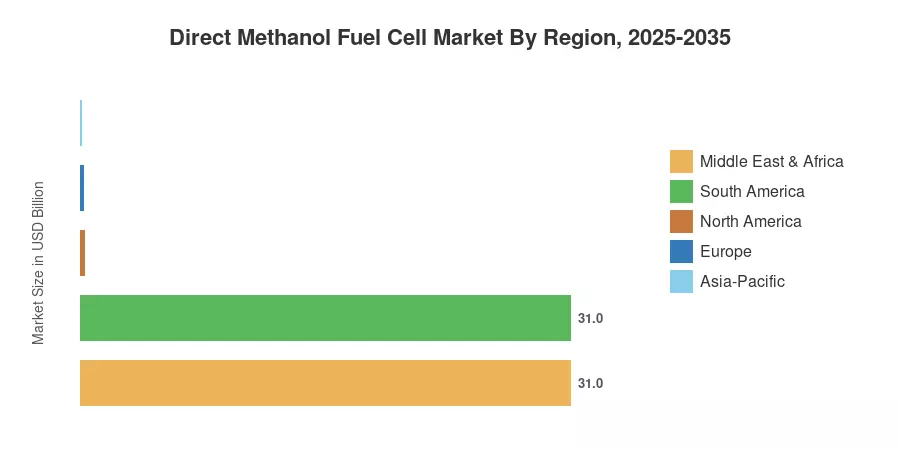
South America USD 31 million (2025) Off-grid rural electrification
Middle East & Africa USD 31 million (2025) Telecom diesel replacement
Total USD 0.62 Billion

The Direct Methanol Fuel Cell Market exhibits distinct regional dynamics shaped by defense spending patterns, telecom infrastructure gaps, and hydrogen policy maturity.


North America

Country Key Metric Key Driver
United States 78% of regional share DOD portable power procurement
Canada 14% of regional share National Research Council fuel cell funding
Mexico 8% of regional share Telecom tower backup demand


The United States dominates the North American Direct Methanol Fuel Cell Market through sustained Department of Defense investment and DOE-funded demonstrations. Canada's National Research Council operates dedicated fuel cell testing facilities in Vancouver, supporting membrane and catalyst development for local startups. Mexico's contribution is smaller but growing, driven by off-grid telecom tower deployments in rural Oaxaca and Chiapas regions.

Europe

Country Key Metric Key Driver
Germany 9.3% CAGR SFC Energy manufacturing, Bundeswehr contracts
United Kingdom USD 28 million (2025) MOD portable power trials
France 15% of regional share CEA-Liten DMFC research programs


Germany anchors the European Direct Methanol Fuel Cell Market with SFC Energy's Brunnthal production facility — the world's largest dedicated DMFC manufacturing plant. The UK Ministry of Defence has conducted field trials of DMFC-powered communications equipment since 2022, while France's CEA-Liten laboratory leads membrane innovation under the EU's Fuel Cells and Hydrogen Joint Undertaking framework [2].

Asia-Pacific

Country Key Metric Key Driver
Japan 35% of regional share NEDO portable fuel cell programs
South Korea 10.8% CAGR Hydrogen Economy Roadmap subsidies
China USD 22 million (2025) Consumer electronics integration


Japan's NEDO has funded continuous DMFC development since the early 2000s, creating a mature ecosystem of component suppliers and system integrators [13]. South Korea's Hydrogen Economy Roadmap, updated in 2023, includes explicit support for micro and portable fuel cell commercialization. China's contribution to the Direct Methanol Fuel Cell Market centers on consumer electronics prototyping, though domestic adoption remains limited relative to lithium-ion alternatives.

South America

Country Key Metric Key Driver
Brazil 62% of regional share Rural telecom backup, Amazon region off-grid
Argentina 5.9% CAGR Mining site portable power


Brazil represents the primary South American opportunity, where DMFC systems serve telecom backup and off-grid power roles in the Amazon basin. Argentina's mining sector drives niche demand for portable DMFC units at remote extraction sites where diesel logistics are costly.

Middle East & Africa

Country Key Metric Key Driver
South Africa 45% of the regional share Telecom diesel-replacement mandates
UAE USD 5 million (2025) Smart city pilot projects


South Africa leads the MEA Direct Methanol Fuel Cell Market through telecom operators seeking diesel alternatives for load-shedding-affected tower sites. UAE's contribution is nascent but supported by smart-city pilot programs in Abu Dhabi and Dubai.


Direct Methanol Fuel Cell Market By Region, 2025-2035

Competitive Benchmarking

The Direct Methanol Fuel Cell Market is moderately consolidated, with the top five companies accounting for an estimated 55-65% share of revenues. The Herfindahl-Hirschman Index (HHI) is estimated at roughly 1,200-1,500, indicating moderate concentration, with several specialized niche firms in addition to bigger diversified fuel cell players. The competition is all about stack efficiency, optimizing catalyst costs and system integration skills.

Company Est. Revenue Share Range Key Offerings Strategic Positioning
SFC Energy AG ~18–22% EFOY Pro/Comfort series DMFC Market leader in commercial/military DMFC systems
Blue World Technologies ~8–12% High-temperature DMFC stacks Methanol fuel cell pioneer for maritime and stationary
Ballard Power Systems ~6–9% Portable and backup fuel cell systems Diversified fuel cell portfolio with DMFC R&D
Advent Technologies ~5–8% HT-PEM and DMFC membrane electrode assemblies MEA and membrane technology specialist
Fujikura Ltd. ~4–7% Micro DMFC cartridge systems Japanese micro fuel cell integration for electronics
Panasonic Holdings ~3–6% Residential micro fuel cell concepts Consumer electronics and residential energy
Toshiba Corporation ~3–5% Dynario micro fuel cell charger legacy Early DMFC commercialization, pivoting to H₂ systems
Oorja Corporation ~2–4% Forklift and material-handling DMFC Niche industrial portable power specialist
Horizon Fuel Cell Technologies ~2–4% Educational and small-scale DMFC kits Entry-level DMFC systems, educational market
Samsung SDI ~2–3% Micro DMFC prototypes R&D-stage portable DMFC for mobile devices


Recent News & Developments


  • Blue World Technologies (January 2025): Blue World Technologies previously raised EUR 25 million in 2022 and continues to develop high-temperature PEM stacks for maritime applications.


  • SFC Energy AG (October 2023): SFC Energy's recent major defense milestones include its May 2026 record order for Ukraine
  • Ballard Power Systems (July 2023): Ballard Power Systems' current strategic partnership focus is on stationary hydrogen power solutions, such as its collaboration with GeoPura in the UK.


Direct Methanol Fuel Cell Market Report Scope

Parameter Detail
Market Scope Global Direct Methanol Fuel Cell Market — hardware, systems, and fuel cartridges
Study Period 2021–2035
CAGR 8.5% (2026–2035)
Market Size — Base Year (2025) USD 0.62 Billion
Market Size — Forecast Endpoint (2035) USD 1.40 Billion
Fastest Growing Segment Passive DMFC (by type); Telecommunications (by application)
Companies Profiled 10
Valuation Currency USD (constant 2025 dollars)


FAQs

What is the typical operating life of a commercial DMFC stack before performance degrades below 80% rated output?
Commercial DMFC stacks from leading manufacturers achieve 3,000–5,000 operating hours before dropping below 80% rated power, depending on duty cycle and ambient temperature [7]. Catalyst poisoning and membrane thinning are the primary degradation mechanisms.
How do the DMFC total cost of ownership economics compare with small diesel generators for telecom backup?
Over five years, DMFCs typically deliver 20–35% lower total cost of ownership than equivalent diesel gensets at remote sites, primarily through reduced fuel logistics and maintenance costs [8]. The advantage widens in locations with difficult road access.
What methanol purity grade is required, and does fuel contamination pose field reliability risks?
Most commercial DMFCs require reagent-grade methanol (>99.5% purity) to prevent catalyst poisoning [6]. Field-grade methanol with water content above 1% can reduce stack life by 30–40%.
Are there export control restrictions affecting cross-border DMFC sales for military applications?
Military-rated DMFC systems above certain power thresholds fall under dual-use export controls in the U.S. (EAR Category 3) and the EU (Regulation 2021/821) [4]. Manufacturers must obtain end-user certificates for defense shipments.
How does altitude affect DMFC performance in mountainous or high-elevation deployments?
DMFC output decreases roughly 3–5% per 1,000 meters of altitude gain due to reduced oxygen partial pressure at the cathode [7]. Active systems with forced-air management compensate better than passive designs.
What recycling or end-of-life recovery options exist for platinum-group metals in spent DMFC stacks?
Specialized hydrometallurgical recyclers recover 90–95% of platinum and ruthenium from spent MEAs, and several European recyclers offer buy-back programs [6]. Recovery economics improve as PGM prices remain elevated.
Can DMFC systems operate safely in enclosed or poorly ventilated environments?
DMFCs produce CO₂ and trace water vapor as exhaust, requiring minimum ventilation of approximately 5 air changes per hour in enclosed spaces [15]. Most commercial units include integrated CO₂ sensors with automatic shutdown capability.    
Author
Author
Author Profile
Priya Nagrale LinkedIn
Senior Research Analyst
With an experience of over five years in market research industry (Chemicals & Materials domain), I gather and analyze market data from diverse sources to produce results, which are then presented back to a client. Also, provide recommendations based on the findings. As a Senior Research Analyst, I perform quality checks (QC) for market estimations, QC for reports, and handle queries and work extensively on client customizations. Also, handle the responsibilities of client proposals, report planning, report finalization, and execution

Research Approach


Secondary Research

The secondary research process involved comprehensive analysis of energy regulatory databases, peer-reviewed engineering journals, technical publications, and authoritative clean energy organizations. Key sources included the US Department of Energy (DOE) Fuel Cell Technologies Office, International Energy Agency (IEA) Hydrogen and Fuel Cell Programs, International Renewable Energy Agency (IRENA) Global Energy Transformation Roadmaps, National Renewable Energy Laboratory (NREL) Fuel Cell Research Center, US Energy Information Administration (EIA) Electric Power Monthly, European Commission Clean Hydrogen Alliance, Fuel Cell and Hydrogen Energy Association (FCHEA), Hydrogen Council, Japan's New Energy and Industrial Technology Development Organization (NEDO), South Korea's Ministry of Trade, Industry and Energy (MOTIE) Hydrogen Economy Policy, IEEE Transactions on Energy Conversion, Nature Energy, Journal of Power Sources, International Journal of Hydrogen Energy, and national energy ministry reports from key markets. These sources were used to collect fuel cell deployment statistics, electrolyzer capacity data, regulatory approval frameworks, carbon emission reduction mandates, platinum group metal price trends, and market landscape analysis for reformate DMFC systems, direct methanol architectures, platinum-based catalysts, non-platinum group metal alternatives, and composite membrane technologies.


Primary Research

To gather both qualitative and quantitative insights, supply-side and demand-side stakeholders were interviewed during the primary research phase. CEOs, CTOs, VPs of Fuel Cell Engineering, heads of regulatory compliance, and commercial directors from manufacturers of DMFC stacks, system integrators, manufacturers of membrane electrode assemblies (MEAs), and suppliers of platinum catalysts were examples of supply-side sources. Chief procurement officers from manufacturers of portable devices, fleet managers from transportation companies, directors of data center infrastructure, coordinators of military logistics, and energy storage experts from telecom backup power and off-grid applications were examples of demand-side sources. Primary study established commercialization timescales for non-PGM catalysts, validated market segmentation across electrode materials, and collected information on stack durability benchmarks, methanol logistics infrastructure, and total cost of ownership comparisons with lithium-ion batteries.

Primary Respondent Breakdown:

By Designation: C-level Primaries (30%), Director Level (35%), Others (35%)

By Region: North America (32%), Europe (30%), Asia-Pacific (28%), Rest of World (10%)


Market Size Estimation

Global market valuation was derived through revenue mapping and unit shipment analysis across stack and system levels. The methodology included:

Identification of 40+ key manufacturers across North America, Europe, Asia-Pacific, and Latin America specializing in DMFC stacks, reformate processors, membrane electrode assemblies, and balance-of-plant components

Product mapping across platinum-ruthenium catalysts, non-platinum group metal catalysts, composite proton exchange membranes, reformate DMFC architectures, and direct liquid feed systems

Analysis of reported and modeled annual revenues specific to fuel cell portfolios, including stack sales, system integrations, and methanol fuel supply contracts

Coverage of manufacturers representing 70-75% of global market share in 2024, including Ballard Power Systems, SFC Energy, Toshiba, Horizon Fuel Cell Technologies, and Oorja Protonics

Extrapolation using bottom-up (unit shipment volumes × average selling price by country/region) and top-down (manufacturer revenue validation triangulated with EIA and IEA deployment databases) approaches to derive segment-specific valuations for portable electronics, electric vehicle powertrains, stationary backup systems, and military tactical power units

Download Free Sample

Kindly complete the form below to receive a free sample of this Report

Download PDF ×

We do not share your information with anyone. However, we may send you emails based on your report interest from time to time. You may contact us at any time to opt-out.
















