×
Request Free Sample ×

Kindly complete the form below to receive a free sample of this Report

* Please use a valid business email

Leading companies partner with us for data-driven Insights

clients tt-cursor
Hero Background

Disk Based Data Fabric Market

ID: MRFR/SEM/3689-HCR
100 Pages
Ankit Gupta
October 2025

Disk-Based Data Fabric Market Research Report By Deployment Type (On-Premises, Cloud-based, Hybrid), By Application (Data Integration, Data Governance, Analytics), By End User (BFSI, Healthcare, Retail, Telecommunications, Manufacturing), By Architecture (Monolithic Architecture, Microservices Architecture, Service-Oriented Architecture) and By Regional (North America, Europe, South America, Asia Pacific, Middle East and Africa) - Forecast to 2035.

Share:
Download PDF ×

We do not share your information with anyone. However, we may send you emails based on your report interest from time to time. You may contact us at any time to opt-out.

Disk Based Data Fabric Market Infographic
Purchase Options

Disk Based Data Fabric Market Summary

As per MRFR analysis, the Disk-Based Data Fabric Market Size was estimated at 3.55 USD Billion in 2024. The Disk-Based Data Fabric industry is projected to grow from 4.066 USD Billion in 2025 to 15.79 USD Billion by 2035, exhibiting a compound annual growth rate (CAGR) of 14.53 during the forecast period 2025 - 2035.

Key Market Trends & Highlights

The Disk-Based Data Fabric Market is experiencing robust growth driven by evolving data management needs.

  • The market is witnessing increased adoption of hybrid solutions, particularly in North America.
  • A strong focus on data security and compliance is shaping strategies across the Asia-Pacific region.
  • Real-time data processing is becoming a critical requirement, especially within the cloud-based segment.
  • Rising demand for data integration solutions and an increased focus on data governance are key drivers propelling market expansion.

Market Size & Forecast

2024 Market Size 3.55 (USD Billion)
2035 Market Size 15.79 (USD Billion)
CAGR (2025 - 2035) 14.53%

Major Players

IBM (US), Oracle (US), Microsoft (US), SAP (DE), Dell Technologies (US), Hewlett Packard Enterprise (US), NetApp (US), Hitachi Vantara (US), Infinidat (US)

Disk Based Data Fabric Market Trends

The Disk-Based Data Fabric Market is currently experiencing a transformative phase, driven by the increasing demand for efficient data management solutions. Organizations are recognizing the necessity of integrating disparate data sources to enhance operational efficiency and decision-making processes. This market appears to be characterized by a growing emphasis on scalability and flexibility, as businesses seek to adapt to evolving technological landscapes. Furthermore, the rise of cloud computing and big data analytics is likely to propel the adoption of disk-based data fabric solutions, enabling organizations to harness vast amounts of information seamlessly. In addition, the Disk-Based Data Fabric Market seems to be influenced by the need for improved data governance and security measures. As data privacy regulations become more stringent, companies are compelled to implement robust frameworks that ensure compliance while maintaining accessibility. This trend indicates a shift towards solutions that not only facilitate data integration but also prioritize security and regulatory adherence. Overall, the Disk-Based Data Fabric Market is poised for growth, with organizations increasingly recognizing the value of comprehensive data management strategies that align with their business objectives.

Increased Adoption of Hybrid Solutions

Organizations are increasingly gravitating towards hybrid data fabric solutions that combine on-premises and cloud-based infrastructures. This trend reflects a desire for flexibility, allowing businesses to optimize their data management strategies while balancing cost and performance.

Focus on Data Security and Compliance

As regulatory frameworks evolve, there is a heightened focus on data security within the Disk-Based Data Fabric Market. Companies are prioritizing solutions that not only integrate data but also ensure compliance with stringent data protection regulations.

Emphasis on Real-Time Data Processing

The demand for real-time data processing capabilities is growing, as organizations seek to derive insights from data instantaneously. This trend underscores the importance of agility in data management, enabling businesses to respond swiftly to market changes.

Disk Based Data Fabric Market Drivers

Increased Focus on Data Governance

In the Disk-Based Data Fabric Market, there is an increasing emphasis on data governance as organizations strive to ensure data quality and compliance. With the proliferation of data regulations, such as GDPR and CCPA, businesses are compelled to adopt robust governance frameworks. This focus on governance is not merely a regulatory requirement; it is also a strategic initiative aimed at enhancing data trustworthiness. As organizations invest in data governance tools and practices, the market for disk-based data fabrics is expected to expand. Analysts suggest that the data governance segment could witness a growth rate of around 12% annually, reflecting the critical role of governance in data management. Consequently, the Disk-Based Data Fabric Market is poised to evolve in response to these governance demands, fostering a culture of accountability and transparency in data handling.

Emergence of Multi-Cloud Strategies

The emergence of multi-cloud strategies is reshaping the Disk-Based Data Fabric Market. Organizations are increasingly adopting multi-cloud environments to enhance their operational resilience and avoid vendor lock-in. This trend is driven by the desire for flexibility and the ability to leverage the best services from various cloud providers. As businesses implement multi-cloud strategies, the demand for disk-based data fabrics that can seamlessly integrate and manage data across multiple cloud platforms is expected to rise. Market analysts project that the multi-cloud segment could experience growth rates of around 14% annually. This shift towards multi-cloud architectures necessitates robust data management solutions, positioning the Disk-Based Data Fabric Market as a critical player in facilitating effective data governance and integration across diverse cloud environments.

Adoption of Advanced Analytics and AI

The integration of advanced analytics and artificial intelligence (AI) into data management practices is significantly influencing the Disk-Based Data Fabric Market. Organizations are increasingly leveraging AI-driven insights to enhance their data processing capabilities. This trend is indicative of a broader movement towards data-driven decision-making, where businesses utilize analytics to derive actionable insights from their data. The market for AI in data management is projected to grow at a staggering rate, potentially exceeding 20% annually. This growth is likely to propel the Disk-Based Data Fabric Market forward, as companies seek to harness the power of AI to optimize their data architectures. As a result, the demand for disk-based data fabrics that support advanced analytics capabilities is expected to rise, enabling organizations to remain competitive in an increasingly data-centric landscape.

Growing Need for Scalability and Flexibility

In the Disk-Based Data Fabric Market, the growing need for scalability and flexibility is becoming increasingly apparent. As organizations expand their operations and data volumes increase, the ability to scale data management solutions becomes paramount. Businesses are seeking disk-based data fabrics that can adapt to changing requirements without compromising performance. This demand for scalability is reflected in market forecasts, which indicate that the segment for scalable data solutions could grow by approximately 18% over the next few years. Furthermore, the flexibility offered by disk-based data fabrics allows organizations to integrate new technologies and data sources seamlessly. This adaptability is crucial for businesses aiming to stay agile in a rapidly evolving technological landscape. Thus, the Disk-Based Data Fabric Market is likely to see a robust increase in solutions that prioritize scalability and flexibility.

Rising Demand for Data Integration Solutions

The Disk-Based Data Fabric Market is experiencing a notable surge in demand for data integration solutions. Organizations are increasingly recognizing the necessity of unifying disparate data sources to enhance operational efficiency. This trend is driven by the growing complexity of data environments, where businesses often manage data across various platforms. According to recent estimates, the data integration segment is projected to grow at a compound annual growth rate of approximately 15% over the next five years. This growth is indicative of a broader shift towards integrated data management strategies, which are essential for organizations aiming to leverage data as a strategic asset. As such, the Disk-Based Data Fabric Market is likely to benefit from this rising demand, as companies seek to streamline their data workflows and improve decision-making processes.
Market Segment Insights

By Deployment Type: On-Premises (Largest) vs. Cloud-based (Fastest-Growing)

In the Disk-Based Data Fabric Market, the deployment type segment is notably split among On-Premises, Cloud-based, and Hybrid solutions. Currently, On-Premises solutions hold a significant share as they appeal to enterprises requiring strict control over their data security and compliance. This preference for On-Premises solutions has solidified its position as the largest segment in this market. Meanwhile, Cloud-based solutions are rapidly gaining traction, driven by their flexibility and scalability, appealing particularly to organizations seeking cost-effective and resource-efficient storage options.

On-Premises (Dominant) vs. Cloud-based (Emerging)

On-Premises solutions are characterized by their ability to offer comprehensive control over infrastructure and data management, making them the dominant choice among traditional enterprises. They allow businesses to tailor storage environments to specific requirements, ensuring enhanced security and compliance. In contrast, Cloud-based solutions are emerging rapidly, offering scalability and ease of access that suit modern business demands. They are particularly favored by startups and tech-driven companies that prioritize agility and rapid deployment. The flexibility of cloud offerings complements diverse operational needs, positioning them as a formidable alternative in the Disk-Based Data Fabric Market.

By Application: Data Integration (Largest) vs. Data Governance (Fastest-Growing)

In the Disk-Based Data Fabric Market, the application segment is primarily dominated by Data Integration, which has secured the largest market share due to its crucial role in unifying and managing data from diverse sources. Data Governance closely follows, showcasing its growing importance for enterprises aiming to ensure data quality and compliance amidst increasing regulatory requirements. Analytics, while vital, holds a smaller portion of the market share as organizations increasingly focus on integration and governance frameworks as foundational components for effective data management. The growth trends within this application segment are being driven by an accelerating demand for Data Integration solutions as businesses seek to streamline their operations by consolidating fragmented data silos. On the other hand, Data Governance is emerging as a key focus area for organizations to mitigate risks linked to data misuse and to adhere to legal regulations, making it the fastest-growing segment. The analytics domain, although important, tends to play secondary to integration and governance as part of a comprehensive data strategy.

Data Integration (Dominant) vs. Analytics (Emerging)

Data Integration is the dominant player in the Disk-Based Data Fabric Market, serving as the backbone for organizations seeking to harmonize data from multiple sources into a unified platform. This segment emphasizes the necessity of real-time data availability, enabling businesses to make informed decisions swiftly. In contrast, Analytics is an emerging area within this segment that focuses on deriving insights from integrated data. While Analytics enhances the value of integrated data, it often relies on effective Data Integration and Governance strategies to function optimally. As enterprises continue to prioritize data-driven decision-making, both segments will see further refinement and innovation aimed at maximizing the value derived from data assets.

By End User: BFSI (Largest) vs. Healthcare (Fastest-Growing)

In the Disk-Based Data Fabric Market, the end user segment showcases a diverse range of applications. The BFSI sector accounts for the largest share, driven by the need for robust data management solutions that can handle extensive transactional data securely. Following closely is the healthcare sector, which benefits from data fabrics for managing patient records and improving operational efficiencies. Retail, telecommunications, and manufacturing sectors are also significant contributors but share smaller portions of the overall market.

BFSI (Dominant) vs. Healthcare (Emerging)

The BFSI sector dominates the Disk-Based Data Fabric Market due to its emphasis on data integrity, security, and compliance. Financial institutions rely heavily on sophisticated data architectures to manage vast quantities of transactions and customer data efficiently. In contrast, the healthcare sector, while currently emerging, is rapidly expanding its use of data fabrics to enhance patient care and streamline operations. This transition is fueled by regulatory requirements and the need for improved interoperability across systems. Both sectors are critical to the overall ecosystem, yet they exhibit contrasting characteristics in data handling and usage.

By Architecture: Monolithic Architecture (Largest) vs. Microservices Architecture (Fastest-Growing)

In the Disk-Based Data Fabric Market, the Monolithic Architecture holds the largest share due to its traditional and well-established frameworks that appeal to enterprises focused on stability and simplicity in data management. This architecture offers a unified approach to system design, making it easier for organizations to manage their data effectively, thus leading to a significant presence in the market. Conversely, the Microservices Architecture, while currently smaller in market share, is witnessing rapid acceptance and growth, especially among tech-savvy businesses that prioritize flexibility and scalability in their data solutions.

Architecture: Monolithic (Dominant) vs. Microservices (Emerging)

The Monolithic Architecture is characterized by its single-tiered approach where all components are interconnected and interdependent, making it easier to develop and deploy but challenging to scale. This architecture remains dominant in traditional industries that require robust performance and stability. On the other hand, the Microservices Architecture represents an emerging trend, focusing on decoupled services that operate independently. This approach allows for greater agility, as organizations can update individual services without disrupting the entire system. As more companies seek to adopt DevOps practices and cloud-native solutions, the Microservices Architecture is becoming increasingly attractive, driving its growth in the Disk-Based Data Fabric Market.

Get more detailed insights about Disk Based Data Fabric Market

Regional Insights

North America : Innovation and Leadership Hub

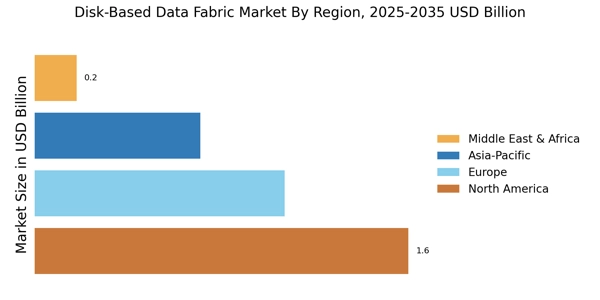
North America leads the Disk-Based Data Fabric market, accounting for approximately 45% of the global share. The region's growth is driven by rapid technological advancements, increasing data generation, and a strong focus on data management solutions. Regulatory support, particularly from government initiatives promoting digital transformation, further fuels demand. The U.S. is the largest market, followed by Canada, which contributes significantly to the overall growth trajectory. The competitive landscape in North America is robust, featuring key players like IBM, Microsoft, and Oracle. These companies are at the forefront of innovation, offering advanced solutions tailored to meet diverse business needs. The presence of major tech hubs and a skilled workforce enhances the region's attractiveness for investment in data fabric technologies. As organizations increasingly prioritize data-driven decision-making, the demand for disk-based solutions is expected to rise.

Europe : Emerging Data Management Powerhouse

Europe is witnessing significant growth in the Disk-Based Data Fabric market, holding approximately 30% of the global share. The region's expansion is propelled by stringent data protection regulations, such as GDPR, which mandate effective data management solutions. Additionally, the increasing adoption of cloud technologies and digital transformation initiatives across various sectors are key demand drivers. Germany and the UK are the largest markets, contributing substantially to the overall growth in Europe. The competitive landscape in Europe is characterized by a mix of established players and innovative startups. Companies like SAP and Dell Technologies are leading the charge, offering comprehensive data fabric solutions. The presence of a diverse range of industries, from finance to healthcare, creates a fertile ground for growth. As organizations seek to enhance their data management capabilities, the demand for disk-based solutions is expected to continue its upward trajectory.

Asia-Pacific : Rapidly Growing Market Potential

Asia-Pacific is rapidly emerging as a significant player in the Disk-Based Data Fabric market, accounting for approximately 20% of the global share. The region's growth is driven by increasing digitalization, a surge in data generation, and a growing emphasis on data security and management. Countries like China and India are leading this growth, supported by government initiatives aimed at enhancing technological infrastructure and promoting innovation in data management solutions. The competitive landscape in Asia-Pacific is evolving, with both The Disk-Based Data Fabric share. Companies such as Hitachi Vantara and Infinidat are making strides in providing tailored solutions to meet regional demands. The increasing investment in IT infrastructure and the rise of smart technologies are expected to further boost the demand for disk-based data fabric solutions, making this region a focal point for future growth.

Middle East and Africa : Emerging Market with Potential

The Middle East and Africa region is gradually emerging in the Disk-Based Data Fabric market, holding about 5% of the global share. The growth is primarily driven by increasing investments in digital transformation and a rising awareness of the importance of data management. Countries like the UAE and South Africa are leading the charge, supported by government initiatives aimed at enhancing technological capabilities and fostering innovation in data solutions. The competitive landscape in this region is still developing, with a mix of local and international players entering the market. Companies are increasingly focusing on providing customized solutions to cater to the unique needs of various industries. As organizations in the region recognize the value of effective data management, the demand for disk-based solutions is expected to grow, presenting significant opportunities for market players.

Disk Based Data Fabric Market Regional Image

Key Players and Competitive Insights

The Disk-Based Data Fabric Market has seen a significant emergence of competitive dynamics driven by the escalating demand for efficient data management solutions. As organizations increasingly recognize the importance of data in driving strategic decision-making, several companies have positioned themselves to leverage this trend. They focus on the deployment of advanced technologies to enable seamless data integration and real-time analytics across diverse environments. This market is characterized by a wide array of players that develop robust data fabric solutions aimed at simplifying data access, enhancing security measures, and providing scalable architectures.

The competitive landscape is marked by both established tech giants and innovative startups that are continually pushing the boundaries of data management capabilities, optimizing performance, and offering tailored solutions for various industry verticals.

In the context of the Disk-Based Data Fabric Market, Teradata has cultivated a strong market presence highlighted by its robust platform designed to handle large volumes of data efficiently. The company excels in providing advanced analytics and data warehousing solutions, which are integral to organizations seeking to derive actionable insights from their data. Teradata’s strengths lie in its ability to integrate data from multiple sources into a unified architecture, delivering improved performance while enabling scalability.

Its focus on innovation drives the development of services that cater to the complex needs of modern enterprises, positioning Teradata as a trusted partner for businesses looking to refine their data strategies. The company’s emphasis on real-time data processing and analytics has set it apart in the market, making it a key player that is well-equipped to respond to evolving customer demands.

Nutanix showcases a compelling profile in the Disk-Based Data Fabric Market with its specialized offerings that emphasize simplicity and scalability in data deployment. The company is recognized for its hyper-converged infrastructure solutions that facilitate the seamless orchestration of data across on-premises and cloud environments. Nutanix's approach allows organizations to manage their data resources with heightened efficiency, making it easier to scale operations as needed. Its strength lies in the ability to provide a software-defined platform that integrates storage, computing, and networking, simplifying the management of extensive data ecosystems.

By offering flexibility, reliability, and robust performance, Nutanix resonates with businesses that prioritize agility and cost-efficiency in their data management processes, ensuring it remains competitive within the global market landscape.

Key Companies in the Disk Based Data Fabric Market market include

Industry Developments

The Disk-Based Data Fabric Market has seen significant developments recently, with major companies actively shaping the landscape. Teradata launched new innovations focusing on enhancing data analytics capabilities, while Nutanix has expanded its partnerships to bolster its cloud offerings, enhancing the integration of storage solutions. Dell Technologies announced advancements in its data fabric solutions aimed at improving efficiency and scalability for enterprises leveraging hybrid cloud environments.

Similarly, SAP unveiled updates in its HANA platform, optimizing data management processes. IBM continues to innovate in hybrid cloud systems, specifically enhancing its data fabric technology. Oracle has also made strides by integrating AI within its storage offerings, significantly elevating performance metrics. In the acquisition sphere, Elastic completed the acquisition of a startup specializing in AI-driven data analytics, further solidifying its position in the market. Snowflake and Couchbase announced strategic partnerships, focusing on expanding their data solutions.

The overall market valuation of key players like Hitachi Vantara and Microsoft has grown significantly, driven by increasing demand for advanced data management solutions, thereby enhancing their competitive positions within the Disk-Based Data Fabric Market.

Future Outlook

Disk Based Data Fabric Market Future Outlook

The Disk-Based Data Fabric Market is projected to grow at a 14.53% CAGR from 2024 to 2035, driven by increasing data volumes, cloud adoption, and demand for real-time analytics.

New opportunities lie in:

  • Development of hybrid cloud data management solutions
  • Integration of AI-driven analytics for data optimization
  • Expansion into emerging markets with tailored data solutions

By 2035, the market is expected to achieve substantial growth, solidifying its role in data management.

Market Segmentation

Disk Based Data Fabric Market End User Outlook

  • BFSI
  • Healthcare
  • Retail
  • Telecommunications
  • Manufacturing

Disk Based Data Fabric Market Application Outlook

  • Data Integration
  • Data Governance
  • Analytics

Disk Based Data Fabric Market Architecture Outlook

  • Monolithic Architecture
  • Microservices Architecture
  • Service-Oriented Architecture

Disk Based Data Fabric Market Deployment Type Outlook

  • On-Premises
  • Cloud-based
  • Hybrid

Report Scope

MARKET SIZE 2024 3.55(USD Billion)
MARKET SIZE 2025 4.066(USD Billion)
MARKET SIZE 2035 15.79(USD Billion)
COMPOUND ANNUAL GROWTH RATE (CAGR) 14.53% (2024 - 2035)
REPORT COVERAGE Revenue Forecast, Competitive Landscape, Growth Factors, and Trends
BASE YEAR 2024
Market Forecast Period 2025 - 2035
Historical Data 2019 - 2024
Market Forecast Units USD Billion
Key Companies Profiled Market analysis in progress
Segments Covered Market segmentation analysis in progress
Key Market Opportunities Integration of artificial intelligence enhances data management in the Disk-Based Data Fabric Market.
Key Market Dynamics Rising demand for seamless data integration drives innovation and competition in the Disk-Based Data Fabric Market.
Countries Covered North America, Europe, APAC, South America, MEA

Market Highlights

Author
Ankit Gupta
Senior Research Analyst

Ankit Gupta is an analyst in market research industry in ICT and SEMI industry. With post-graduation in "Telecom and Marketing Management" and graduation in "Electronics and Telecommunication" vertical he is well versed with recent development in ICT industry as a whole. Having worked on more than 150+ reports including consultation for fortune 500 companies such as Microsoft and Rio Tinto in identifying solutions with respect to business problems his opinions are inclined towards mixture of technical and managerial aspects.

Leave a Comment

FAQs

What is the projected market valuation of the Disk-Based Data Fabric Market by 2035?

The Disk-Based Data Fabric Market is projected to reach a valuation of 15.79 USD Billion by 2035.

What was the market valuation of the Disk-Based Data Fabric Market in 2024?

In 2024, the Disk-Based Data Fabric Market had a valuation of 3.55 USD Billion.

What is the expected CAGR for the Disk-Based Data Fabric Market during the forecast period 2025 - 2035?

The expected CAGR for the Disk-Based Data Fabric Market during the forecast period 2025 - 2035 is 14.53%.

Which companies are considered key players in the Disk-Based Data Fabric Market?

Key players in the Disk-Based Data Fabric Market include IBM, Oracle, Microsoft, SAP, Dell Technologies, Hewlett Packard Enterprise, NetApp, Hitachi Vantara, and Infinidat.

What are the main deployment types in the Disk-Based Data Fabric Market?

The main deployment types in the Disk-Based Data Fabric Market are On-Premises, Cloud-based, and Hybrid.

How did the On-Premises segment perform in terms of valuation in 2024?

The On-Premises segment was valued at 1.42 USD Billion in 2024.

What is the valuation of the Data Integration application segment in 2024?

The Data Integration application segment was valued at 1.42 USD Billion in 2024.

Which end-user segment had the highest valuation in 2024?

The BFSI end-user segment had the highest valuation at 0.85 USD Billion in 2024.

What is the projected valuation for the Hybrid deployment type by 2035?

The Hybrid deployment type is projected to reach a valuation of 4.33 USD Billion by 2035.

What architectural segment is expected to show significant growth in the Disk-Based Data Fabric Market?

The Monolithic Architecture segment is expected to show significant growth, with a projected valuation of 6.25 USD Billion by 2035.

Download Free Sample

Kindly complete the form below to receive a free sample of this Report

Compare Licence

×
Features License Type
Single User Multiuser License Enterprise User
Price $4,950 $5,950 $7,250
Maximum User Access Limit 1 User Upto 10 Users Unrestricted Access Throughout the Organization
Free Customization
Direct Access to Analyst
Deliverable Format
Platform Access
Discount on Next Purchase 10% 15% 15%
Printable Versions