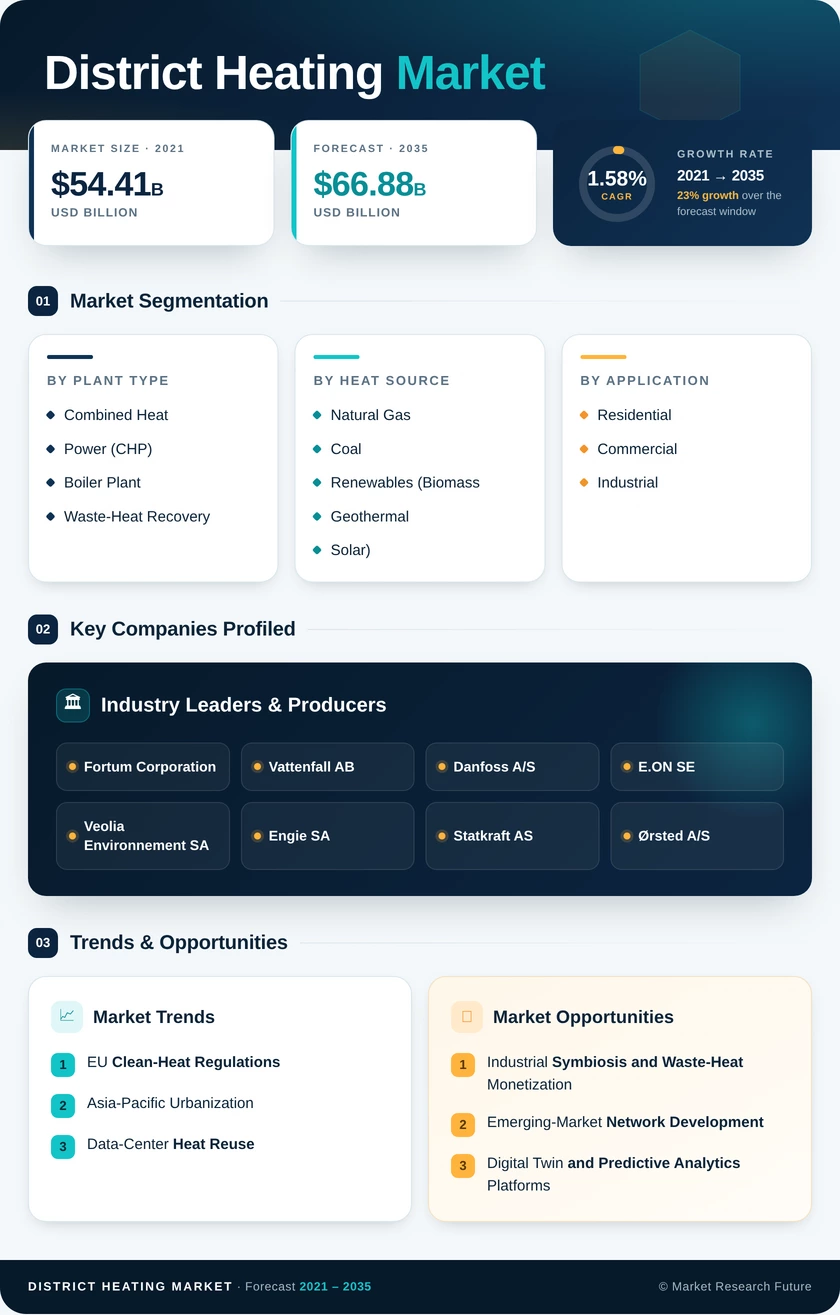
District Heating Market

ID: MRFR/EnP/17708-CR
128 Pages
Chitranshi Jaiswal
Last Updated: June 22, 2026
District Heating Market Size, Share & Growth Analysis Report By Energy Source (Natural Gas, Biomass, Electricity, Waste Heat, Geothermal), By Implementation Type (New Construction, Retrofitting, Expansion), By End Use (Residential, Commercial, Industrial), By System Type (Combined Heat and Power, Single Energy Source, Multi-Energy Source) and By Regional (North America, Europe, South America, Asia Pacific, Middle East and Africa) - Trends & Industry Forecast to 2035
Download PDF ×

We do not share your information with anyone. However, we may send you emails based on your report interest from time to time. You may contact us at any time to opt-out.

  1. 1 Market Overview |
    1. 1.1 Study Assumptions & Market Definition |
    2. 1.2 Scope of the Study |
    3. 1.3 Research Methodology
  2. 2 Market Summary & Key Takeaways
  3. 3 Market Dynamics |
    1. 3.1 Market Drivers Analysis | |
      1. 3.1.1 EU Clean-Heat Regulations and National Heating Plans | |
      2. 3.1.2 Urbanization-Led Heating Demand in Asia-Pacific | |
      3. 3.1.3 Data-Center Waste-Heat Reuse Programs | |
      4. 3.1.4 Industrial Decarbonization Mandates | |
      5. 3.1.5 Heat-Pump Cost Reductions and Technology Scaling | |
      6. 3.1.6 Carbon-Pricing Mechanisms | |
      7. 3.1.7 Digital Optimization and Predictive Load Management |
    2. 3.2 Market Restraints Analysis | |
      1. 3.2.1 High Upfront Infrastructure Capital Costs | |
      2. 3.2.2 Natural-Gas Price Volatility | |
      3. 3.2.3 Aging Pipeline Networks Requiring Costly Refurbishment | |
      4. 3.2.4 Regulatory Fragmentation Across Municipalities | |
      5. 3.2.5 Competition from Individual Heat-Pump Installations |
    3. 3.3 Market Opportunity Analysis | |
      1. 3.3.1 Industrial Symbiosis and Waste-Heat Monetization | |
      2. 3.3.2 Emerging-Market Network Development | |
      3. 3.3.3 Digital Twin and Predictive Analytics Platforms | |
      4. 3.3.4 Seasonal Thermal Energy Storage | |
      5. 3.3.5 Cross-Border Heat Trade |
    4. 3.4 Industry Value Chain Analysis |
    5. 3.5 Porter's Five Forces Analysis
  4. 4 Global District Heating Market Size & Forecast (2021–2035) |
    1. 4.1 Historical Market Size (2021–2025) |
    2. 4.2 Current & Forecast Market Size (2026–2035) |
    3. 4.3 Market Size by Revenue (USD Billion) |
    4. 4.4 Year-over-Year Growth Analysis
  5. 5 Segmentation Analysis |
    1. 5.1 By Plant Type | |
      1. 5.1.1 Combined Heat and Power (CHP) | |
      2. 5.1.2 Boiler Plant | |
      3. 5.1.3 Waste-Heat Recovery |
    2. 5.2 By Heat Source | |
      1. 5.2.1 Natural Gas | |
      2. 5.2.2 Coal | |
      3. 5.2.3 Renewables (Biomass, Geothermal, Solar) | |
      4. 5.2.4 Oil & Others |
    3. 5.3 By Application | |
      1. 5.3.1 Residential | |
      2. 5.3.2 Commercial | |
      3. 5.3.3 Industrial |
    4. 5.4 By Distribution Temperature Tier | |
      1. 5.4.1 High-Temperature (>100 °C) | |
      2. 5.4.2 Low-Temperature (50–100 °C) | |
      3. 5.4.3 Ultra-Low-Temperature (<50 °C)
  6. 6 Regional Analysis |
    1. 6.1 North America | |
      1. 6.1.1 United States | |
      2. 6.1.2 Canada | |
      3. 6.1.3 Mexico |
    2. 6.2 Europe | |
      1. 6.2.1 Germany | |
      2. 6.2.2 United Kingdom | |
      3. 6.2.3 France | |
      4. 6.2.4 Italy | |
      5. 6.2.5 Spain | |
      6. 6.2.6 Nordic Countries | |
      7. 6.2.7 Russia | |
      8. 6.2.8 Rest of Europe |
    3. 6.3 Asia-Pacific | |
      1. 6.3.1 China | |
      2. 6.3.2 India | |
      3. 6.3.3 Japan | |
      4. 6.3.4 South Korea | |
      5. 6.3.5 ASEAN | |
      6. 6.3.6 Rest of Asia-Pacific |
    4. 6.4 South America | |
      1. 6.4.1 Brazil | |
      2. 6.4.2 Argentina | |
      3. 6.4.3 Rest of South America |
    5. 6.5 Middle East & Africa | |
      1. 6.5.1 Saudi Arabia | |
      2. 6.5.2 UAE | |
      3. 6.5.3 South Africa | |
      4. 6.5.4 Egypt | |
      5. 6.5.5 Rest of MEA
  7. 7 Competitive Landscape |
    1. 7.1 Market Share Analysis (2025) |
    2. 7.2 Competitive Benchmarking Matrix |
    3. 7.3 Company Profiles | |
      1. 7.3.1 Fortum Corporation | |
      2. 7.3.2 Vattenfall AB | |
      3. 7.3.3 Danfoss A/S | |
      4. 7.3.4 E.ON SE | |
      5. 7.3.5 Veolia Environnement SA | |
      6. 7.3.6 Engie SA | |
      7. 7.3.7 Statkraft AS | |
      8. 7.3.8 Ørsted A/S | |
      9. 7.3.9 Kamstrup A/S | |
      10. 7.3.10 Alfa Laval AB | |
      11. 7.3.11 Ramboll Group A/S | |
      12. 7.3.12 Logstor A/S
  8. 8 Future Outlook & Strategic Recommendations (2026–2035) |
    1. 8.1 AI-Driven Network Operations |
    2. 8.2 Electrification and Sector Coupling |
    3. 8.3 ESG Reporting and Green-Bond Financing |
    4. 8.4 Hydrogen Blending and Synthetic Fuels
  9. 9 Recent Developments & News
  10. 10 Frequently Asked Questions (FAQs)
  11. 11 Report Scope & Methodology |
    1. 11.1 Study Period & Base Year |
    2. 11.2 Data Sources & Citations |
    3. 11.3 Abbreviations
  12. 12 LIST OF TABLES |
  13. TABLE 1 Global District Heating Market Size & Forecast, by Revenue (USD Billion), 2021–2035 |
  14. TABLE 2 Global District Heating Market — Year-over-Year Growth Analysis, 2021–2035 |
  15. TABLE 3 Global District Heating Market — Driver Impact Analysis |
  16. TABLE 4 Global District Heating Market — Restraint Impact Analysis |
  17. TABLE 5 Global District Heating Market Size, by Plant Type, 2021–2035 (USD Billion) |
  18. TABLE 6 Global District Heating Market Size, by Heat Source, 2021–2035 (USD Billion) |
  19. TABLE 7 Global District Heating Market Size, by Application, 2021–2035 (USD Billion) |
  20. TABLE 8 Global District Heating Market Size, by Distribution Temperature Tier, 2021–2035 (USD Billion) |
  21. TABLE 9 Global District Heating Market Size, by Region, 2021–2035 (USD Billion) |
  22. TABLE 10 North America District Heating Market Size, by Country, 2021–2035 (USD Billion) |
  23. TABLE 11 Europe District Heating Market Size, by Country, 2021–2035 (USD Billion) |
  24. TABLE 12 Asia-Pacific District Heating Market Size, by Country, 2021–2035 (USD Billion) |
  25. TABLE 13 South America District Heating Market Size, by Country, 2021–2035 (USD Billion) |
  26. TABLE 14 Middle East & Africa District Heating Market Size, by Country, 2021–2035 (USD Billion) |
  27. TABLE 15 Competitive Benchmarking Matrix — Global District Heating Market, 2025 |
  28. TABLE 16 Company Profiles — Key Players, Global District Heating Market |
  29. TABLE 17 Recent Developments & Strategic Announcements, 2023–2025 |
  30. TABLE 18 North America District Heating Market Size, by Plant Type, 2021–2035 (USD Billion) |
  31. TABLE 19 North America District Heating Market Size, by Heat Source, 2021–2035 (USD Billion) |
  32. TABLE 20 North America District Heating Market Size, by Application, 2021–2035 (USD Billion) |
  33. TABLE 21 North America District Heating Market Size, by Distribution Temperature Tier, 2021–2035 (USD Billion) |
  34. TABLE 22 Europe District Heating Market Size, by Plant Type, 2021–2035 (USD Billion) |
  35. TABLE 23 Europe District Heating Market Size, by Heat Source, 2021–2035 (USD Billion) |
  36. TABLE 24 Europe District Heating Market Size, by Application, 2021–2035 (USD Billion) |
  37. TABLE 25 Europe District Heating Market Size, by Distribution Temperature Tier, 2021–2035 (USD Billion) |
  38. TABLE 26 Asia-Pacific District Heating Market Size, by Plant Type, 2021–2035 (USD Billion) |
  39. TABLE 27 Asia-Pacific District Heating Market Size, by Heat Source, 2021–2035 (USD Billion) |
  40. TABLE 28 Asia-Pacific District Heating Market Size, by Application, 2021–2035 (USD Billion) |
  41. TABLE 29 Asia-Pacific District Heating Market Size, by Distribution Temperature Tier, 2021–2035 (USD Billion) |
  42. TABLE 30 South America District Heating Market Size, by Plant Type, 2021–2035 (USD Billion) |
  43. TABLE 31 South America District Heating Market Size, by Heat Source, 2021–2035 (USD Billion) |
  44. TABLE 32 South America District Heating Market Size, by Application, 2021–2035 (USD Billion) |
  45. TABLE 33 South America District Heating Market Size, by Distribution Temperature Tier, 2021–2035 (USD Billion) |
  46. TABLE 34 Middle East & Africa District Heating Market Size, by Plant Type, 2021–2035 (USD Billion) |
  47. TABLE 35 Middle East & Africa District Heating Market Size, by Heat Source, 2021–2035 (USD Billion) |
  48. TABLE 36 Middle East & Africa District Heating Market Size, by Application, 2021–2035 (USD Billion) |
  49. TABLE 37 Middle East & Africa District Heating Market Size, by Distribution Temperature Tier, 2021–2035 (USD Billion) |
  50. TABLE 38 United States District Heating Market Size, by Plant Type, 2021–2035 (USD Billion) |
  51. TABLE 39 United States District Heating Market Size, by Heat Source, 2021–2035 (USD Billion) |
  52. TABLE 40 United States District Heating Market Size, by Application, 2021–2035 (USD Billion) |
  53. TABLE 41 United States District Heating Market Size, by Distribution Temperature Tier, 2021–2035 (USD Billion) |
  54. TABLE 42 Canada District Heating Market Size, by Plant Type, 2021–2035 (USD Billion) |
  55. TABLE 43 Canada District Heating Market Size, by Heat Source, 2021–2035 (USD Billion) |
  56. TABLE 44 Canada District Heating Market Size, by Application, 2021–2035 (USD Billion) |
  57. TABLE 45 Canada District Heating Market Size, by Distribution Temperature Tier, 2021–2035 (USD Billion) |
  58. TABLE 46 Mexico District Heating Market Size, by Plant Type, 2021–2035 (USD Billion) |
  59. TABLE 47 Mexico District Heating Market Size, by Heat Source, 2021–2035 (USD Billion) |
  60. TABLE 48 Mexico District Heating Market Size, by Application, 2021–2035 (USD Billion) |
  61. TABLE 49 Mexico District Heating Market Size, by Distribution Temperature Tier, 2021–2035 (USD Billion) |
  62. TABLE 50 Germany District Heating Market Size, by Plant Type, 2021–2035 (USD Billion) |
  63. TABLE 51 Germany District Heating Market Size, by Heat Source, 2021–2035 (USD Billion) |
  64. TABLE 52 Germany District Heating Market Size, by Application, 2021–2035 (USD Billion) |
  65. TABLE 53 Germany District Heating Market Size, by Distribution Temperature Tier, 2021–2035 (USD Billion) |
  66. TABLE 54 United Kingdom District Heating Market Size, by Plant Type, 2021–2035 (USD Billion) |
  67. TABLE 55 United Kingdom District Heating Market Size, by Heat Source, 2021–2035 (USD Billion) |
  68. TABLE 56 United Kingdom District Heating Market Size, by Application, 2021–2035 (USD Billion) |
  69. TABLE 57 United Kingdom District Heating Market Size, by Distribution Temperature Tier, 2021–2035 (USD Billion) |
  70. TABLE 58 France District Heating Market Size, by Plant Type, 2021–2035 (USD Billion) |
  71. TABLE 59 France District Heating Market Size, by Heat Source, 2021–2035 (USD Billion) |
  72. TABLE 60 France District Heating Market Size, by Application, 2021–2035 (USD Billion) |
  73. TABLE 61 France District Heating Market Size, by Distribution Temperature Tier, 2021–2035 (USD Billion) |
  74. TABLE 62 China District Heating Market Size, by Plant Type, 2021–2035 (USD Billion) |
  75. TABLE 63 China District Heating Market Size, by Heat Source, 2021–2035 (USD Billion) |
  76. TABLE 64 China District Heating Market Size, by Application, 2021–2035 (USD Billion) |
  77. TABLE 65 China District Heating Market Size, by Distribution Temperature Tier, 2021–2035 (USD Billion) |
  78. TABLE 66 Japan District Heating Market Size, by Plant Type, 2021–2035 (USD Billion) |
  79. TABLE 67 Japan District Heating Market Size, by Heat Source, 2021–2035 (USD Billion) |
  80. TABLE 68 Japan District Heating Market Size, by Application, 2021–2035 (USD Billion) |
  81. TABLE 69 Japan District Heating Market Size, by Distribution Temperature Tier, 2021–2035 (USD Billion) |
  82. TABLE 70 South Korea District Heating Market Size, by Plant Type, 2021–2035 (USD Billion) |
  83. TABLE 71 South Korea District Heating Market Size, by Heat Source, 2021–2035 (USD Billion) |
  84. TABLE 72 South Korea District Heating Market Size, by Application, 2021–2035 (USD Billion) |
  85. TABLE 73 South Korea District Heating Market Size, by Distribution Temperature Tier, 2021–2035 (USD Billion) |
  86. TABLE 74 India District Heating Market Size, by Plant Type, 2021–2035 (USD Billion) |
  87. TABLE 75 India District Heating Market Size, by Heat Source, 2021–2035 (USD Billion) |
  88. TABLE 76 India District Heating Market Size, by Application, 2021–2035 (USD Billion) |
  89. TABLE 77 India District Heating Market Size, by Distribution Temperature Tier, 2021–2035 (USD Billion) |
  90. TABLE 78 Brazil District Heating Market Size, by Plant Type, 2021–2035 (USD Billion) |
  91. TABLE 79 Brazil District Heating Market Size, by Heat Source, 2021–2035 (USD Billion) |
  92. TABLE 80 Brazil District Heating Market Size, by Application, 2021–2035 (USD Billion) |
  93. TABLE 81 Brazil District Heating Market Size, by Distribution Temperature Tier, 2021–2035 (USD Billion) |
  94. TABLE 82 Saudi Arabia District Heating Market Size, by Plant Type, 2021–2035 (USD Billion) |
  95. TABLE 83 Saudi Arabia District Heating Market Size, by Heat Source, 2021–2035 (USD Billion) |
  96. TABLE 84 Saudi Arabia District Heating Market Size, by Application, 2021–2035 (USD Billion) |
  97. TABLE 85 Saudi Arabia District Heating Market Size, by Distribution Temperature Tier, 2021–2035 (USD Billion) |
  98. TABLE 86 UAE District Heating Market Size, by Plant Type, 2021–2035 (USD Billion) |
  99. TABLE 87 UAE District Heating Market Size, by Heat Source, 2021–2035 (USD Billion) |
  100. TABLE 88 UAE District Heating Market Size, by Application, 2021–2035 (USD Billion) |
  101. TABLE 89 UAE District Heating Market Size, by Distribution Temperature Tier, 2021–2035 (USD Billion) |
  102. TABLE 90 Report Scope & Methodology Summary |
  103. TABLE 91 Detailed Sources & Citations
  104. 13 LIST OF FIGURES |
  105. FIGURE 1 Global District Heating Market Dynamics — Drivers, Restraints & Opportunities |
  106. FIGURE 2 Industry Value Chain Analysis — District Heating Market |
  107. FIGURE 3 Porter's Five Forces Analysis — District Heating Market |
  108. FIGURE 4 Global District Heating Market Size Trend & Forecast (USD Billion), 2021–2035 |
  109. FIGURE 5 Global District Heating Market Share, by Plant Type (%), 2025 |
  110. FIGURE 6 Global District Heating Market Share, by Heat Source (%), 2025 |
  111. FIGURE 7 Global District Heating Market Share, by Application (%), 2025 |
  112. FIGURE 8 Global District Heating Market Share, by Distribution Temperature Tier (%), 2025 |
  113. FIGURE 9 Global District Heating Market Share, by Region (%), 2025 |
  114. FIGURE 10 North America District Heating Market Size & Forecast (USD Billion), 2021–2035 |
  115. FIGURE 11 Europe District Heating Market Size & Forecast (USD Billion), 2021–2035 |
  116. FIGURE 12 Asia-Pacific District Heating Market Size & Forecast (USD Billion), 2021–2035 |
  117. FIGURE 13 South America District Heating Market Size & Forecast (USD Billion), 2021–2035 |
  118. FIGURE 14 Middle East & Africa District Heating Market Size & Forecast (USD Billion), 2021–2035 |
  119. FIGURE 15 Competitive Landscape — Market Share Analysis, District Heating Market (%), 2025 |
  120. FIGURE 16 Competitive Benchmarking Radar — Top 10 Players, District Heating Market |
  121. FIGURE 17 District Heating Market Growth Rate, by Plant Type (CAGR %), 2026–2035 |
  122. FIGURE 18 District Heating Market Growth Rate, by Heat Source (CAGR %), 2026–2035 |
  123. FIGURE 19 District Heating Market Growth Rate, by Application (CAGR %), 2026–2035 |
  124. FIGURE 20 District Heating Market Growth Rate, by Distribution Temperature Tier (CAGR %), 2026–2035

SEGMENTATION QUICK REFERENCE

DimensionSub-SegmentsDominant SegmentFastest Growing Segment
By Plant TypeCombined Heat and Power (CHP); Boiler Plant; Waste-Heat RecoveryCombined Heat and Power (CHP)Waste-Heat Recovery
By Heat SourceNatural Gas; Coal; Renewables (Biomass, Geothermal, Solar); Oil & OthersNatural GasRenewables
By ApplicationResidential; Commercial; IndustrialResidentialIndustrial
By Distribution Temperature TierHigh-Temperature (>100 °C); Low-Temperature (50–100 °C); Ultra-Low-Temperature (<50 °C)High-TemperatureUltra-Low-Temperature


MARKET SEGMENTATION OVERVIEW

By Plant Type

Sub-SegmentKey Trend
Combined Heat and Power (CHP)Fuel-switching from coal to gas and biomass; revenue diversification via electricity-market participation.
Boiler PlantLegacy replacement cycles are driving modernization to condensing and modular designs.
Waste-Heat RecoveryData-center heat capture and industrial symbiosis creating new feedstock streams


Combined Heat and Power plants remain the primary generation asset class in district heating, delivering both thermal and electrical output from a single fuel stream. CHP dominance is sustained by dual-revenue economics and high installed-base inertia across European and Chinese networks. Waste-heat recovery is the segment attracting the most new capital as industrial operators and data-center developers seek to monetize thermal by-products that were previously vented to the atmosphere.

By Heat Source

Sub-SegmentKey Trend
Natural GasContinued CHP reliance with growing pressure from carbon pricing and electrification
CoalAccelerating phase-out in the EU and OECD; persistence in China and Eastern Europe.
Renewables (Biomass, Geothermal, Solar)Policy-driven rapid expansion; Scandinavian benchmark models scaling to continental Europe
Oil & OthersMarginal and declining share; primarily in legacy island and remote systems


Natural gas retains the largest share of the fuel mix but faces structural headwinds as carbon-pricing escalation and renewable-heat mandates shift investment priorities. Renewables — encompassing biomass, geothermal, and solar thermal — are growing fastest, with Denmark and Sweden demonstrating that 80–90% renewable heat shares are commercially achievable in mature networks.

By Application

Sub-SegmentKey Trend
ResidentialMandatory connection policies in high-density urban zones; metering modernization
CommercialOffice, retail, and institutional buildings seeking green-lease compliance
IndustrialProcess-heat decarbonization and waste-heat exchange are driving adoption.


Residential heating dominates district network demand by volume, driven by space-heating and hot-water requirements in cold-climate urban centers. Industrial applications are growing faster from a smaller base as manufacturing facilities pursue low-carbon process heat to satisfy regulatory and supply-chain sustainability requirements.

By Distribution Temperature Tier

Sub-SegmentKey Trend
High-Temperature (>100 °C)Legacy steam networks serving industrial loads and older building stock
Low-Temperature (50–100 °C)Modern hot-water networks enabling broader heat-source integration
Ultra-Low-Temperature (<50 °C)New-build developments with high-performance insulation and heat-pump boosters


The temperature transition from high-temperature steam to low- and ultra-low-temperature hot-water systems is the defining infrastructure shift in district heating. Lower supply temperatures reduce distribution losses, expand the range of usable heat sources, and align with building-stock energy-efficiency improvements, positioning networks for long-term relevance in a decarbonized energy system.