×
Request Free Sample ×

Kindly complete the form below to receive a free sample of this Report

* Please use a valid business email

Leading companies partner with us for data-driven Insights

clients tt-cursor
Hero Background

Drone Camera Market

ID: MRFR/SEM/9280-HCR
200 Pages
Shubham Munde
October 2025

Drone Camera Market Research Report Information By Resolution Type (12 MP, 12 to 20 MP, 20 to 32 MP, and 32 MP & Above), By Application (Photography & Videography, Thermal Imaging, and Surveillance), By Type (SD Camera and HD Camera), By End User (Commercial, Military, and Homeland security), And By Region (North America, Europe, Asia-Pacific, And Rest Of The World) – Industry Size, Share and Trends Till 2030

Share:
Download PDF ×

We do not share your information with anyone. However, we may send you emails based on your report interest from time to time. You may contact us at any time to opt-out.

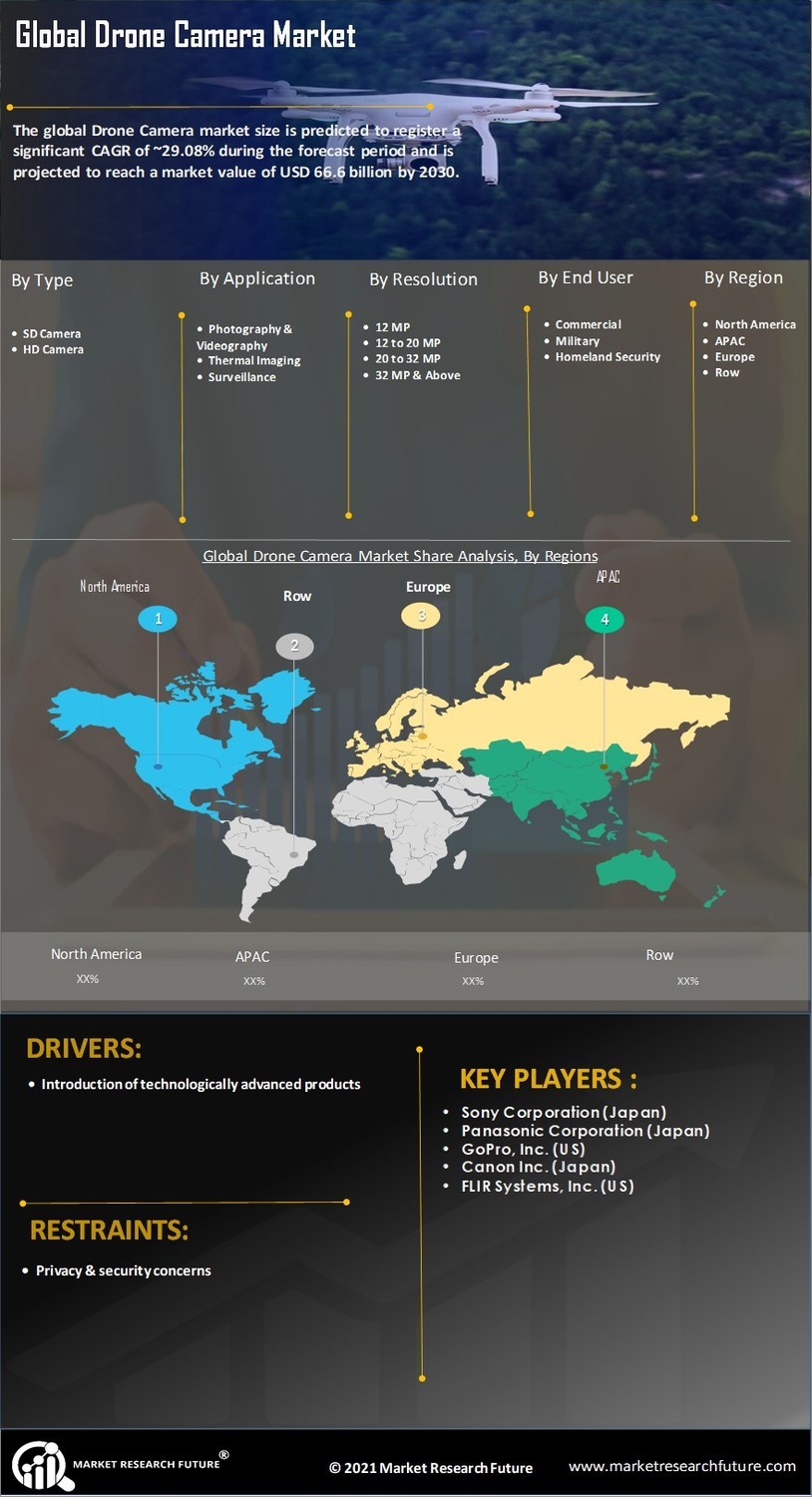
Drone Camera Market Infographic
Purchase Options

Drone Camera Market Summary

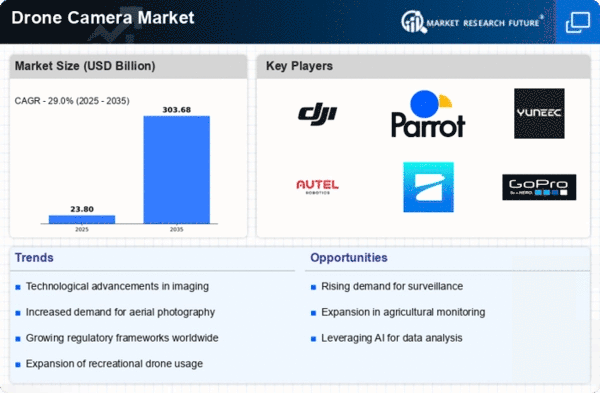
As per MRFR analysis, the Drone Camera Market Size was estimated at 18.45 USD Billion in 2024. The Drone Camera industry is projected to grow from 23.8 in 2025 to 303.68 by 2035, exhibiting a compound annual growth rate (CAGR) of 29.0 during the forecast period 2025 - 2035.

Key Market Trends & Highlights

The Drone Camera Market is experiencing robust growth driven by technological advancements and diverse applications.

  • Technological advancements are enhancing the capabilities of drone cameras, leading to increased adoption across various sectors.
  • North America remains the largest market for drone cameras, while Asia-Pacific is emerging as the fastest-growing region.
  • The aerial photography segment continues to dominate the market, whereas the surveillance segment is witnessing rapid growth.
  • Key market drivers include the increasing demand for aerial photography and regulatory support that facilitates drone operations.

Market Size & Forecast

2024 Market Size 18.45 (USD Billion)
2035 Market Size 303.68 (USD Billion)
CAGR (2025 - 2035) 29.0%

Major Players

DJI (CN), Parrot (FR), Yuneec (CN), Autel Robotics (US), Skydio (US), GoPro (US), Insitu (US), senseFly (CH), Aeryon Labs (CA)

Drone Camera Market Trends

The Drone Camera Market is currently experiencing a dynamic evolution, driven by advancements in technology and increasing consumer interest. The proliferation of high-quality imaging capabilities in drones has attracted a diverse range of users, from hobbyists to professionals in various sectors such as agriculture, real estate, and filmmaking. As these devices become more accessible, the market is likely to witness a surge in demand, particularly for models that offer enhanced features such as improved battery life, advanced stabilization systems, and user-friendly interfaces. Furthermore, the integration of artificial intelligence and machine learning into drone technology appears to be reshaping the landscape, enabling smarter functionalities and more efficient operations. In addition to technological advancements, regulatory frameworks are also playing a crucial role in shaping the Drone Camera Market. Governments worldwide are increasingly establishing guidelines to ensure safe and responsible drone usage, which may foster greater public acceptance and encourage investment in this sector. As the market continues to mature, it seems poised for further growth, with potential applications expanding into areas such as environmental monitoring, infrastructure inspection, and emergency response. The convergence of innovation and regulation suggests a promising future for the Drone Camera Market, as stakeholders adapt to evolving consumer needs and technological possibilities.

Technological Advancements

The Drone Camera Market is witnessing rapid technological progress, with innovations in imaging quality, flight stability, and automation. Enhanced sensors and cameras are enabling users to capture high-resolution images and videos, while improved flight control systems are making drones easier to operate. This trend is likely to attract a broader audience, including professionals seeking advanced tools for various applications.

Regulatory Developments

As the Drone Camera Market expands, regulatory frameworks are becoming increasingly important. Governments are implementing guidelines to ensure safe operation and mitigate risks associated with drone usage. These regulations may encourage responsible practices and foster public trust, potentially leading to increased adoption and investment in drone technology.

Diverse Applications

The versatility of drone cameras is driving their adoption across multiple sectors. From agriculture to real estate, the ability to capture aerial imagery is proving invaluable. This trend suggests that as industries recognize the benefits of drone technology, the market may continue to diversify, leading to innovative applications and new business opportunities.

Drone Camera Market Drivers

Market Growth Projections

The Global Drone Camera Market Industry is projected to experience substantial growth, with estimates indicating a market value of 18.3 USD Billion in 2024 and a remarkable increase to 236.5 USD Billion by 2035. This growth trajectory suggests a robust compound annual growth rate (CAGR) of 26.19% from 2025 to 2035. Such projections highlight the increasing integration of drone cameras across various sectors and the growing consumer demand for aerial imaging solutions. The anticipated expansion reflects the evolving landscape of the Global Drone Camera Market Industry, where technological advancements and diverse applications are likely to play pivotal roles.

Technological Advancements

The Global Drone Camera Market Industry experiences rapid growth due to continuous technological advancements. Innovations in camera resolution, stabilization, and flight control systems enhance the capabilities of drone cameras, making them more appealing to consumers and businesses alike. For instance, the introduction of 4K and 8K cameras in drones has significantly improved image quality, attracting industries such as real estate and agriculture. As a result, the market is projected to reach 18.3 USD Billion in 2024, indicating a strong demand for high-quality aerial imagery. This trend suggests that ongoing research and development will likely drive further expansion in the Global Drone Camera Market Industry.

Regulatory Support and Frameworks

The Global Drone Camera Market Industry is positively influenced by the establishment of regulatory frameworks that support drone operations. Governments worldwide are increasingly recognizing the potential benefits of drone technology, leading to the development of guidelines that facilitate safe and efficient drone usage. For instance, regulations that allow for commercial drone operations have opened new avenues for businesses to leverage drone cameras for various applications. This regulatory support is likely to foster innovation and investment in the sector, further propelling the market's growth. As the industry matures, the alignment of regulations with technological advancements may enhance the overall landscape of the Global Drone Camera Market Industry.

Emerging Markets and Consumer Awareness

The Global Drone Camera Market Industry is witnessing growth in emerging markets, where increasing consumer awareness and accessibility to drone technology are driving adoption. As prices for drone cameras decrease and technology becomes more user-friendly, a broader audience is likely to engage with these devices. Countries in Asia-Pacific and Latin America are experiencing a surge in interest, as consumers recognize the potential applications of drone cameras in personal and professional settings. This trend suggests that the Global Drone Camera Market Industry will continue to expand as more individuals and businesses in these regions invest in drone technology.

Increased Adoption in Various Industries

The Global Drone Camera Market Industry benefits from increased adoption across diverse sectors, including agriculture, construction, and surveillance. Drones equipped with advanced cameras are utilized for crop monitoring, site inspections, and security surveillance, showcasing their versatility. For example, in agriculture, farmers employ drone cameras to assess crop health and optimize yields, leading to enhanced productivity. This widespread application is expected to contribute to the market's growth, with projections indicating a rise to 236.5 USD Billion by 2035. The diverse use cases across industries suggest that the Global Drone Camera Market Industry will continue to expand as more sectors recognize the value of drone technology.

Growing Demand for Aerial Photography and Videography

The Global Drone Camera Market Industry sees a surge in demand for aerial photography and videography, driven by the increasing popularity of content creation. Social media platforms and streaming services have amplified the need for high-quality visual content, prompting filmmakers, photographers, and influencers to adopt drone cameras. The ability to capture stunning aerial shots has transformed the creative landscape, making drone cameras essential tools for professionals and enthusiasts alike. This trend is expected to contribute to the market's growth, with a projected CAGR of 26.19% from 2025 to 2035. The rising demand for unique visual perspectives indicates a promising future for the Global Drone Camera Market Industry.

Market Segment Insights

By Application: Aerial Photography (Largest) vs. Surveillance (Fastest-Growing)

In the Drone Camera Market, Aerial Photography is the largest application segment, accounting for a significant share due to its widespread usage in the media and real estate sectors. This segment benefits from advancements in camera technology, offering higher resolutions and improved stabilization, which enhances the quality of captured images and videos. Surveillance follows closely, showcasing robust growth as more industries recognize the advantages of drone technology in monitoring and security tasks, driving demand for cameras with high-performance features.

Aerial Photography (Dominant) vs. Surveillance (Emerging)

Aerial Photography stands as the dominant application in the Drone Camera Market, leveraged for both professional filming and recreational purposes. Its ability to capture stunning visuals has made it a preferred choice among content creators and real estate professionals. In contrast, the Surveillance application is emerging rapidly, driven by increasing security concerns and the necessity for effective surveillance solutions in urban areas. Manufacturers are focusing on enhancing surveillance cameras with features such as thermal imaging and real-time data analytics, positioning this segment as a key player in the market's evolving landscape.

By End Use: Commercial (Largest) vs. Government (Fastest-Growing)

The Drone Camera Market is notably segmented by end use, with the Commercial sector holding the largest share. Various industries, such as agriculture, media, and real estate, are increasingly adopting drone cameras for their operational efficiencies. The Government sector follows closely as a significant user, utilizing drone technology for surveillance, infrastructure monitoring, and environmental protection. Both segments reflect the growing versatility of drone cameras across different applications, highlighting their importance throughout multiple sectors. In terms of growth trends, the Government segment is emerging as the fastest-growing area, driven by increasing investments in public safety and national security. Meanwhile, the demand in the Commercial segment is propelled by the continuously expanding drone service offerings and advancements in camera capabilities, fostering a competitive environment. This dual growth is indicative of the broader technological advancements making drone cameras more efficient and accessible for diverse applications.

Commercial: Dominant vs. Government: Emerging

The Commercial segment of the Drone Camera Market remains the dominant force, characterized by its widespread applications across various industries such as agriculture, logistics, and media. This segment benefits from advancements in technology that enhance the usability and performance of drone cameras, such as improved imaging capabilities and real-time data processing. The extensive adoption of drone cameras in commercial operations has established this segment as critical for businesses aiming to increase efficiency and reduce operational costs. In contrast, the Government segment is emerging as a vital player, driven by heightened awareness around security and surveillance needs. With significant investments in infrastructure monitoring and public safety, government agencies are increasingly looking toward drone cameras for innovative solutions to enhance their operational capacities. The emphasis on regulation and compliance within this sector also indicates a growing necessity for reliable drone technologies.

By Camera Type: Mirrorless (Largest) vs. Action Camera (Fastest-Growing)

The Drone Camera Market is significantly influenced by the types of cameras utilized, where Mirrorless cameras hold the largest segment share due to their balance of quality and portability. These cameras are preferred by enthusiasts and professionals alike, taking advantage of their superior image quality and versatility. In contrast, Action Cameras are rapidly gaining traction, appealing to extreme sports enthusiasts and adventure seekers. Their compact size and durability make them a popular choice for capturing dynamic action footage in diverse environments. Growth trends in this segment indicate a rising demand for Mirrorless cameras, driven by advancements in technology and consumer preferences for high-quality aerial imagery. Conversely, the Action Camera segment is witnessing exponential growth due to increasing interest in personal and sport-related videography. Factors such as the proliferation of social media and the rising popularity of adventure sports are propelling the Action Camera market forward, making it the fastest-growing area within the Drone Camera industry.

Mirrorless (Dominant) vs. Action Camera (Emerging)

Mirrorless cameras dominate the Drone Camera Market due to their lightweight designs, interchangeable lenses, and exceptional video recording capabilities. This camera type allows for advanced imaging techniques and boasts features like high dynamic range and superior autofocus systems, catering to the needs of both professional aerial photographers and videographers. Meanwhile, Action Cameras, though emerging, are becoming increasingly popular for their ruggedness and versatility, suitable for users who want to capture high-quality footage in demanding conditions. Their ease of use and ability to withstand extreme environments make them appealing to a younger demographic engaged in outdoor sports and activities. With their rapid technological advancements, such as 4K recording and enhanced stabilization features, Action Cameras are establishing a strong foothold in the market.

By Technology: Optical Zoom (Largest) vs. 4K Video (Fastest-Growing)

The Drone Camera Market exhibits a diverse range of technologies, with Optical Zoom representing the largest segment due to its extensive application in aerial photography and surveillance. This segment is favored for its ability to capture high-quality images from varying distances, making it indispensable for professional drone operators. Meanwhile, 4K Video technology is rapidly gaining traction, reflecting the growing demand for high-definition video content in various sectors, including media and entertainment.

Technology: Optical Zoom (Dominant) vs. 4K Video (Emerging)

Optical Zoom technology stands out as the dominant player in the Drone Camera Market due to its superior image quality and versatility, appealing to both professional and recreational users. It allows for significant flexibility in capturing close-ups and distant shots without compromising resolution. On the other hand, 4K Video is emerging as a significant trendsetter, driven by an increasing desire for high-quality video content across different platforms. This technology enhances the visual experience, catering to the needs of filmmakers and content creators, thus opening up new opportunities in the market.

Get more detailed insights about Drone Camera Market

Regional Insights

North America : Market Leader in Innovation

North America continues to lead the drone camera market, holding a significant share of 9.0 in 2025. The region's growth is driven by advancements in technology, increasing demand for aerial photography, and regulatory support for drone operations. The Federal Aviation Administration (FAA) has implemented regulations that facilitate commercial drone use, further boosting market potential. The United States is the primary market, with key players like DJI, Autel Robotics, and Skydio dominating the landscape. The competitive environment is characterized by continuous innovation and product launches, catering to various sectors such as agriculture, real estate, and filmmaking. The presence of established companies and startups fosters a vibrant ecosystem, ensuring sustained growth in the region.

Europe : Emerging Market with Potential

Europe's drone camera market is poised for growth, with a market size of 4.5 in 2025. The region benefits from increasing investments in drone technology and supportive regulations from the European Union Aviation Safety Agency (EASA). The demand for drone cameras is rising in sectors like agriculture, surveillance, and logistics, driven by the need for efficiency and cost-effectiveness. Leading countries include Germany, France, and the UK, where companies like Parrot and senseFly are making significant strides. The competitive landscape is evolving, with both established firms and new entrants vying for market share. The focus on sustainability and innovation is expected to further enhance the region's position in the global market.

Asia-Pacific : Rapidly Growing Market

The Asia-Pacific region is witnessing a surge in the drone camera market, with a size of 3.5 in 2025. Factors such as increasing urbanization, technological advancements, and a growing interest in aerial photography are driving demand. Countries like China and Japan are at the forefront, supported by favorable government policies that encourage drone usage in various sectors. China, home to major players like DJI and Yuneec, dominates the market, while Japan and Australia are also emerging as key players. The competitive landscape is marked by innovation and collaboration among companies to enhance product offerings. As the region continues to embrace drone technology, the market is expected to expand significantly in the coming years.

Middle East and Africa : Untapped Market Opportunities

The Middle East and Africa region presents untapped opportunities in the drone camera market, with a size of 1.45 in 2025. The growth is driven by increasing investments in infrastructure, agriculture, and surveillance, alongside a rising interest in drone technology. Governments are beginning to recognize the potential of drones, leading to more favorable regulations and support for the industry. Countries like the UAE and South Africa are leading the way, with initiatives to integrate drone technology into various sectors. The competitive landscape is still developing, with both local and international players exploring market entry. As awareness and acceptance of drone technology grow, the region is expected to see significant advancements in the drone camera market.

Key Players and Competitive Insights

The Drone Camera Market is currently characterized by a dynamic competitive landscape, driven by rapid technological advancements and increasing demand across various sectors, including agriculture, surveillance, and entertainment. Key players such as DJI (CN), Autel Robotics (US), and Skydio (US) are at the forefront, each adopting distinct strategies to enhance their market positioning. DJI (CN) continues to dominate through relentless innovation, focusing on high-performance imaging technology and expanding its ecosystem of accessories and software solutions. Meanwhile, Autel Robotics (US) emphasizes user-friendly designs and competitive pricing, aiming to capture a broader consumer base. Skydio (US), on the other hand, leverages its expertise in AI and autonomous flight capabilities, positioning itself as a leader in the commercial drone segment, particularly for applications requiring advanced obstacle avoidance and autonomous navigation.

In terms of business tactics, companies are increasingly localizing manufacturing to mitigate supply chain disruptions and enhance responsiveness to regional market demands. The competitive structure of the market appears moderately fragmented, with several players vying for market share, yet a few dominant firms maintain significant influence. This fragmentation allows for innovation and niche offerings, while the larger companies often set the pace for technological advancements and pricing strategies.

In November 2025, DJI (CN) announced the launch of its latest drone model, which features enhanced 8K video capabilities and improved battery life. This strategic move not only reinforces DJI's commitment to innovation but also aims to capture the growing demand for high-resolution imaging in both consumer and professional markets. The introduction of this model is likely to further solidify DJI's market leadership and attract new customers seeking cutting-edge technology.

In October 2025, Autel Robotics (US) unveiled a partnership with a leading agricultural technology firm to develop specialized drones for precision farming. This collaboration is strategically significant as it allows Autel to tap into the burgeoning agricultural sector, where drone applications are increasingly recognized for their potential to optimize crop management and yield. By aligning with a key player in agri-tech, Autel positions itself to leverage synergies that could enhance its product offerings and market reach.

In September 2025, Skydio (US) secured a major contract with a government agency for the deployment of its autonomous drones in public safety operations. This contract underscores Skydio's growing reputation in the public sector and highlights the increasing reliance on drone technology for critical applications. The strategic importance of this contract lies in its potential to establish Skydio as a trusted partner in government operations, paving the way for future opportunities in similar sectors.

As of December 2025, the Drone Camera Market is witnessing trends that emphasize digitalization, sustainability, and the integration of AI technologies. Strategic alliances are becoming increasingly pivotal, as companies recognize the value of collaboration in enhancing their technological capabilities and market presence. Looking ahead, competitive differentiation is likely to evolve, shifting from traditional price-based competition to a focus on innovation, advanced technology, and supply chain reliability. This transition suggests that companies that prioritize R&D and strategic partnerships will be better positioned to thrive in an increasingly competitive environment.

Key Companies in the Drone Camera Market market include

Industry Developments

Jul 2023: DJI, a leading global drone tech provider, launched its latest drone DJI Air 3. The semi-flagship drone stands out with its dual camera that can offer more powerful photo and video capabilities than its predecessor, Air 2s. DJI Air 3 has a dual 4K camera system featuring a wide-angle lens with a 24mm equivalent focal length & an f/1.7 aperture and a medium telephoto lens with a 70mm equivalent focal length & an f/2.8 aperture. These lenses are 1/1.3-inch in size and support dual native ISO.

Jul 2023: SimActive Inc., a leading global developer of photogrammetry software, announced new pricing for larger drone cameras, Correlator3D software. Larger drone cameras of up to 61 megapixels are now covered under the low-priced UAV license option, previously capped at 50MP. The new pricing addresses the rising demand for bigger drone sensors, such as the Sony A7R IV.

Apr 2023: DJI launched the world's first drone with three optical cameras, the Mavic 3 Pro, following the success of the Mavic 3. The DJI Mavic 3 Pro gives creators, filmmakers, and drone pilots worldwide the much-desired creative flexibility. The world’s first triple optical camera drone offers advanced imaging capabilities, featuring a Hasselblad camera and dual telephoto lenses.

Apr 2023: DJI, a leading drone maker, launched a new high-end professional cinema camera drone named Inspire 3 in Shenzhen. Inspire 3 is a cinema camera drone with a Zenmuse X9-8K Air camera, and it will be available by the end of June this year. The Zenmuse X9-8K Air camera offers an 8K video recording and imaging system. The Inspire 3 is an updated version of DJI's cinematic drone series, launched in late 2014 and was refreshed with the Inspire 2 in 2016, offering a 5K camera.

April 2022: Ronin 4D, a DJI cinematography camera, was released by Drone Nerds, a developer of drone technology and solutions for businesses and consumers. Solo cinematographers have a complete and flexible cinematography solution thanks to Ronin 4D's integrated and modular architecture. Ronin 4D blends cinematic images with LiDAR focusing for rapid and straightforward filming. The Ronin 4D's LiDAR Waveform feature offers quick manual focusing, making it possible to record accurately even in dimly lit environments.

April 2022: Now, a new "Grade 10" productivity improvement option is available for Canon Inc.'s FPA-6300ES6a KrF semiconductor lithography equipment.

Jan 2022: KDDI (Japan), a leading telecommunication operator, announced its partnership with a commercial drone manufacturer, PRODRONE, and underwater robotics provider QYSEA Technology to create the first revolutionary sea-to-air drone. 

The new drone is the result of six years of development that features a combination of a heavy-duty aerial drone and an industrial-class underwater remote-operated vehicle (ROV). This first commercial drone, capable of operating seamlessly through land, sea, and air, is equipped with a 12-megapixel 4K camera. The sea-air integrated drone will have far-reaching applications across various marine-based industries.

Future Outlook

Drone Camera Market Future Outlook

The Drone Camera Market is projected to grow at a 29.0% CAGR from 2024 to 2035, driven by advancements in imaging technology, increased demand for aerial photography, and expanding applications in various industries.

New opportunities lie in:

  • Development of AI-driven image processing software for enhanced analytics.
  • Expansion into agricultural monitoring solutions using drone cameras.
  • Partnerships with real estate firms for aerial property marketing services.

By 2035, the Drone Camera Market is expected to be robust, reflecting substantial growth and innovation.

Market Segmentation

Drone Camera Market End Use Outlook

  • Commercial
  • Government
  • Military
  • Consumer

Drone Camera Market Technology Outlook

  • Optical Zoom
  • Digital Zoom
  • Thermal Imaging
  • 4K Video

Drone Camera Market Application Outlook

  • Aerial Photography
  • Surveillance
  • Agriculture
  • Infrastructure Inspection
  • Search and Rescue

Drone Camera Market Camera Type Outlook

  • Single Lens Reflex
  • Mirrorless
  • Compact
  • Action Camera

Report Scope

MARKET SIZE 202418.45(USD Billion)
MARKET SIZE 202523.8(USD Billion)
MARKET SIZE 2035303.68(USD Billion)
COMPOUND ANNUAL GROWTH RATE (CAGR)29.0% (2024 - 2035)
REPORT COVERAGERevenue Forecast, Competitive Landscape, Growth Factors, and Trends
BASE YEAR2024
Market Forecast Period2025 - 2035
Historical Data2019 - 2024
Market Forecast UnitsUSD Billion
Key Companies ProfiledDJI (CN), Parrot (FR), Yuneec (CN), Autel Robotics (US), Skydio (US), GoPro (US), Insitu (US), senseFly (CH), Aeryon Labs (CA)
Segments CoveredApplication, End Use, Camera Type, Technology
Key Market OpportunitiesIntegration of artificial intelligence in Drone Camera Market enhances automated imaging and data analysis capabilities.
Key Market DynamicsTechnological advancements and regulatory changes drive innovation and competition in the Drone Camera Market.
Countries CoveredNorth America, Europe, APAC, South America, MEA

Market Highlights

Author
Shubham Munde
Research Analyst Level II

With a technical background in information technology & semiconductors, Shubham has 4.5+ years of experience in market research and analytics with the tasks of data mining, analysis, and project execution. He is the POC for our clients, for their consulting projects running under the ICT/Semiconductor domain. Shubham holds a Bachelor’s in Information and Technology and a Master of Business Administration (MBA). Shubham has executed over 150 research projects for our clients under the brand name Market Research Future in the last 2 years. His core skill is building the research respondent relation for gathering the primary information from industry and market estimation for niche markets. He is having expertise in conducting secondary & primary research, market estimations, market projections, competitive analysis, analysing current market trends and market dynamics, deep-dive analysis on market scenarios, consumer behaviour, technological impact analysis, consulting, analytics, etc. He has worked on fortune 500 companies' syndicate and consulting projects along with several government projects. He has worked on the projects of top tech brands such as IBM, Google, Microsoft, AWS, Meta, Oracle, Cisco Systems, Samsung, Accenture, VMware, Schneider Electric, Dell, HP, Ericsson, and so many others. He has worked on Metaverse, Web 3.0, Zero-Trust security, cyber-security, blockchain, quantum computing, robotics, 5G technology, High-Performance computing, data centers, AI, automation, IT equipment, sensors, semiconductors, consumer electronics and so many tech domain projects.

Leave a Comment

FAQs

How much is the Drone Camera market?

The Drone Camera Market size was valued at USD 11.1 Billion in 2022.

What is the growth rate of the Drone Camera market?

The global market is projected to grow at a CAGR of 29,0% during the forecast period 2022-2030.

Which region held the largest market share in the Drone Camera market?

North America had the largest share in the global market.

Who are the key players in the Drone Camera market?

The key players in the market are Sony Corporation (Japan), Panasonic Corporation (Japan), GoPro Inc. (US), Canon Inc. (Japan), and FLIR Systems Inc. (US), among others.

Which type led the Drone Camera market?

The HD Drone Camera category dominated the market in 2022.

Which end-user had the largest market share in the Drone Camera market?

The military end user had the largest share in the global market.

Download Free Sample

Kindly complete the form below to receive a free sample of this Report

Compare Licence

×
Features License Type
Single User Multiuser License Enterprise User
Price $4,950 $5,950 $7,250
Maximum User Access Limit 1 User Upto 10 Users Unrestricted Access Throughout the Organization
Free Customization
Direct Access to Analyst
Deliverable Format
Platform Access
Discount on Next Purchase 10% 15% 15%
Printable Versions