Author

Pradeep Nandi

Duty-Free Retailing Market Size, Share, Industry Trend & Analysis Research Report By Product Category (Beverages, Tobacco Products, Cosmetics, Fashion Accessories, Perfumes), By Distribution Channel (Airport Duty-Free Shops, Seaport Duty-Free Shops, Border Shops, Online Platforms), By Consumer Demographics (Tourists, Business Travelers, Local Residents), By Packaging Type (Luxury Packaging, Standard Packaging, Travel-sized Packaging) andBy Regional (North America, Europe, South America, Asia Pacific, Middle East and Africa)- Forecast to 2035
As per Market Research Future analysis, the Duty-Free Retailing Market was estimated at 99.1 USD Billion in 2024. The Duty-Free Retailing industry is projected to grow from 103.03 USD Billion in 2025 to 151.95 USD Billion by 2035, exhibiting a compound annual growth rate (CAGR) of 3.96% during the forecast period 2025 - 2035
The Duty-Free Retailing Market is experiencing dynamic growth driven by evolving consumer preferences and technological advancements.
| 2024 Market Size | 99.1 (USD Billion) |
| 2035 Market Size | 151.95 (USD Billion) |
| CAGR (2025 - 2035) | 3.96% |
Dufry AG (CH), Lotte Duty Free (KR), Heinemann Duty Free (DE), DFS Group (US), Shilla Duty Free (KR), King Power International (TH), Aelia Duty Free (FR), Duty Free Americas (US), China Duty Free Group (CN)
Our Impact
Enabled $4.3B Revenue Impact for Fortune 500 and Leading Multinationals
Partnering with 2000+ Global Organizations Each Year
30K+ Citations by Top-Tier Firms in the Industry
The Duty-Free Retailing Market, a major segment of the global duty-free and travel retail market, is currently experiencing a dynamic evolution, driven by various factors that influence consumer behavior and purchasing patterns. As international travel continues to gain momentum, the demand for duty-free products appears to be on the rise across the duty free travel retail market. Travelers are increasingly seeking unique and premium products that are often unavailable in their home countries. This trend suggests a growing appreciation for luxury items, cosmetics, and spirits, which are frequently featured in duty-free shops within the expanding duty free retail market. Furthermore, the expansion of e-commerce platforms dedicated to duty-free shopping is likely to enhance accessibility, allowing consumers to browse and purchase products conveniently before their travels, reinforcing the digital transformation of the duty-free retailing market.
In addition, the Duty-Free Retailing Market is witnessing a shift towards sustainability and ethical sourcing within the broader duty free and travel retail market structure. Consumers are becoming more conscious of their purchasing decisions, favoring brands that demonstrate a commitment to environmental responsibility. This shift may lead retailers to adapt their offerings, focusing on sustainable products and practices across the duty free retailing market. Overall, the Duty-Free Retailing Market appears poised for growth, with evolving consumer preferences and technological advancements shaping its future landscape in the duty free retail market.
The Duty-Free Retailing Market is increasingly embracing e-commerce across the duty free travel retail market, allowing travelers to pre-order products online. This trend enhances convenience and provides access to a wider range of products, catering to the preferences of tech-savvy consumers within the expanding duty-free and travel retail market.
There is a noticeable shift towards sustainability within the Duty-Free Retailing Market and the overall duty-free retailing market. Retailers are likely to prioritize eco-friendly products and ethical sourcing, responding to consumer demand for responsible purchasing options across the duty free retail market.
Enhancing customer experience through personalization is becoming a key trend in the duty free retailing market. Duty-free retailers may implement tailored marketing strategies and loyalty programs to engage travelers, fostering brand loyalty and repeat purchases within the competitive duty free and travel retail market.
The Duty-Free Retailing Market is characterized by a diverse range of product offerings, which appears to attract a broad customer base. Retailers are increasingly expanding their product lines to include not only traditional items like alcohol and tobacco but also luxury goods, cosmetics, and electronics. This diversification is crucial as it caters to the varying preferences of international travelers. In 2025, the market for duty-free cosmetics alone is projected to reach USD 12 billion, indicating a growing consumer interest in beauty products. By providing a wide array of choices, duty-free retailers can enhance customer satisfaction and potentially increase sales. This trend suggests that the ability to adapt product offerings to meet consumer demands is vital for success in the duty-free retailing landscape.
The Duty-Free Retailing Market is witnessing a growing demand for luxury goods, which appears to be a significant driver of market growth. As disposable incomes rise in various regions, consumers are increasingly willing to spend on high-end products. In 2025, the luxury goods market is projected to reach USD 300 billion, with a considerable portion of this growth attributed to duty-free sales. Travelers often seek luxury items such as designer handbags, watches, and premium spirits at duty-free shops, where they can enjoy tax-free prices. This trend suggests that duty-free retailers who focus on luxury offerings may experience enhanced sales and customer loyalty. Additionally, the allure of exclusive products available only in duty-free stores could further entice consumers, driving growth in this segment.
The Duty-Free Retailing Market appears to benefit from the ongoing rise in international travel. As more individuals embark on overseas journeys, the demand for duty-free products tends to increase. In 2025, it is estimated that international tourist arrivals will reach approximately 1.8 billion, which could significantly bolster sales in duty-free outlets. Travelers often seek luxury goods, cosmetics, and spirits at competitive prices, which duty-free retailers provide. This trend suggests that as travel becomes more accessible, the duty-free sector may experience substantial growth. Furthermore, the expansion of airports and the introduction of new routes could enhance the visibility and accessibility of duty-free shops, potentially leading to increased consumer spending in this market.
The Duty-Free Retailing Market is likely to see a positive impact from the ongoing expansion of airport infrastructure. Many countries are investing in modernizing and enlarging their airports to accommodate the growing number of travelers. This expansion often includes the development of larger duty-free shopping areas, which can enhance the shopping experience for passengers. For instance, recent reports indicate that airport retail sales are projected to reach USD 40 billion by 2026, with a significant portion attributed to duty-free sales. Enhanced facilities and a wider range of products could attract more consumers, thereby driving sales in the duty-free sector. Additionally, improved airport amenities may encourage travelers to spend more time in duty-free shops, further boosting the market.
The Duty-Free Retailing Market is increasingly influenced by technological advancements that enhance the shopping experience. Innovations such as mobile payment systems, augmented reality, and personalized marketing strategies are becoming more prevalent in duty-free shops. These technologies not only streamline the purchasing process but also engage consumers in unique ways. For instance, the integration of mobile apps allows travelers to browse products and make purchases before arriving at the airport, potentially increasing sales. Furthermore, the use of data analytics can help retailers understand consumer behavior, enabling them to tailor their offerings more effectively. As technology continues to evolve, it is likely that duty-free retailers will adopt new solutions to improve customer engagement and drive sales.
In the Duty-Free Retailing Market, a key component of the global duty free and travel retail market, the product category segment is diversified, with beverages being the largest segment, accounting for a significant portion of overall sales. Following beverages, tobacco products maintain a robust presence in the duty free retail market, driven by increased consumer interest in high-quality tobacco brands offered in duty-free shops. Cosmetics, fashion accessories, and perfumes also hold their share within the duty-free retailing market, but they play a more niche role, catering to specific customer preferences and demographics.
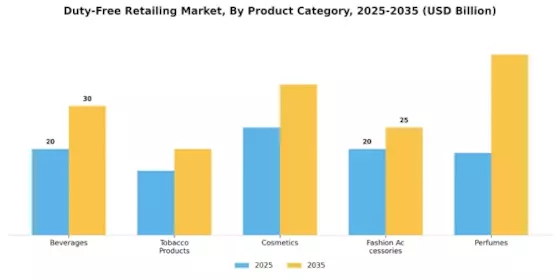
Beverages: Dominant vs. Tobacco Products: Emerging
Beverages continue to dominate the Duty-Free Retailing Market due to their broad appeal and variety, ranging from alcoholic beverages like wine and spirits to non-alcoholic options. This category benefits from travelers seeking to purchase premium options that are often unavailable in their home markets. Tobacco products, while following closely, represent an emerging segment with rapid growth, fueled by ongoing changes in traveler preferences and regulations. As consumers increasingly seek out distinctive or luxury tobacco brands, this segment is expected to see substantial expansion, positioning it as a key area for development in the duty-free landscape.
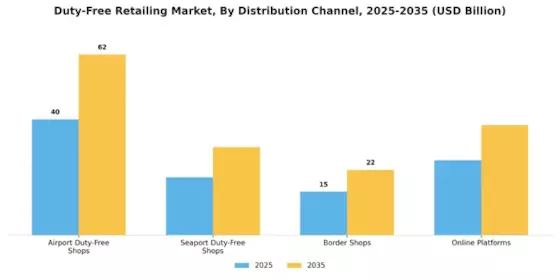
The distribution of the Duty-Free Retailing Market predominantly benefits from Airport Duty-Free Shops, which hold the largest share among distribution channels. This growth can be attributed to the high foot traffic at airports and a wide range of international travelers. Meanwhile, Seaport Duty-Free Shops and Border Shops also contribute to the market, although at reduced shares compared to airport outlets. The rising popularity of online platforms as a distribution channel marks a notable change in consumer preferences, leading to a more diversified shopping experience.
Airport Duty-Free Shops: Dominant vs. Online Platforms: Emerging
Airport Duty-Free Shops are established as the dominant distribution channel within the Duty-Free Retailing Market, offering an extensive range of products that cater to frequent international travelers. These shops are strategically located, ensuring maximum visibility and accessibility to passengers looking for luxury goods at competitive prices. Conversely, Online Platforms represent an emerging channel that is rapidly gaining traction, driven by technological advancements and shifting consumer behaviors favoring convenience. Online platforms allow consumers to access a variety of duty-free products from the comfort of their homes, attracting a broader audience and expanding market reach beyond physical borders.
In the Duty-Free Retailing Market, tourists represent the largest consumer demographic, driving significant sales volume. They often purchase a wide range of products, from luxury goods to everyday items, capitalizing on tax-free prices. Business travelers, while smaller in numbers, are increasingly contributing to sales due to their focused purchasing behavior during trips. They typically buy premium products like alcohol, perfumes, and electronics, seeking convenience and quality.
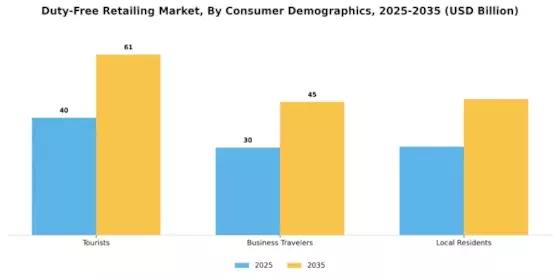
Tourists: Largest vs. Business Travelers: Fastest-Growing
Tourists are the dominant segment in duty-free retailing, characterized by their propensity to spend on luxury goods and gifts while on leisure trips. This demographic enjoys the experience of shopping in duty-free stores, often influenced by travel promotions and seasonal offers. In contrast, business travelers are the emerging segment, known for their high spending per capita on premium products. Their purchases are driven by the need for convenience and brand reputation, as they look for high-quality items that reflect their status. As travel policies evolve and international trips increase, both segments are expected to continue shaping the landscape of duty-free retailing.
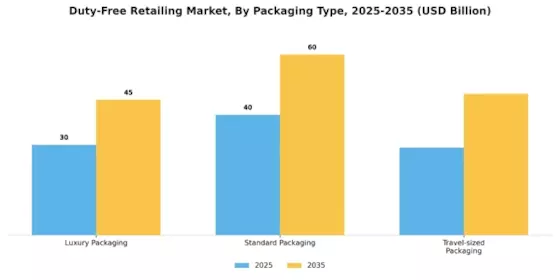
In the Duty-Free Retailing Market, packaging type plays a crucial role in influencing consumer preferences and purchasing decisions. Currently, luxury packaging holds the largest market share, driven by the desire for premium products that enhance the shopping experience. Meanwhile, standard packaging is gaining traction, primarily owing to its cost-effectiveness and ability to cater to a wider audience in duty-free stores. As consumers become increasingly discerning, the shift in packaging strategies is evident, with a notable preference for high-end appearances that signify quality.
Luxury Packaging (Dominant) vs. Travel-sized Packaging (Emerging)
Luxury packaging is currently the dominant force in the Duty-Free Retailing Market, appealing to consumers seeking high-quality products that reflect their status and provide a unique shopping experience. It often features elegant designs, sustainable materials, and meticulous craftsmanship that enhance the perceived value of products. In contrast, travel-sized packaging is an emerging segment that caters to the needs of travelers looking for convenience and portability. This segment is rapidly gaining popularity as more consumers seek to optimize their travel experiences with compact, easy-to-carry products. While luxury packaging continues to attract affluent buyers, travel-sized packaging offers versatility and accessibility, ensuring its growth in the competitive retail landscape.
Get more detailed insights about Duty Free Retailing Market Request Free Sample
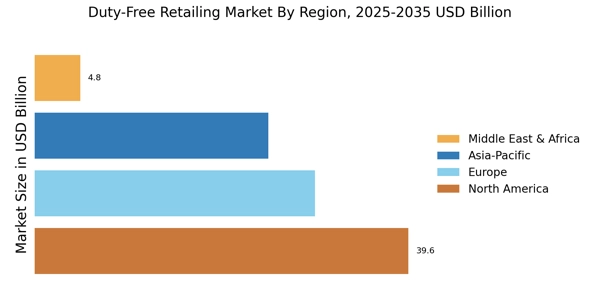
The Duty-Free Retailing Market is projected to achieve significant growth across various regions, reflecting diverse consumer behaviors and cross-border shopping habits. In 2023, North America leads the market with a valuation of 25.0 USD Billion, anticipated to grow to 36.0 USD Billion by 2032, showcasing its majority holding in the duty-free retail space.
Europe follows closely, valued at 27.0 USD Billion in 2023, with expectations to reach 38.0 USD Billion by 2032, emphasizing its importance owing to high tourism influx and strong purchasing power.The APAC region, valued at 22.0 USD Billion in 2023, is also expected to grow to 34.0 USD Billion by 2032, highlighting a significant opportunity driven by a growing middle class and increasing travel activities. South America and the MEA region are comparatively smaller, valued at 10.0 USD Billion and 7.69 USD Billion, respectively, in 2023.
Their growth rates are slower, with South America projected to reach 13.0 USD Billion and MEA 9.0 USD Billion by 2032. This regional segmentation reveals both the dominance of mature markets like North America and Europe and the emerging potential of APAC, while South America and MEA present opportunities for future growth within the Duty-Free Retailing Market industry.
Source Primary Research, Secondary Research, Market Research Future Database and Analyst Review
The Duty-Free Retailing Market has shown dynamic growth over the years, driven by increasing international travel, the expansion of travel retail channels, and a rising propensity for luxury and premium products among consumers. As travelers seek value and exclusive products during their journeys, duty-free retailing has emerged as a critical avenue for both retailers and brands, fostering competition among multiple players in the market. Key factors such as product assortment, pricing strategies, customer experience, and strategic partnerships significantly influence competitive dynamics. Understanding the strengths and strategies of leading players is crucial for stakeholders looking to navigate this evolving landscape successfully. Relay operates within the Duty-Free Retailing Market with a notable presence in travel retail, focusing on a broad spectrum of products, including tobacco, liquor, cosmetics, and confectionery. The strengths of Relay lie in its extensive network of stores located in airports and travel hubs, allowing it to capture a significant share of traveler spending. The brand is well-regarded for its customer-centric approach, which includes strategically curated product offerings that cater to the preferences of international travelers. Relay's effective merchandising strategies and promotional campaigns enhance its visibility and appeal, making it a strong competitor in the duty-free environment. Moreover, its commitment to service excellence and operational efficiency further solidifies its position within the market, enabling Relay to respond effectively to changing consumer demands and preferences.ICF Duty-Free has established itself as a prominent entity in the Duty-Free Retailing Market, offering a diverse range of products that appeal to an international clientele. The company has a robust presence in key travel locations, facilitating access to a wide variety of luxury goods, from high-end cosmetics to exclusive spirits. The strengths of ICF Duty-Free are deeply rooted in its ability to create unique shopping experiences for customers, blending a welcoming atmosphere with expertly curated product selections. The brand is recognized for its competitive pricing strategies that attract price-sensitive travelers who seek value without compromising on quality. Additionally, ICF Duty-Free actively engages in partnerships and collaborations with renowned brands to secure exclusive product lines, enhancing its market appeal. Its agility in adapting to market trends and consumer preferences enables ICF Duty-Free to maintain relevance and foster loyalty among travelers, positioning it favorably in the competitive landscape of duty-free retailing.



The Duty-Free Retailing Market has witnessed several noteworthy developments recently. Companies such as Dufry and DFS Group are exploring strategic partnerships to enhance their market presence amid rising consumer demand. Moreover, Travel Retail Norway is experiencing growth driven by increasing air travel and a focus on premium product offerings, while Heinemann continues to expand its footprint through innovative retail solutions. Relay and Aelia Duty-Free are also adapting to emerging trends by diversifying their product ranges to attract a broader customer base.
In the realm of mergers and acquisitions, notable activities include King Power International strengthening its competitive edge through potential collaborations, while Abu Dhabi Duty-Free is reportedly seeking new opportunities for growth. Duty-Free Americas and Flemingo International are similarly looking at expansions to capitalize on the resurgence in travel post-pandemic. Recent reports indicate a marked valuation increase across the sector, driven by rising disposable incomes and changing consumer preferences, which is positively impacting the overall market dynamics, propelling efforts by major players to innovate and invest in customer-centric initiatives.
This evolving environment signals a robust outlook for the Duty-Free Retailing Market going forward.
The Duty-Free Retailing Market is projected to grow at a 3.96% CAGR from 2025 to 2035, driven by increasing international travel, luxury consumer demand, and digital transformation.
New opportunities lie in:
By 2035, the market is expected to achieve robust growth, capitalizing on evolving consumer preferences and technological advancements.
| MARKET SIZE 2024 | 99.1(USD Billion) |
| MARKET SIZE 2025 | 103.03(USD Billion) |
| MARKET SIZE 2035 | 151.95(USD Billion) |
| COMPOUND ANNUAL GROWTH RATE (CAGR) | 3.96% (2025 - 2035) |
| REPORT COVERAGE | Revenue Forecast, Competitive Landscape, Growth Factors, and Trends |
| BASE YEAR | 2024 |
| Market Forecast Period | 2025 - 2035 |
| Historical Data | 2019 - 2024 |
| Market Forecast Units | USD Billion |
| Key Companies Profiled | Dufry AG (CH), Lotte Duty Free (KR), Heinemann Duty Free (DE), DFS Group (US), Shilla Duty Free (KR), King Power International (TH), Aelia Duty Free (FR), Duty Free Americas (US), China Duty Free Group (CN) |
| Segments Covered | Product Category, Distribution Channel, Consumer Demographics, Packaging Type, Regional |
| Key Market Opportunities | Integration of digital payment solutions enhances consumer experience in the Duty-Free Retailing Market. |
| Key Market Dynamics | Evolving consumer preferences and regulatory changes drive competitive dynamics in the Duty-Free Retailing Market. |
| Countries Covered | North America, Europe, APAC, South America, MEA |
The Duty-Free Retailing Market was valued at 99.1 USD Billion in 2024.
The market is projected to reach 151.95 USD Billion by 2035.
The expected CAGR for the Duty-Free Retailing Market during 2025 - 2035 is 3.96%.
Cosmetics is anticipated to generate the highest revenue, with projections ranging from 25.0 to 35.0 USD Billion.
Airport duty-free shops are projected to generate between 39.64 and 61.79 USD Billion, significantly higher than seaport shops, which are expected to generate 19.82 to 30.12 USD Billion.
Tourists are projected to contribute the most, with expected revenues between 39.64 and 61.0 USD Billion.
Key players include Dufry AG, Lotte Duty Free, Heinemann Duty Free, and DFS Group, among others.
Tobacco products are projected to generate revenues between 15.0 and 20.0 USD Billion.
Standard packaging is expected to generate the highest revenue, with projections between 40.0 and 60.0 USD Billion.
Online platforms are projected to generate revenues between 25.63 and 37.68 USD Billion, indicating a growing trend in digital retailing.


The secondary research process involved comprehensive analysis of regulatory databases, trade publications, aviation industry reports, tourism statistics, and authoritative retail organizations. Key sources included the International Air Transport Association (IATA), World Tourism Organization (UNWTO), Airports Council International (ACI), International Civil Aviation Organization (ICAO), US Customs and Border Protection (CBP), European Commission Taxation and Customs Union (TAXUD), World Customs Organization (WCO), International Trade Centre (ITC), OECD Tourism Statistics, Eurostat International Trade Database, UN Comtrade Database, national civil aviation authorities, airport authority financial reports, and duty-free industry associations including the Duty Free World Council (DFWC) and European Travel Retail Confederation (ETRC). These sources were used to collect passenger traffic data, duty-free allowance regulations, retail concession data, tourism flow analysis, and competitive landscape intelligence across beverages, tobacco products, cosmetics, fashion accessories, and perfumes categories distributed through airport duty-free shops, seaport duty-free shops, border shops, and online platforms.
Qualitative and quantitative insights were obtained by interviewing supply-side and demand-side stakeholders during the primary research process. From duty-free retail operators, airport retail concessionaires, and luxury brand suppliers, supply-side sources included CEOs, VPs of Retail Operations, concession directors, and procurement chiefs. The demand-side sources included category buyers from the beverages, cosmetics, and luxury products segments, airline executives, seaport terminal operators, border crossing administrators, and travel retail consultants. The primary research validated market segmentation, confirmed expansion pipeline timelines, and collected insights on passenger spending patterns, concession fee structures, digital integration strategies, and regional regulatory variations.
Primary Respondent Breakdown:
By Designation: C-level Primaries (28%), Director Level (32%), Others (40%)
By Region: North America (28%), Europe (32%), Asia-Pacific (35%), Rest of World (5%)
Global market valuation was derived through revenue mapping and passenger traffic analysis. The methodology included:
Identification of 50+ key duty-free operators across North America, Europe, Asia-Pacific, Middle East, and Latin America
Product mapping across beverages, tobacco products, cosmetics, fashion accessories, and perfumes categories
Analysis of reported and modeled annual revenues specific to duty-free retail portfolios
Coverage of operators representing 75-80% of global market share in 2024
Extrapolation using bottom-up (passenger volume × spend per passenger by corridor) and top-down (operator revenue validation) approaches to derive segment-specific valuations across airport duty-free shops, seaport duty-free shops, border shops, and online platforms
Kindly complete the form below to receive a free sample of this Report

“This is really good guys. Excellent work on a tight deadline. I will continue to use you going forward and recommend you to others. Nice job”


“Thanks. It’s been a pleasure working with you, please use me as reference with any other Intel employees.”


“Thanks for sending the report it gives us a good global view of the Betaïne market.”


“Thank you, this will be very helpful for OQS.”


“We found the report very insightful! we found your research firm very helpful. I'm sending this email to secure our future business.”


“I am very pleased with how market segments have been defined in a relevant way for my purposes (such as "Portable Freezers & refrigerators" and "last-mile"). In general the report is well structured. Thanks very much for your efforts.”


“I have been reading the first document or the study, ,the Global HVAC and FP market report 2021 till 2026. Must say, good info! I have not gone in depth at all parts, but got a good indication of the data inside!”


“We got the report in time, we really thank you for your support in this process. I also thank to all of your team as they did a great job.”


“The Automotive 48V ECU Components Procurement Intelligence Study” was a complex project, but the Market Research Future (MRFR) team handled it with quality, agility, and customer-centricity. They delivered all requested data on time and within the agreed scope. The team, including Shubhendra Anand and Rahul Gotadki, was always readily available to clarify questions and swiftly implement necessary adjustments, driving the project to a successful conclusion within a very demanding timeframe.
I would also like to specifically commend Akshay Agarwal for his responsiveness and support at every stage—from our initial inquiry on May 6th through to final delivery on June 18th. His dedication made the entire process seamless.”


.png?v=1778851992)
