×
Request Free Sample ×

Kindly complete the form below to receive a free sample of this Report

* Please use a valid business email

Leading companies partner with us for data-driven Insights

clients tt-cursor
Hero Background

Dye Stuff Market

ID: MRFR/CnM/2344-HCR
140 Pages
Chitranshi Jaiswal
October 2025

Dyestuff Market Research Report Information by Form (Natural and Synthetic), Composition (Organic and Inorganic), Process (Disperse Dye, Direct Dye, Reactive Dye, Vat Dye, Acid Dye, and Others), Types (Azo Dyes, Cyanine Dyes, Nitroso Dyes, Anthraquinone Dyes, and Others), Application (Textile, Leather, Paper, Wood, and Others), Region (North America, Asia-Pacific, Europe, Latin America, and Middle East & Africa) - Forecast till 2035

Share:
Download PDF ×

We do not share your information with anyone. However, we may send you emails based on your report interest from time to time. You may contact us at any time to opt-out.

Dye Stuff Market Infographic
Purchase Options

Dye Stuff Market Summary

As per MRFR analysis, the Dye Stuff Market Size was estimated at 14.48 USD Million in 2024. The Dye Stuff industry is projected to grow from 16.92 in 2025 to 80.64 by 2035, exhibiting a compound annual growth rate (CAGR) of 16.9 during the forecast period 2025 - 2035.

Key Market Trends & Highlights

The Dye Stuff Market is currently experiencing a transformative shift towards sustainability and technological innovation.

  • North America remains the largest market for dye stuff, driven by robust industrial applications and consumer demand.
  • Asia-Pacific is recognized as the fastest-growing region, fueled by increasing manufacturing capabilities and urbanization.
  • The textile segment continues to dominate the market, while the leather segment is emerging rapidly due to rising fashion trends.
  • Sustainability initiatives and consumer preferences for customization are key drivers influencing market dynamics.

Market Size & Forecast

2024 Market Size 14.48 (USD Million)
2035 Market Size 80.64 (USD Million)
CAGR (2025 - 2035) 16.9%

Major Players

BASF SE (DE), Huntsman Corporation (US), Clariant AG (CH), Dystar GmbH (DE), Kraton Corporation (US), Lanxess AG (DE), Ferro Corporation (US), Eastman Chemical Company (US), Troy Corporation (US)

Dye Stuff Market Trends

The Dye Stuff Market is currently experiencing a dynamic evolution, driven by various factors including technological advancements and shifting consumer preferences. The increasing demand for sustainable and eco-friendly dyeing processes appears to be reshaping production methodologies. Manufacturers are likely to invest in innovative solutions that minimize environmental impact while maintaining product quality. Furthermore, the rise of the fashion and textile industries, alongside the growing popularity of natural dyes, suggests a potential shift in market dynamics. As consumers become more conscious of their choices, the emphasis on organic and biodegradable options may lead to a redefinition of traditional dyeing practices. In addition, The Dye Stuff. Companies may need to adapt to stricter environmental regulations, which could drive the development of greener alternatives. This transition may not only enhance brand reputation but also align with the values of a more environmentally aware consumer base. Overall, the Dye Stuff Market appears poised for transformation, with opportunities for growth in sustainable practices and innovative technologies that cater to evolving market demands.

Sustainability Focus

The emphasis on eco-friendly practices is becoming increasingly prevalent in the Dye Stuff Market. Companies are exploring sustainable alternatives to traditional dyes, which may lead to a rise in the use of natural and organic materials. This trend reflects a broader societal shift towards environmental responsibility.

Technological Advancements

Innovations in dyeing technology are likely to enhance efficiency and reduce waste in the Dye Stuff Market. New methods, such as digital printing and waterless dyeing techniques, could revolutionize production processes, offering manufacturers the ability to meet consumer demands more effectively.

Consumer Awareness

As consumers become more informed about the environmental impact of their choices, there is a growing demand for transparency in the Dye Stuff Market. Brands that prioritize ethical sourcing and sustainable practices may gain a competitive edge, appealing to a conscientious customer base.

Dye Stuff Market Drivers

Expansion of Textile Industry

The Global Dyestuff Market Industry is significantly influenced by the expansion of the textile sector, which remains one of the largest consumers of dyes. The increasing production of garments, driven by rising disposable incomes and changing fashion trends, propels the demand for various dyestuffs. As the textile industry continues to evolve, the need for vibrant and diverse color palettes becomes paramount. This growth trajectory is expected to contribute to the market's valuation, with projections indicating a rise to 747.5 USD Million by 2035. The synergy between textile innovation and dyestuff development is likely to foster a robust market environment.

Regulatory Support for Chemical Safety

The Global Dyestuff Market Industry is positively impacted by regulatory frameworks that promote chemical safety and environmental protection. Governments worldwide are increasingly implementing stringent regulations regarding the use of hazardous substances in dye production. This regulatory support encourages manufacturers to develop safer alternatives and invest in research and development. Compliance with these regulations not only enhances product safety but also boosts consumer confidence in dyed products. As a result, the industry is likely to witness a shift towards safer, more sustainable dye options, further driving market growth.

Rising Demand for Sustainable Products

The Global Dyestuff Market Industry is experiencing a notable shift towards sustainable and eco-friendly dyes. As consumers become increasingly aware of environmental issues, manufacturers are compelled to innovate and adopt greener practices. This trend is reflected in the growing preference for natural dyes derived from plants and minerals, which are perceived as less harmful compared to synthetic alternatives. The demand for sustainable products is projected to drive the market's growth, with the industry expected to reach 317.3 USD Million in 2024. This shift not only aligns with consumer preferences but also encourages companies to invest in sustainable technologies.

Technological Advancements in Dye Production

Technological advancements play a crucial role in shaping the Global Dyestuff Market Industry. Innovations in dye manufacturing processes, such as the development of high-performance dyes and improved application techniques, enhance the efficiency and effectiveness of dye usage. These advancements not only reduce waste but also improve colorfastness and overall product quality. As companies adopt cutting-edge technologies, the market is poised for growth, with a projected compound annual growth rate of 8.1% from 2025 to 2035. This technological evolution is likely to attract investments and drive competitiveness within the industry.

Growth in the Automotive and Construction Sectors

The Global Dyestuff Market Industry is also benefiting from the growth in the automotive and construction sectors, which utilize dyes for various applications. In automotive manufacturing, dyes are essential for achieving desired colors in vehicle interiors and exteriors. Similarly, the construction industry employs dyes in materials such as concrete and plastics to enhance aesthetic appeal. As these sectors expand, the demand for specialized dyestuffs is expected to rise, contributing to the overall market growth. This diversification of applications underscores the versatility of dyestuffs and their integral role in various industries.

Market Segment Insights

By Application: Textile (Largest) vs. Leather (Fastest-Growing)

In the Dye Stuff Market, the Textile application represents the largest share as it continues to be the primary segment driving demand. It is essential for coloring and enhancing various textiles, reflecting consumer preferences and fashion trends. The increasing popularity of natural and synthetic fabrics is boosting the use of diverse dyeing techniques and products. As a result, textile dyeing remains pivotal to the overall market dynamics. In contrast, the Leather application segment is experiencing rapid growth, fueled by rising demand for sustainable and eco-friendly leather products. This shift towards environmentally responsible consumption is encouraging innovations in dyeing processes, providing significant opportunities for manufacturers to develop unique formulations and products.

Textile (Dominant) vs. Leather (Emerging)

The Textile segment, as the dominant force in the Dye Stuff Market, encompasses a wide range of applications including garments, upholstery, and industrial fabrics. Its strength lies in the diverse techniques applied for dyeing, such as printing and coloring, which cater to the changing aesthetics of consumers. On the other hand, the Leather segment is emerging, driven by trends focusing on alternative leathers and sustainability. Manufacturers are increasingly adopting environmentally friendly dyeing solutions, which not only cater to eco-conscious brands but also enhance the appeal of leather goods. As both segments develop, collaboration between material innovation and consumer demands will play a critical role in shaping their futures.

By End Use: Apparel (Largest) vs. Home Furnishings (Fastest-Growing)

The dye stuff market segmented by end use reveals that apparel dominates the market, driven by the increasing demand for colorful and diverse clothing options. A significant share of dye products is funneled into the apparel sector, as fashion trends continue to evolve, leading to a robust market presence in this category. In contrast, home furnishings represent the fastest-growing segment, reflecting shifting consumer preferences towards vibrant home decor and textiles.

Apparel: Dominant vs. Home Furnishings: Emerging

In the dye stuff market, the apparel segment stands as a dominant force, characterized by its broad application in clothing production, where vibrant colors and dye fastness are paramount. This segment benefits from ongoing fashion trends that encourage frequent updates in color palettes. On the other hand, home furnishings emerge as a quickly expanding segment, fueled by the surge in demand for colorful upholstery and decorative textiles. This growth is supported by interior design trends that advocate for expressive living spaces, leading to increased dye usage in furniture and decor items.

By Type: Synthetic Dyes (Largest) vs. Natural Dyes (Fastest-Growing)

In the Dye Stuff Market, the distribution of market share favors synthetic dyes, which dominate the landscape due to their versatility, cost-effectiveness, and vibrant color options. As industries increasingly rely on synthetic options for fabrics, plastics, and food, this segment maintains a significant share. Meanwhile, natural dyes, though smaller in comparison, are gaining traction as consumer preferences shift towards eco-friendly products, driving an increase in market presence and share. The growth trends in the Dye Stuff Market are heavily influenced by the rising demand for sustainable and organic products. Natural dyes are witnessing the fastest growth due to a growing awareness of environmental issues and consumer inclination towards sustainable practices. This is coupled with the increasing adoption of natural dyes in various applications, including textiles and cosmetics, making them a priority for many manufacturers aiming to meet the evolving market demands.

Synthetic Dyes (Dominant) vs. Natural Dyes (Emerging)

Synthetic dyes have established themselves as the dominant force in the Dye Stuff Market due to their wide range of applications and cost efficiency. They offer a vast palette of colors and are known for their adaptability to various materials. On the other hand, natural dyes are emerging as a significant segment fueled by the green movement and consumer demand for environmentally friendly products. While synthetic dyes provide durability and vibrant hues, natural dyes present benefits like biodegradability and lower environmental impact. The rising interest in artisanal and handcrafted goods is also propelling the popularity of natural dyes, positioning them as a valuable alternative in a market historically led by their synthetic counterparts.

By Form: Powder (Largest) vs. Liquid (Fastest-Growing)

In the Dye Stuff Market, the distribution among segment values is notably diverse, with powder forms leading the way in terms of market share. The powder segment benefits from widespread acceptance and versatility in various applications, making it the preferred choice in many industries. In contrast, liquid dyes are experiencing rapid growth thanks to their convenience of use and the increasing technological innovations aimed at enhancing their performance across different textile applications.

Powder (Dominant) vs. Liquid (Emerging)

The powder dye segment is characterized by its longstanding dominance in the Dye Stuff Market. Its robust performance is attributed to its stability and adaptability across numerous uses, particularly in textiles and industrial processes. On the other hand, liquid dyes are emerging as a compelling alternative, capturing the interest of manufacturers looking for efficiency and ease of application. These products are ideal for processes requiring quick color changes and precise mixing, making them increasingly sought after in fashion and design-driven industries. As a result, while powder remains a stalwart choice, the liquid segment's innovative developments are positioning it as a vital player in the market.

By Color: Red (Largest) vs. Blue (Fastest-Growing)

In the Dye Stuff Market, the color segment showcases a diverse distribution, with red holding a significant share as the dominant color choice across various applications, including textiles and cosmetics. Blue follows closely, marking its presence as a trendy option, particularly in the fashion industry. Green, yellow, and black, while essential, comprise relatively smaller shares, catering to niche markets and specific consumer preferences. This dispersion illustrates the varying consumer demands and preferences for colors in different industries.

Dye Colors: Red (Dominant) vs. Blue (Emerging)

In the current Dye Stuff Market landscape, red is recognized as the dominant color due to its wide-ranging applications and strong consumer affinity. Its presence is felt predominantly in textiles, printing, and food industries, driven by the psychological impact of red in marketing. On the other hand, blue emerges as a rapidly growing segment, especially appealing to younger demographics used to its calming effects and versatility. The increasing trend of personalized and sustainable products contributes to the rising demand for blue dyes, positioning them as an emerging favorite. As color preferences evolve, both segments are likely to play pivotal roles in shaping market trends.

Get more detailed insights about Dye Stuff Market

Regional Insights

North America : Established Market with Innovation

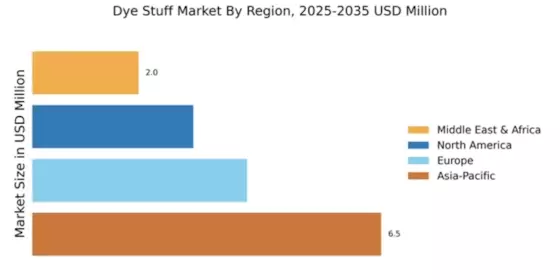
The North American dye stuff market is projected to reach $3.62 billion by December 2025, driven by increasing demand in textiles, automotive, and food industries. Regulatory support for sustainable practices and eco-friendly dyes is also a significant catalyst for growth. The region's focus on innovation and technology adoption further enhances market dynamics, positioning it as a leader in high-quality dye production. The United States and Canada are the primary contributors to this market, with key players like Huntsman Corporation and Eastman Chemical Company leading the charge. The competitive landscape is characterized by a mix of established companies and emerging players, all striving to meet the growing demand for sustainable and high-performance dye solutions. The presence of advanced manufacturing facilities and R&D centers bolsters the region's competitive edge.

Europe : Sustainable Practices Driving Growth

Europe's dye stuff market is expected to reach €4.34 billion by December 2025, fueled by stringent regulations promoting sustainability and eco-friendly products. The region's commitment to reducing environmental impact is driving demand for natural dyes and innovative solutions. Additionally, the growing textile and automotive sectors are significant contributors to market growth, reflecting a shift towards sustainable practices in manufacturing. Germany, France, and Italy are the leading countries in this market, with major players like BASF SE and Clariant AG at the forefront. The competitive landscape is marked by a strong emphasis on research and development, enabling companies to innovate and meet evolving consumer preferences. The presence of regulatory bodies ensures compliance with environmental standards, further enhancing market stability.

Asia-Pacific : Emerging Powerhouse in Dye Production

Asia-Pacific is the largest dye stuff market, projected to reach $5.8 billion by December 2025. The region's rapid industrialization, coupled with a growing population and increasing disposable income, drives demand across various sectors, including textiles and packaging. Regulatory frameworks are evolving to support sustainable practices, further enhancing market growth. The region's diverse manufacturing capabilities also contribute to its dominant market position. China, India, and Japan are the leading countries in this market, with significant contributions from companies like Dystar GmbH and Lanxess AG. The competitive landscape is characterized by a mix of local and international players, all vying for market share. The presence of robust supply chains and a focus on innovation position Asia-Pacific as a key player in The Dye Stuff.

Middle East and Africa : Emerging Market with Potential

The Middle East and Africa dye stuff market is projected to reach $0.72 billion by December 2025, driven by increasing industrial activities and a growing demand for textiles. The region's focus on diversifying its economy and investing in manufacturing capabilities is expected to catalyze market growth. Additionally, regulatory initiatives aimed at promoting sustainable practices are beginning to take shape, which could further enhance market dynamics. Countries like South Africa and the UAE are emerging as key players in this market, with local manufacturers and international companies exploring opportunities. The competitive landscape is still developing, with a mix of established firms and new entrants. As the region continues to invest in infrastructure and technology, the dye stuff market is poised for significant growth in the coming years.

Key Players and Competitive Insights

The Dye Stuff Market is currently characterized by a dynamic competitive landscape, driven by innovation, sustainability, and strategic partnerships. Key players such as BASF SE (DE), Huntsman Corporation (US), and Clariant AG (CH) are actively shaping the market through their distinct operational focuses. BASF SE (DE) emphasizes innovation in sustainable dye solutions, aiming to reduce environmental impact while enhancing product performance. Huntsman Corporation (US) is strategically expanding its portfolio through acquisitions, thereby strengthening its market position and diversifying its offerings. Clariant AG (CH) focuses on digital transformation, leveraging advanced technologies to optimize production processes and improve customer engagement. Collectively, these strategies contribute to a competitive environment that is increasingly oriented towards sustainability and technological advancement.

In terms of business tactics, companies are localizing manufacturing to enhance supply chain efficiency and reduce lead times. The market structure appears moderately fragmented, with several key players exerting significant influence. This fragmentation allows for niche players to thrive, while larger corporations leverage their scale to optimize operations and innovate. The collective influence of these key players fosters a competitive atmosphere where agility and responsiveness to market demands are paramount.

In November 2025, BASF SE (DE) announced the launch of a new line of biodegradable dyes aimed at the textile industry. This strategic move underscores the company's commitment to sustainability and positions it favorably in a market increasingly driven by eco-conscious consumer preferences. The introduction of biodegradable options not only enhances BASF's product portfolio but also aligns with global trends towards environmentally friendly manufacturing practices.

In October 2025, Huntsman Corporation (US) completed the acquisition of a specialty chemicals firm, which is expected to bolster its dye production capabilities. This acquisition is strategically significant as it allows Huntsman to integrate new technologies and expand its market reach, thereby enhancing its competitive edge. The move reflects a broader trend in the industry where consolidation is seen as a means to achieve greater operational efficiency and innovation.

In September 2025, Clariant AG (CH) launched a digital platform designed to streamline customer interactions and improve service delivery. This initiative is indicative of the growing importance of digitalization in the Dye Stuff Market, as companies seek to enhance customer experience and operational efficiency. By investing in digital tools, Clariant positions itself as a forward-thinking player capable of adapting to the evolving needs of its clientele.

As of December 2025, the Dye Stuff Market is witnessing trends that emphasize digitalization, sustainability, and the integration of AI technologies. Strategic alliances are increasingly shaping the competitive landscape, enabling companies to pool resources and expertise to drive innovation. The shift from price-based competition to a focus on technological advancement and supply chain reliability is evident. Moving forward, competitive differentiation will likely hinge on the ability to innovate and respond to sustainability demands, as companies strive to meet the expectations of a more environmentally conscious market.

Key Companies in the Dye Stuff Market market include

Industry Developments

    • In the present report, the Synthetic Corporation (South Korea), Orion Colorchem Industries (India), SETAŞ (Turkey), and other top key players of the Asian Pacific market are developing their research in providing better quality to their customers.

Future Outlook

Dye Stuff Market Future Outlook

The Dye Stuff Market is projected to grow at a 16.9% CAGR from 2024 to 2035, driven by increasing demand for sustainable and innovative dye solutions.

New opportunities lie in:

  • Expansion into bio-based dye production facilities
  • Development of smart dyeing technologies for real-time color adjustments
  • Strategic partnerships with eco-friendly textile manufacturers

By 2035, the Dye Stuff Market is expected to achieve substantial growth, reflecting evolving consumer preferences and technological advancements.

Market Segmentation

Dye Stuff Market Form Outlook

  • Powder
  • Liquid
  • Granular
  • Paste
  • Solid

Dye Stuff Market Type Outlook

  • Natural Dyes
  • Synthetic Dyes
  • Reactive Dyes
  • Acid Dyes
  • Direct Dyes

Dye Stuff Market Color Outlook

  • Red
  • Blue
  • Green
  • Yellow
  • Black

Dye Stuff Market End Use Outlook

  • Apparel
  • Home Furnishings
  • Automotive
  • Industrial
  • Cosmetics

Dye Stuff Market Application Outlook

  • Textile
  • Leather
  • Paper
  • Plastics
  • Food

Report Scope

MARKET SIZE 202414.48(USD Million)
MARKET SIZE 202516.92(USD Million)
MARKET SIZE 203580.64(USD Million)
COMPOUND ANNUAL GROWTH RATE (CAGR)16.9% (2024 - 2035)
REPORT COVERAGERevenue Forecast, Competitive Landscape, Growth Factors, and Trends
BASE YEAR2024
Market Forecast Period2025 - 2035
Historical Data2019 - 2024
Market Forecast UnitsUSD Million
Key Companies ProfiledBASF SE (DE), Huntsman Corporation (US), Clariant AG (CH), Dystar GmbH (DE), Kraton Corporation (US), Lanxess AG (DE), Ferro Corporation (US), Eastman Chemical Company (US), Troy Corporation (US)
Segments CoveredApplication, End Use, Type, Form, Color
Key Market OpportunitiesAdoption of sustainable dyeing technologies driven by consumer demand for eco-friendly products in the Dye Stuff Market.
Key Market DynamicsRising demand for sustainable dyes drives innovation and regulatory shifts in the dye stuff market.
Countries CoveredNorth America, Europe, APAC, South America, MEA

Market Highlights

Author
Chitranshi Jaiswal
Research Analyst Level I

In her 3 years of experience in the market research field, she has handled critical cross-domain projects. She has an in-depth knowledge of market estimation & analysis, problem-solving, primary as well as secondary research, and team management.She holds an engineering degree and is an MBA professional from a well-known university, capable of evaluating the market and competitive conditions. An exceptional strategist with excellent communication skills and a passion for delivering cutting-edge & practical insights for the market. Proficient in multi-tasking, and can successfully deal with competing demands, while maintaining complete confidentiality. Generated business through active client and project development, networking, and high-quality responses. Her knowledge and skills have helped in making solid business decisions, securing funding from investors, and avoiding business failures.

Leave a Comment

FAQs

What is the valuation of the dyestuff market?

The global dyestuff market is expected to reach a valuation of USD 306.8 Million by 2022.

What is the expected CAGR of the dyestuff market?

The global dyestuff market is expected to exhibit a strong 8.20% CAGR over the forecast period from 2023-2035.

What are the major applications of dyestuff?

Leading application segments of the dyestuff market include textiles, leather, wood, paper, and others.

Which region is predicted to dominate the global Dyestuff Market for the forecast period?

The Asia Pacific region is predicted to dominate the global Dyestuff Market for the forecast period.

What are the leading players in the dyestuff market?

Leading players in the dyestuff market include Lanxess, Clariant, BASF, Synthetic Corporation, Synthesia, Arkema, and Huntsman, among others.

What are the important segments operating the global Dyestuff Market?

The Dyestuff Market is operating with various segments like forms, applications, types, processes, and composition.

Download Free Sample

Kindly complete the form below to receive a free sample of this Report

Compare Licence

×
Features License Type
Single User Multiuser License Enterprise User
Price $4,950 $5,950 $7,250
Maximum User Access Limit 1 User Upto 10 Users Unrestricted Access Throughout the Organization
Free Customization
Direct Access to Analyst
Deliverable Format
Platform Access
Discount on Next Purchase 10% 15% 15%
Printable Versions