×
Request Free Sample ×

Kindly complete the form below to receive a free sample of this Report

* Please use a valid business email

Leading companies partner with us for data-driven Insights

clients tt-cursor
Hero Background

Edible Algae Market

ID: MRFR/FnB/30202-HCR
128 Pages
Snehal Singh
October 2025

Edible Algae Market Research Report By Algae Type (Spirulina, Chlorella, Dunaliella, Klamath Blue Green Algae, Nannochloropsis), By Form of Algae Product (Powder, Tablet/Capsule, Liquid Extract, Flakes, Granules), By End Use Industry (Food and Beverage, Nutraceuticals, Cosmetics, Animal Feed, Biofuels), By Distribution Channel (Direct Sales, Online Retail, Health Food Stores, Supermarkets, Specialty Stores), By Consumer Type (Health-conscious Consumers, Athletes and Fitness Enthusiasts, Vegans and Vegetarians, Parents of Young Children, Elde... read more

Share:
Download PDF ×

We do not share your information with anyone. However, we may send you emails based on your report interest from time to time. You may contact us at any time to opt-out.

Edible Algae Market  Infographic
Purchase Options

Edible Algae Market Summary

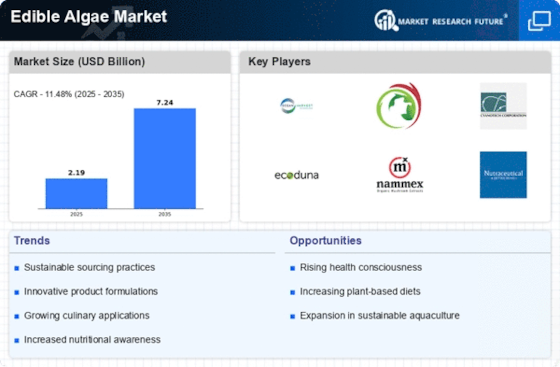
As per MRFR analysis, the Edible Algae Market Size was estimated at 2.189 USD Billion in 2024. The Edible Algae industry is projected to grow from 2.44 in 2025 to 7.236 by 2035, exhibiting a compound annual growth rate (CAGR) of 11.48 during the forecast period 2025 - 2035.

Key Market Trends & Highlights

The Edible Algae Market is experiencing robust growth driven by health trends and sustainability.

  • Health consciousness is significantly driving demand for edible algae, particularly in North America.
  • Innovation in product development is fostering new applications, especially in the Asia-Pacific region.
  • Spirulina remains the largest segment, while Chlorella is emerging as the fastest-growing segment in the market.
  • Nutritional benefits and rising vegan trends are key drivers propelling the market forward.

Market Size & Forecast

2024 Market Size 2.189 (USD Billion)
2035 Market Size 7.236 (USD Billion)
CAGR (2025 - 2035) 11.48%

Major Players

Ocean Harvest Technology (IE), Algaia (FR), Cyanotech Corporation (US), Ecoduna (AT), Nammex (CA), Nutraceutical Corporation (US), Algatechnologies (IL), Seakura (IL), Spirulina Pacifica (US), Earthrise Nutritionals (US)

Edible Algae Market Trends

The Edible Algae Market is currently experiencing a notable transformation, driven by increasing consumer awareness regarding health and nutrition. This shift is largely attributed to the growing recognition of the nutritional benefits associated with various algae species, which are rich in vitamins, minerals, and essential fatty acids. As a result, there is a rising demand for algae-based products in food and beverage sectors, as well as in dietary supplements. Furthermore, the trend towards plant-based diets appears to be influencing the market positively, as consumers seek sustainable and environmentally friendly food sources. In addition to health benefits, the Edible Algae Market is also witnessing innovations in product development. Companies are exploring new applications for algae, including snacks, beverages, and functional foods. This diversification is likely to attract a broader consumer base, including those who may not have previously considered algae as a food source. Moreover, the increasing focus on sustainability and eco-friendly practices is prompting manufacturers to invest in algae cultivation, which could further enhance the market's growth potential. Overall, the Edible Algae Market seems poised for continued expansion as it adapts to evolving consumer preferences and environmental considerations.

Health Consciousness Driving Demand

The growing awareness of health and wellness among consumers is significantly influencing the Edible Algae Market. Individuals are increasingly seeking nutritious food options, and algae are recognized for their high protein content and essential nutrients. This trend is likely to continue as more people prioritize their dietary choices.

Innovation in Product Development

The Edible Algae Market is witnessing a surge in innovative product offerings. Companies are experimenting with various algae types to create new food products, including snacks and beverages. This diversification may attract a wider audience, enhancing market appeal.

Sustainability and Eco-Friendly Practices

There is a notable emphasis on sustainability within the Edible Algae Market. As consumers become more environmentally conscious, the demand for sustainable food sources is rising. Algae cultivation is viewed as a viable solution, potentially leading to increased investment and growth in this sector.

Edible Algae Market Drivers

Rising Vegan and Vegetarian Trends

The Edible Algae Market is benefiting from the increasing popularity of vegan and vegetarian diets. As more consumers adopt plant-based lifestyles, the demand for alternative protein sources has intensified. Edible algae, particularly spirulina and seaweeds, are being recognized as viable protein sources that align with these dietary preferences. Market Research Future indicates that the plant-based food market is expected to grow significantly, with algae products playing a crucial role in this expansion. This shift towards plant-based eating habits is likely to bolster the Edible Algae Market, as consumers seek nutritious and sustainable food options.

Nutritional Benefits of Edible Algae

The Edible Algae Market is experiencing a surge in demand due to the recognized nutritional benefits of algae. Rich in vitamins, minerals, and essential fatty acids, edible algae are increasingly viewed as a superfood. For instance, spirulina and chlorella are known for their high protein content and antioxidant properties. As consumers become more health-conscious, the incorporation of these algae into diets is likely to rise. Market data indicates that the global market for spirulina alone is projected to reach approximately 1.5 billion USD by 2025. This trend suggests that the Edible Algae Market is poised for substantial growth as more individuals seek natural sources of nutrition.

Sustainability and Environmental Awareness

The Edible Algae Market is gaining traction due to heightened awareness of sustainability and environmental issues. Algae cultivation is considered environmentally friendly, requiring less land and water compared to traditional crops. Furthermore, algae can absorb carbon dioxide, contributing to climate change mitigation. As consumers become more environmentally conscious, they are increasingly inclined to choose products that align with their values. This trend is reflected in the growing market for sustainable food products, with edible algae positioned as a key player. The Edible Algae Market is likely to thrive as sustainability becomes a priority for consumers.

Government Support and Regulatory Frameworks

The Edible Algae Market is likely to benefit from increasing government support and favorable regulatory frameworks. Many governments are recognizing the potential of algae as a sustainable food source and are implementing policies to promote its cultivation and consumption. This support may include funding for research and development, as well as initiatives to educate consumers about the benefits of edible algae. As regulatory barriers are lowered, the Edible Algae Market is expected to expand, providing opportunities for new entrants and established companies alike. This supportive environment could significantly enhance the growth trajectory of the industry.

Innovative Applications in Food and Beverage

The Edible Algae Market is witnessing innovation in product development, particularly in the food and beverage sector. Companies are exploring new ways to incorporate algae into various products, from snacks to beverages. For example, algae-based smoothies and energy bars are gaining popularity among health-conscious consumers. This innovation is not only expanding the product range but also attracting a broader audience. Market data suggests that the demand for algae-based food products is on the rise, with projections indicating a compound annual growth rate of over 10% in the coming years. This trend indicates a promising future for the Edible Algae Market.


Market Segment Insights

By Type: Spirulina (Largest) vs. Chlorella (Fastest-Growing)

In the Edible Algae Market, Spirulina holds the largest share due to its high nutritional value and widespread use in dietary supplements. Chlorella follows closely, gaining traction among health-conscious consumers. The distribution of market share reveals a strong preference for these two types among various consumer demographics, highlighting their established presence in the industry. Other types, such as Dunaliella, Klamath Blue Green Algae, and Nannochloropsis, are emerging but currently hold smaller portions of the market. Despite their niche status, they are significant players in specific applications such as cosmetics and aquaculture. The growth trends within the Edible Algae Market are driven by increasing awareness of health benefits associated with algae consumption. Spirulina continues to thrive due to various endorsements and a strong consumer base. On the other hand, Chlorella is rapidly expanding its market presence, influenced by rising demand for plant-based nutrition and sustainability. Additionally, innovative extraction methods and product formulations are enabling lesser-known varieties like Nannochloropsis and Dunaliella to find their audience, thereby diversifying the overall market landscape.

Spirulina (Dominant) vs. Dunaliella (Emerging)

Spirulina is recognized as the dominant type in the Edible Algae Market, renowned for its rich concentration of protein, essential amino acids, vitamins, and minerals. Its versatility allows it to be incorporated into numerous products, from dietary supplements to functional foods. The strong brand recognition and extensive research supporting its health benefits solidify Spirulina's market position. In contrast, Dunaliella, while still considered an emerging type, is gaining attention for its unique nutrient composition, particularly its high beta-carotene content. This pigment not only provides coloration but also serves as a powerful antioxidant. As consumer interest in natural and sustainable food sources grows, Dunaliella's applications in cosmetics and fortified foods are expected to rise, offering new opportunities for market penetration.

By Form of Algae Product: Powder (Largest) vs. Liquid Extract (Fastest-Growing)

The Edible Algae Market showcases a diverse range of product forms, among which powders dominate due to their versatility and ease of incorporation into various food products. Tablets and capsules also find considerable popularity, especially for consumers seeking convenient supplementation forms. Liquid extracts, while smaller in market share, are rapidly gaining attention for their effectiveness and ease of use. Flakes and granules, on the other hand, hold niche segments with specific culinary applications, particularly in Asian cuisines.

Powder (Dominant) vs. Liquid Extract (Emerging)

Powdered algae products are the reigning category in the Edible Algae Market, celebrated for their versatility in food applications and nutritional benefits. They serve as key ingredients in smoothies, snack bars, and health supplements. This form appeals particularly to health-conscious consumers and food manufacturers seeking innovative ways to enhance their products. Liquid extracts, while emerging, are carving a significant space in the market by appealing to those seeking concentrated nutrients without the need for cooking. Their liquid nature offers a convenient delivery method in smoothies, beverages, and sauces, attracting a younger demographic interested in quick, effective dietary options.

By End Use Industry: Food and Beverage (Largest) vs. Nutraceuticals (Fastest-Growing)

The Edible Algae Market showcases a diverse application landscape, with the Food and Beverage segment commanding a dominant market share. As consumers increasingly turn towards health-conscious eating choices, this segment reflects a substantial portion of overall market activities. Following closely are Nutraceuticals, which are carving out an important niche, capturing the attention of health enthusiasts and supplement users alike. Other segments such as Cosmetics, Animal Feed, and Biofuels, while important, remain smaller in comparison to the leading segments.

Food and Beverage: Dominant vs. Nutraceuticals: Emerging

The Food and Beverage segment of the Edible Algae Market remains the dominant force due to its broad appeal and integration into various products, including snacks, beverages, and health foods. Rich in nutrients, edible algae is increasingly featured in recipes aiming to enhance taste and nutritional value. On the other hand, Nutraceuticals stands as an emerging leader driven by the rising consumer awareness surrounding health benefits linked to algae consumption, such as antioxidants and omega-3 fatty acids. This segment is expected to expand rapidly as companies develop innovative products and supplement formulations. Notably, a synergy between these two segments may foster collaborative growth opportunities in healthy eating trends and dietary supplements.

By Distribution Channel: Supermarkets (Largest) vs. Online Retail (Fastest-Growing)

In the Edible Algae Market, Supermarkets hold a significant share as the primary distribution channel, driven by their extensive reach and the convenience they offer consumers. This channel benefits from established supply chains and the consumer preference for one-stop shopping experiences. In contrast, Online Retail is rapidly gaining traction, propelled by the increasing popularity of e-commerce and the pandemic-driven shift towards online shopping, appealing especially to tech-savvy and health-conscious customers.

Supermarkets (Dominant) vs. Online Retail (Emerging)

Supermarkets are the dominant distribution channel in the Edible Algae Market, leveraging their widespread presence and consumer trust to offer a diverse range of edible algae products. This channel not only showcases established brands but also promotes innovative algae products, enhancing consumer awareness and acceptance. On the other hand, Online Retail emerges as a significant player in this market, catering to a growing demographic that prefers shopping from home. This channel provides convenience, access to niche products, and often better price comparisons, making it an attractive option for health-conscious consumers seeking unique edible algae offerings.

By Consumer Type: Health-conscious Consumers (Largest) vs. Athletes and Fitness Enthusiasts (Fastest-Growing)

In the Edible Algae Market, health-conscious consumers represent the largest segment due to a growing awareness of the health benefits associated with algae consumption. This segment includes individuals who prioritize nutrition, seeking products rich in vitamins, minerals, and antioxidants. Meanwhile, athletes and fitness enthusiasts are emerging as the fastest-growing group as they increasingly recognize the performance-enhancing properties of edible algae, including improved recovery and muscle building.

Health-conscious Consumers (Dominant) vs. Athletes and Fitness Enthusiasts (Emerging)

Health-conscious consumers are characterized by their proactive approach to nutrition, often including superfoods like edible algae in their diets for enhanced wellness. This segment values sustainability and is drawn to natural products that promote longevity and overall health. In contrast, athletes and fitness enthusiasts represent a dynamic market segment tapping into the energy-boosting and recovery benefits of edible algae. These consumers are more likely to experiment with algae-based dietary supplements and foods to optimize their performance and health outcomes, making them a rapidly expanding demographic in this niche.

Get more detailed insights about Edible Algae Market

Regional Insights

North America : Innovation and Sustainability Leader

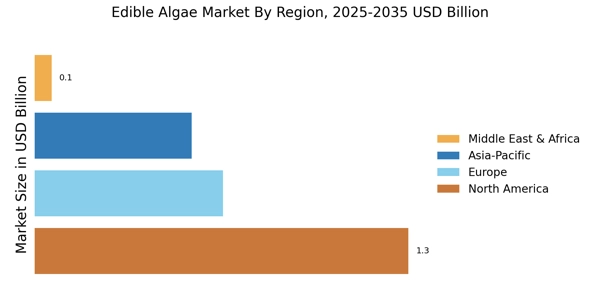
The North American edible algae market is experiencing significant growth, driven by increasing consumer awareness of health benefits and sustainability. The U.S. holds the largest market share at approximately 60%, followed by Canada at around 25%. Regulatory support for sustainable food sources is a key catalyst, with initiatives promoting algae as a viable alternative to traditional protein sources. Leading countries in this region include the United States and Canada, with a competitive landscape featuring major players like Cyanotech Corporation and Nutraceutical Corporation. The presence of innovative companies and research institutions fosters a robust ecosystem for algae production. The market is characterized by a focus on organic and non-GMO products, appealing to health-conscious consumers.

Europe : Sustainable Food Innovation Hub

Europe is rapidly emerging as a key player in the edible algae market, driven by stringent regulations promoting sustainable food practices and a growing demand for plant-based proteins. Germany and France are the largest markets, collectively holding about 45% of the European market share. The European Union's Green Deal emphasizes the importance of algae in achieving sustainability goals, further catalyzing market growth. Countries like France and the Netherlands are at the forefront of algae innovation, with companies such as Algaia and Ecoduna leading the charge. The competitive landscape is marked by collaborations between startups and established firms, focusing on research and development to enhance product offerings. The region's commitment to sustainability and health trends positions it well for future growth.

Asia-Pacific : Emerging Market Potential

The Asia-Pacific region is witnessing a surge in the edible algae market, driven by increasing health consciousness and a rising demand for natural food ingredients. China and Japan are the largest markets, accounting for approximately 50% of the region's share. The growing trend of vegetarianism and veganism, coupled with government initiatives to promote algae cultivation, are significant growth drivers. China leads in production capacity, with numerous companies focusing on spirulina and other algae varieties. The competitive landscape includes key players like Seakura and Earthrise Nutritionals, which are expanding their market presence through innovative product development. The region's diverse culinary traditions also contribute to the growing acceptance of algae in various food applications.

Middle East and Africa : Resource-Rich Algae Frontier

The Middle East and Africa region is gradually recognizing the potential of the edible algae market, driven by increasing interest in sustainable food sources and health benefits. South Africa and Israel are the leading markets, holding about 30% of the regional share. The region's arid climate presents unique opportunities for algae cultivation, supported by government initiatives aimed at diversifying food sources. Israel is emerging as a hub for algae research and innovation, with companies like Algatechnologies leading the way. The competitive landscape is characterized by a mix of local startups and international players, focusing on developing algae-based products for both food and nutraceutical applications. The region's growing awareness of health and sustainability is expected to drive future market growth.

Edible Algae Market  Regional Image

Key Players and Competitive Insights

The Global Edible Algae Market has witnessed significant growth in recent years, driven by increasing consumer consciousness regarding health and nutrition, as well as a growing demand for sustainable food sources. Competitive insights into this market reveal a diverse landscape characterized by a blend of established players and emerging companies striving for market share. The market is shaped by various factors, including innovative product offerings, strategic partnerships, and an increased focus on sustainability. Key players are continuously investing in research and development to enhance product quality and expand their portfolios.

As more consumers seek plant-based dietary options, the dynamics of competition in the edible algae sector are evolving, pushing businesses to adapt and innovatively position themselves to meet changing consumer preferences.Nori Health has been a notable player in the Global Edible Algae Market, leveraging its strengths in quality and product innovation. The company's dedication to offering high-quality edible algae products is underscored by its commitment to sustainability and environmental responsibility.

Nori Health emphasizes the nutritional benefits of its algae offerings, positioning them as not only a food source but also as a health-enhancing ingredient that can be easily integrated into various diets. This strategic focus on health benefits, combined with a robust supply chain and effective distribution channels, enables Nori Health to maintain a strong market presence.

Consequently, the company has garnered a loyal customer base and positioned itself as a trusted name in the edible algae segment.Ocean Harvest Technology brings a unique approach to the Global Edible Algae Market through its emphasis on innovation and technology-driven solutions for algae cultivation. The company is dedicated to producing high-quality, sustainable algae products that not only cater to the food industry but also address various health and environmental concerns. Ocean Harvest Technology's proprietary cultivation methods and processing techniques ensure that its products maintain optimal nutritional profiles, thereby appealing to health-conscious consumers.

With a strong focus on research and development, the company is well-equipped to adapt to market trends and consumer demands, reinforcing its competitive position within the edible algae arena. As the market continues to grow, Ocean Harvest Technology's commitment to quality and sustainability stands out, further enhancing its reputation in the sector.

Key Companies in the Edible Algae Market market include

Industry Developments

Recent developments in the global edible algae market indicate a growing interest in sustainable and nutritious food sources driven by increasing awareness of health benefits and environmental concerns. Innovations in cultivation techniques, such as vertical farming and controlled environments, are enhancing production efficiency and scalability. Companies are experimenting with advanced processing methods to improve the taste and texture of algae-based products, making them more appealing to consumers. Additionally, partnerships and collaborations between food manufacturers and algae producers are on the rise, aiming to develop new product lines that cater to plant-based diets.

The market is also witnessing an influx of investment from both public and private sectors, accelerating research into the nutritional properties of various edible algae. Regulatory bodies in several regions are enhancing guidelines and standards for algae production and consumption to ensure food safety, thereby encouraging mainstream adoption. Overall, these trends reflect a shift towards integrating edible algae into everyday diets as a sustainable and health-conscious choice, influenced by a combination of innovation, investment, and increasing consumer demand for alternative food sources.

Future Outlook

Edible Algae Market Future Outlook

The Edible Algae Market is projected to grow at 11.48% CAGR from 2024 to 2035, driven by increasing health awareness, sustainable food sources, and innovative product development.

New opportunities lie in:

  • Development of algae-based protein supplements for fitness enthusiasts.
  • Expansion of algae cultivation technologies for urban farming.
  • Partnerships with food manufacturers for algae-infused snack products.

By 2035, the Edible Algae Market is expected to be a robust sector, reflecting substantial growth and innovation.

Market Segmentation

Edible Algae Market Type Outlook

  • Spirulina
  • Chlorella
  • Dunaliella
  • Klamath Blue Green Algae
  • Nannochloropsis

Edible Algae Market Consumer Type Outlook

  • Health-conscious Consumers
  • Athletes and Fitness Enthusiasts
  • Vegans and Vegetarians
  • Parents of Young Children
  • Elderly Population

Edible Algae Market End Use Industry Outlook

  • Food and Beverage
  • Nutraceuticals
  • Cosmetics
  • Animal Feed
  • Biofuels

Edible Algae Market Distribution Channel Outlook

  • Direct Sales
  • Online Retail
  • Health Food Stores
  • Supermarkets
  • Specialty Stores

Edible Algae Market Form of Algae Product Outlook

  • Powder
  • Tablet/Capsule
  • Liquid Extract
  • Flakes
  • Granules

Report Scope

MARKET SIZE 20242.189(USD Billion)
MARKET SIZE 20252.44(USD Billion)
MARKET SIZE 20357.236(USD Billion)
COMPOUND ANNUAL GROWTH RATE (CAGR)11.48% (2024 - 2035)
REPORT COVERAGERevenue Forecast, Competitive Landscape, Growth Factors, and Trends
BASE YEAR2024
Market Forecast Period2025 - 2035
Historical Data2019 - 2024
Market Forecast UnitsUSD Billion
Key Companies ProfiledMarket analysis in progress
Segments CoveredMarket segmentation analysis in progress
Key Market OpportunitiesGrowing consumer demand for sustainable protein sources drives innovation in the Edible Algae Market.

Key Market DynamicsRising consumer demand for plant-based proteins drives innovation and competition in the edible algae market.
Countries CoveredNorth America, Europe, APAC, South America, MEA

Leave a Comment

FAQs

What is the current valuation of the Edible Algae Market as of 2024?

The Edible Algae Market was valued at 2.189 USD Billion in 2024.

What is the projected market size for the Edible Algae Market in 2035?

The market is projected to reach 7.236 USD Billion by 2035.

What is the expected CAGR for the Edible Algae Market during the forecast period 2025 - 2035?

The expected CAGR for the Edible Algae Market during 2025 - 2035 is 11.48%.

Which segment of edible algae is projected to have the highest valuation by 2035?

Spirulina is projected to have the highest valuation, reaching 2.6 USD Billion by 2035.

What are the key forms of edible algae products and their projected market sizes?

The key forms include Powder, Tablet/Capsule, and Liquid Extract, with Powders projected to reach 2.6 USD Billion by 2035.

Which end-use industry is expected to dominate the Edible Algae Market by 2035?

The Food and Beverage industry is expected to dominate, with a projected valuation of 2.5 USD Billion by 2035.

What distribution channels are anticipated to be most effective for edible algae products?

Direct Sales and Supermarkets are anticipated to be effective, with Direct Sales projected to reach 2.6 USD Billion by 2035.

Who are the primary consumer types driving the Edible Algae Market?

Health-conscious Consumers and Athletes are primary drivers, with Health-conscious Consumers projected to reach 2.227 USD Billion by 2035.

Which companies are considered key players in the Edible Algae Market?

Key players include Ocean Harvest Technology, Cyanotech Corporation, and Ecoduna, among others.

What is the projected growth trend for the Chlorella segment by 2035?

The Chlorella segment is projected to grow to 1.8 USD Billion by 2035.

Download Free Sample

Kindly complete the form below to receive a free sample of this Report

Compare Licence

×
Features License Type
Single User Multiuser License Enterprise User
Price $4,950 $5,950 $7,250
Maximum User Access Limit 1 User Upto 10 Users Unrestricted Access Throughout the Organization
Free Customization
Direct Access to Analyst
Deliverable Format
Platform Access
Discount on Next Purchase 10% 15% 15%
Printable Versions