×
Request Free Sample ×

Kindly complete the form below to receive a free sample of this Report

* Please use a valid business email

Leading companies partner with us for data-driven Insights

clients tt-cursor
Hero Background

Edible Films Coatings For Fruits Vegetables Market

ID: MRFR/FnB/39882-HCR
128 Pages
Snehal Singh
October 2025

Edible Films and Coatings for Fruits and Vegetables Market Research Report By Material Type (Polysaccharides, Proteins, Lipids, Composite Films), By Application (Fruits, Vegetables, Processed Foods), By Functionality (Moisture Control, Barrier Properties, Edible Coating, Preservation), By End Use (Retail, Food Service, Food Processing) and By Regional (North America, Europe, South America, Asia Pacific, Middle East and Africa) - Forecast to 2035

Share:
Download PDF ×

We do not share your information with anyone. However, we may send you emails based on your report interest from time to time. You may contact us at any time to opt-out.

Edible Films Coatings For Fruits Vegetables Market Infographic
Purchase Options

Edible Films Coatings For Fruits Vegetables Market Summary

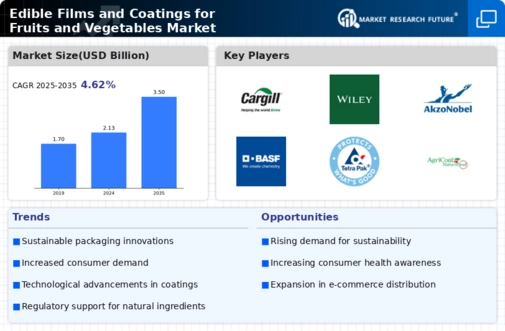
As per MRFR analysis, the Edible Films and Coatings for Fruits and Vegetables Market was estimated at 2.134 USD Billion in 2024. The Edible Films and Coatings industry is projected to grow from 2.233 USD Billion in 2025 to 3.508 USD Billion by 2035, exhibiting a compound annual growth rate (CAGR) of 4.62 during the forecast period 2025 - 2035.

Key Market Trends & Highlights

The Edible Films and Coatings for Fruits and Vegetables Market is experiencing a robust shift towards sustainability and health-conscious innovations.

  • North America remains the largest market for edible films and coatings, driven by increasing consumer demand for fresh produce.
  • The Asia-Pacific region is emerging as the fastest-growing market, fueled by rising health awareness and changing dietary preferences.
  • Polysaccharides dominate the market as the largest segment, while protein-based coatings are gaining traction as the fastest-growing segment.
  • Sustainability initiatives and health and wellness trends are key drivers propelling market growth in both regions.

Market Size & Forecast

2024 Market Size 2.134 (USD Billion)
2035 Market Size 3.508 (USD Billion)
CAGR (2025 - 2035) 4.62%

Major Players

Tate & Lyle (GB), DuPont (US), Cargill (US), Kraton Corporation (US), MGP Ingredients (US), NatureSeal (US), Mitsubishi Chemical (JP), BASF (DE), Avery Dennison (US)

Edible Films Coatings For Fruits Vegetables Market Trends

The Edible Films and Coatings for Fruits and Vegetables Market is experiencing notable evolution, driven by increasing consumer awareness regarding food preservation and sustainability. These films and coatings serve as protective barriers, extending the shelf life of perishable products while maintaining their quality. As environmental concerns rise, the demand for biodegradable and natural ingredients in food packaging is becoming more pronounced. This shift reflects a broader trend towards eco-friendly solutions in the food industry, where consumers are increasingly seeking products that align with their values of health and environmental responsibility. Moreover, advancements in technology are facilitating the development of innovative edible coatings that enhance the sensory attributes of fruits and vegetables. These coatings not only provide protection against spoilage but also contribute to the visual appeal and taste of the produce. The market appears to be on a trajectory of growth, as manufacturers explore new formulations and applications that cater to diverse consumer preferences. As the Edible Films and Coatings for Fruits and Vegetables Market continues to evolve, it is likely to play a crucial role in shaping the future of food preservation and packaging practices.

Sustainability Focus

There is a growing emphasis on sustainable practices within the Edible Films and Coatings for Fruits and Vegetables Market. Consumers are increasingly favoring products that utilize biodegradable materials, reflecting a shift towards environmentally friendly solutions. This trend suggests that manufacturers may need to adapt their offerings to meet the rising demand for eco-conscious packaging.

Technological Innovations

Technological advancements are driving the development of new edible coatings that enhance the quality and longevity of fruits and vegetables. Innovations in formulation and application techniques indicate a potential for improved sensory attributes, such as taste and appearance, which could attract more consumers to these products.

Health-Conscious Consumer Behavior

The Edible Films and Coatings for Fruits and Vegetables Market is witnessing a shift towards health-oriented products. As consumers become more health-conscious, there is a growing interest in coatings that not only preserve freshness but also offer nutritional benefits. This trend may encourage manufacturers to explore functional ingredients that align with health trends.

Edible Films Coatings For Fruits Vegetables Market Drivers

Health and Wellness Trends

The rising health consciousness among consumers is a significant driver for the Edible Films and Coatings for Fruits and Vegetables Market. As individuals become more aware of the nutritional value of their food, there is a growing demand for products that not only preserve freshness but also enhance the nutritional profile of fruits and vegetables. Edible coatings can be enriched with vitamins, minerals, and antioxidants, appealing to health-conscious consumers. This trend is reflected in market data, which indicates that the demand for functional food products is on the rise, with projections suggesting a market size increase of approximately 10% annually. This shift towards healthier eating habits is likely to propel the growth of edible films and coatings.

Sustainability Initiatives

The increasing emphasis on sustainability is a pivotal driver for the Edible Films and Coatings for Fruits and Vegetables Market. Consumers and manufacturers alike are becoming more aware of the environmental impact of packaging materials. Edible films and coatings, often derived from natural sources, offer a biodegradable alternative to traditional plastic packaging. This shift towards eco-friendly solutions is not merely a trend; it is becoming a necessity as regulatory bodies impose stricter guidelines on waste management. The market for edible coatings is projected to grow significantly, with estimates suggesting a compound annual growth rate of over 5% in the coming years. This growth reflects a broader commitment to reducing carbon footprints and promoting sustainable agricultural practices.

Technological Advancements

Technological advancements play a crucial role in shaping the Edible Films and Coatings for Fruits and Vegetables Market. Innovations in material science have led to the development of more effective and versatile edible coatings that enhance the shelf life and quality of fruits and vegetables. For instance, the incorporation of nanotechnology has improved the barrier properties of these films, making them more effective against moisture and gas exchange. This not only preserves the freshness of produce but also reduces food waste, which is a growing concern globally. The market is witnessing a surge in research and development activities aimed at optimizing these technologies, with investments in this sector expected to rise significantly in the next few years.

Regulatory Support and Standards

Regulatory support and the establishment of standards are increasingly influencing the Edible Films and Coatings for Fruits and Vegetables Market. Governments and international bodies are recognizing the potential of edible coatings in enhancing food safety and reducing waste. As a result, there is a growing framework of regulations that promote the use of natural and safe materials in food packaging. This regulatory environment not only encourages innovation but also instills consumer confidence in edible films and coatings. The market is likely to benefit from these supportive policies, as they pave the way for broader adoption and integration of edible coatings in the food supply chain, ultimately enhancing food quality and safety.

Consumer Demand for Fresh Produce

The increasing consumer demand for fresh and minimally processed produce is a key driver for the Edible Films and Coatings for Fruits and Vegetables Market. As consumers seek convenience and quality, the need for effective preservation methods becomes paramount. Edible coatings serve as a barrier to moisture loss and microbial contamination, thereby extending the shelf life of fruits and vegetables. Market analysis indicates that the fresh produce sector is experiencing robust growth, with sales projected to reach unprecedented levels in the next few years. This trend underscores the importance of innovative preservation techniques, as consumers are willing to pay a premium for products that maintain their freshness and quality.


Market Segment Insights

By Material Type: Polysaccharides (Largest) vs. Proteins (Fastest-Growing)

The Edible Films and Coatings for Fruits and Vegetables Market is predominantly driven by the use of polysaccharides as the material of choice. Their natural origin, excellent film-forming capabilities, and ability to enhance moisture retention make polysaccharides collectively hold the largest segment share in this market. In contrast, protein-based films, although currently smaller in market share, are gaining traction due to their biodegradability and ability to offer a more substantial barrier to gases and moisture, making them popular among environmentally conscious consumers.

Polysaccharides (Dominant) vs. Composite Films (Emerging)

Polysaccharides dominate the Edible Films and Coatings Market due to their versatile properties, ease of incorporation with other components, and cost-effectiveness. They have proven their ability to extend shelf life while maintaining the freshness of fruits and vegetables. Emerging composite films, which combine polysaccharides with lipids or proteins, are gaining attention for their enhanced mechanical and barrier properties. This innovative approach addresses consumer demand for superior quality food preservation while improving the sustainability profile of packaging materials. Brands are increasingly exploring composite films as they align with trends towards eco-friendliness, thereby promising significant market potential.

By Application: Fruits (Largest) vs. Vegetables (Fastest-Growing)

The Edible Films and Coatings for Fruits and Vegetables Market showcases fruits as the dominant application segment, significantly outpacing the others in market share. This is primarily driven by the increasing demand for fresh produce preservation and the rising consumer awareness regarding food safety and quality. In contrast, vegetables are emerging as the fastest-growing segment as the industry adapts to new consumer trends and the rising popularity of plant-based diets, contributing to enhanced market dynamics within the sector.

Fruits (Dominant) vs. Vegetables (Emerging)

The fruit application segment is characterized by its well-established position within the Edible Films and Coatings market, owing to its significant usage in extending shelf-life and maintaining the quality of various fruit types. This dominance is attributed to growing consumer preferences for fresh, organic fruits and innovative preservation solutions. On the other hand, the vegetable segment is rapidly gaining momentum, driven by the need for longer-lasting freshness and nutrition in an increasingly health-conscious marketplace. As demand for ready-to-eat vegetable products rises, the use of edible films is becoming a popular choice, positioning this segment as an emerging contender in the market.

By Functionality: Moisture Control (Largest) vs. Barrier Properties (Fastest-Growing)

In the Edible Films and Coatings market for fruits and vegetables, the functionality segment demonstrates a diverse distribution of market share among its values. Moisture Control holds the largest share as it directly impacts the preservation and quality of fruits and vegetables. Barrier Properties, while not as prominent in terms of share, is rapidly gaining traction in the market as consumers become increasingly concerned about food waste and spoilage. Both functionalities are essential for extending shelf life and enhancing the overall quality of produce, making them crucial in today's market landscape. The growth trends in this segment indicate a growing demand for solutions that enhance the quality and longevity of fruits and vegetables. Moisture Control is driven by the need to maintain freshness and prevent spoilage, while Barrier Properties are being embraced due to their ability to protect against external contaminants and prolong shelf life. Increased consumer awareness regarding food preservation techniques and rising preferences for natural and edible coatings propel the expansion of this segment, suggesting a positive trajectory for both functionalities over the coming years.

Moisture Control (Dominant) vs. Barrier Properties (Emerging)

Moisture Control is characterized by its ability to regulate the moisture content in fruits and vegetables, thereby playing a dominant role in preserving freshness and extending shelf life. This functionality is widely favored by consumers and producers alike, as it directly correlates with quality retention and reduced spoilage rates. On the other hand, Barrier Properties are emerging as a crucial focus for many players in the market. This functionality refers to the ability of edible films and coatings to create a protective layer around produce, preventing moisture loss and safeguarding against pollutants. As sustainability and natural solutions become more prominent, Barrier Properties are attracting attention for their potential to enhance food safety and improve product appeal.

By End Use: Retail (Largest) vs. Food Processing (Fastest-Growing)

The Edible Films and Coatings for Fruits and Vegetables Market exhibits significant diversity in its end-use segments, with retail applications holding the largest share. Retail usage is driving the demand for edible coatings due to the increased focus on consumer convenience and product longevity. Additionally, retail channels offer a vast platform for product visibility, encouraging investments in innovative edible coating solutions that enhance the appearance and shelf life of fresh produce. On the other hand, the food processing segment is witnessing the fastest growth within this market. As food processors increasingly adopt eco-friendly packaging alternatives, edible films and coatings are gaining traction. The rising awareness regarding food waste and the need for sustainable practices are key drivers propelling the growth in this segment, as manufacturers pivot towards more sustainable and natural preservation methods.

Retail (Dominant) vs. Food Processing (Emerging)

The retail segment, as the dominant force in the edible films and coatings market, is characterized by a strong emphasis on consumer preferences, with a focus on enhancing the appeal and extend the shelf life of fruits and vegetables. Retailers prioritize innovative packaging solutions that not only attract consumers but also reduce food waste. The fast adoption of edible coatings in this segment is driven by their ability to provide a visually appealing and fresh appearance to produce. In contrast, the food processing segment is emerging rapidly, primarily due to a robust shift towards sustainable food preservation methods. Processors are increasingly exploring edible films and coatings as they cater to the environmentally-conscious consumer base, integrating these solutions into their operations to meet growing demands for clean-label and minimally processed food products.

Get more detailed insights about Edible Films Coatings For Fruits Vegetables Market

Regional Insights

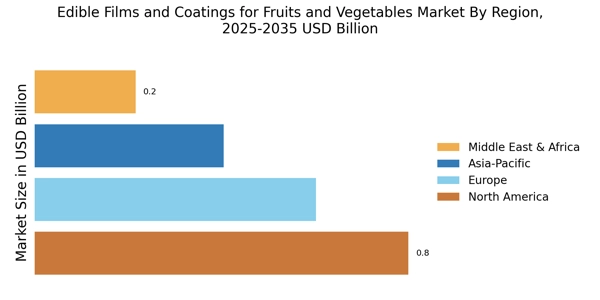
The Regional segment of the Edible Films and Coatings for Fruits and Vegetables Market is projected to see varied growth across different geographical areas. In 2024, North America held a significant majority with a market valuation of 0.85 USD Billion, expected to grow to 1.4 USD Billion by 2035, highlighting its dominance due to rising consumer demand for food safety and extended shelf life.

Europe follows with a valuation of 0.6 USD Billion in 2024 and anticipated growth to 1.0 USD Billion by 2035, driven by strict regulations on food quality and sustainability.The APAC region, starting at 0.5 USD Billion in 2024 and reaching 0.8 USD Billion by 2035, represents emerging markets where population growth fuels the need for innovative packaging solutions. South America and MEA are smaller segments, with valuations of 0.12 USD Billion and 0.06 USD Billion, respectively, in 2024, illustrating the potential for future expansion as awareness of edible films and coatings increases and market infrastructure develops.

Overall, these valuations reflect the Edible Films and Coatings for Fruits and Vegetables Market statistics, signifying distinct regional dynamics that drive growth opportunities and challenges within the industry.

Edible Films Coatings For Fruits Vegetables Market Regional Image

Key Players and Competitive Insights

The Edible Films and Coatings for Fruits and Vegetables Market has experienced significant evolution due to changing consumer preferences, advancements in technology, and increasing awareness regarding food safety and preservation. Edible films and coatings serve as a sustainable solution for enhancing the shelf life of fruits and vegetables while maintaining their nutritional quality and sensory attributes. The competitive landscape is characterized by a mixture of established players and emerging companies that are investing in research and development.

Competitors in this market are focusing on innovation to improve product formulations that are not only effective but also align with the growing demand for organic and clean-label products. This has led to collaborations and partnerships to streamline the supply chain and tap into new customer segments, thereby heightening market competition.Cargill has established itself as a strong player in the Edible Films and Coatings for Fruits and Vegetables Market, leveraging its vast resources and expertise. With a robust portfolio of solutions, Cargill focuses on creating innovative edible coatings that enhance the freshness and quality of fruits and vegetables.

The company's strengths lie in its strong research and development capabilities, allowing it to formulate customized products that meet specific customer needs. Cargill’s extensive distribution network and reputation for reliability further bolster its competitive position, enabling it to effectively reach various markets worldwide. Additionally, the company places significant emphasis on sustainability, which aligns with current market trends and boosts its appeal among environmentally conscious consumers.Wiley has carved out a notable presence in the Edible Films and Coatings for Fruits and Vegetables Market through its commitment to quality and innovation.

Wiley specializes in the development of biodegradable and edible coatings that enhance the shelf life and quality of produce while being environmentally friendly. The company’s strengths are rooted in its dedication to customer service and an active focus on developing products that cater to specific requirements in the fresh produce sector. By employing advanced technologies and leveraging its knowledge base, Wiley aims to not only meet industry standards but also set new benchmarks in product performance.

Wiley’s strategic approach to sustainability and quality improvement positions it effectively within the competitive landscape, appealing to a growing segment of the market that prioritizes ecological responsibility while seeking effective preservation techniques.

Key Companies in the Edible Films Coatings For Fruits Vegetables Market market include

Industry Developments

  • Q1 2024: Apeel Sciences Expands Partnership with Kroger to Roll Out Plant-Based Edible Coating for Avocados Nationwide Apeel Sciences announced a nationwide rollout of its plant-based edible coating for avocados at Kroger stores, aiming to double the shelf life of fresh produce and reduce food waste.
  • Q2 2024: Apeel Launches New Edible Coating for Citrus Fruits in Collaboration with Costco Apeel Sciences introduced a new edible coating for citrus fruits, developed in partnership with Costco, to extend freshness and reduce spoilage across the retailer’s U.S. locations.
  • Q1 2025: Evonik Launches ISCC PLUS Certified Biocarbon-Based Additives for Edible Films and Coatings Evonik Industries AG introduced TEGO® Wet 270 eCO and TEGO® Foamex 812 eCO, ISCC PLUS certified biocarbon-based additives designed to reduce CO2 footprints in edible films and coatings for food-contact applications.
  • Q2 2024: Heliatek Opens Production Line for Ultra-Light Edible Films with Annual Capacity of 1 Million m² Heliatek inaugurated a new production line capable of manufacturing ultra-light edible films for food applications, supporting scalability for fruit and vegetable coatings.

Future Outlook

Edible Films Coatings For Fruits Vegetables Market Future Outlook

The Edible Films and Coatings for Fruits and Vegetables Market is projected to grow at a 4.62% CAGR from 2024 to 2035, driven by increasing demand for sustainable packaging and enhanced shelf life.

New opportunities lie in:

  • Development of biodegradable edible coatings for organic produce
  • Integration of smart packaging technologies for real-time freshness monitoring
  • Expansion of distribution channels targeting emerging markets in Asia and Africa

By 2035, the market is expected to achieve substantial growth, driven by innovation and sustainability.

Market Segmentation

Edible Films Coatings For Fruits Vegetables Market End Use Outlook

  • Retail
  • Food Service
  • Food Processing

Edible Films Coatings For Fruits Vegetables Market Application Outlook

  • Fruits
  • Vegetables
  • Processed Foods

Edible Films Coatings For Fruits Vegetables Market Functionality Outlook

  • Moisture Control
  • Barrier Properties
  • Edible Coating
  • Preservation

Edible Films Coatings For Fruits Vegetables Market Material Type Outlook

  • Polysaccharides
  • Proteins
  • Lipids
  • Composite Films

Report Scope

MARKET SIZE 20242.134(USD Billion)
MARKET SIZE 20252.233(USD Billion)
MARKET SIZE 20353.508(USD Billion)
COMPOUND ANNUAL GROWTH RATE (CAGR)4.62% (2024 - 2035)
REPORT COVERAGERevenue Forecast, Competitive Landscape, Growth Factors, and Trends
BASE YEAR2024
Market Forecast Period2025 - 2035
Historical Data2019 - 2024
Market Forecast UnitsUSD Billion
Key Companies ProfiledMarket analysis in progress
Segments CoveredMarket segmentation analysis in progress
Key Market OpportunitiesGrowing demand for sustainable packaging solutions drives innovation in the Edible Films and Coatings for Fruits and Vegetables Market.
Key Market DynamicsRising consumer demand for sustainable packaging drives innovation in edible films and coatings for fruits and vegetables.
Countries CoveredNorth America, Europe, APAC, South America, MEA

Leave a Comment

FAQs

What is the projected market valuation for Edible Films and Coatings for Fruits and Vegetables by 2035?

The projected market valuation for Edible Films and Coatings for Fruits and Vegetables is expected to reach 3.508 USD Billion by 2035.

What was the market valuation for Edible Films and Coatings in 2024?

The overall market valuation for Edible Films and Coatings was 2.134 USD Billion in 2024.

What is the expected CAGR for the Edible Films and Coatings market during the forecast period 2025 - 2035?

The expected CAGR for the Edible Films and Coatings market during the forecast period 2025 - 2035 is 4.62%.

Which material type segment had the highest valuation in 2024?

In 2024, the Polysaccharides segment had the highest valuation at 0.853 USD Billion.

What are the key applications of Edible Films and Coatings in the market?

The key applications include Fruits, Vegetables, and Processed Foods, with Fruits valued at 0.853 USD Billion in 2024.

Which functionality segment is projected to grow the most by 2035?

The Moisture Control functionality segment is projected to grow significantly, with a valuation of 0.853 USD Billion in 2024.

Who are the leading companies in the Edible Films and Coatings market?

Key players in the market include Tate & Lyle, DuPont, Cargill, and BASF, among others.

What was the valuation of the Vegetables segment in 2024?

The Vegetables segment was valued at 0.641 USD Billion in 2024.

What end-use segment is expected to show substantial growth by 2035?

The Retail end-use segment is expected to show substantial growth, with a valuation of 0.853 USD Billion in 2024.

How do the Composite Films compare to other material types in terms of valuation?

In 2024, Composite Films were valued at 0.427 USD Billion, indicating a competitive position among other material types.

Download Free Sample

Kindly complete the form below to receive a free sample of this Report

Compare Licence

×
Features License Type
Single User Multiuser License Enterprise User
Price $4,950 $5,950 $7,250
Maximum User Access Limit 1 User Upto 10 Users Unrestricted Access Throughout the Organization
Free Customization
Direct Access to Analyst
Deliverable Format
Platform Access
Discount on Next Purchase 10% 15% 15%
Printable Versions