×
Request Free Sample ×

Kindly complete the form below to receive a free sample of this Report

* Please use a valid business email

Leading companies partner with us for data-driven Insights

clients tt-cursor
Hero Background

Elastic Adhesive Market

ID: MRFR/CnM/4573-HCR
100 Pages
Anshula Mandaokar
October 2025

Elastic Adhesive Market Research Report Information By Type (Silicone Modified Polymers, Silicone), Application (Building Maintenance, Floor Covering, and Automobiles), By End-Use (Construction, Transportation), By Region - Forecast till 2035

Share:
Download PDF ×

We do not share your information with anyone. However, we may send you emails based on your report interest from time to time. You may contact us at any time to opt-out.

Elastic Adhesive Market Infographic
Purchase Options

Elastic Adhesive Market Summary

As per MRFR analysis, the Elastic Adhesive Market Size was estimated at 17.85 USD Million in 2024. The Elastic Adhesive industry is projected to grow from 19.61 USD Million in 2025 to 50.17 USD Million by 2035, exhibiting a compound annual growth rate (CAGR) of 9.85 during the forecast period 2025 - 2035.

Key Market Trends & Highlights

The Elastic Adhesive Market is poised for robust growth driven by sustainability and technological advancements.

  • Sustainability initiatives are increasingly shaping product development in the Elastic Adhesive Market.
  • Technological advancements are enhancing the performance and application versatility of elastic adhesives.
  • The North American region remains the largest market, while the Asia-Pacific region is recognized as the fastest-growing market.
  • Rising demand in the construction sector and technological innovations in adhesive formulations are key drivers propelling market expansion.

Market Size & Forecast

2024 Market Size 17.85 (USD Million)
2035 Market Size 50.17 (USD Million)
CAGR (2025 - 2035) 9.85%

Major Players

Henkel AG (DE), 3M Company (US), Sika AG (CH), BASF SE (DE), H.B. Fuller Company (US), Dow Inc. (US), ITW (US), Avery Dennison Corporation (US), Momentive Performance Materials Inc. (US)

Elastic Adhesive Market Trends

The Elastic Adhesive Market is currently experiencing a dynamic evolution, driven by various factors that influence its growth trajectory. The increasing demand for versatile bonding solutions across multiple industries, including automotive, construction, and electronics, appears to be a primary catalyst. As manufacturers seek to enhance product performance and durability, the adoption of elastic adhesives is likely to rise. Furthermore, advancements in adhesive technology, such as the development of eco-friendly formulations, suggest a shift towards sustainable practices within the industry. This trend aligns with global efforts to reduce environmental impact, potentially reshaping consumer preferences and regulatory frameworks. In addition to technological innovations, the Elastic Adhesive Market is also influenced by changing consumer behaviors and preferences. The growing emphasis on lightweight materials in manufacturing processes indicates a potential shift towards adhesives that offer superior bonding capabilities without adding significant weight. Moreover, the rise of e-commerce and online retailing may lead to increased demand for packaging solutions that utilize elastic adhesives, as businesses strive to ensure product integrity during transit. Overall, the Elastic Adhesive Market appears poised for continued growth, driven by a combination of technological advancements and evolving market demands.

Sustainability Initiatives

The Elastic Adhesive Market is witnessing a notable trend towards sustainability, as manufacturers increasingly prioritize eco-friendly formulations. This shift is driven by consumer demand for environmentally responsible products and regulatory pressures aimed at reducing harmful emissions. Companies are exploring bio-based raw materials and low-VOC options, which may enhance their market appeal and align with global sustainability goals.

Technological Advancements

Innovations in adhesive technology are significantly impacting the Elastic Adhesive Market. The development of high-performance adhesives that offer improved bonding strength and flexibility is becoming more prevalent. These advancements enable applications in diverse sectors, including automotive and construction, where durability and reliability are paramount.

Customization and Versatility

The trend towards customization in the Elastic Adhesive Market is gaining momentum, as businesses seek tailored solutions to meet specific application needs. This demand for versatility allows manufacturers to create adhesives that cater to unique requirements across various industries, enhancing their competitive edge and fostering customer loyalty.

Elastic Adhesive Market Drivers

Growing Demand in Construction Sector

The Global Elastic Adhesives Market Industry experiences robust growth driven by increasing demand in the construction sector. As urbanization accelerates, the need for durable and flexible bonding solutions in building materials becomes paramount. Elastic adhesives are favored for their ability to withstand structural movements and environmental changes. In 2024, the market is valued at 22.6 USD Million, reflecting the industry's response to construction trends. Furthermore, the anticipated growth in infrastructure projects globally suggests a sustained demand for these adhesives, potentially leading to a market valuation of 43.2 USD Million by 2035. This growth trajectory indicates a compound annual growth rate of 6.06% from 2025 to 2035.

Market Segment Insights

By Application: Construction (Largest) vs. Automotive (Fastest-Growing)

In the Elastic Adhesive Market, the application segments are predominantly driven by construction, automotive, electronics, aerospace, and medical sectors. Among these, the construction segment holds the largest market share due to the increasing demand for durable and flexible bonding solutions in building materials. The automotive sector, while smaller currently, shows promising growth potential as manufacturers shift towards lightweight materials and sustainable bonding solutions. Other applications, including aerospace and medical, also contribute but to a lesser extent in terms of overall market volume. The growth trends within this market segment are favored by technological advancements in adhesive formulations that foster better performance and environmental compliance. The automotive industry's transition towards electric vehicles and innovative manufacturing techniques boosts the demand for elastic adhesives. In the construction sector, there’s a rise in renovation and infrastructure projects, further expanding application areas for adhesives. Trends in customization and eco-friendly adhesives are also gaining traction, which helps in sustaining the growth of this segment.

Construction: Dominant vs. Automotive: Emerging

The construction segment remains dominant in the Elastic Adhesive Market, characterized by its extensive use in creating durable bonds for various building materials such as wood, concrete, and plastics. This sector benefits from a steady demand driven by global construction activities and the need for long-lasting, weather-resistant solutions. On the other hand, the automotive segment is emerging rapidly, fueled by trends in lightweight materials and a focus on electric vehicle manufacturing. Automotive adhesives are increasingly being incorporated into innovations that require high-strength bonds while maintaining flexibility and ease of application. Both segments represent significant opportunities, but the construction sector provides a more stable foundation, while automotive is marked by dynamic growth driven by technological shifts.

By End Use: Building and Construction (Largest) vs. Automotive Manufacturing (Fastest-Growing)

The Elastic Adhesive Market is predominantly driven by the Building and Construction segment, which holds the largest market share among all end-use applications. This segment benefits from increasing investments in infrastructure and residential construction, leading to high demand for adhesive solutions that provide durability and flexibility. Following closely is the Automotive Manufacturing sector, which is experiencing significant growth due to rising demand for lightweight and fuel-efficient vehicles, creating a need for advanced adhesive technologies that meet stringent performance standards.

Building and Construction (Dominant) vs. Automotive Manufacturing (Emerging)

In the Elastic Adhesive Market, Building and Construction represents the dominant force, characterized by extensive use in bonding construction materials such as roofing, flooring, and insulation. Its strength lies in providing robust, weather-resistant solutions essential for construction durability. On the other hand, the Automotive Manufacturing sector is emerging as a vital end-use application, driven by innovations in vehicle design and stringent environmental regulations. Adhesives in this sector are increasingly favored for their ability to bond lightweight materials, offering manufacturers a competitive edge in enhancing vehicle performance while reducing emissions.

By Type: Polyurethane Adhesives (Largest) vs. Silicone Adhesives (Fastest-Growing)

The Elastic Adhesive Market is characterized by a diverse range of adhesive types, with Polyurethane adhesives currently leading the market. They are renowned for their superior versatility and bonding strength, catering to various applications in construction and automotive industries. Following closely are Silicone adhesives, which are gaining traction due to their increasing adoption in the electronics and healthcare sectors, contributing to their rapid growth. Other types, such as Acrylic, Epoxy, and Rubber adhesives, also play a significant role, but their market share is comparatively smaller.

Polyurethane Adhesives (Dominant) vs. Silicone Adhesives (Emerging)

Polyurethane adhesives are recognized for their outstanding flexibility, durability, and excellent bonding properties which make them the material of choice for industries requiring robust adhesion solutions. They dominate the market, particularly in construction and furniture manufacturing due to their resistance to environmental factors. In contrast, Silicone adhesives are emerging strongly, primarily driven by their unique properties such as high-temperature resistance and flexibility. These characteristics propel their increasing use in applications like automotive and electronics, where reliability and performance are essential. As a result, Silicone adhesives are witnessing rapid adoption and innovation, positioning them as the fastest-growing segment within the Elastic Adhesive Market.

By Formulation: Water-Based Adhesives (Largest) vs. Hot Melt Adhesives (Fastest-Growing)

The Elastic Adhesive Market is increasingly characterized by its diverse formulation segments, with Water-Based Adhesives holding the largest market share due to their eco-friendly nature and broad application range. Solvent-Based Adhesives and Pressure-Sensitive Adhesives also command significant shares, appealing to various sectors like packaging and automotive. In contrast, Reactive Adhesives and Hot Melt Adhesives are gaining traction, especially in specialized applications requiring rapid bonding and flexibility.

Water-Based Adhesives (Dominant) vs. Hot Melt Adhesives (Emerging)

Water-Based Adhesives dominate the Elastic Adhesive Market primarily due to their environmental benefits and versatility across industries including construction, automotive, and aerospace. These adhesives are favored for their low volatile organic compound (VOC) content, making them safer for users and better for the environment. On the other hand, Hot Melt Adhesives are emerging rapidly, praised for their quick bonding and ease of application. They are especially popular in packaging and product assembly, where speed and efficiency are critical. As sustainability concerns rise, both segments are set to innovate and adapt, reinforcing their positions in the market.

By Curing Mechanism: Thermal Curing (Largest) vs. UV Curing (Fastest-Growing)

The Elastic Adhesive Market shows a diverse distribution of curing mechanisms, with thermal curing holding the largest market share. Notably, it is widely adopted due to its efficiency and versatility in various applications, leading to its stable position in the market. UV curing, while currently smaller, is quickly gaining traction thanks to its rapid curing times and environmentally friendly characteristics, making it a significant contender in the segment. Growth trends indicate that the increasing demand for fast and efficient curing methods is propelling the popularity of UV curing forward. Additionally, the rise of eco-conscious consumers and regulatory pressures favor technologies that reduce VOC emissions, enhancing UV curing's appeal among manufacturers. These factors, combined with continuous innovation in adhesive formulations, are expected to drive expansion in the segment.

Curing Mechanisms: Thermal Curing (Dominant) vs. UV Curing (Emerging)

Thermal curing remains the dominant mechanism in the Elastic Adhesive Market, primarily due to its robust performance across various industrial applications, including automotive and construction. This curing type relies on heat to initiate the adhesive formation process, making it suitable for substrates that can withstand elevated temperatures. On the other hand, UV curing is emerging rapidly, marking its footprint in sectors such as electronics and packaging. This method utilizes ultraviolet light to trigger curing, allowing for fast processing times and lower energy consumption. With increasing interest in sustainable practices, UV curing's minimal environmental impact positions it as a competitive alternative, particularly appealing to manufacturers aiming to meet stringent ecological standards.

Get more detailed insights about Elastic Adhesive Market

Regional Insights

North America : Market Leader in Adhesives

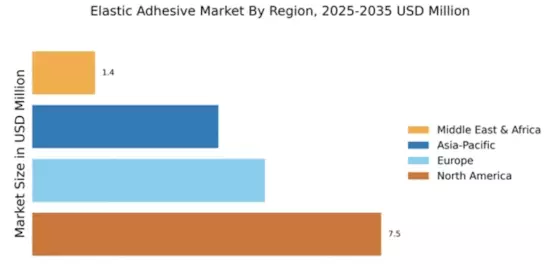
North America is poised to maintain its leadership in the elastic adhesive market, holding a significant market share of 7.5 in 2024. The region's growth is driven by robust demand from construction, automotive, and aerospace sectors, alongside increasing investments in infrastructure. Regulatory support for sustainable materials further propels market expansion, as companies seek eco-friendly adhesive solutions to meet consumer preferences and compliance standards. The competitive landscape in North America is characterized by the presence of major players such as Henkel AG, 3M Company, and Dow Inc. These companies leverage advanced technologies and extensive distribution networks to capture market share. The U.S. stands out as the leading country, with a strong focus on innovation and product development. As the market evolves, partnerships and mergers among key players are expected to enhance product offerings and market reach.

Europe : Growing Demand for Sustainable Solutions

Europe's elastic adhesive market is projected to grow significantly, with a market size of 5.0 in 2024. The region is witnessing a surge in demand for sustainable adhesive solutions, driven by stringent regulations and consumer preferences for eco-friendly products. The European Union's commitment to reducing carbon emissions and promoting green technologies acts as a catalyst for market growth, encouraging manufacturers to innovate and adapt their product lines accordingly. Leading countries in this region include Germany, France, and the UK, where key players like Sika AG and BASF SE are actively investing in R&D to enhance product performance. The competitive landscape is marked by a focus on high-performance adhesives that meet regulatory standards. As the market evolves, collaboration among industry stakeholders is expected to foster innovation and drive growth in the elastic adhesive sector.

Asia-Pacific : Emerging Market with High Potential

The Asia-Pacific region is emerging as a significant player in the elastic adhesive market, with a market size of 4.0 in 2024. The growth is fueled by rapid industrialization, urbanization, and increasing demand from the automotive and construction sectors. Governments in countries like China and India are investing heavily in infrastructure projects, which is expected to drive the demand for high-performance adhesives. Additionally, favorable regulations promoting the use of advanced materials are further enhancing market prospects. China is the leading country in this region, with a strong presence of key players such as H.B. Fuller Company and Momentive Performance Materials Inc. The competitive landscape is characterized by a mix of local and international companies striving to capture market share. As the market matures, innovation and product differentiation will be crucial for companies to maintain a competitive edge in this dynamic environment.

Middle East and Africa : Untapped Market Opportunities

The Middle East and Africa (MEA) region presents untapped opportunities in the elastic adhesive market, with a market size of 1.35 in 2024. The growth is driven by increasing construction activities and a rising demand for automotive applications. Governments are focusing on infrastructure development, which is expected to boost the demand for adhesives. Additionally, the region's diverse industrial landscape offers potential for various adhesive applications, from packaging to electronics. Leading countries in this region include the UAE and South Africa, where local and international players are beginning to establish a foothold. The competitive landscape is evolving, with companies exploring partnerships and collaborations to enhance their market presence. As the market develops, addressing local needs and preferences will be key for success in this emerging market.

Key Players and Competitive Insights

The Elastic Adhesive Market is currently characterized by a dynamic competitive landscape, driven by innovation, sustainability, and strategic partnerships. Key players such as Henkel AG (DE), 3M Company (US), and Sika AG (CH) are actively shaping the market through their distinct operational focuses. Henkel AG (DE) emphasizes innovation in product development, particularly in eco-friendly adhesives, while 3M Company (US) leverages its extensive research capabilities to enhance product performance. Sika AG (CH) is strategically expanding its global footprint, particularly in emerging markets, which indicates a robust approach to capturing new customer segments. Collectively, these strategies contribute to a competitive environment that is increasingly focused on technological advancements and sustainability initiatives.

In terms of business tactics, companies are localizing manufacturing to reduce lead times and optimize supply chains, which appears to be a critical strategy in the current market. The competitive structure of the Elastic Adhesive Market is moderately fragmented, with several key players exerting influence. This fragmentation allows for niche players to thrive, while larger companies leverage their scale to optimize operations and enhance market presence.

In November 2025, Henkel AG (DE) announced a partnership with a leading technology firm to develop smart adhesive solutions that integrate IoT capabilities. This strategic move is likely to position Henkel at the forefront of innovation, catering to industries that require advanced monitoring and control systems. The integration of technology into adhesive products may enhance their functionality and appeal, thereby attracting a broader customer base.

In October 2025, 3M Company (US) launched a new line of sustainable adhesives designed to reduce environmental impact without compromising performance. This initiative reflects a growing trend towards sustainability in the adhesive sector, suggesting that 3M is not only responding to market demands but also setting a benchmark for competitors. The emphasis on eco-friendly products may enhance brand loyalty and attract environmentally conscious consumers.

In September 2025, Sika AG (CH) completed the acquisition of a regional adhesive manufacturer, which is expected to bolster its market share in Europe. This acquisition aligns with Sika's strategy to enhance its product portfolio and expand its operational capabilities. By integrating local expertise, Sika may improve its responsiveness to regional market needs, thereby strengthening its competitive position.

As of December 2025, the Elastic Adhesive Market is witnessing trends such as digitalization, sustainability, and AI integration, which are redefining competitive dynamics. Strategic alliances are increasingly shaping the landscape, enabling companies to pool resources and expertise. The shift from price-based competition to a focus on innovation, technology, and supply chain reliability is evident. Moving forward, competitive differentiation will likely hinge on the ability to innovate and adapt to evolving market demands, with sustainability becoming a core component of product development.

Key Companies in the Elastic Adhesive Market market include

Industry Developments

March 2023:

 3M Company announced the acquisition of Nanolink, a developer of high-performance elastic adhesives. The acquisition is expected to strengthen 3M's position in the growing market for elastic adhesives.

April 2023:

 Huntsman Corporation launched a new line of elastic adhesives for the medical device industry. The adhesives are designed to be biocompatible and meet the strict regulatory requirements for medical devices.

Intended Audience

    • Elastic adhesives manufacturers
    • Traders and distributors of elastic adhesives
    • Research and development institutes
    • Potential investors
    • Raw material suppliers
    • Nationalized laboratory

Future Outlook

Elastic Adhesive Market Future Outlook

The Elastic Adhesive Market is projected to grow at a 9.85% CAGR from 2024 to 2035, driven by increasing demand in construction, automotive, and packaging sectors.

New opportunities lie in:

  • Development of eco-friendly adhesive formulations
  • Expansion into emerging markets with tailored products
  • Integration of smart technology in adhesive application systems

By 2035, the market is expected to achieve robust growth, solidifying its position as a key industry player.

Market Segmentation

Elastic Adhesive Market Type Outlook

  • Polyurethane Adhesives
  • Silicone Adhesives
  • Acrylic Adhesives
  • Epoxy Adhesives
  • Rubber Adhesives

Elastic Adhesive Market End Use Outlook

  • Building and Construction
  • Automotive Manufacturing
  • Consumer Electronics
  • Industrial Applications
  • Medical Devices

Elastic Adhesive Market Application Outlook

  • Construction
  • Automotive
  • Electronics
  • Aerospace
  • Medical

Elastic Adhesive Market Formulation Outlook

  • Water-Based Adhesives
  • Solvent-Based Adhesives
  • Hot Melt Adhesives
  • Reactive Adhesives
  • Pressure-Sensitive Adhesives

Elastic Adhesive Market Curing Mechanism Outlook

  • Thermal Curing
  • UV Curing
  • Moisture Curing
  • Chemical Curing
  • Pressure Curing

Report Scope

MARKET SIZE 202417.85(USD Million)
MARKET SIZE 202519.61(USD Million)
MARKET SIZE 203550.17(USD Million)
COMPOUND ANNUAL GROWTH RATE (CAGR)9.85% (2024 - 2035)
REPORT COVERAGERevenue Forecast, Competitive Landscape, Growth Factors, and Trends
BASE YEAR2024
Market Forecast Period2025 - 2035
Historical Data2019 - 2024
Market Forecast UnitsUSD Million
Key Companies ProfiledHenkel AG (DE), 3M Company (US), Sika AG (CH), BASF SE (DE), H.B. Fuller Company (US), Dow Inc. (US), ITW (US), Avery Dennison Corporation (US), Momentive Performance Materials Inc. (US)
Segments CoveredApplication, End Use, Type, Formulation, Curing Mechanism
Key Market OpportunitiesGrowing demand for eco-friendly formulations in the Elastic Adhesive Market presents significant opportunities for innovation.
Key Market DynamicsRising demand for eco-friendly formulations drives innovation and competition in the elastic adhesive market.
Countries CoveredNorth America, Europe, APAC, South America, MEA

Market Highlights

Author
Anshula Mandaokar
Team Lead - Research

Anshula Mandaokar holds an academic degree in Chemical Engineering and has been contributing to the field for more than 5 years. She has expertise in Market Research and Business Consulting and serves as a Team Lead for a reputed Market Research firm under the Chemicals and Materials domain spectrum. She has worked on multiple projects, generating explicit results in a quick turnaround time. Her understanding of data interpretation justifies her role as a leader.

Leave a Comment

FAQs

What are elastic adhesives used for?

Elastic adhesives are mainly used for bonding together machines that are expected to undergo significant vibration.

What are the leading applications of elastic adhesives?

Major applications of elastic adhesives include building maintenance, floor covering, automobiles, aircrafts, ships, and domestic appliances.

What is the major driver for the market?

Growth of the construction industry is likely to be the major driver for the elastic adhesives market.

Which is the leading regional market?

Asia Pacific is the fastest growing regional market for elastic adhesives, due to the growing construction industry in the region.

What are the leading market players?

Leading players in the elastic adhesives market include Henkel, Arkema, and DowDuPont, among others.

Download Free Sample

Kindly complete the form below to receive a free sample of this Report

Compare Licence

×
Features License Type
Single User Multiuser License Enterprise User
Price $4,950 $5,950 $7,250
Maximum User Access Limit 1 User Upto 10 Users Unrestricted Access Throughout the Organization
Free Customization
Direct Access to Analyst
Deliverable Format
Platform Access
Discount on Next Purchase 10% 15% 15%
Printable Versions