Electric Motorcycle Market (2026 - 2035)

Electric Motorcycle Market Research Report By Battery Type (Lead-Acid, Lithium-Ion, Lithium-Ion Polymer, Sodium-Ion and Emerging Chemistries), By Power Output (Below 3.6 kW, 3.6–7.2 kW, Above 7.2 kW), By Motor Type (Hub Motor, Belt Drive, Chain Drive, Mid-Drive Motor), By End-Use (Personal, Commercial (Delivery & Logistics), Government & Institutional) and By Regional (North America, Europe, South America, Asia Pacific, Middle East and Africa) - Industry Forecast to 2035
ID: MRFR/AT/6664-CR
180 Pages
Shubham Munde, Sejal Akre
Last Updated: July 23, 2026
Electric Motorcycle Market
Market Size
Forecast Period2026-2035
CAGR (2026-2035)23.4%
2025 Market SizeUSD 1.22 Billion
2035 Market SizeUSD 9.98 Billion
Key Players
Yadea Group Holdings
AIMA Technology
Niu Technologies
Zero Motorcycles
Ather Energy
Ola Electric
Opportunities
  • Last-Mile Delivery Fleet Electrification
  • Battery-as-a-Service and Subscription Models
  • Emerging Market Expansion in Africa

Electric Motorcycle Market Summary

The Electric Motorcycle Market reached a valuation of USD 1.22 Billion in 2025 and is projected to grow from USD 1.51 Billion in 2026 to USD 9.98 Billion by 2035, registering a CAGR of 23.4% across the forecast period. Two forces are converging to accelerate adoption: lithium-ion cell prices dropped below USD 120 per kWh in late 2024, slashing total cost of ownership below that of comparable internal combustion engine (ICE) motorcycles in urban commute use cases [1]. Simultaneously, zero-emission vehicle mandates in the European Union and several Indian states have imposed registration surcharges on new ICE two-wheelers, tilting purchase economics further toward electric alternatives [2].

The technology landscape is shifting away from sealed lead-acid batteries and brushed DC motors toward high-density lithium-ion packs paired with permanent-magnet synchronous motors. Governments have backed this transition with capital: India's FAME III scheme allocated USD 1.2 billion to electric two-wheeler purchase subsidies through 2028, while China's Ministry of Industry and Information Technology extended its New Energy Vehicle production credit program into 2027 [3]. Sodium-ion and solid-state chemistries are moving from laboratory prototypes to pilot-line production, promising cheaper cathode materials and faster charge acceptance that could reshape the Electric Motorcycle Market by the early 2030s [4].

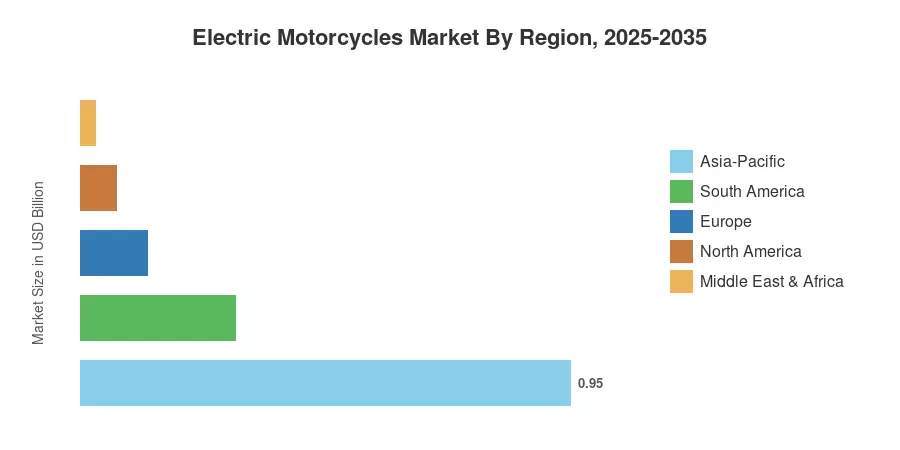
Asia-Pacific dominates the Electric Motorcycle Market with a 78.2% revenue share in 2024, underpinned by integrated supply chains in China and mass-market demand in India and ASEAN economies. South America is the fastest-growing region at a 24.2% CAGR, driven by Brazil's Rota 2030 incentives and expanding urban delivery fleets. Europe holds the second-largest share at 10.3%, supported by the EU's CO₂ fleet targets and municipal combustion-engine bans. As battery costs decline another 30–40% by 2030, the Electric Motorcycle Market is poised to transition from early-adopter niches to mainstream urban and rural mobility.


Key Report Takeaways

• By Battery Type

  • Lithium-ion batteries held approximately 69% of the Electric Motorcycle Market share in 2024, reflecting mature cell manufacturing and competitive pack pricing.
  • Sodium-ion chemistries are advancing at a 24.1% CAGR through 2035, offering a cobalt-free cost advantage for low-speed urban models.

• By Motor Type

  • Hub motors accounted for roughly 66.8% of unit shipments in 2024, favored for their mechanical simplicity in commuter-class platforms.


• By Power Output

  • Hub motors accounted for roughly 66.8% of unit shipments in 2024, favored for their mechanical simplicity in commuter-class platforms.
  • Models rated above 10 kW are compounding at a 25.5% CAGR, reflecting growing interest in highway-capable performance platforms.

• By End-Use

  • Personal ownership represented about 83.6% of the Electric Motorcycle Market revenue in 2024, though delivery and logistics applications are expanding at a 26.1% CAGR as fleet operators pursue lower per-kilometer costs.

• By Region

  • Asia-Pacific commanded 78.2% of the Electric Motorcycle Market in 2024.
  • South America is the fastest-growing region at a 24.2% CAGR, with Brazil leading adoption.


Electric Motorcycle Market Size and Forecast (2021–2035)

Market Research Future's sizing model combines bottom-up production-shipment data from 38 OEMs across 14 countries with top-down import/export and registration statistics from national transport authorities. Historical figures (2021–2024) are reconciled against customs databases and quarterly earnings disclosures; forecast projections (2026–2035) apply regression-adjusted growth assumptions validated by battery cost curves and policy pipeline analysis.
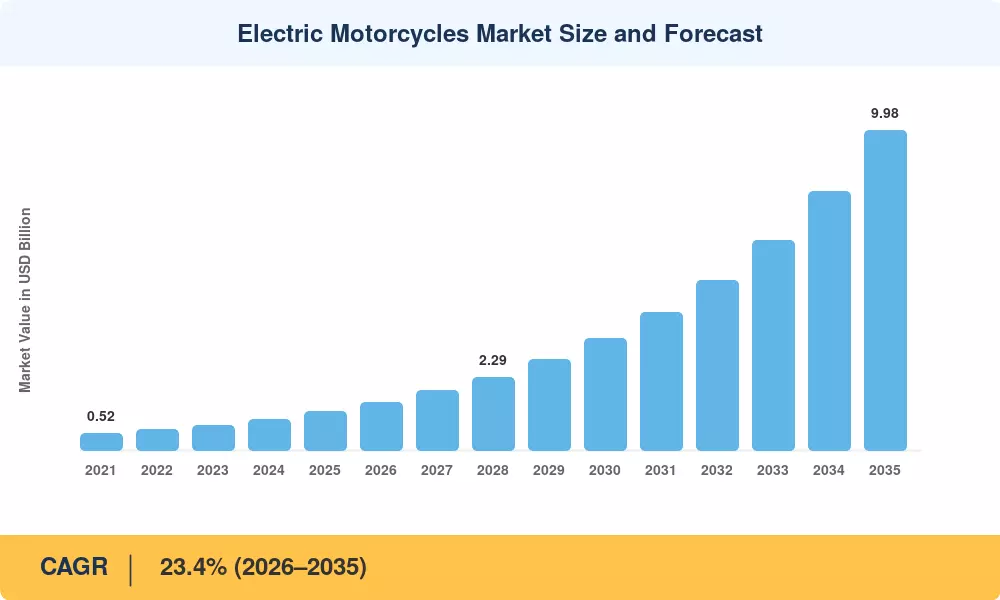
Electric Motorcycles Market Size and Forecast
Our Impact
Enabled $4.3B Revenue Impact for Fortune 500 and Leading Multinationals
Partnering with 2000+ Global Organizations Each Year
30K+ Citations by Top-Tier Firms in the Industry

Driver Impact Analysis

Driver ~% Impact on CAGR Geographic Relevance Impact Timeline
Lithium-ion battery cost reductions 25–30% Global Short-term (≤2 yr)
Government purchase subsidies and tax exemptions 20–25% Asia-Pacific, Europe Short-term (≤2 yr)
Urban zero-emission zone mandates 15–18% Europe, China Medium-term (2–4 yr)
Charging and battery-swap network expansion 10–14% Asia-Pacific, South America Medium-term (2–4 yr)
Delivery and logistics fleet electrification 8–12% Global Medium-term (2–4 yr)
Sodium-ion and solid-state cell commercialization 5–8% Global Long-term (≥4 yr)
Rising fuel prices and ICE maintenance cost inflation 4–6% Middle East & Africa, South America Long-term (≥4 yr)


Battery Cost Deflation

Cell-level lithium-ion pack prices fell 20% year-on-year in 2024 to reach USD 115 per kWh, according to BloombergNEF's annual battery price survey [1]. At pack level, this translated into a USD 250–400 reduction in motorcycle battery cost, pushing the five-year total cost of ownership for a 3 kW commuter electric motorcycle roughly 12% below an equivalent 125 cc ICE model in India and Southeast Asia. Continued capacity additions in China's CATL and BYD gigafactories suggest a further 25–30% price decline by 2028, eliminating the upfront price premium in most sub-7.2 kW categories.

Policy Subsidies and Tax Incentives

India's PM E-DRIVE scheme, effective in 2024, allocates INR 10,900 crore total outlay for electric two-wheelers over four years, covering up to 15% of the ex-showroom price [3]. Indonesia's electric motorcycle conversion subsidy, capped at IDR 7 million per unit, stimulated 180,000 registrations in 2024 alone. These fiscal interventions compress payback periods to under two years for ride-hailing drivers and delivery riders, creating a self-reinforcing adoption cycle in the Electric Motorcycle Market.

Urban Zero-Emission Mandates

The Euro 5+ is a new European Commission regulation beginning in January 2025 that tightens the limitations on particulates and NOx emissions for L-category cars to a level that many small-displacement ICE motorbikes cannot meet without costly aftertreatment [9]. From 2030, Paris, Amsterdam and Barcelona will ban combustion engines in city centres for two-wheelers. Demand is being rerouted to electric versions with Chinese Tier-1 cities like Beijing, Shanghai and Guangzhou currently banning ICE motorbike registrations.


Charging and Swap Infrastructure Growth

By the end of 2024, Gogoro had built a battery swapping network of over 13,500 stations spanning Taiwan, India, and Indonesia, delivering sub-six-second energy replenishment and addressing range anxiety for urban commuters [10]. In China, Niu Technologies and Yadea have implemented their own swap cabinets in more than 60 cities. Standardized swap protocols, supported by China’s GB/T battery swap standard, are being used, providing interoperability to spur growth in price-sensitive segments of the Electric Motorcycle Market.


Restraints Impact Analysis

Restraint ~% Drag on CAGR Geographic Relevance Impact Timeline
High upfront purchase price vs. ICE −8 to −12% Africa, South America Short-term (≤2 yr)
Limited rural charging infrastructure −6 to −9% South Asia, Sub-Saharan Africa Medium-term (2–4 yr)
Battery degradation and replacement costs −4 to −7% Global Long-term (≥4 yr)
Range limitations for intercity travel −3 to −5% Global Medium-term (2–4 yr)
Fragmented safety and homologation standards −2 to −4% ASEAN, Africa Long-term (≥4 yr)


Upfront Price Premium

Even with dropping battery prices, the typical retail price of a 3 kW electric motorcycle is still 20–35% more than a comparable ICE motorcycle in sub-Saharan Africa and portions of South America, where consumer finance is less available, and incomes limit discretionary consumption [15]. Price parity in these places may be deferred till 2029-2030 in the absence of subsidy support akin to India’s FAME program, which may impact the near-termElectric Motorcycle Market penetration.


Rural Infrastructure Gaps

Approximately 580 million people in sub-Saharan Africa lack reliable grid electricity, making overnight home charging impractical in rural areas [16]. Solar-powered micro-charging hubs offer a partial solution, but deployment remains fragmented. Until off-grid energy access improves, the Electric Motorcycle Market's addressable base in these geographies will remain concentrated in urban and peri-urban corridors.

Battery Lifecycle and Disposal

In tropical settings, lithium-ion packs degrade 15–20% faster than standards in temperate regions, due to continuous high ambient temperatures [17]. The cost of replacement packs at USD 400-700 is a major hardship for owners, especially for ride-hailing companies that cycle 80-120 km per day. The problem is compounded by poor recycling infrastructure in Southeast Asia and Africa, creating environmental and economic issues.


Electric Motorcycle Market Opportunities

Last-Mile Delivery Fleet Electrification

Global parcel shipping volumes are expected to pass 260 billion units by 2026. This high volume drives delivery giants like Amazon India and Flipkart to implement large-scale electric two-wheeler fleet conversions, utilizing vehicle swapping networks to lower per-kilometer costs by 40% to 60%.

Battery-as-a-Service and Subscription Models

Separating battery ownership from the vehicle through subscription pricing lowers the upfront purchase price by 25–35%, directly addressing the restraint described in. Gogoro, Sun Mobility, and Battery Smart have demonstrated viable unit economics in Taiwan, India, and Indonesia, respectively. Expanding BaaS to Africa and South America could unlock millions of price-sensitive buyers.

Emerging Market Expansion in Africa

The motorcycle-taxi (“boda-boda”) business in Africa has more than 5 million vehicles in East Africa alone, with Kenya, Uganda, and Rwanda granting duty exemptions on imported electric two-wheelers [20]. Startups such as Ampersand and Roam have implemented swap-enabled fleets in Kigali and Nairobi, showing that the strategy works even in low-income metropolitan areas. This emerging possibility can bring USD 0.4-0.6 billion to the Electric Motorcycle Market by 2032.


Connected Vehicle Data Monetization

Onboard telematics modules generate ride-pattern, battery-health, and geolocation data that can be monetized through insurance telematics, predictive maintenance contracts, and municipal traffic analytics [13]. Fleet operators equipped with connected electric motorcycles report 18–22% reductions in unplanned downtime. As 4G/5G connectivity penetrates emerging markets, data-driven services will become a meaningful revenue layer within the Electric Motorcycle Market.

Vehicle-to-Grid and Energy Arbitrage

Bidirectional charging trials in Japan and the Netherlands have demonstrated that parked electric two-wheelers can feed stored energy back to the grid during peak demand, generating USD 50–120 per vehicle annually in arbitrage revenue [13]. Scaling V2G across the installed base would transform electric motorcycles from pure transport assets into distributed energy resources.


Electric Motorcycle Market Future Outlook

Next-Generation Battery Chemistries

Sodium-ion cells reached pilot-line production at CATL and HiNa Battery in 2024, offering cathode costs 30–40% below lithium iron phosphate at the expense of roughly 20% lower gravimetric energy density [4]. For sub-5 kW urban commuter motorcycles where weight is less critical, sodium-ion packs could become the default chemistry by 2030. Solid-state prototypes from Toyota and Samsung SDI target energy densities above 400 Wh/kg, which would extend range beyond 300 km and reposition the Electric Motorcycle Market for intercity touring applications.

Autonomous and Connected Mobility

Low-speed autonomous delivery motorcycles — operating in geo-fenced urban zones — are already in pilot testing by companies like Nuro (US) and Motional (Singapore). Integration of ADAS features such as automatic emergency braking and blind-spot detection will improve safety profiles and accelerate insurance-driven adoption in the Electric Motorcycle Market.

Platform Economics and Shared Mobility

Ride-hailing platforms in Southeast Asia and Africa are transitioning to asset-light models where drivers lease electric motorcycles under monthly subscription plans bundled with battery swap access, insurance, and telematics [22]. Gojek, Grab, and SafeBoda have each announced electrification targets covering 25–50% of their active driver fleets by 2030. This platform-driven demand creates predictable volume commitments that help OEMs justify capacity investment.

ESG Reporting and Corporate Fleet Mandates

The EU's Corporate Sustainability Reporting Directive (CSRD), effective 2025, requires large enterprises to disclose Scope 3 transport emissions, incentivizing the electrification of courier and field-service fleets [23]. Companies such as Amazon, DHL, and Zomato have set public two-wheeler electrification targets. As ESG disclosure requirements spread to Asia-Pacific jurisdictions, corporate procurement will become a structurally important demand driver for the Electric Motorcycle Market.


Electric Motorcycle Market Segmentation

By Battery Type

Segment Key Metric Primary Demand Driver
Lead-Acid USD 0.14 Billion (2025) Ultra-low-cost segment in South Asia and Africa
Lithium-Ion 69.0% share (2024) Mature manufacturing, high energy density
Lithium-Ion Polymer 22.7% CAGR Lightweight packs for premium models
Sodium-Ion and Emerging Chemistries 24.1% CAGR Cobalt-free cost advantage for urban commuters


Lithium-ion remains the backbone of the Electric Motorcycle Market, supported by a global cell production capacity that exceeded 2,500 GWh in 2024 [1]. Pack-level costs for NMC and LFP chemistries fell to USD 95–130 per kWh, making lithium-ion the default for every power class above 1.5 kW. Sodium-ion systems are poised to disrupt the low-speed commuter tier where cycle life and cold-weather performance outweigh energy density, potentially capturing 8–12% of unit volume by 2032.

By Power Output

Segment Key Metric Primary Demand Driver
Below 3.6 kW 47.2% share (2024) Urban commute, low licensing requirements
3.6–7.2 kW USD 0.31 Billion (2025) Versatile mid-range for suburban and delivery use
Above 7.2 kW 25.5% CAGR Highway-capable performance and touring models


The sub-3.6 kW class dominates on a volume basis because most Asian and European licensing frameworks allow these motorcycles to be ridden with a standard moped or scooter permit. The above-7.2 kW tier is gaining momentum as OEMs like Energica, Zero Motorcycles, and LiveWire release highway-rated models with 150+ km range and DC fast-charging compatibility, catering to riders who demand ICE-equivalent performance.

By Motor Type

Segment Key Metric Primary Demand Driver
Hub Motor 66.8% share (2024) Low cost, minimal drivetrain complexity
Belt Drive USD 0.08 Billion (2025) Quiet operation, premium positioning
Chain Drive 14.3% share (2024) Familiar architecture for ICE-conversion platforms
Mid-Drive Motor 25.3% CAGR Superior torque delivery for performance and off-road


Hub motors dominate because they eliminate transmission components, reducing manufacturing cost and maintenance frequency. Mid-drive architectures are gaining share in the performance and off-road segments of the Electric Motorcycle Market, where centralized mass distribution and geared torque multiplication deliver a superior riding experience.

By End-Use

Segment Key Metric Primary Demand Driver
Personal 83.6% share (2024) Daily commute and recreational use
Commercial (Delivery & Logistics) 26.1% CAGR Lower per-km cost, corporate ESG targets
Government & Institutional USD 0.02 Billion (2025) Police and municipal patrol fleets


Personal ownership continues to account for the largest share of the Electric Motorcycle Market, driven by commuters seeking fuel savings and simplified maintenance. Commercial delivery is the fastest-growing end-use, propelled by platform-economy logistics operators who benefit from predictable energy costs and reduced downtime.


Regional Market Share Analysis

Region Key Metric Primary Investment Themes
Asia-Pacific 78.2% share (2024) Domestic manufacturing scale, swap networks, subsidy programs
Europe 10.3% share (2024) Zero-emission zones, Euro 5+ compliance, premium segment
North America 6.1% share (2024) Performance and recreation segment, federal EV credits
South America 24.2% CAGR (2026–2035) Urban delivery fleets, Rota 2030 incentives
Middle East & Africa USD 0.03 Billion (2025) Motorcycle-taxi electrification, solar charging
Total USD 1.22 Billion (2025)

The Electric Motorcycle Market exhibits pronounced regional concentration, with Asia-Pacific accounting for the vast majority of global revenue. Policy incentives, manufacturing proximity, and urban density drive regional divergence in adoption rates.


North America

Country Key Metric Key Driver
US 72.4% of regional share Federal EV tax credits under IRA; performance/recreation demand
Canada 16.8% of regional share Provincial rebate programs in BC and Quebec
Mexico 10.8% of regional share Urban delivery fleet adoption in Mexico City


The US leads North American demand, driven by the Inflation Reduction Act's clean-vehicle credits and a growing premium performance segment. Zero Motorcycles and LiveWire command brand recognition among enthusiast buyers, while fleet operators in major metro areas increasingly pilot electric motorcycles for courier services [21]. Canada's provincial incentive stack — up to CAD 4,000 per vehicle in British Columbia — supports steady, if smaller, uptake.

Europe

Country Key Metric Key Driver
Germany 23.5% CAGR Environmental bonus and strong OEM ecosystem
UK USD 0.018 Billion (2025) Plug-in motorcycle grant; London ULEZ expansion
France 19.8% of regional share Ecological bonus up to EUR 900 per unit
Italy 17.4% of regional share Ecobonus program for L-category vehicles
Spain 11.6% of regional share MOVES III subsidy plan
Nordic Countries 8.2% of regional share High environmental awareness and EV infrastructure density
Russia 2.1% of regional share Limited incentive structure; cold-climate range concerns
Rest of Europe 6.3% of regional share Mixed regulatory landscape


Europe's Electric Motorcycle Market is shaped by stringent emission regulations and generous purchase subsidies. France's ecological bonus and Italy's Ecobonus have stimulated double-digit registration growth since 2023 [9]. Municipal combustion bans planned for 2030 in Paris, Amsterdam, and Barcelona are expected to convert remaining ICE holdouts, particularly among urban scooter and moped riders.

Asia-Pacific

Country Key Metric Key Driver
China 58.3% of regional share NEV credits, local manufacturing dominance
India 26.1% CAGR FAME III subsidies, startup ecosystem
Japan USD 0.04 Billion (2025) Honda and Yamaha electrification roadmaps
South Korea 3.8% of regional share K-EV subsidy and battery technology R&D
ASEAN 22.4% CAGR Indonesia conversion subsidies, Vietnam urbanization
Rest of Asia-Pacific 4.1% of regional share Emerging policy frameworks


China's Electric Motorcycle Market dwarfs all other national markets, powered by vertically integrated supply chains stretching from cathode refineries to final assembly. Yadea, AIMA, and Niu Technologies collectively ship over 15 million electric two-wheelers annually within China alone [7]. India's market is on a steeper growth trajectory thanks to FAME III, a competitive startup landscape (Ather Energy, Ola Electric, Revolt Motors), and rising fuel prices that make the economic case for electrification increasingly compelling [3].

South America

Country Key Metric Key Driver
Brazil 61.2% of regional share Rota 2030 tax incentives; iFood delivery fleet pilots
Argentina 22.7% of regional share Urban commute demand; import duty reductions
Rest of South America 16.1% of regional share Nascent policy frameworks


Brazil anchors South America's Electric Motorcycle Market, benefiting from the Rota 2030 program's tax incentives for low-emission vehicles and a large motorcycle-dependent commuter base. Delivery platforms like iFood and Rappi are piloting electric fleets in São Paulo and Bogotá, creating commercial demand that supplements personal-use growth [12].

Middle East & Africa

Country Key Metric Key Driver
Saudi Arabia 21.3% of regional share Vision 2030 sustainability agenda
UAE 18.7% of regional share Green mobility initiatives in Dubai and Abu Dhabi
South Africa 24.8% of regional share E-mobility startup ecosystem in Johannesburg and Cape Town
Egypt 14.6% of regional share Urban congestion and fuel subsidy reform
Rest of MEA 20.6% of regional share Motorcycle-taxi electrification in East Africa


East Africa represents the most dynamic sub-segment within MEA, where motorcycle-taxi operators face rising petrol costs and governments in Kenya, Uganda, and Rwanda have eliminated import duties on electric two-wheelers [20]. Startups such as Ampersand and Roam are deploying swap-enabled fleets that demonstrate payback periods under 18 months for boda-boda drivers.


Electric Motorcycles Market By Region, 2025-2035

Competitive Benchmarking

The Electric Motorcycle Market exhibits low-to-moderate concentration. The top five players hold an estimated 30–38% of global revenue, reflecting a fragmented landscape where Chinese volume leaders compete alongside Western performance specialists and Indian startups. The Herfindahl-Hirschman Index (HHI) is estimated below 600, indicating a competitive structure open to new entrants targeting fleet, premium, or region-specific niches.

Company Est. Revenue Share Range Key Offerings for Electric Motorcycle Market Strategic Positioning
Yadea Group Holdings ~8–11% G5, T5, and Champion series for urban commute Volume leader in China; expanding into ASEAN and Europe
AIMA Technology ~6–9% A-series urban scooters and delivery platforms Domestic scale in China; cost leadership
Niu Technologies ~4–7% NQi, MQi, and RQi series Smart connectivity and premium urban positioning
Zero Motorcycles ~3–5% SR/F, SR/S, FX series Premium performance leader in North America and Europe
Ather Energy ~2–4% 450X, Rizta family Technology-led brand in India; proprietary fast-charging grid
Ola Electric ~3–5% S1 Pro, S1 X, Roadster Mass-market pricing in India; vertical integration
LiveWire (Harley-Davidson) ~2–3% LiveWire ONE, S2 Del Mar Heritage brand leveraging Harley-Davidson dealer network
Energica Motor Company ~1–2% Ego, Eva Ribelle, Experia High-performance segment; MotoE supplier
Revolt Motors ~1–3% RV400, RV1 Affordable AI-enabled models in India
Vmoto Limited ~1–2% Stash, CPx series B2B fleet and shared-mobility focus; global export model


Recent News & Developments

  • Ola Electric (August 2024): Filed for IPO on the Bombay Stock Exchange, targeting a USD 700 million raise to fund gigafactory expansion and Roadster production [24].


  • Yadea Group (March 2026): Formally opened its USD 100 million smart electric motorcycle manufacturing hub in Bac Ninh, Vietnam, introducing an automated production line with an initial annual capacity of 1 million units to serve Southeast Asia.


  • European Commission (January 2025): Enacted Euro 5+ emission standards for L-category vehicles, effectively eliminating non-compliant ICE two-wheelers from new registrations [9].


  • LiveWire (August 2024): Announced a partnership with KYMCO to co-develop mid-weight electric platforms for the Asian market, leveraging KYMCO's dealer network across Taiwan and Southeast Asia [21].


Electric Motorcycle Market Report Scope

Parameter Detail
Market Scope Global Electric Motorcycle Market by Battery Type, Power Output, Motor Type, End-Use, and Region
Study Period 2021–2035
CAGR (Forecast) 23.4% (2026–2035)
Market Size (2025) USD 1.22 Billion
Market Size (2035) USD 9.98 Billion
Fastest Growing Segment Delivery & Logistics (End-Use); Sodium-Ion (Battery Type)
Companies Profiled 10+ (including Yadea, AIMA, Niu, Zero, Ather, Ola, LiveWire, Energica, Revolt, Vmoto)
Valuation Currency USD Billion


FAQs

How does lithium iron phosphate compare with nickel manganese cobalt for electric motorcycles?
LFP cells offer 30–40% lower cost per kWh and longer cycle life but sacrifice roughly 20% in gravimetric energy density versus NMC [1]. For sub-5 kW urban commuters where weight matters less, LFP delivers a better value proposition.
What warranty structures do leading OEMs offer on battery packs?
Most tier-1 OEMs warrant battery packs for 3–5 years or 50,000–70,000 km, with guaranteed capacity retention above 70% at warranty expiry [17]. Extended coverage up to 8 years is available from select brands.
How do electric motorcycles perform in extreme-cold climates?
Lithium-ion cells lose 20–35% of usable capacity below −10 °C due to increased internal resistance [17]. Battery thermal management systems with active heating mitigate this but add USD 80–150 to pack cost.
What is the typical resale value trajectory for electric motorcycles?
Electric motorcycles retain approximately 45–55% of their purchase price after three years, trailing ICE equivalents by 5–8 percentage points primarily due to battery depreciation uncertainty [18].
How do insurance premiums for electric motorcycles compare with ICE models?
Premiums run 10–20% higher than comparable ICE motorcycles in most markets, reflecting limited actuarial data and higher repair costs for battery and motor assemblies [15].
Can existing ICE motorcycle service networks maintain electric models?
Basic wear items swap easily, but servicing high-voltage powertrains requires certified training. Because 70% to 90% of independent repair shops lack specialized diagnostic gear, early maintenance remains anchored to official OEM service centers.
What role do electric motorcycles play in grid-balancing strategies?
Aggregated light electric vehicle fleets with bidirectional software act as decentralized energy reservoirs. While financial revenue tracking varies by local utility frameworks, large-scale deployments allow stored battery capacity to smooth local peak-demand curves through load shifting.    
Author
Author
Author Profile
Shubham Munde LinkedIn
Team Lead - Research
Shubham brings over 7 years of expertise in Market Intelligence and Strategic Consulting, with a strong focus on the Automotive, Aerospace, and Defense sectors. Backed by a solid foundation in semiconductors, electronics, and software, he has successfully delivered high-impact syndicated and custom research on a global scale. His core strengths include market sizing, forecasting, competitive intelligence, consumer insights, and supply chain mapping. Widely recognized for developing scalable growth strategies, Shubham empowers clients to navigate complex markets and achieve a lasting competitive edge. Trusted by start-ups and Fortune 500 companies alike, he consistently converts challenges into strategic opportunities that drive sustainable growth.
Co-Author
Co-Author Profile
Sejal Akre LinkedIn
Senior Research Analyst
She has over 5 years of rich experience, in market research and consulting providing valuable market insights to client. Hands on expertise in management consulting, and extensive knowledge in domain including ICT, Automotive & Transportation and Aerospace & Defense. She is skilled in Go-to market strategy, industry analysis, market sizing, in depth company profiling, competitive intelligence & benchmarking and value chain amongst others.

Research Approach


Secondary Research

The secondary research process involved comprehensive analysis of regulatory databases, industry publications, technical standards documentation, and authoritative transportation organizations. Key sources included the US Department of Transportation (DOT), National Highway Traffic Safety Administration (NHTSA), Environmental Protection Agency (EPA), California Air Resources Board (CARB), European Environment Agency (EEA), European Commission Directorate-General for Mobility and Transport (DG MOVE), International Energy Agency (IEA) Global EV Outlook, International Council on Clean Transportation (ICCT), International Electrotechnical Commission (IEC), Society of Automotive Engineers (SAE International), China Association of Automobile Manufacturers (CAAM), Japan Automobile Manufacturers Association (JAMA), Bureau of Indian Standards (BIS), International Motorcycle Manufacturers Association (IMMA), World Bank Transport Data, OECD Transport Statistics, UNEP Global Electric Mobility Programme, national transport ministry reports from key markets (Germany's BMVI, UK's DfT, France's DGITM), and charging infrastructure databases from Electrify America, ChargePoint, and IONITY.

Vehicle registration statistics, emissions regulations, battery safety standards, incentive program data, infrastructure deployment metrics, and competitive landscape analysis for lithium-ion, lead-acid, and nickel-metal hydride battery technologies across various voltage categories and range segments were gathered using these sources.


Primary Research

Qualitative and quantitative insights were obtained by interviewing supply-side and demand-side stakeholders during the primary research process. The supply-side sources consist of CEOs, VPs of Product Development, battery technology leaders, and commercial directors from electric motorcycle OEMs, battery manufacturers, and powertrain suppliers. Demand-side sources included procurement leads from last-mile delivery companies, ride-sharing operators, government transport authorities, and commercial fleet operators, as well as fleet managers, urban mobility planners, and dealership proprietors. Market segmentation was verified, product development timelines were confirmed, and insights regarding the adoption of charging infrastructure, pricing strategies, battery switching preferences, and regulatory compliance requirements were obtained through primary research.

Primary Respondent Breakdown:

By Designation: C-level Primaries (32%), Director Level (30%), Others (38%)

By Region: North America (32%), Europe (30%), Asia-Pacific (33%), Rest of World (5%)


Market Size Estimation

Revenue mapping and unit shipment analysis were implemented to determine the global market valuation. The methodology comprised the following:

The identification of over 50 key manufacturers in North America, Europe, Asia-Pacific, and Latin America

Product mapping within the categories of 75-100 miles, 75-100 miles, and above 100 miles

Li-ion, lead acid, and nickel metal hydride battery technology segmentation

Analysis of voltage classification in the following segments: below 24V, 24-48V, 48-60V, and above 60V

Examination of annual revenues that are specific to electric motorcycle portfolios, as reported and modeled

Manufacturers that account for 75-80% of the global market share in 2024 are included in the coverage.

Extrapolation is employed to generate segment-specific valuations by utilizing both bottom-up (unit shipment × ASP by country) and top-down (manufacturer revenue validation) methodologies.

Download Free Sample

Kindly complete the form below to receive a free sample of this Report

Download PDF ×

We do not share your information with anyone. However, we may send you emails based on your report interest from time to time. You may contact us at any time to opt-out.
















