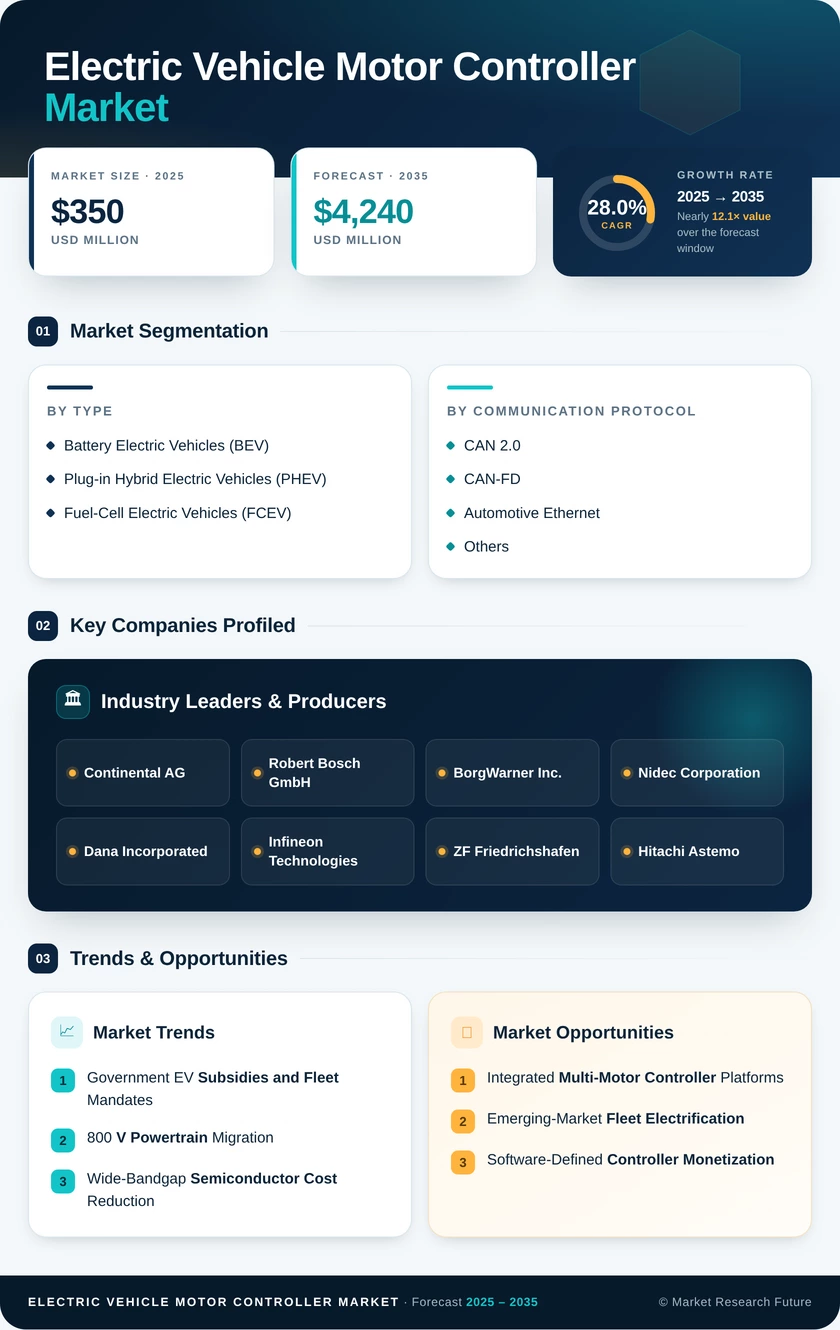
Segmentation Quick Reference
| Dimension | Sub-Segments | Dominant Segment | Fastest Growing Segment |
| Motor Type | AC Induction, Permanent-Magnet Synchronous (PMSM), Brushless DC, Others | AC Induction | Brushless DC |
| Communication Protocol | CAN 2.0, CAN-FD, Automotive Ethernet, Others | CAN 2.0 | Automotive Ethernet |
| Vehicle Type | Passenger Cars, Light Commercial Vehicles, Medium & Heavy Commercial Vehicles | Passenger Cars | Medium & Heavy Commercial Vehicles |
| Propulsion Type | Battery Electric Vehicles (BEV), Plug-in Hybrid Electric Vehicles (PHEV), Fuel-Cell Electric Vehicles (FCEV) | BEV | FCEV |
| Geography | North America, Europe, Asia-Pacific, South America, Middle East & Africa | Asia-Pacific | Asia-Pacific |
Market Segmentation Overview
By Motor Type
| Sub-Segment | Key Trend |
| AC Induction | Volume leader driven by rare-earth-free cost advantage; dominant in mass-market BEV platforms |
| Permanent-Magnet Synchronous (PMSM) | Rising share in premium EVs; efficiency above 97% at partial loads |
| Brushless DC | Fastest growth; compact form factor suits light commercial and two-wheeler applications |
| Others | Includes switched reluctance motors under R&D for heavy-duty mining and off-highway EVs |
AC Induction controllers continue to benefit from cost-optimized supply chains and broad OEM adoption across high-volume platforms. Brushless DC controllers are gaining momentum in emerging-market applications where compact packaging and thermal resilience are prioritized over peak-efficiency metrics.
By Communication Protocol
| Sub-Segment | Key Trend |
| CAN 2.0 | Entrenched legacy standard; bandwidth ceiling driving migration pressure |
| CAN-FD | Interim upgrade path with 8× payload increase over CAN 2.0 |
| Automotive Ethernet | Fastest growth; essential for OTA, autonomous driving, and zone-controller networks |
| Others | LIN and FlexRay used in auxiliary subsystem integration |
CAN 2.0 retains dominance through backward compatibility across existing vehicle architectures. Automotive Ethernet adoption is accelerating as OEMs design new platforms natively around 100BASE-T1 and 1000BASE-T1 physical layers to meet data throughput demands.
By Vehicle Type
| Sub-Segment | Key Trend |
| Passenger Cars | Largest segment; driven by consumer BEV adoption globally |
| Light Commercial Vehicles | Growing with last-mile delivery electrification mandates |
| Medium & Heavy Commercial Vehicles | Fastest growth; zero-emission freight regulations in EU and California |
Passenger cars will sustain volume leadership, but medium and heavy commercial vehicles are emerging as the highest-growth category as regulatory deadlines for zero-emission trucking approach in key jurisdictions.
By Propulsion Type
| Sub-Segment | Key Trend |
| Battery Electric Vehicles (BEV) | Dominant powertrain; most OEM roadmaps are BEV-first |
| Plug-in Hybrid Electric Vehicles (PHEV) | Transitional role; declining share post-2030 as BEV costs fall |
| Fuel-Cell Electric Vehicles (FCEV) | Fastest growth; anchored in heavy-duty trucking and long-haul logistics |
BEVs will maintain majority share through 2035, while FCEVs are carving a durable niche in applications where battery weight and refueling time are prohibitive constraints.