Electric Vehicle Range Extender Market

Key Players: AVL List GmbH, Mahle GmbH, Rheinmetall AG, Magna International, Ceres Power Holdings, Ballard Power Systems, FEV Group, REFIRE Technology

Electric Vehicle Range Extender Market

Electric Vehicle Range Extender Market Research Report Information By Technology Type (ICE Range Extenders, Fuel Cell Range Extenders, Solid-Oxide Fuel Cell Range Extenders), By Component (Battery Pack, Electric Motor, Generator, Power Converters), By Vehicle Class (Passenger Cars, Light Commercial Vehicles, Heavy Commercial Vehicles), By Power Output (Less Than 30 kW, 30–60 kW, 60–100 kW, Above 100 kW) and Region (North America, Europe, Asia-Pacific, South & Central America, Middle East & Africa) - Growth & Industry Forecast to 2035
ID: MRFR/EnP/21288-CR
191 Pages
Sejal Akre
Last Updated: June 22, 2026

Electric Vehicle Range Extender Market Summary

The electric vehicle range extender market reached USD 1.43 billion in 2025 and is projected to grow from USD 1.60 billion in 2026 to USD 4.81 billion by 2035, registering a 13.0% CAGR during the forecast period. This expansion is anchored in two converging forces: tightening fleet CO₂ limits across the EU and China's aggressive subsidies for extended-range electric vehicles (EREVs) [1]. With more than 40 countries committing to zero-emission vehicle sales mandates by 2035, OEMs are turning to onboard auxiliary power units as a cost-effective bridge between legacy combustion drivetrains and pure battery-electric platforms [2].

Battery pack costs declined to roughly USD 139 per kWh in 2024, tracking toward USD 113 per kWh in 2025, which reshapes the economics of hybrid architectures [3]. Pairing a smaller, lighter battery with a compact range-extending generator allows automakers to cut vehicle curb weight by 15–20% compared with a full-size BEV battery, trimming both material costs and energy consumption per kilometer. This engineering trade-off has reignited interest from European premium brands and Chinese mass-market OEMs alike.

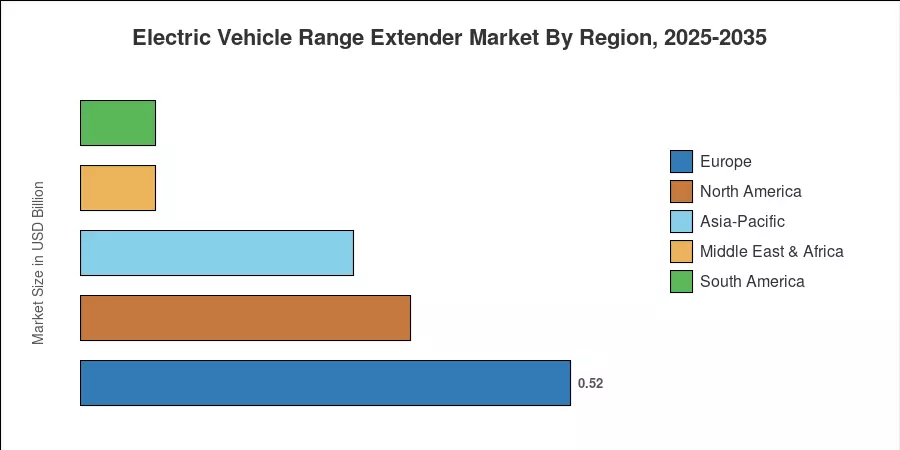
Europe commands a 36.3% revenue share of the electric vehicle range extender market, supported by strict Euro 7 emission norms and clean-air zone enforcement in major cities. Asia-Pacific is the fastest-growing region at a 20.4% CAGR, propelled by China's booming EREV SUV segment and expanding domestic component supply chains. North America holds the second-largest share as U.S. fleet operators evaluate range extenders for medium-duty logistics. The decade ahead will reward suppliers who can deliver modular, multi-fuel generator platforms adaptable to hydrogen and synthetic fuels.


Key Report Takeaways

• By Technology

  • ICE-based range extenders captured 71.2% of the electric vehicle range extender market in 2025, reflecting mature engine supply chains and lower per-unit costs.
  • Fuel cell range extender variants are forecast to expand at a 23.8% CAGR through 2035, driven by hydrogen corridor buildouts in Europe and South Korea.

• By Component

  • Battery packs accounted for 46.1% of component-level value in 2025, underscoring the battery's dual role as primary energy store and buffer for regenerative braking energy.


• By Vehicle Class

  • Battery packs accounted for 46.1% of component-level value in 2025, underscoring the battery's dual role as primary energy store and buffer for regenerative braking energy.
  • Heavy commercial vehicles are poised to grow at a 22.1% CAGR through 2035 as mining and defense fleets adopt range-extended electric platforms.

• By Region

  • Europe generated 36.3% of the electric vehicle range extender market revenue in 2025, led by Germany, France, and the Nordic countries.
  • Asia-Pacific is forecast to register a 20.4% CAGR, with China alone accounting for over half of regional unit shipments.


Market Size and Forecast (2021–2035)

Market Research Future's sizing methodology integrates bottom-up component shipment analysis with top-down OEM production data, cross-validated against customs trade records, patent filings, and investor disclosures from public-market participants in the electric vehicle range extender market.
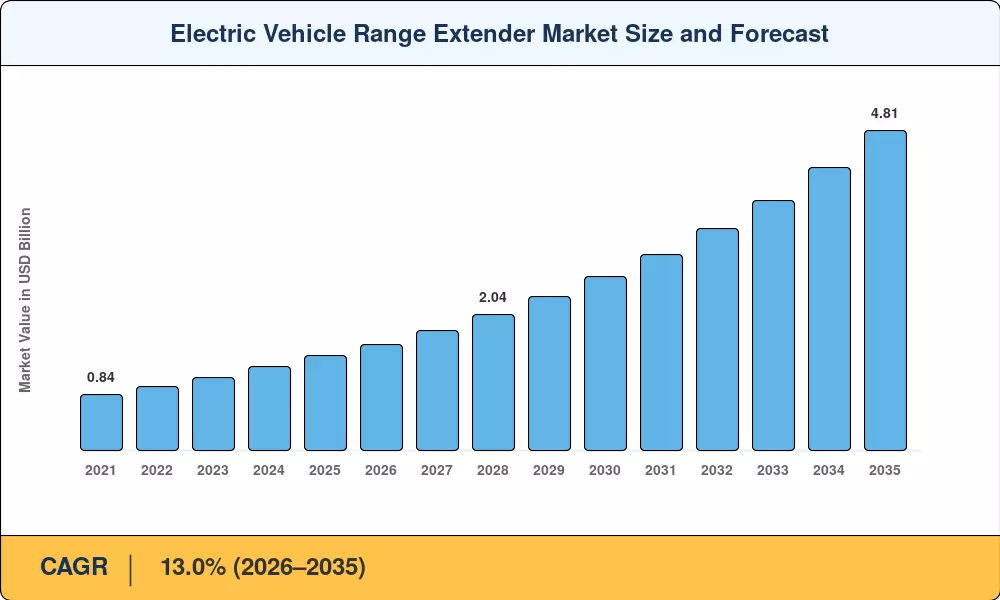
Electric Vehicle Range Extender Market Size and Forecast
Our Impact
Enabled $4.3B Revenue Impact for Fortune 500 and Leading Multinationals
Partnering with 2000+ Global Organizations Each Year
30K+ Citations by Top-Tier Firms in the Industry

Driver Impact Analysis

Driver ~% Impact on CAGR Geographic Relevance Impact Timeline
Government zero-emission mandates ~22% Global Short-term (≤2 yr)
Battery cost reduction trajectory ~18% Global Medium-term (2–4 yr)
Charging infrastructure gaps ~16% North America, South America Short-term (≤2 yr)
China EREV SUV demand surges ~14% Asia-Pacific Short-term (≤2 yr)
Fleet electrification deadlines ~12% Europe, North America Medium-term (2–4 yr)
Defense and mining sector adoption ~10% MEA, Asia-Pacific Long-term (≥4 yr)
Multi-fuel generator platform R&D ~8% Europe, Japan Long-term (≥4 yr)


Government Zero-Emission Mandates

The EU's revised CO₂ standards require a 55% reduction in fleet-average emissions by 2030 relative to 2021 levels, with a full phase-out of combustion-only passenger cars by 2035 [1]. These targets create a regulatory floor beneath which OEMs cannot operate without electrified drivetrains. Range extenders allow compliance with interim targets while preserving manufacturing flexibility. China's dual-credit policy similarly rewards EREVs with more favorable credit scores than plug-in hybrids, giving domestic OEMs like Li Auto and AITO a direct incentive to scale production.

Battery Cost Reduction Trajectory

BloombergNEF reports that lithium-ion pack prices fell 14% year-over-year to USD 139/kWh in late 2023, with projections pointing toward USD 113/kWh by 2025 [3]. Lower battery costs make smaller packs — the 20–35 kWh units typical of range-extended EVs — economically viable at mass-market price points. This cost trajectory directly supports the electric vehicle range extender market by reducing the most expensive single component in the powertrain stack.

Charging Infrastructure Gaps

According to the International Energy Agency, the world would require 14 million public charging points by 2030, when only 3.9 million were working by the end of 2024 [6]. That gap causes lasting range anxiety for would-be EV purchasers, especially in rural corridors, developing countries, and cold-climate regions where batteries don’t perform as well. This gap in infrastructure readiness is directly addressed by range extenders, which enable autonomous onboard energy replenishment.


China EREV SUV Demand

In 2024, EREV sales in China surged 157% YoY, outperforming pure BEV sales growth of 31% [7]. Models from Li Auto, Huawei-backed AITO, and Deep Blue shipped more than 800,000 units together in 2024. This consumer preference for extended-range SUVs is based on practical concerns: charging deserts are widespread throughout western China, and holiday travel patterns over large distances favor vehicles with 1,000+ km total range. The trend analysis in the report indicated that Asia-Pacific will be the fastest-growing engine for the electric car range extender industry till 2035.


Restraints Impact Analysis

Restraint impact percentages represent estimated negative pressure on the electric vehicle range extender market CAGR and are not directly subtracted from the 13.0% growth rate.

Restraint ~% Impact on CAGR Geographic Relevance Impact Timeline
BEV range improvements, reducing RE necessity ~-18% Global Medium-term (2–4 yr)
Regulatory ambiguity on hybrid classification ~-12% Europe, North America Short-term (≤2 yr)
Added mechanical complexity and weight ~-10% Global Long-term (≥4 yr)
Consumer preference shifts toward pure BEV ~-9% Europe, China Medium-term (2–4 yr)
Hydrogen fueling infrastructure limitations ~-7% Global Long-term (≥4 yr)


BEV Range Improvements

Contemporary Amperex Technology (CATL) and BYD have achieved cell-level energy densities of more than 300 Wh/kg, allowing production of BEVs to have 600-800 km range on a single charge [11]. But as these gains filter down to mid-range cars, the practical need for a separate range-extending powerplant disappears. Solid-state batteries, which are estimated to be in limited commercial production by 2028, could further narrow the addressable window for the electric car range extender industry.


Regulatory Classification Uncertainty

Several jurisdictions have yet to definitively classify EREVs as zero-emission or low-emission vehicles. European Commission's Green Deal revisions left ambiguity around type-approval pathways for vehicles with combustion-based range extenders [12]. This regulatory fog complicates long-term product planning and could delay OEM investment commitments.


Electric Vehicle Range Extender Market Opportunities

Hydrogen Fuel Cell Range Extenders for Heavy-Duty Fleets

Mining trucks, military logistics vehicles, and port handling equipment are all operating in conditions where fast charging is impracticable and diesel dependency is extreme. The hydrogen fuel cell range extenders may be operated in a zero-emission mode and can be refueled in less than 15 minutes, which makes them a direct replacement for diesel in these high-value verticals [15].


Modular Multi-Fuel Generator Platforms

OEMs developing generator units compatible with gasoline, ethanol, compressed natural gas, and hydrogen can hedge against fuel-transition uncertainty. A modular platform strategy reduces per-variant engineering costs by an estimated 30–40%, improving unit economics for the electric vehicle range extender market [10].

Emerging-Market Electrification

Countries across Southeast Asia, Sub-Saharan Africa, and South America face severe charging infrastructure deficits but growing urban pollution mandates. Range-extended EVs enable electrification without prerequisite grid investment, opening a USD 400–600 Million addressable opportunity by 2032 [6].

Vehicle-to-Grid and Energy Arbitrage Services

Range-extended EVs equipped with bidirectional inverters can supply stored and generated electricity back to the grid during peak-demand windows. Pilot programs in the UK and Germany have demonstrated household savings of EUR 800–1,200 per year through energy arbitrage, creating an ancillary revenue stream that enhances the total cost of ownership proposition [16].

Data-Driven Predictive Maintenance as a Service

Connected range extender systems produce continuous information — operational temperature, fuel consumption rates, vibration signatures — that can be fed into AI-driven predictive maintenance solutions. Suppliers able to monetize this data via subscription-based analytics could yield recurring revenue of 8 to 12 percent of the hardware selling value over the product lifespan [17].


Electric Vehicle Range Extender Market Future Outlook

Solid-State Battery Integration and Range Extender Redesign

Solid-state batteries entering limited production by 2028–2030 will reshape range extender sizing requirements [11]. Higher energy density packs (400–500 Wh/kg) will reduce the primary battery's volume, potentially shrinking range extender duty cycles from continuous operation to intermittent peak-shaving. This shift could reduce generator output requirements to sub-20 kW for passenger vehicles, favoring ultra-compact turbine and micro fuel cell architectures in the electric vehicle range extender market.

Hydrogen Economy Convergence

The IEA projects global low-emission hydrogen production capacity to reach 38 Mt by 2030 under announced policies [15]. As green hydrogen costs decline from USD 4–6/kg toward the DOE's USD 1/kg target, fuel cell range extenders become economically competitive with ICE alternatives. OEMs investing in dual-capability platforms — supporting both ICE and fuel cell generator modules — will hold a strategic advantage in the electric vehicle range extender market through the 2030s.

Autonomous Vehicle Applications

Self-driving delivery pods, robo-taxis, and autonomous mining vehicles require guaranteed uptime without human-dependent refueling stops. Range extenders provide continuous operational autonomy, enabling 20+ hour duty cycles critical for autonomous fleet economics [17].

ESG Reporting and Scope 3 Emissions Compliance

Corporate fleet operators face increasing pressure to disclose and reduce Scope 3 transportation emissions under CSRD and SEC climate rules [16]. Range-extended EVs offer a documented, measurable emissions reduction pathway — typically 40–60% lower well-to-wheel CO₂ than diesel equivalents — while avoiding the operational disruptions of full BEV transitions. This regulatory tailwind will sustain commercial demand within the electric vehicle range extender market well into the mid-2030s.


Electric Vehicle Range Extender Market Segmentation

By Technology Type

Segment Key Metric Primary Demand Driver
ICE Range Extenders 71.2% share (2025) Mature supply chains, lower upfront cost
Fuel Cell Range Extenders 23.8% CAGR (2026–2035) Hydrogen infrastructure expansion
Solid-Oxide Fuel Cell Range Extenders USD 0.06 Billion (2025) High-efficiency stationary and marine crossover


ICE-based systems dominate the electric vehicle range extender market because they leverage existing automotive engine manufacturing at scale. Compact three-cylinder and rotary engines from suppliers like Mahle and AVL deliver 30–60 kW of continuous electric generation while meeting Euro 7 emission standards in range-extender mode. Fuel cell variants, though currently a smaller segment, are attracting disproportionate R&D investment — Hyundai, Toyota, and Ceres Power collectively allocated over USD 3 billion to fuel cell development through 2025 [15]. Solid-oxide fuel cells occupy a niche but growing position, particularly in marine and stationary backup applications where their high electrical efficiency (55–60%) and fuel flexibility compensate for slower start-up times.

By Component

Segment Key Metric Primary Demand Driver
Battery Pack 46.1% share (2025) Core energy storage and regenerative capture
Electric Motor USD 0.22 Billion (2025) Traction and generation dual-use designs
Generator 11.5% CAGR (2026–2035) Compact rotary and micro-turbine innovations
Power Converters 19.9% CAGR (2026–2035) SiC/GaN semiconductor adoption


Battery packs remain the highest-value component in the electric vehicle range extender market, though their relative share is declining as pack costs drop faster than other subsystems. Power converters represent the fastest-growing component category, driven by the transition from silicon-based IGBTs to silicon carbide (SiC) and gallium nitride (GaN) semiconductors that improve conversion efficiency by 3–5 percentage points while reducing thermal management requirements [13].

By Vehicle Class

Segment Key Metric Primary Demand Driver
Passenger Cars 66.2% share (2025) Consumer range anxiety, OEM platform strategies
Light Commercial Vehicles USD 0.18 Billion (2025) Last-mile delivery fleet electrification
Heavy Commercial Vehicles 22.1% CAGR (2026–2035) Mining, defense, and construction applications


Passenger cars hold the dominant position in the electric vehicle range extender market, anchored by successful platforms like Li Auto's L-series in China and legacy programs in Europe. Heavy commercial vehicles represent the fastest growth vector, as mining companies and defense ministries seek electrified platforms capable of sustained multi-shift operations in locations far from charging infrastructure [9].

By Power Output

Segment Key Metric Primary Demand Driver
Less Than 30 kW 22.3% share (2025) City cars, micro-mobility platforms
30–60 kW 43.7% share (2025) Passenger car sweet spot
60–100 kW USD 0.19 Billion (2025) SUVs and light trucks
Above 100 kW 27.0% CAGR (2026–2035) Heavy commercial and defense vehicles


The 30–60 kW bracket dominates because it matches the continuous power demand of mid-size passenger vehicles traveling at highway speeds. Systems above 100 kW are growing fastest, driven by mining haul trucks and military logistics vehicles that require sustained high-output generation for 12–18-hour operational cycles in the electric vehicle range extender market.


Regional Market Share Analysis

Region Key Metric Primary Investment Themes
North America 24.8% revenue share (2025) Fleet electrification mandates, medium-duty logistics
Europe 36.3% revenue share (2025) Euro 7 compliance, clean-air zones, premium OEM programs
Asia-Pacific 20.4% CAGR (2026–2035) China EREV boom, domestic supplier scaling
South America USD 0.08 Billion (2025) Urban pollution controls, ethanol-compatible RE platforms
Middle East & Africa 5.3% CAGR (2026–2035) Mining fleet electrification, defense modernization
Total USD 1.43 Billion (2025)


North America

Country Key Metric Key Driver
US 72% of regional share Federal fleet electrification executive orders
Canada 13.1% CAGR Provincial ZEV mandates in Quebec and BC
Mexico USD 0.02 Billion (2025) Nearshoring of EV component manufacturing


The U.S. Department of Energy allocated USD 7.5 billion to charging infrastructure under the NEVI program, yet rural deployment timelines extend past 2030, sustaining demand for range-extending solutions in fleet and commercial segments [6]. Canada's federal ZEV mandate requires 100% of new passenger vehicle sales to be electric by 2035, and provinces like British Columbia already enforce interim targets that favor EREV-eligible architectures.

Europe

Country Key Metric Key Driver
Germany 28% of the regional share OEM R&D leadership (BMW, Stellantis)
UK 14.2% CAGR 2030 ICE ban with EREV exemptions under review
France USD 0.06 Billion (2025) Renault-Nissan range extender platform
Italy 9% of regional share Light commercial vehicle electrification
Spain 11.8% CAGR Urban clean-air zone expansion
Nordic Countries USD 0.04 Billion (2025) Cold-climate performance advantages
Russia 3% of regional share Import-substitution programs
Rest of Europe 7.5% CAGR CEE fleet modernization


Germany anchors the European electric vehicle range extender market through its OEM engineering base and Tier 1 supplier ecosystem. BMW's i3 REX legacy platform established consumer familiarity, and next-generation range extenders from Mahle and AVL target sub-30 kg weight with 30 kW continuous output [10]. The UK's forthcoming 2030 ICE phase-out still permits certain hybrid classifications, creating a policy-driven runway for range-extended architectures across the British Isles.

Asia-Pacific

Country Key Metric Key Driver
China 58% of regional share Li Auto, AITO, Deep Blue EREV programs
India 22.5% CAGR Commercial vehicle electrification policy
Japan USD 0.05 Billion (2025) Solid-oxide fuel cell R&D
South Korea 16.8% CAGR Hyundai-Kia fuel cell strategy
ASEAN USD 0.03 Billion (2025) Urban air quality mandates
Rest of Asia-Pacific 14.2% CAGR Emerging EV policy frameworks


China dominates the Asia-Pacific electric vehicle range extender market, with EREV registrations surpassing 1.2 million units cumulatively through 2024 [7]. Government policy treats EREVs favorably under the dual-credit system, and domestic suppliers such as REFIRE Technology and Weichai Power are scaling hydrogen fuel cell range extender production for commercial trucks. India's FAME III program, expected to allocate INR 10,000 Crore toward commercial EV adoption, positions range extenders as a practical solution for intercity trucking where charging infrastructure remains minimal.

South America

Country Key Metric Key Driver
Brazil 64% of regional share Flex-fuel range extender compatibility
Argentina 12.0% CAGR Lithium mining fleet electrification
Rest of South America USD 0.01 Billion (2025) Early-stage regulatory adoption


Brazil's established ethanol infrastructure creates a unique opportunity for flex-fuel range extenders compatible with E100 blends, differentiating the South American electric vehicle range extender market from other regions. São Paulo's new low-emission zone regulations, effective in 2026, are expected to accelerate commercial fleet adoption.

Middle East & Africa

Country Key Metric Key Driver
Saudi Arabia 32% of regional share Vision 2030 industrial diversification
UAE 15.6% CAGR Green mobility initiatives
South Africa USD 0.01 Billion (2025) Mining fleet decarbonization
Egypt 10.2% CAGR Urban transport modernization
Rest of MEA 7.8% CAGR Defense and humanitarian logistics


Saudi Arabia's Public Investment Fund has committed over USD 50 billion to EV ecosystem development under Vision 2030, including localized assembly of range-extended commercial vehicles for mining and construction applications [9]. South Africa's mining sector — contributing 8% of GDP — faces mounting ESG disclosure pressure from international investors, making range-extended electric haul trucks an increasingly attractive decarbonization pathway.


Electric Vehicle Range Extender Market By Region, 2025-2035

Competitive Benchmarking

The electric vehicle range extender market exhibits medium concentration, with the top five players holding an estimated 38–45% combined revenue share. The Herfindahl-Hirschman Index (HHI) falls in the 900–1,200 range, indicating a moderately fragmented competitive environment where specialized Tier 1 suppliers compete alongside diversified automotive conglomerates. Innovation in compact generators, fuel cell stacks, and power electronics differentiates leaders from followers.

Company Est. Revenue Share Range Key Offerings Strategic Positioning
AVL List GmbH ~8–12% Compact ICE range extender platforms Engineering services leader with OEM co-development model
Mahle GmbH ~7–10% Integrated range extender powertrain modules Thermal management and engine expertise
Rheinmetall AG ~5–8% APU systems for defense and commercial vehicles Dual-use defense-commercial positioning
Magna International ~6–9% Complete powertrain integration solutions Full-vehicle system integrator
Ceres Power Holdings ~4–7% Solid-oxide fuel cell stacks IP licensing model for fuel cell technology
Ballard Power Systems ~5–8% PEM fuel cell range extender modules Heavy-duty commercial vehicle focus
FEV Group ~3–6% Range extender engineering and testing Independent engineering consultancy
REFIRE Technology ~4–7% Hydrogen fuel cell systems for commercial EVs Chinese market leader in FC commercial vehicles
Plug Power Inc. ~3–5% Hydrogen fuel cell solutions Integrated green hydrogen ecosystem
Proton Motor Fuel Cell GmbH ~2–4% PEM fuel cell systems for mobility and stationary European fuel cell specialist


Recent News & Developments

  • Li Auto (April 2024): Launched the L6 EREV with an upgraded 1.5T range extender delivering 40 kW continuous output and a combined range of 1,390 km, setting a new benchmark in the China passenger car segment [7].
  • Mahle GmbH (September 2025): Unveiled its advanced production-ready high-voltage range extender system at IAA Mobility, featuring an 85 kW rated continuous output engine-generator combination engineered to offer flexible thermal integration and cost-effective battery sizing for future passenger car platforms.
  • Ceres Power (December 2018): Signed a licensing agreement with Weichai Power to produce solid-oxide fuel cell range extender modules for Chinese commercial trucks at a planned capacity of 20,000 units annually [15].
  • European Commission (May 2024): Finalized Euro 7 emission standards permitting range extender operation under defined conditions, providing regulatory clarity for OEM product planning [12].


Electric Vehicle Range Extender Market Report Scope

Parameter Detail
Market Scope Global electric vehicle range extender market by technology, component, vehicle class, power output, and region
Study Period 2021–2035
CAGR 13.0% (2026–2035)
Base Year Market Size USD 1.43 Billion (2025)
Forecast Endpoint USD 4.81 Billion (2035)
Fastest Growing Segments Fuel cell technology (23.8% CAGR); Above 100 kW power output (27.0% CAGR); Asia-Pacific (20.4% CAGR)
Companies Profiled 10 (AVL, Mahle, Rheinmetall, Magna, Ceres Power, Ballard, FEV, REFIRE, Plug Power, Proton Motor)
Valuation Currency USD Billion


FAQs

What is the typical payback period for fleet operators investing in range-extended electric vehicles?

Fleet operators typically achieve payback within 3–5 years through fuel savings of 35–50% versus diesel equivalents and reduced maintenance costs [14]. Government purchase incentives in the EU and China further shorten this timeline.

How do rotary engines compare to inline engines for range extender applications?

Rotary engines offer 40–50% weight savings and lower vibration, but inline three-cylinder units deliver better thermal efficiency and longer service intervals [10]. Application requirements — packaging space versus fuel economy — determine the optimal choice.

What cybersecurity risks do connected range extender systems introduce?

Connected generator telemetry creates attack surfaces for remote manipulation of power output and fuel systems [17]. OEMs are implementing ISO/SAE 21434-compliant cybersecurity management systems to mitigate these risks in the electric vehicle range extender market.

Can existing ICE range extender platforms be retrofitted to accept hydrogen fuel?

Most ICE platforms require combustion chamber modifications, new fuel injection systems, and hydrogen-rated storage tanks [15]. Retrofit costs typically range from USD 8,000–15,000 per unit, making purpose-built hydrogen platforms more economical at scale.

How does altitude affect the electric vehicle range extender market product performance?

ICE range extenders lose approximately 3–4% power output per 1,000 meters of altitude due to reduced air density [13]. Fuel cell variants maintain more consistent output, making them preferable for high-altitude mining and military operations.

What role do range extenders play in cold-climate EV performance?

Range extenders provide cabin heating as a byproduct of power generation, offsetting the 20–30% battery range loss typical in sub-zero temperatures [6]. This thermal advantage is a key purchase driver in Nordic and Canadian markets.

Are there standardization efforts for range extender interfaces across OEMs?

SAE International's J3072 standard addresses interconnection requirements, and ISO 6469 covers electrical safety for onboard generators [12]. Broader platform standardization remains limited, creating integration complexity in the electric vehicle range extender market.    

Author
Author
Author Profile
Sejal Akre LinkedIn
Senior Research Analyst
She has over 5 years of rich experience, in market research and consulting providing valuable market insights to client. Hands on expertise in management consulting, and extensive knowledge in domain including ICT, Automotive & Transportation and Aerospace & Defense. She is skilled in Go-to market strategy, industry analysis, market sizing, in depth company profiling, competitive intelligence & benchmarking and value chain amongst others.

Research Approach


Secondary Research

The secondary research process involved comprehensive analysis of regulatory databases, automotive industry publications, technical journals, and authoritative transportation organizations. Key sources included the US Department of Transportation (DOT), National Highway Traffic Safety Administration (NHTSA), Environmental Protection Agency (EPA), European Environment Agency (EEA), International Energy Agency (IEA), International Council on Clean Transportation (ICCT), Society of Automotive Engineers (SAE International), International Organization of Motor Vehicle Manufacturers (OICA), European Automobile Manufacturers' Association (ACEA), China Association of Automobile Manufacturers (CAAM), California Air Resources Board (CARB), US Energy Information Administration (EIA), International Renewable Energy Agency (IRENA), BloombergNEF, and McKinsey Center for Future Mobility. These sources were used to collect vehicle registration statistics, emissions regulations, technology adoption trends, charging infrastructure data, and market landscape analysis for internal combustion engine range extenders, fuel cell range extenders, and alternative powertrain technologies.


Primary Research

In order to gather both qualitative and quantitative insights, supply-side and demand-side stakeholders were interviewed during the primary research process. CEOs, CTOs, VPs of Powertrain Engineering, heads of Electrification Strategy, and regulatory affairs managers from automakers, tier-1 suppliers, and producers of range extender systems were examples of supply-side sources. Fleet managers, public transportation operators, directors of commercial vehicle procurement, and sustainability officers from logistics firms, local transit authorities, and ride-sharing platforms were examples of demand-side sources. Market segmentation, product development schedules, and insights on technology adoption trends, total cost of ownership analysis, and charging infrastructure deployment tactics were all verified by primary research.

Primary Respondent Breakdown:

By Designation: C-level Primaries (32%), Director Level (31%), Others (37%)

By Region: North America (32%), Europe (30%), Asia-Pacific (33%), Rest of World (5%)


Market Size Estimation

Global market valuation was derived through revenue mapping and vehicle production volume analysis. The methodology included:

Identification of 50+ key manufacturers and tier-1 suppliers across North America, Europe, Asia-Pacific, and Latin America

Product mapping across ICE range extender, fuel cell range extender, and emerging range extender technologies

Analysis of reported and modeled annual revenues specific to range extender portfolios and electrification divisions

Coverage of manufacturers and suppliers representing 75-80% of global market share in 2024

Extrapolation using bottom-up (vehicle production volume × system ASP by country/region) and top-down (manufacturer revenue validation) approaches to derive segment-specific valuations for passenger cars, commercial vehicles, fleet applications, and public transport segments

Download Free Sample

Kindly complete the form below to receive a free sample of this Report

Download PDF ×

We do not share your information with anyone. However, we may send you emails based on your report interest from time to time. You may contact us at any time to opt-out.














