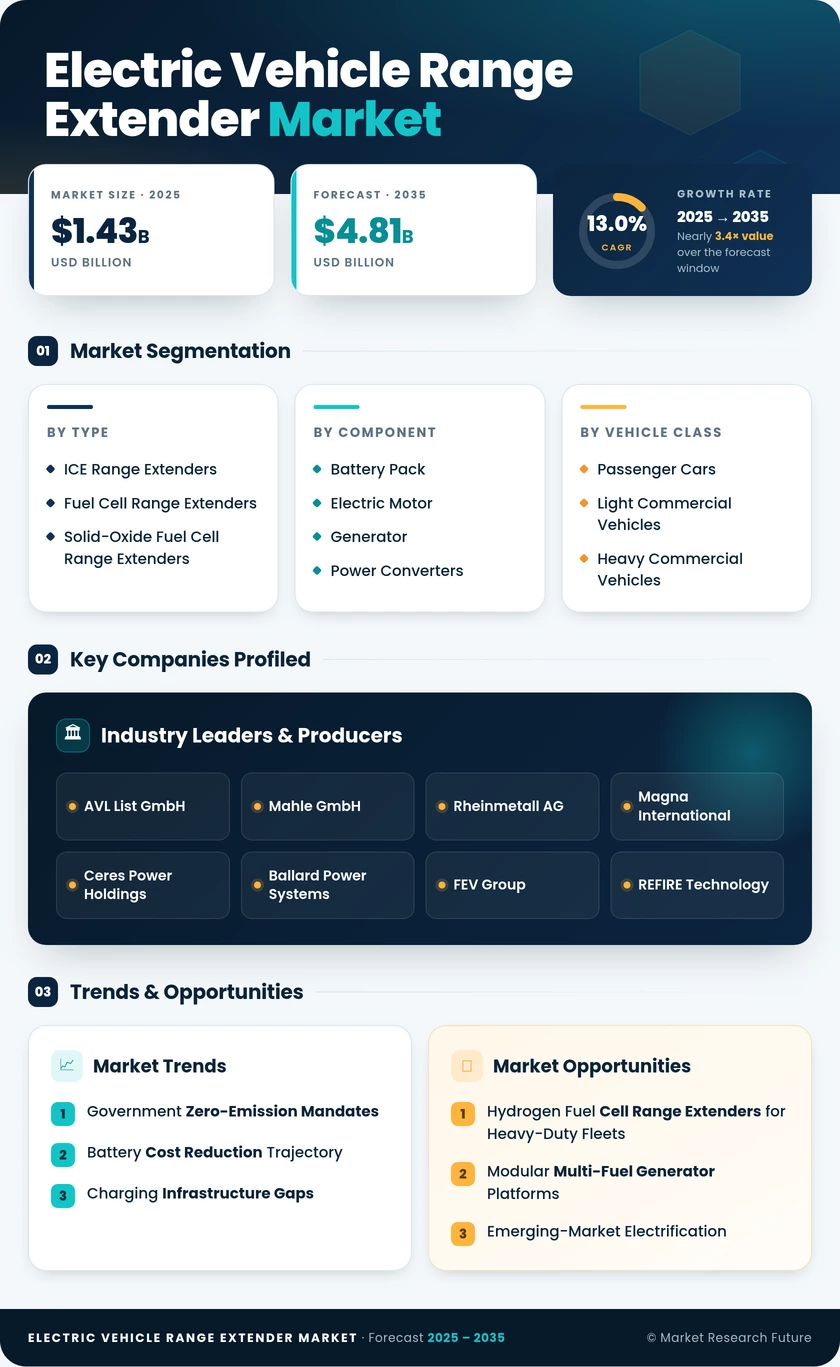
Electric Vehicle Range Extender Market

ID: MRFR/EnP/21288-CR
191 Pages
Sejal Akre
Last Updated: June 22, 2026
Electric Vehicle Range Extender Market Research Report Information By Technology Type (ICE Range Extenders, Fuel Cell Range Extenders, Solid-Oxide Fuel Cell Range Extenders), By Component (Battery Pack, Electric Motor, Generator, Power Converters), By Vehicle Class (Passenger Cars, Light Commercial Vehicles, Heavy Commercial Vehicles), By Power Output (Less Than 30 kW, 30–60 kW, 60–100 kW, Above 100 kW) and Region (North America, Europe, Asia-Pacific, South & Central America, Middle East & Africa) - Growth & Industry Forecast to 2035
Download PDF ×

We do not share your information with anyone. However, we may send you emails based on your report interest from time to time. You may contact us at any time to opt-out.

  1. 1 Market Overview |
    1. 1.1 Study Assumptions & Market Definition |
    2. 1.2 Scope of the Study |
    3. 1.3 Research Methodology
  2. 2 Market Summary & Key Takeaways
  3. 3 Market Dynamics |
    1. 3.1 Market Drivers Analysis | |
      1. 3.1.1 Government Zero-Emission Mandates | |
      2. 3.1.2 Battery Cost Reduction Trajectory | |
      3. 3.1.3 Charging Infrastructure Gaps | |
      4. 3.1.4 China EREV SUV Demand Surge | |
      5. 3.1.5 Fleet Electrification Deadlines | |
      6. 3.1.6 Defense and Mining Sector Adoption | |
      7. 3.1.7 Multi-Fuel Generator Platform R&D |
    2. 3.2 Market Restraints Analysis | |
      1. 3.2.1 BEV Range Improvements Reducing RE Necessity | |
      2. 3.2.2 Regulatory Ambiguity on Hybrid Classification | |
      3. 3.2.3 Added Mechanical Complexity and Weight | |
      4. 3.2.4 Consumer Preference Shift Toward Pure BEV | |
      5. 3.2.5 Hydrogen Fueling Infrastructure Limitations |
    3. 3.3 Market Opportunity Analysis | |
      1. 3.3.1 Hydrogen Fuel Cell Range Extenders for Heavy-Duty Fleets | |
      2. 3.3.2 Modular Multi-Fuel Generator Platforms | |
      3. 3.3.3 Emerging-Market Electrification | |
      4. 3.3.4 Vehicle-to-Grid and Energy Arbitrage Services | |
      5. 3.3.5 Data-Driven Predictive Maintenance as a Service |
    4. 3.4 Industry Value Chain Analysis |
    5. 3.5 Porter's Five Forces Analysis
  4. 4 Global Electric Vehicle Range Extender Market Size & Forecast (2021–2035) |
    1. 4.1 Historical Market Size (2021–2025) |
    2. 4.2 Current & Forecast Market Size (2026–2035) |
    3. 4.3 Market Size by Revenue (USD Billion) |
    4. 4.4 Year-over-Year Growth Analysis
  5. 5 Segmentation Analysis |
    1. 5.1 By Technology Type | |
      1. 5.1.1 ICE Range Extenders | |
      2. 5.1.2 Fuel Cell Range Extenders | |
      3. 5.1.3 Solid-Oxide Fuel Cell Range Extenders |
    2. 5.2 By Component | |
      1. 5.2.1 Battery Pack | |
      2. 5.2.2 Electric Motor | |
      3. 5.2.3 Generator | |
      4. 5.2.4 Power Converters |
    3. 5.3 By Vehicle Class | |
      1. 5.3.1 Passenger Cars | |
      2. 5.3.2 Light Commercial Vehicles | |
      3. 5.3.3 Heavy Commercial Vehicles |
    4. 5.4 By Power Output | |
      1. 5.4.1 Less Than 30 kW | |
      2. 5.4.2 30–60 kW | |
      3. 5.4.3 60–100 kW | |
      4. 5.4.4 Above 100 kW
  6. 6 Regional Analysis |
    1. 6.1 North America | |
      1. 6.1.1 United States | |
      2. 6.1.2 Canada | |
      3. 6.1.3 Mexico |
    2. 6.2 Europe | |
      1. 6.2.1 Germany | |
      2. 6.2.2 United Kingdom | |
      3. 6.2.3 France | |
      4. 6.2.4 Italy | |
      5. 6.2.5 Spain | |
      6. 6.2.6 Nordic Countries | |
      7. 6.2.7 Russia | |
      8. 6.2.8 Rest of Europe |
    3. 6.3 Asia-Pacific | |
      1. 6.3.1 China | |
      2. 6.3.2 India | |
      3. 6.3.3 Japan | |
      4. 6.3.4 South Korea | |
      5. 6.3.5 ASEAN | |
      6. 6.3.6 Rest of Asia-Pacific |
    4. 6.4 South America | |
      1. 6.4.1 Brazil | |
      2. 6.4.2 Argentina | |
      3. 6.4.3 Rest of South America |
    5. 6.5 Middle East & Africa | |
      1. 6.5.1 Saudi Arabia | |
      2. 6.5.2 UAE | |
      3. 6.5.3 South Africa | |
      4. 6.5.4 Egypt | |
      5. 6.5.5 Rest of MEA
  7. 7 Competitive Landscape |
    1. 7.1 Market Share Analysis (2025) |
    2. 7.2 Competitive Benchmarking Matrix |
    3. 7.3 Company Profiles | |
      1. 7.3.1 AVL List GmbH | |
      2. 7.3.2 Mahle GmbH | |
      3. 7.3.3 Rheinmetall AG | |
      4. 7.3.4 Magna International | |
      5. 7.3.5 Ceres Power Holdings | |
      6. 7.3.6 Ballard Power Systems | |
      7. 7.3.7 FEV Group | |
      8. 7.3.8 REFIRE Technology | |
      9. 7.3.9 Plug Power Inc. | |
      10. 7.3.10 Proton Motor Fuel Cell GmbH
  8. 8 Future Outlook & Strategic Recommendations (2026–2035) |
    1. 8.1 Solid-State Battery Integration and Range Extender Redesign |
    2. 8.2 Hydrogen Economy Convergence |
    3. 8.3 Autonomous Vehicle Applications |
    4. 8.4 ESG Reporting and Scope 3 Emissions Compliance
  9. 9 Recent Developments & News
  10. 10 Frequently Asked Questions (FAQs)
  11. 11 Report Scope & Methodology |
    1. 11.1 Study Period & Base Year |
    2. 11.2 Data Sources & Citations |
    3. 11.3 Abbreviations
  12. 12 LIST OF TABLES |
  13. TABLE 1 Global Electric Vehicle Range Extender Market Size & Forecast, by Revenue (USD Billion), 2021–2035 |
  14. TABLE 2 Global Electric Vehicle Range Extender Market – Year-over-Year Growth Analysis, 2021–2035 |
  15. TABLE 3 Market Driver Impact Analysis, 2026–2035 |
  16. TABLE 4 Market Restraint Impact Analysis, 2026–2035 |
  17. TABLE 5 Global Electric Vehicle Range Extender Market Size, by Technology Type, 2021–2035 (USD Billion) |
  18. TABLE 6 Global Electric Vehicle Range Extender Market Size, by Component, 2021–2035 (USD Billion) |
  19. TABLE 7 Global Electric Vehicle Range Extender Market Size, by Vehicle Class, 2021–2035 (USD Billion) |
  20. TABLE 8 Global Electric Vehicle Range Extender Market Size, by Power Output, 2021–2035 (USD Billion) |
  21. TABLE 9 Global Electric Vehicle Range Extender Market Size, by Region, 2021–2035 (USD Billion) |
  22. TABLE 10 North America Electric Vehicle Range Extender Market Size, by Country, 2021–2035 (USD Billion) |
  23. TABLE 11 Europe Electric Vehicle Range Extender Market Size, by Country, 2021–2035 (USD Billion) |
  24. TABLE 12 Asia-Pacific Electric Vehicle Range Extender Market Size, by Country, 2021–2035 (USD Billion) |
  25. TABLE 13 South America Electric Vehicle Range Extender Market Size, by Country, 2021–2035 (USD Billion) |
  26. TABLE 14 Middle East & Africa Electric Vehicle Range Extender Market Size, by Country, 2021–2035 (USD Billion) |
  27. TABLE 15 Competitive Benchmarking Matrix – Global Electric Vehicle Range Extender Market, 2025 |
  28. TABLE 16 Company Profiles – Key Players, Global Electric Vehicle Range Extender Market |
  29. TABLE 17 Recent Developments & Strategic Announcements, 2023–2025 |
  30. TABLE 18 Report Scope & Methodology Summary |
  31. TABLE 19 Detailed Sources and Citations |
  32. TABLE 20 North America Electric Vehicle Range Extender Market Size, by Technology Type, 2021–2035 (USD Billion) |
  33. TABLE 21 North America Electric Vehicle Range Extender Market Size, by Component, 2021–2035 (USD Billion) |
  34. TABLE 22 North America Electric Vehicle Range Extender Market Size, by Vehicle Class, 2021–2035 (USD Billion) |
  35. TABLE 23 North America Electric Vehicle Range Extender Market Size, by Power Output, 2021–2035 (USD Billion) |
  36. TABLE 24 Europe Electric Vehicle Range Extender Market Size, by Technology Type, 2021–2035 (USD Billion) |
  37. TABLE 25 Europe Electric Vehicle Range Extender Market Size, by Component, 2021–2035 (USD Billion) |
  38. TABLE 26 Europe Electric Vehicle Range Extender Market Size, by Vehicle Class, 2021–2035 (USD Billion) |
  39. TABLE 27 Europe Electric Vehicle Range Extender Market Size, by Power Output, 2021–2035 (USD Billion) |
  40. TABLE 28 Asia-Pacific Electric Vehicle Range Extender Market Size, by Technology Type, 2021–2035 (USD Billion) |
  41. TABLE 29 Asia-Pacific Electric Vehicle Range Extender Market Size, by Component, 2021–2035 (USD Billion) |
  42. TABLE 30 Asia-Pacific Electric Vehicle Range Extender Market Size, by Vehicle Class, 2021–2035 (USD Billion) |
  43. TABLE 31 Asia-Pacific Electric Vehicle Range Extender Market Size, by Power Output, 2021–2035 (USD Billion) |
  44. TABLE 32 South America Electric Vehicle Range Extender Market Size, by Technology Type, 2021–2035 (USD Billion) |
  45. TABLE 33 South America Electric Vehicle Range Extender Market Size, by Component, 2021–2035 (USD Billion) |
  46. TABLE 34 South America Electric Vehicle Range Extender Market Size, by Vehicle Class, 2021–2035 (USD Billion) |
  47. TABLE 35 South America Electric Vehicle Range Extender Market Size, by Power Output, 2021–2035 (USD Billion) |
  48. TABLE 36 Middle East & Africa Electric Vehicle Range Extender Market Size, by Technology Type, 2021–2035 (USD Billion) |
  49. TABLE 37 Middle East & Africa Electric Vehicle Range Extender Market Size, by Component, 2021–2035 (USD Billion) |
  50. TABLE 38 Middle East & Africa Electric Vehicle Range Extender Market Size, by Vehicle Class, 2021–2035 (USD Billion) |
  51. TABLE 39 Middle East & Africa Electric Vehicle Range Extender Market Size, by Power Output, 2021–2035 (USD Billion)
  52. 13 LIST OF FIGURES |
  53. FIGURE 1 Global Electric Vehicle Range Extender Market Dynamics Overview |
  54. FIGURE 2 Industry Value Chain Analysis |
  55. FIGURE 3 Porter's Five Forces Analysis |
  56. FIGURE 4 Global Electric Vehicle Range Extender Market Size Trend (USD Billion), 2021–2035 |
  57. FIGURE 5 Market Share by Technology Type (%), 2025 |
  58. FIGURE 6 Market Share by Component (%), 2025 |
  59. FIGURE 7 Market Share by Vehicle Class (%), 2025 |
  60. FIGURE 8 Market Share by Power Output (%), 2025 |
  61. FIGURE 9 Regional Market Share (%), 2025 |
  62. FIGURE 10 North America Market Size Trend (USD Billion), 2021–2035 |
  63. FIGURE 11 Europe Market Size Trend (USD Billion), 2021–2035 |
  64. FIGURE 12 Asia-Pacific Market Size Trend (USD Billion), 2021–2035 |
  65. FIGURE 13 South America Market Size Trend (USD Billion), 2021–2035 |
  66. FIGURE 14 Middle East & Africa Market Size Trend (USD Billion), 2021–2035 |
  67. FIGURE 15 Competitive Landscape – Market Share of Top 10 Players (%), 2025 |
  68. FIGURE 16 Competitive Positioning Matrix, 2025

Segmentation Quick Reference

DimensionSub-SegmentsDominant SegmentFastest Growing Segment
Technology TypeICE Range Extenders; Fuel Cell Range Extenders; Solid-Oxide Fuel Cell Range ExtendersICE Range Extenders (71.2% share, 2025)Fuel Cell Range Extenders (23.8% CAGR)
ComponentBattery Pack; Electric Motor; Generator; Power ConvertersBattery Pack (46.1% share, 2025)Power Converters (19.9% CAGR)
Vehicle ClassPassenger Cars; Light Commercial Vehicles; Heavy Commercial VehiclesPassenger Cars (66.2% share, 2025)Heavy Commercial Vehicles (22.1% CAGR)
Power OutputLess Than 30 kW; 30–60 kW; 60–100 kW; Above 100 kW30–60 kW (43.7% share, 2025)Above 100 kW (27.0% CAGR)
RegionNorth America; Europe; Asia-Pacific; South America; Middle East & AfricaEurope (36.3% share, 2025)Asia-Pacific (20.4% CAGR)


Market Segmentation Overview

By Technology Type

Sub-SegmentKey Trend
ICE Range ExtendersCompact rotary and three-cylinder engines achieving sub-30 kg weight targets for passenger car integration
Fuel Cell Range ExtendersPEM fuel cell stacks scaling for heavy-duty commercial applications as hydrogen costs decline
Solid-Oxide Fuel Cell Range ExtendersHigh-efficiency (55–60%) stacks crossing over from stationary power to marine and specialty vehicle markets


ICE range extenders maintain dominance through cost advantage and manufacturing maturity, yet fuel cell variants are closing the gap as government hydrogen strategies and falling electrolyzer costs improve total cost of ownership. Solid-oxide systems serve niche applications where fuel flexibility and high electrical efficiency outweigh slower start-up characteristics.

By Component

Sub-SegmentKey Trend
Battery PackDeclining cell costs enabling smaller, lighter packs optimized for range-extender duty cycles
Electric MotorDual-use motor-generator architectures reducing component count and system weight
GeneratorMicro-turbine and Wankel rotary designs competing with traditional reciprocating generators
Power ConvertersSiC and GaN wide-bandgap semiconductors improving conversion efficiency and thermal performance


Battery packs remain the highest-value component, though their cost share is declining faster than other subsystems. Power converters are emerging as a critical differentiator, with wide-bandgap semiconductor adoption enabling smaller, lighter, and more efficient power electronics packages.

By Vehicle Class

Sub-SegmentKey Trend
Passenger CarsChinese EREV SUVs driving volume; European premium brands developing next-generation platforms
Light Commercial VehiclesLast-mile delivery operators adopting range extenders to guarantee daily route completion
Heavy Commercial VehiclesMining, defense, and construction sectors requiring high-output, continuous-duty generation systems


Passenger cars drive the majority of unit volume, but heavy commercial vehicles contribute disproportionately to revenue per unit due to higher power output requirements and premium pricing for ruggedized, duty-rated systems.

By Power Output

Sub-SegmentKey Trend
Less Than 30 kWCity cars and micro-mobility platforms using ultra-compact generators for urban duty cycles
30–60 kWSweet spot for mid-size passenger vehicles, balancing highway performance and packaging constraints
60–100 kWGrowing segment for SUVs and light trucks requiring sustained highway-speed generation
Above 100 kWHeavy-duty mining trucks, military logistics vehicles, and marine applications demanding continuous high output


The 30–60 kW bracket serves the largest installed base, reflecting the passenger car segment's dominance. Above-100 kW systems are expanding rapidly as electrification reaches heavy industrial and defense verticals where no practical alternative to onboard high-power generation currently exists.

By Region

Sub-SegmentKey Trend
North AmericaFleet electrification mandates and the NEVI infrastructure program driving commercial adoption
EuropeEuro 7 compliance, clean-air zones, and OEM R&D investment anchoring the largest regional market
Asia-PacificChina's EREV boom and expanding domestic supply chains fueling the fastest regional growth
South AmericaFlex-fuel range extender compatibility with Brazil's ethanol infrastructure creating unique demand
Middle East & AfricaMining and defense fleet decarbonization programs under Vision 2030 and ESG pressure


Europe leads on revenue share through its combination of stringent emission regulations and OEM engineering investment. Asia-Pacific's growth trajectory reflects China's consumer-driven EREV adoption wave and the scaling of domestic component manufacturers, positioning the region to potentially surpass Europe in absolute market size before 2035.