Electrical Bushing Market (2026 - 2035)

Electrical Bushing Market Research Report By Type (Oil Impregnated Paper (OIP), Resin Impregnated Paper (RIP), Other Types), By Application (Transformers, Switchgears, Other Applications) and By Regional (North America, Europe, South America, Asia Pacific, Middle East and Africa) - Forecast to 2035
ID: MRFR/EnP/5346-HCR
111 Pages
Anshula Mandaokar
Last Updated: August 24, 2026
Electrical Bushing Market
Market Size
Forecast Period2026-2035
CAGR (2026-2035)6.0%
2025 Market SizeUSD 4.20 Billion
2035 Market SizeUSD 7.52 Billion
Key Players
Hitachi Energy
Siemens Energy
GE Vernova
Trench Group
Hubbell Incorporated
HSP Hochspannungsgeräte
Opportunities
  • RIP and Composite Technology Transition
  • Emerging-Market Grid Build-Out
  • Smart Monitoring and Condition-Based Maintenance Services

Electrical Bushing Market Summary

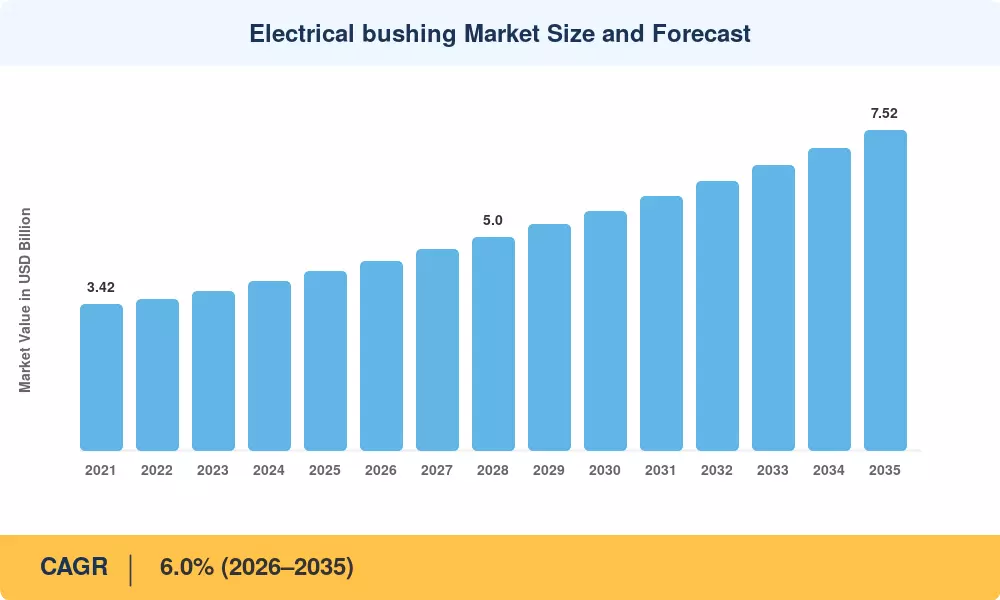
The global Electrical Bushing Market reached an estimated USD 4.20 billion in 2025 and is projected to grow from USD 4.45 billion in 2026 to USD 7.52 billion by 2035, registering a CAGR of 6.0% during the forecast period. This expansion is anchored in accelerating grid modernization programs worldwide, with global transmission and distribution investment surpassing USD 370 billion annually as countries race to integrate renewable generation capacity into aging networks [1]. The push toward high-voltage direct current (HVDC) corridors and cross-border interconnectors has placed transformer and switchgear infrastructure — and the bushings that enable safe conductor passage through grounded barriers — at the center of procurement planning across utilities and independent power producers.

A generational shift is underway in bushing technology. Traditional oil-impregnated paper (OIP) bushings, the workhorses of 20th-century substations, are increasingly giving way to resin-impregnated paper (RIP) designs that eliminate the fire and environmental risks of mineral-oil dielectrics. Several European transmission system operators have mandated RIP or composite alternatives for all new 220 kV-and-above installations, accelerating replacement cycles and pulling forward capital expenditure schedules [2]. IEC 61 462 and IEEE C57.19 revision activity further signal a regulatory environment that rewards next-generation insulation architectures.

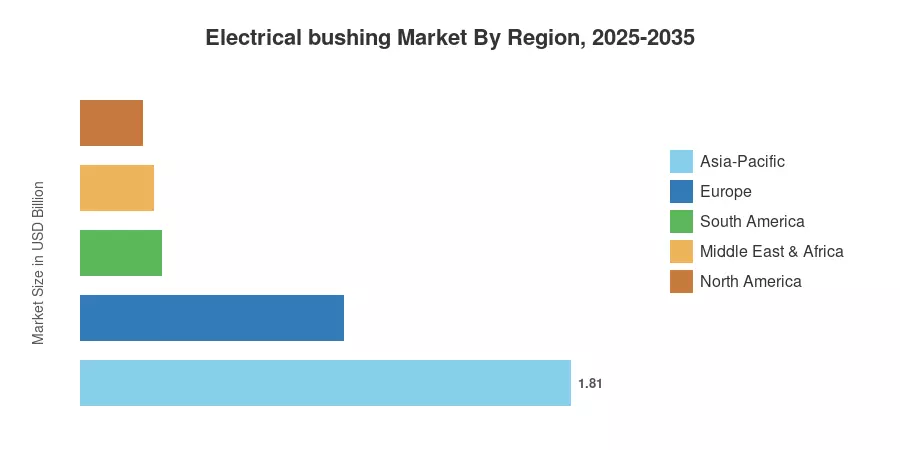
Asia-Pacific commands the largest share of the Electrical Bushing Market at roughly 43% of global revenue, driven by China's State Grid build-out and India's Green Energy Corridor program. The region also posts the fastest CAGR at an estimated 6.8%, outpacing the global average. Europe holds the second-largest position with approximately a 23% share, supported by TEN-E corridor investments and aging fleet replacement. North America follows closely, with substantial grid-hardening spend under the U.S. Bipartisan Infrastructure Law fueling demand through 2030 and beyond.


Key Report Takeaways

• By Type

  • Oil Impregnated Paper (OIP) holds the largest share of the Electrical Bushing Market by type, accounting for roughly 48% of global revenue in 2025, sustained by a massive installed base of legacy transformers.
  • Resin Impregnated Paper (RIP) is the fastest-growing type segment, projected to expand at a CAGR of 7.4% through 2035 as utilities prioritize fire-safe, maintenance-reduced alternatives.
  • Other Types — including composite-housing and gas-insulated designs — represent an emerging niche valued at approximately USD 0.42 billion in 2025.

• By Application

  • Transformers dominate the Electrical Bushing Market by application, contributing nearly 62% of global demand in 2025, reflecting massive ongoing grid development and fleet replacement.
  • Switchgears represent the second-largest application, growing at a CAGR of 5.8% as utilities deploy new circuit-breaker bays for renewable interconnection.

• By Region

  • Asia-Pacific leads the Electrical Bushing Market with an estimated 43% share, underpinned by China and India's grid investment programs.
  • North America is projected to grow at a CAGR of 5.5%, boosted by USD 65 billion in federal grid-modernization funding through the Infrastructure Investment and Jobs Act.
  • Europe accounts for an estimated USD 0.97 billion in 2025, anchored by cross-border corridor upgrades.


Electrical Bushing Market Size and Forecast (2021–2035)

Market Research Future's estimates are derived from a combination of bottom-up component-level revenue modeling, top-down cross-referencing with utility capital expenditure databases, and validation through primary interviews with transformer OEMs, bushing manufacturers, and grid operators across 28 countries. Historical data draws on published financial disclosures and import-export trade databases, while forecast projections incorporate announced infrastructure pipeline values, regulatory mandates, and technology substitution curves.
Electrical bushing Market Size and Forecast
Our Impact
Enabled $4.3B Revenue Impact for Fortune 500 and Leading Multinationals
Partnering with 2000+ Global Organizations Each Year
30K+ Citations by Top-Tier Firms in the Industry

Driver Impact Analysis

Driver ~% Impact on CAGR Geographic Relevance Impact Timeline
Transmission grid expansion for renewables +1.4% Global Long-term (≥4 yr)
Transformer fleet aging and replacement +1.1% North America, Europe Medium-term (2–4 yr)
HVDC corridor deployment +0.8% Europe, Asia-Pacific Long-term (≥4 yr)
Railway electrification programs +0.6% Asia-Pacific Medium-term (2–4 yr)
Smart grid and digital substation rollout +0.5% North America, Europe Short-term (≤2 yr)
Data center power infrastructure boom +0.4% North America, Asia-Pacific Short-term (≤2 yr)
Stricter fire-safety and environmental standards +0.3% Europe Medium-term (2–4 yr)


Transmission Grid Expansion for Renewable Energy

The world added over 510 GW of renewable generation capacity in 2023 alone, according to IEA, and cumulative additions through 2030 are forecast to exceed 3,000 GW [1]. Each gigawatt of solar or wind capacity requires corresponding high-voltage transmission infrastructure — typically 3 to 7 transformer bushings per substation bay — creating a structural demand multiplier for the Electrical Bushing Market.

Transformer Fleet Aging and Replacement

Approximately 70% of North America's large power transformer fleet is over 25 years old, and a significant portion of Europe's installed base predates 1990 [4]. As these units reach or exceed their designed service life, utilities face a binary choice: refurbish with new bushings or replace the entire transformer. Either path generates bushing demand.

HVDC Corridor Deployment

Cross-border HVDC links represent some of the most bushing-intensive infrastructure projects in the global pipeline. Converter-station bushings for HVDC applications carry stringent insulation and partial-discharge specifications, pushing average selling prices 30–40% above conventional AC counterparts and expanding the Electrical Bushing Market's value per unit installed.

Railway Electrification Programs

India’s plan to electrify its entire broad-gauge rail network by 2024 prompted demand for thousands of 25 kV traction transformer bushings, with that pull sustained by ongoing Indian Railways electrification of remaining routes [9]. China’s rapid expansion of high-speed rail, expected to exceed 50,000 km of track by 2035, is driving parallel demand for traction-system and substation bushings. The Electrical Bushing Market is extended outside its conventional utility customer base by these transportation-sector activities.


Restraints Impact Analysis

The following restraint-impact estimates use the same directional methodology as Section 4. Each figure represents the isolated negative effect on growth if other conditions remain unchanged.

Restraint ~% Impact on CAGR Geographic Relevance Impact Timeline
Raw material price volatility (alumina, copper) –0.6% Global Short-term (≤2 yr)
Long lead times for HV bushing manufacturing –0.5% Global Medium-term (2–4 yr)
Competition from gas-insulated switchgear (GIS) –0.4% Europe, Asia-Pacific Long-term (≥4 yr)
Skilled workforce shortages in HV testing –0.3% North America, Europe Medium-term (2–4 yr)
Regulatory fragmentation across IEC/IEEE standards –0.2% Global Long-term (≥4 yr)


Raw Material Price Volatility

Electrical bushings rely on high-purity alumina for porcelain housings, oxygen-free copper conductors, and specialty kraft paper for insulation wraps. Copper, which constitutes roughly 8–12% of total bushing material cost, tracked similarly volatile. These input-cost shocks ripple through the Electrical Bushing Market's value chain, creating procurement uncertainty that can defer capital projects by 6–12 months.

Long Manufacturing Lead Times

The order-to-delivery lead times for high-voltage bushings of 245 kV and above are frequently in the range of 14 to 22 months [13]. The bottleneck is compounded by limited worldwide manufacturing capacity – with fewer than 15 qualified manufacturers for extra-high-voltage ratings. The U.S. DOE’s 2023 supply-chain assessment identified bushing availability as one of the three worst supply restrictions impacting delivery schedules for big power transformers, warning that a single production setback can ripple into delays of multiple quarters for project schedules.


Competition from Gas-Insulated Switchgear

In the case of urban and space-constrained substations, this means that no separate exterior bushings are needed anymore, but the whole GIS enclosure is replaced by internal gas-to-air connections. GIS is gaining market acceptance, replacing conventional air-insulated switchgear bays and the accompanying bushings, especially in the 72.5-kV to 170-kV distribution-voltage segment in Europe [15]. But GIS does not influence the transformer bushing segment. However, it reduces incremental growth in the switchgear application category of the Electrical Bushing Market.


Electrical Bushing Market Opportunities

RIP and Composite Technology Transition

This technology substitution cycle creates a multi-decade retrofit opportunity that lifts both unit volumes and average selling prices, as RIP bushings typically command a 15–25% premium over OIP equivalents.

Emerging-Market Grid Build-Out

Some countries in sub-Saharan Africa still have an electricity rate of less than 50%. New backbone transmission systems of 500 kV are deployed in Southeast Asian countries [7]. These greenfield networks necessitate full bushing procurement from scratch, rather than the replacement-driven demand of older markets, allowing manufacturers the opportunity to create long-term supply partnerships. The African Development Bank’s Desert-to-Power initiative alone targets 10 GW of solar capacity with associated transmission infrastructure across the Sahel.


Smart Monitoring and Condition-Based Maintenance Services

The events of bushing failure constitute a disproportionate number of catastrophic failures of transformers; hence, real-time monitoring of capacitance, tan-delta, and partial discharge is an increasing priority [10]. Now a number of OEMs are embedding fiber-optic sensors directly inside bushing cores, creating a service revenue stream that supplements hardware sales. This transition to data-enabled aftermarket offerings empowers Electrical Bushing Market players to tap into ongoing sources of revenue beyond one-time equipment sales.


Data Center and Hyperscale Power Demand

Global data center electricity consumption is projected to double between 2024 and 2030, according to IEA estimates [11]. Each hyperscale facility requires dedicated substation infrastructure with multiple transformer bays, directly driving bushing procurement at 66 kV to 230 kV ratings. The concentration of new data center construction in Virginia (U.S.), Frankfurt (Germany), and Singapore presents a geographically targeted demand pocket for the Electrical Bushing Market.

Localization and Domestic Manufacturing Incentives

Several governments have introduced local-content requirements for grid equipment procurement. India's "Make in India" policy mandates domestic manufacturing for transformer components in state-utility tenders, while the U.S. Build America, Buy America Act extends similar provisions to federally funded grid projects [13]. These policies create opportunities for manufacturers willing to establish or expand production facilities in high-growth markets, reshaping the competitive landscape over the forecast period.


Electrical Bushing Market Future Outlook

Grid Digitalization and Predictive Bushing Analytics

The proliferation of IEC 61850-compliant digital substations is transforming how bushing condition data is collected, analyzed, and monetized. By 2030, an estimated 35% of new substation bays globally will include embedded bushing-monitoring systems capable of real-time capacitance and dissipation-factor trending [10]. This shift creates a parallel software and services market adjacent to the core Electrical Bushing Market.

Electrification Supercycle and Load Growth

The convergence of electric vehicle charging infrastructure, building electrification mandates, and industrial heat-pump adoption is forecast to increase global electricity demand by 40–60% between 2025 and 2040, per IEA projections [1]. Each incremental terawatt-hour of consumption requires corresponding grid capacity — substations, transformers, and their associated bushings. The Electrical Bushing Market stands to benefit disproportionately during peak build-out years (2028–2033) as utilities race to eliminate grid bottlenecks.

ESG, SF₆-Free Switchgear, and Insulation Innovation

Growing regulatory scrutiny of sulfur hexafluoride (SF₆) — a greenhouse gas with 23,500 times the global warming potential of CO₂ — is accelerating the transition to alternative insulating media in switchgear [15]. As GIS manufacturers shift to vacuum, clean air, or fluoronitrile solutions, bushing-to-enclosure interface designs must evolve accordingly. This presents both a challenge and an opportunity for the Electrical Bushing Market, as new gas-insulation chemistries require redesigned bushing sealing systems and may expand the addressable market to include retrofit kits for existing GIS installations.

Supply-Chain Regionalization and Capacity Expansion

Geopolitical tensions and pandemic-era disruptions have pushed utilities toward regionalized procurement strategies. Manufacturers are responding by establishing new production facilities closer to end markets — particularly in India, the United States, and Turkey [13]. By 2030, at least three major bushing OEMs are expected to commission greenfield factories outside their traditional European and East Asian manufacturing bases, reshaping cost structures and lead times across the Electrical Bushing Market.


Electrical Bushing Market Segmentation

By Type

Segment Key Metric Primary Demand Driver
Oil Impregnated Paper (OIP) ~48% share (2025) Legacy installed base, cost competitiveness at lower voltage ratings
Resin Impregnated Paper (RIP) CAGR ~7.4% Fire-safety mandates, reduced maintenance, environmental compliance
Other Types ~USD 0.42 B (2025) Composite-housing adoption, gas-insulated bushing niches


Oil Impregnated Paper bushings remain the volume leader in the Electrical Bushing Market, benefiting from decades of field-proven reliability and a global maintenance ecosystem that utilities are reluctant to abandon. OIP technology dominates the 72.5 kV to 170 kV range, where its cost advantage over RIP alternatives remains significant — often 20–30% lower per unit. However, OIP's reliance on mineral oil introduces fire-risk and environmental-spill liabilities that increasingly conflict with utility ESG commitments, particularly in indoor and urban substation installations.

Resin Impregnated Paper bushings are the clear growth engine of the type segment. RIP technology eliminates free mineral oil, dramatically reducing fire hazard and enabling installation in confined spaces without supplementary fire-suppression systems. European TSOs have led this transition — several mandate RIP for all new installations above 170 kV — and Asian utilities are following, with State Grid Corporation of China specifying RIP for select 500 kV and 750 kV projects [2]. The technology's higher upfront cost is partially offset by lower lifecycle maintenance expense, a trade-off that resonates with utilities adopting total-cost-of-ownership procurement frameworks.

By Application

Segment Key Metric Primary Demand Driver
Transformers ~62% share (2025) Grid expansion, fleet aging, HVDC converter stations
Switchgears CAGR ~5.8% Renewable interconnection, circuit-breaker bay additions
Other Applications ~USD 0.21 B (2025) Wall bushings, cable terminations, reactor installations


The transformer application dominates the Electrical Bushing Market because every power transformer — whether distribution, auto, or converter — requires multiple bushings as the sole insulated path between internal windings and external conductors. A typical 500 MVA autotransformer uses 9–12 bushings across HV, LV, and neutral terminals. As transformer fleet replacement accelerates globally and new renewable-evacuation transformers are commissioned, bushing demand scales proportionally. The switchgear application is growing steadily as utilities add new feeder bays and breaker-and-a-half configurations to accommodate distributed generation interconnections.


Regional Market Share Analysis

Region Key Metric Primary Investment Themes
Asia-Pacific ~43% share (2025) UHV transmission, railway electrification, renewable corridors
Europe ~23% share (2025) TEN-E interconnectors, RIP retrofit mandates, offshore wind grid
North America CAGR ~5.5% Grid hardening, transformer reserve, data center substations
South America ~USD 0.30 B (2025) Hydro-thermal transmission, mining-sector substations
Middle East & Africa CAGR ~6.4% GCC grid unification, African electrification programs
Total USD 4.20 B (2025)  

The Electrical Bushing Market displays distinct regional dynamics shaped by grid maturity, policy environments, and capital investment cycles. Asia-Pacific's dominance reflects the sheer scale of new-build transmission programs in China and India, while North America and Europe are driven primarily by aging-infrastructure replacement and regulatory mandates.


North America

Country Key Metric Key Driver
United States ~74% of regional share Infrastructure Investment & Jobs Act grid funding
Canada CAGR ~5.2% Inter-provincial transmission expansion
Mexico ~USD 0.06 B (2025) CFE modernization program


North America's Electrical Bushing Market growth is anchored in the USD 65 billion federal grid-investment commitment under the 2021 Infrastructure Investment and Jobs Act, supplemented by DOE loan guarantees for transmission projects exceeding USD 20 billion [4]. The U.S. accounts for the lion's share, with FERC Order 1920 expected to accelerate regional transmission planning and unlock dozens of new high-voltage line projects. Canada's interprovincial clean-energy corridor plans — notably the Atlantic Loop and Prairie Link — add incremental demand, while Mexico's CFE is upgrading aging 400 kV substations across the central corridor.

Europe

Country Key Metric Key Driver
Germany ~22% of regional share Energiewende, North Sea offshore wind connection
United Kingdom CAGR ~5.6% Great Grid Upgrade
France ~USD 0.12 B (2025) Nuclear fleet extension and new EPR substations
Italy ~12% of regional share Terna interconnector investments
Spain CAGR ~5.3% Solar corridor transmission build-out
Nordic Countries ~USD 0.08 B (2025) Cross-border HVDC links
Russia ~9% of regional share Federal Grid Company East Siberia expansion
Rest of Europe CAGR ~4.9% EU cohesion-fund grid projects


Europe's Electrical Bushing Market benefits from the ENTSO-E Ten-Year Network Development Plan, which identifies over EUR 100 billion in priority transmission investments through 2032 [6]. The United Kingdom's Great Grid Upgrade — described by National Grid as the largest overhaul since the 1950s — plans 17 new onshore and offshore transmission projects that will require thousands of EHV bushings. Germany's SuedLink and SuedOstLink HVDC corridors, each exceeding 700 km, further concentrate demand at the highest voltage ratings, pulling the regional average selling price upward.

Asia-Pacific

Country Key Metric Key Driver
China ~54% of regional share State Grid UHV program, "desert, gobi, and wasteland" initiative
India CAGR ~7.6% Green Energy Corridor Phase II, railway electrification
Japan ~USD 0.18 B (2025) Grid resilience post-earthquake upgrades
South Korea ~8% of regional share KEPCO offshore wind transmission
ASEAN CAGR ~6.9% ASEAN Power Grid cross-border interconnectors
Rest of Asia-Pacific ~USD 0.10 B (2025) Australia NEM Integrated System Plan, Bangladesh grid expansion


Asia-Pacific's position as the largest region in the Electrical Bushing Market reflects China's unmatched scale of transmission construction. State Grid Corporation of China plans to invest over CNY 500 billion annually in grid infrastructure through 2030, with UHV AC and DC corridors accounting for a significant portion [12]. India's Green Energy Corridor Phase II targets 10.7 GW of transmission capacity for renewable evacuation, and Indian Railways' ongoing electrification program continues to pull traction-transformer bushing volumes. Rapid industrialization across Southeast Asia, particularly Vietnam and Indonesia, adds a fast-growing demand frontier.

South America

Country Key Metric Key Driver
Brazil ~58% of regional share ANEEL transmission auctions, Amazon hydro evacuation
Argentina CAGR ~5.1% Vaca Muerta energy-corridor substations
Rest of South America ~USD 0.06 B (2025) Chile, Colombia copper-mining substations


Brazil dominates South America's Electrical Bushing Market through its annual ANEEL transmission-line auctions, which consistently award 5,000–8,000 km of new 500 kV lines per cycle. The Amazon region's remote hydroelectric complexes require long-distance HVDC transmission with specialized converter-station bushings. Argentina's nascent Vaca Muerta shale development is driving new 500 kV substation construction in Neuquén province, while Chilean and Colombian mining expansions sustain steady procurement at medium-voltage ratings.

Middle East & Africa

Country Key Metric Key Driver
Saudi Arabia ~28% of regional share Vision 2030, NEOM and renewable mega-projects
UAE CAGR ~6.1% DEWA and ADWEC grid modernization
South Africa ~USD 0.05 B (2025) Eskom Transmission Development Plan
Egypt ~14% of regional share 500 kV Benban solar interconnection
Rest of MEA CAGR ~6.7% East African Power Pool, West Africa Power Pool


The Middle East & Africa region posts the second-fastest growth trajectory in the Electrical Bushing Market, propelled by divergent but complementary drivers. GCC nations are investing heavily in grid unification and renewable mega-projects — Saudi Arabia's NEOM alone will require dedicated transmission infrastructure at multiple voltage levels [7]. In Sub-Saharan Africa, the African Development Bank's electrification programs and cross-border power pools (EAPP, WAPP, SAPP) are commissioning new 220 kV and 330 kV backbone networks that represent greenfield bushing demand with limited incumbent-replacement competition.


Electrical bushing Market By Region, 2025-2035

Competitive Benchmarking

The Electrical Bushing Market exhibits medium concentration, with the top five manufacturers accounting for an estimated 48–55% of global revenue. The Herfindahl-Hirschman Index (HHI) for the market is estimated in the 900–1,100 range, indicating a moderately competitive structure. Barriers to entry remain high for extra-high-voltage ratings (245 kV+) due to stringent type-testing requirements under IEC 60137, specialized manufacturing equipment, and the need for extensive field-performance track records to qualify with major utilities.

Company Est. Revenue Share Range Key Offerings for Electrical Bushing Market Strategic Positioning
Hitachi Energy ~12–15% Full OIP/RIP portfolio up to 1,200 kV; embedded monitoring Global leader with broadest voltage-range coverage
Siemens Energy ~10–13% RIP and composite bushings; digital condition monitoring Integrated transformer-bushing system supplier
GE Vernova ~7–10% OIP and RIP bushings for power and instrument transformers Strong North American utility relationships
Trench Group ~6–9% High-voltage instrument transformers and bushings Niche EHV specialist with deep utility trust
Hubbell Incorporated ~4–7% Medium-voltage distribution bushings and accessories Cost-competitive, high-volume distribution focus
HSP Hochspannungsgeräte ~3–5% EHV bushings up to 800 kV; RIP technology pioneer Swiss engineering heritage, premium positioning
RHM International ~3–5% OIP and RIP bushings for transformers and reactors Mid-tier global supplier with diversified customer base
Meister International ~2–4% Capacitive graded bushings for utility and industrial European retrofit and replacement specialist
Yash Highvoltage ~2–4% OIP bushings and wall bushings up to 420 kV Cost-leader in Indian and Asian markets
Jiangsu Jingke Smart Electric ~2–4% OIP and RIP bushings, smart monitoring modules Fast-growing Chinese supplier with export ambitions


Recent News & Developments

  • Hitachi Energy (October 2023): Hitachi Energy expanded its global transformer component production capacity across European and Asian manufacturing sites, accelerating dry-type Resin-Impregnated Paper (RIP) and Resin-Impregnated Synthetics (RIS) bushing deliveries to meet transmission grid expansion demand.


  • GE Vernova (March 2024): GE Vernova expanded its high-voltage bushing portfolio by introducing eco-friendly Resin-Impregnated Synthetics (RIS) transformer bushings up to 420 kV, offering fire-resistant and explosion-proof replacements for legacy oil-impregnated paper units.


  • Indian Ministry of Power (January 2024): Released updated procurement guidelines mandating domestic manufacturing of transformer bushings for all central-government-funded transmission projects above 132 kV [9].


  • HSP Hochspannungsgeräte (June 2023): Launched an integrated fiber-optic monitoring system embedded within RIP bushing cores, enabling continuous tan-delta and partial-discharge measurement without external sensors [10].


Electrical Bushing Market Report Scope

Parameter Details
Market Scope Global Electrical Bushing Market covering all insulation types, applications, and voltage classes
Study Period 2021–2035
Historical Period 2021–2024
Base Year 2025
Forecast Period 2026–2035
CAGR 6.0% (2026–2035)
2025 Market Size USD 4.20 Billion
2035 Market Size USD 7.52 Billion
Fastest Growing Segment Resin Impregnated Paper (by Type); Asia-Pacific (by Region)
Companies Profiled 10 (Hitachi Energy, Siemens Energy, GE Vernova, Trench Group, Hubbell, HSP, RHM International, Meister International, Yash Highvoltage, Jiangsu Jingke Smart Electric)
Valuation Currency USD (United States Dollar)

FAQs

What is the typical service life of a high-voltage bushing, and when should utilities plan for replacement?
Most OIP bushings are designed for a 30–40 year service life, though actual replacement timing depends on operating conditions, pollution levels, and diagnostic results from routine tan-delta testing [10]. Utilities generally begin monitoring more intensively after 25 years.
How do RIP bushings compare to OIP designs in terms of total cost of ownership?
RIP bushings carry a 15–25% higher upfront price but eliminate oil-monitoring costs, reduce fire-suppression requirements, and typically require no scheduled maintenance over their service life [2]. The lifecycle cost advantage often appears within 10–12 years of installation.
What procurement lead times should grid operators expect for EHV bushings rated above 245 kV?
Lead times for EHV-rated bushings currently range from 14 to 22 months depending on voltage class and manufacturer backlog [13]. Utilities are increasingly placing frame-agreement orders 24–36 months ahead to secure production slots.
How does the transition to SF₆-free switchgear affect bushing specifications?
New insulating media such as fluoronitrile or clean air operate at different pressures and dielectric strengths, requiring redesigned bushing-to-enclosure sealing interfaces [15]. Bushing manufacturers are developing compatible flange designs in parallel with GIS OEMs.
Are there voltage-class thresholds where composite-housing bushings are preferred over porcelain?
Composite silicone-rubber housings are utilized across all voltage tiers—from 72.5 kV up to 800 kV UHV—due to their superior non-shattering seismic resilience, light weight, and self-cleaning hydrophobic properties in heavily polluted environments. Rather than being restricted below 245 kV, composite insulation is rapidly replacing traditional porcelain across extra-high-voltage transmission networks.
What role do domestic-content requirements play in bushing sourcing decisions?
India, the U.S., and Brazil all enforce local-content mandates for utility grid equipment, directing procurement toward domestic or regionally manufactured bushings [9]. These policies can add 5–10% to unit costs but reduce supply-chain risk exposure.
How is embedded sensor technology changing bushing condition monitoring?
Fiber-optic sensors integrated into bushing cores enable continuous, real-time measurement of temperature, capacitance, and partial discharge without external coupling devices [10]. This capability shifts maintenance from calendar-based schedules to condition-based intervention.    
Author
Author
Author Profile
Anshula Mandaokar LinkedIn
Team Lead - Research
Anshula Mandaokar holds an academic degree in Chemical Engineering and has been contributing to the field for more than 5 years. She has expertise in Market Research and Business Consulting and serves as a Team Lead for a reputed Market Research firm under the Chemicals and Materials domain spectrum. She has worked on multiple projects, generating explicit results in a quick turnaround time. Her understanding of data interpretation justifies her role as a leader.

Research Approach


Secondary Research

The secondary research process involved comprehensive analysis of regulatory databases, industry standards, peer-reviewed engineering journals, and authoritative energy sector organizations. Key sources included the U.S. Department of Energy (DOE), International Electrotechnical Commission (IEC), IEEE (Institute of Electrical and Electronics Engineers), CIGRE (International Council on Large Electric Systems), U.S. Energy Information Administration (EIA), European Network of Transmission System Operators for Electricity (ENTSO-E), International Energy Agency (IEA), National Electrical Manufacturers Association (NEMA), Edison Electric Institute (EEI), Power Transformer News & Intelligence, Transformer Technology Magazine, IEC 60137 standards database, IEEE Transformer Committee publications, Asian Development Bank (ADB) Energy Sector reports, World Bank Energy & Extractives Global Practice, and national grid operator annual reports from key markets (China State Grid, Tennet, National Grid, TEPCO). These sources were used to collect equipment statistics, technical specification data, smart grid deployment figures, transmission infrastructure investment trends, and market landscape analysis for oil-impregnated paper bushings, liquid-insulated bushings, gas-insulated bushings, and combined insulation technologies.


Primary Research

To gather both qualitative and quantitative insights, supply-side and demand-side stakeholders were interviewed during the primary research phase. CEOs, VPs of engineering, heads of product development, directors of research and development, and regulatory affairs managers from manufacturers of electrical bushings, transformers, and insulating materials were examples of supply-side sources. Demand-side sources included railway electrification authorities, heavy industries (steel, mining, and petrochemicals), transmission system operators (TSOs), distribution system operators (DSOs), chief engineers, asset managers, procurement directors, and grid infrastructure planners from electric utilities. Market segmentation, product development timetables, technical specifications, procurement trends, lifetime cost analysis, and aftermarket service dynamics were all verified by primary research.

Primary Respondent Breakdown:

By Designation: C-level Primaries (28%), Director Level (35%), Others (37%)

By Region: North America (32%), Europe (30%), Asia-Pacific (33%), Rest of World (5%)


Market Size Estimation

Global market valuation was derived through revenue mapping and installation volume analysis. The methodology included:

Identification of 35+ key manufacturers across North America, Europe, Asia-Pacific, and the Middle East

Product mapping across oil-impregnated paper (OIP), liquid-insulated (RBP/resin-bonded paper), gas-insulated (SF₆/air), and combined insulation bushing categories

Analysis of reported and modeled annual revenues specific to electrical bushing portfolios

Coverage of manufacturers representing 75-80% of global market share in 2024

Extrapolation using bottom-up (installation volume × ASP by voltage class and region) and top-down (manufacturer revenue validation) approaches to derive segment-specific valuations, including dedicated analysis of transformer OEM demand and utility aftermarket replacement cycles

Download Free Sample

Kindly complete the form below to receive a free sample of this Report

* Please use a valid business email

Download PDF ×

We do not share your information with anyone. However, we may send you emails based on your report interest from time to time. You may contact us at any time to opt-out.
















