Electromagnetic Flowmeter Market (2026 - 2035)

Electromagnetic Flowmeter Market Research Report By Product Type (In-Line Magnetic, Low-Flow Magnetic, Insertion Magnetic, Others (Partial-Fill, Hygienic)), By Component (Flow Tube, Transmitter, Liner), By Liner Material (PTFE, PFA, Rubber (Hard/Soft), Ceramic), By Communication Protocol (4โ€“20 mA / HART, PROFIBUS / PROFINET, Foundation Fieldbus / Others), By End-User Industry (Water and Wastewater, Oil and Gas, Chemicals, Food and Beverage, Pharmaceuticals and Biotech, Metals and Mining, Others (Pulp/Paper, Power)) and By Regional (North America, Europe, South America, Asia Pacific, Middle East and Africa) - Forecast to 2035
ID: MRFR/Equip/23781-HCR
128 Pages
Snehal Singh
Last Updated: August 24, 2026
Electromagnetic Flowmeter Market
Market Size
Forecast Period2026-2035
CAGR (2026-2035)5.85%
2025 Market SizeUSD 15.96 Billion
2035 Market SizeUSD 28.20 Billion
Key Players
Endress+Hauser
ABB Ltd
Siemens AG
Emerson Electric Co.
Yokogawa Electric
Krohne Group
Opportunities
  • Smart Water-Grid Digital Twins
  • Emerging-Market Leapfrog via Mobile-Connected Meters
  • Data Monetization and Predictive Maintenance

Electromagnetic Flowmeter Market Summary

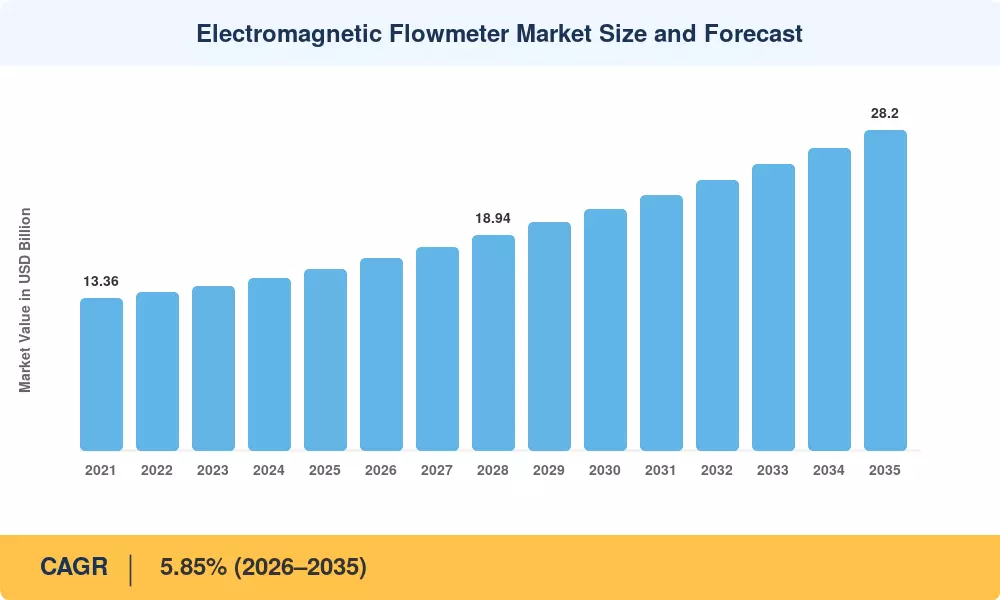
The global electromagnetic flowmeter market reached an estimated USD 15.96 billion in 2025 and is projected to grow from USD 16.90 billion in 2026 to USD 28.20 billion by 2035, registering a CAGR of 5.85% during the forecast period. This growth trajectory reflects a convergence of tightening water-quality regulations and accelerating industrial digitalization. Governments across more than 60 countries have introduced or expanded clean-water mandates since 2022, and the United Nations World Water Development Report identified infrastructure modernization as a USD 150 billion annual investment gap โ€” a gap that directly feeds demand for precision flow instrumentation [1].

Legacy mechanical flow meters โ€” paddle-wheel, turbine, and differential-pressure devices โ€” are steadily yielding ground to electromagnetic alternatives that deliver higher accuracy on conductive liquids without moving parts. The U.S. Environmental Protection Agency's 2024 Lead and Copper Rule revisions, for instance, now require tighter monitoring of distribution-system flow, channeling capital toward digital-ready electromagnetic instruments [2]. Process industries, from pulp-and-paper to mining, are following suit as they pursue ISO 50001 energy management certifications that demand verifiable flow data.

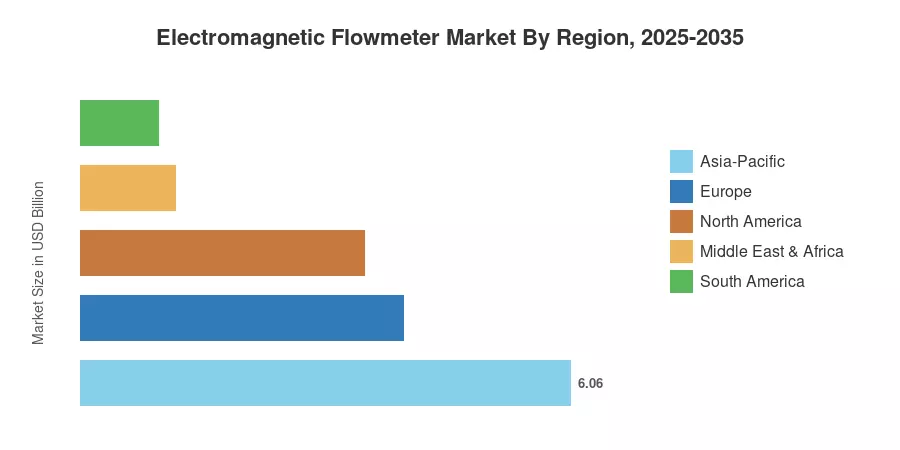
Asia-Pacific commands approximately 38% of the electromagnetic flowmeter market, buoyed by China's "14th Five-Year Plan" wastewater treatment build-out and India's Jal Jeevan Mission piped-water program [3]. The Middle East & Africa region is the fastest-growing segment with an estimated CAGR of 7.4%, propelled by desalination mega-projects in Saudi Arabia and the UAE. Europe holds around 25% share, sustained by the EU Urban Wastewater Treatment Directive recast. The decade ahead will hinge on how quickly IIoT-enabled transmitters replace analog installed bases across all regions.

ย 

Key Report Takeaways

โ€ข By Product Type

  • In-line magnetic flowmeters account for roughly 62% of the electromagnetic flowmeter market, driven by water utility and chemical plant upgrades.
  • Low-flow magnetic devices are growing at a CAGR of approximately 7.1%, propelled by pharmaceutical and semiconductor fab clean-room demand.

โ€ข By End-User Industry

  • Water and wastewater utilities represent USD 5.92 billion of 2025 demand, making the segment the single-largest revenue contributor to the electromagnetic flowmeter market.
  • Oil and gas end users are expanding instrumentation budgets at roughly 6.3% CAGR as upstream operators digitize custody-transfer measurement.

โ€ข By Region

  • Asia-Pacific is the dominant region, with China alone contributing about 44% of regional revenue.
  • The Middle East & Africa electromagnetic flowmeter market is forecast to exceed USD 3.1 billion by 2035, the fastest pace globally.
  • North America holds roughly 22% share, anchored by U.S. EPA regulatory modernization and Canadian mining-sector upgrades.

ย 

Electromagnetic Flowmeter Market Size and Forecast (2021โ€“2035)

Market sizing combines bottom-up revenue analysis of leading manufacturers' annual filings with top-down demand modeling across five end-user verticals. Historical figures (2021โ€“2024) reflect reported revenues and trade data; the 2025 base year blends preliminary company disclosures with distributor channel checks. Forecast values (2026โ€“2035) apply a calibrated CAGR anchored in policy-driven demand scenarios and validated against independent analyst benchmarks.
Electromagnetic Flowmeter Market Size and Forecast
Our Impact
Enabled $4.3B Revenue Impact for Fortune 500 and Leading Multinationals
Partnering with 2000+ Global Organizations Each Year
30K+ Citations by Top-Tier Firms in the Industry

Driver Impact Analysis

Driver ~% Impact on CAGR Geographic Relevance Impact Timeline
Clean-water regulatory mandates +1.4% Global Short-term
Industrial IIoT and digitalization +1.2% North America, Europe Medium-term
Desalination and water-reuse expansion +0.8% Middle East, Asia-Pacific Medium-term
Mining and metals process automation +0.6% South America, Asia-Pacific Long-term
Pharmaceutical and biotech cleanroom growth +0.5% North America, Europe Short-term
Oil and gas custody-transfer digitization +0.4% Middle East, North America Medium-term
Smart-city water-grid investments +0.3% Asia-Pacific, Europe Long-term

ย 

Clean-Water Regulatory Mandates

The electromagnetic flowmeter market draws its strongest near-term tailwind from regulatory enforcement. The U.S. EPA's revised Lead and Copper Rule alone is expected to trigger USD 4.3 billion in distribution-infrastructure upgrades through 2030, with precision flow metering a core compliance requirement [2]. India's Jal Jeevan Mission has allocated INR 3.6 lakh crore (approximately USD 43 billion) toward universal household tap-water connections, creating large-volume procurement pipelines for electromagnetic meters across rural water networks [3].

Industrial IIoT and Digitalization

Process manufacturers are replacing pneumatic and 4โ€“20 mA analog loops with Ethernet-based protocols like PROFINET and EtherNet/IP. A 2024 ARC Advisory Group study found that 47% of process plants plan fieldbus-to-Ethernet migrations within three years, and electromagnetic flowmeters with onboard diagnostics are the preferred upgrade path because they offer self-verification without process interruption [6]. This wave is particularly strong in North American chemical plants and European food-and-beverage facilities.

Desalination and Water-Reuse Expansion

Global desalination capacity is forecast to reach 180 million mยณ/day by 2030, up from roughly 120 million mยณ/day in 2024, according to the International Desalination Association [7]. Each large reverse-osmosis plant requires hundreds of electromagnetic meters for brine-flow management and permeate monitoring. Saudi Arabia's SWCC alone has USD 8 billion in active desalination projects, with the electromagnetic flowmeter market benefiting from mandatory local-content procurement policies.

Mining and Metals Process Automation

Latin American and Australian mining operators are investing in slurry handling automation to meet ESG tailings-management commitments. Rio Tinto's 2024 sustainability report disclosed a USD 520 million digital-operations budget that includes real-time slurry-flow monitoring in iron-ore processing circuits [8]. Electromagnetic flowmeters are uniquely suited for abrasive slurry service because they present no obstructions to the flow stream.

ย 

Restraints Impact Analysis

Restraint ~% Impact on CAGR Geographic Relevance Impact Timeline
Conductivity limitation on non-conductive fluids โ€“0.6% Global Persistent
High installed cost vs. mechanical meters โ€“0.5% Emerging markets Short-term
Skilled-technician shortage for calibration โ€“0.4% Africa, South America Medium-term
Competition from ultrasonic and Coriolis meters โ€“0.3% North America, Europe Medium-term
Raw-material price volatility (PTFE, rare earths) โ€“0.2% Global Short-term

ย 

Conductivity Limitation

Electromagnetic flowmeters require a minimum fluid conductivity of approximately 5 ยตS/cm, which excludes hydrocarbons, deionized water, and many solvents. This fundamental physical constraint caps the addressable market at conductive liquids, channeling a meaningful share of industrial spending toward ultrasonic and Coriolis alternatives [12]. Manufacturers are pushing electrode-material innovations to lower the threshold, but the physics imposes a hard floor.

High Installed Cost in Emerging Markets

A 6-inch electromagnetic flowmeter typically costs 2โ€“3ร— more than a comparable turbine meter, and installation requires straight-run piping that adds civil-works expense. In price-sensitive markets across Sub-Saharan Africa and Southeast Asia, municipal utilities often default to mechanical meters despite inferior accuracy [13]. Financing mechanisms such as World Bank performance-based contracts are beginning to offset this barrier, but adoption lags developed-market norms by five to seven years.

Competition from Ultrasonic and Coriolis Technologies

Clamp-on ultrasonic meters, which require no pipe cutting, have gained share in retrofit scenarios where downtime costs are prohibitive. Coriolis meters, meanwhile, offer mass-flow measurement that electromagnetic designs cannot match. Together these competing technologies constrain the electromagnetic flowmeter market's penetration in custody-transfer oil applications and high-purity pharmaceutical flows [15].

ย 

Electromagnetic Flowmeter Market Opportunities

Smart Water-Grid Digital Twins

Hydraulic digital twins with dense sensor arrays are being built by municipalities in Singapore, Copenhagen and a number of U.S. cities. Electromagnetic flowmeters with edge-computing transmitters are able to deliver real-time pressure and flow data to cloud-based dual platforms , enabling a new recurring-revenue layer for meter OEMs through software subscriptions [11].

ย 

Emerging-Market Leapfrog via Mobile-Connected Meters

While sub-Saharan Africa and parts of South Asia may not have wired SCADA infrastructure, 4G/5G coverage is growing rapidly. Battery powered electromagnetic flowmeters with cellular backhaul โ€“ a recent offering from several tier-one manufacturers โ€“ allow utilities to adopt precision measurement without the historical communications investment [14].

ย 

Data Monetization and Predictive Maintenance

The diagnostic data streams of installed electromagnetic flowmeters are an unexplored revenue opportunity. By aggregating anonymized flow signature data, OEMs can provide predictive maintenance analytics and benchmarking insights back to plant operators, transforming their business model from hardware sales to outcome-based contracts [6].

ย 

Green Hydrogen and Battery Gigafactory Electrolyte Metering

The global push toward green hydrogen electrolysis and lithium-ion battery manufacture necessitates corrosion-resistant metering of caustic electrolytes. Ceramic-lined electromagnetic flowmeters are among the rare ones that can withstand concentrated KOH and sulfuric acid at high temperatures. The market for electromagnetic flowmeters is set to increase its market share in the energy-transition supply chain [17].

ย 

Food and Beverage Hygienic Compliance

Updated FDA and EHEDG sanitary-design guidelines are pushing food processors to replace sight-glass and vortex meters with CIP-compatible electromagnetic instruments that meet 3-A sanitary standards. The global processed-food sector's USD 4.6 trillion revenue base ensures sustained replacement demand [18].

ย 

Electromagnetic Flowmeter Market Future Outlook

AI-Enabled Self-Diagnosing Meters

By 2030, leading electromagnetic flowmeter vendors are expected to embed edge-AI processors that detect electrode fouling, liner degradation, and process anomalies in real time. IEC 62443 cybersecurity certification for these smart devices will become a procurement prerequisite in critical water and chemical infrastructure, creating a differentiation axis for OEMs that invest early [22].

Platform Economics and Outcome-Based Contracts

The electromagnetic flowmeter market is shifting from transactional hardware sales toward platform-based business models. Vendors packaging flow data analytics, remote calibration verification, and regulatory compliance dashboards can capture 3โ€“5ร— the lifetime value of a standalone meter. Emerson's Plantweb and ABB's Ability platforms illustrate this trajectory [23].

Electrification Supercycle and Energy-Transition Metering

The IEA's 2024 World Energy Outlook projects cumulative clean-energy investment of USD 4.5 trillion annually by 2030 [17]. Green hydrogen electrolyzers, battery slurry mixing, and carbon-capture solvent loops all require corrosion-resistant electromagnetic flow measurement, expanding the electromagnetic flowmeter market's addressable verticals beyond its traditional water-and-chemical core.

ESG Reporting and Regulatory Traceability

Scope 3 emissions disclosure rules โ€” including the EU's Corporate Sustainability Reporting Directive and the SEC's climate-risk framework โ€” demand auditable mass-balance data across supply chains. Electromagnetic flowmeters that generate time-stamped, tamper-evident flow records will become compliance infrastructure rather than optional instrumentation [24].

ย 

Electromagnetic Flowmeter Market Segmentation

By Product Type

Segment Key Metric Primary Demand Driver
In-Line Magnetic ~62% share (2025) Municipal water and wastewater metering
Low-Flow Magnetic CAGR ~7.1% Pharma, semiconductor, and lab applications
Insertion Magnetic ~USD 1.28 B (2025) Retrofit on large-diameter pipes
Others (Partial-Fill, Hygienic) ~6% share (2025) Food/beverage and specialty chemical

ย 

In-line magnetic flowmeters dominate the electromagnetic flowmeter market because they offer the widest range of pipe sizes (DN 2.5 to DN 3000) and the broadest chemical compatibility through interchangeable liner materials. Water utilities overwhelmingly specify in-line designs for both distribution and raw-water intake.

Low-flow magnetic devices are gaining traction in applications requiring measurement below 1 liter per minute. Semiconductor fabs, in particular, demand sub-percent accuracy on ultra-pure water and chemical-mechanical planarization slurries, making this the fastest-growing product category.

By Component

Segment Key Metric Primary Demand Driver
Flow Tube ~48% share (2025) Core sensing element in every installation
Transmitter CAGR ~6.4% IIoT and remote-monitoring upgrades
Liner ~USD 2.86 B (2025) Chemical compatibility requirements

ย 

Flow tubes represent the largest component share because they constitute the primary sensing body and carry the highest per-unit material cost, especially in large-diameter alloy-electrode designs. Transmitters are the fastest-growing component as plant operators upgrade standalone indicators to networked units with HART 7 and PROFINET support.

By Liner Material

Segment Key Metric Primary Demand Driver
PTFE ~39% share (2025) Broad chemical resistance
PFA CAGR ~6.7% High-purity pharmaceutical and chemical
Rubber (Hard/Soft) ~USD 2.38 B (2025) Abrasive slurry and mining
Ceramic ~8% share (2025) Extreme abrasion and temperature

ย 

PTFE remains the dominant liner material segment within the electromagnetic flowmeter market, fueled by its exceptional broad-spectrum chemical resistance across aggressive industrial and wastewater applications. PFA stands out as the fastest-growing liner material segment, propelled by stringent cleanliness standards and rising deployment in high-purity pharmaceutical manufacturing and fine-chemical processing.

By Communication Protocol

Segment Key Metric Primary Demand Driver
4โ€“20 mA / HART ~52% share (2025) Legacy installed base compatibility
PROFIBUS / PROFINET CAGR ~7.3% European automation migration
Foundation Fieldbus / Others ~USD 1.62 B (2025) Process-plant specific protocols

ย 

4โ€“20 mA / HART remains the dominant communication protocol segment within the electromagnetic flowmeter market, fueled by its widespread legacy installed base compatibility and trusted reliability across standard industrial process loops. PROFIBUS / PROFINET stands out as the fastest-growing communication protocol segment, propelled by plant-wide digital modernization initiatives and robust European automation migrations toward high-speed, deterministic industrial Ethernet networks.

By End-User Industry

Segment Key Metric Primary Demand Driver
Water and Wastewater ~37% share (2025) Regulatory compliance, smart grids
Oil and Gas CAGR ~6.3% Custody transfer digitization
Chemicals ~USD 2.41 B (2025) Corrosion-resistant metering needs
Food and Beverage ~11% share (2025) Hygienic design compliance
Pharmaceuticals and Biotech CAGR ~7.0% Clean-room and CIP requirements
Metals and Mining ~7% share (2025) Slurry and tailings management
Others (Pulp/Paper, Power) ~USD 1.12 B (2025) Diverse process metering

ย 

Water and wastewater is the electromagnetic flowmeter market's anchor vertical. Utilities prize electromagnetic meters for their obstruction-free design, which avoids clogging on raw water carrying sediment and biological matter. Aging infrastructure in the U.S. and Europe, combined with greenfield build-out in India and Africa, ensures this segment's dominance through 2035.

Oil and gas operators are the fastest-growing major end users, driven by the push to automate produced-water handling and to digitize fiscal-metering stations. The segment's growth is concentrated in the Middle East and North American shale basins, where bi-directional measurement capability during well-testing and injection cycles is critical [10].

ย 

Regional Market Share Analysis

Region Key Metric Primary Investment Themes
Asia-Pacific ~38% share (2025) Water treatment, semiconductor fabs, mining
Europe ~25% share (2025) EU regulatory compliance, food/beverage hygiene
North America ~22% share (2025) EPA mandates, oil & gas digitization
Middle East & Africa CAGR ~7.4% Desalination, smart-city utilities
South America ~6% share (2025) Mining automation, municipal water
Total USD 15.96 B (2025) โ€”

The electromagnetic flowmeter market exhibits a multi-polar geographic structure, with Asia-Pacific leading on volume and the Middle East & Africa growing fastest on intensity of desalination and infrastructure investment.

ย 

North America

Country Key Metric Key Driver
United States ~74% of regional revenue EPA LCRR compliance
Canada CAGR ~5.6% Mining and oil-sands digitization
Mexico ~USD 0.38 B (2025) Municipal water modernization

ย 

North America's electromagnetic flowmeter market is shaped by regulatory pull and industrial upgrade cycles. The Bipartisan Infrastructure Law allocated USD 55 billion toward water systems, with a significant share directed at meter replacement and advanced metering infrastructure in aging U.S. municipal networks [2]. Canadian oil-sands operators are investing in electromagnetic meters to meet Alberta Energy Regulator custody-transfer accuracy mandates.

Europe

Country Key Metric Key Driver
Germany ~23% of regional share Chemical/pharma instrumentation
United Kingdom CAGR ~5.3% Water utility privatization upgrades
France ~USD 0.54 B (2025) Nuclear plant cooling-loop monitoring
Italy ~12% of regional share Food and beverage sector
Spain CAGR ~5.1% Desalination and irrigation
Nordic Countries ~8% of regional share Pulp, paper, district heating
Russia ~USD 0.31 B (2025) Oil refinery modernization
Rest of Europe CAGR ~4.9% Diverse industrial needs

ย 

Europe's share of the electromagnetic flowmeter market is sustained by the recast EU Urban Wastewater Treatment Directive, which extends treatment requirements to agglomerations above 1,000 population equivalents by 2035 [19]. Germany remains the technology hub, with Endress+Hauser and Krohne headquartered in the region and driving R&D in next-generation liner materials.

Asia-Pacific

Country Key Metric Key Driver
China ~44% of regional revenue 14th Five-Year Plan water infrastructure
India CAGR ~7.8% Jal Jeevan Mission, smart cities
Japan ~USD 0.82 B (2025) Semiconductor and pharma clean-rooms
South Korea ~9% of regional share Battery gigafactory expansion
ASEAN CAGR ~6.9% Urbanization-driven water demand
Rest of Asia-Pacific ~5% of regional share Mining and general industrial

ย 

Asia-Pacific dominates the electromagnetic flowmeter market in absolute terms. China's Ministry of Ecology and Environment has mandated continuous discharge monitoring at all industrial wastewater outfalls, generating procurement volumes that no other single country matches [3]. India's rapid urbanization โ€” adding an estimated 300 million urban residents by 2035 โ€” ensures a structural demand floor for metering infrastructure across water, chemicals, and power.

South America

Country Key Metric Key Driver
Brazil ~58% of regional revenue Sanitation framework (Marco Legal)
Argentina CAGR ~5.2% Vaca Muerta shale operations
Rest of South America ~USD 0.18 B (2025) Copper and lithium mining

ย 

Brazil's 2020 Sanitation Framework Law (Marco Legal do Saneamento) targets universal water and sewage coverage by 2033, unlocking an estimated USD 16 billion in concession-linked infrastructure spending that includes electromagnetic flow instrumentation for distribution networks [20].

Middle East & Africa

Country Key Metric Key Driver
Saudi Arabia ~32% of regional revenue NEOM, desalination mega-projects
UAE CAGR ~7.6% Smart-city utility networks
South Africa ~USD 0.19 B (2025) Mining and municipal water
Egypt CAGR ~6.8% Nile basin water management
Rest of MEA ~18% of regional share General infrastructure

ย 

The Middle East & Africa electromagnetic flowmeter market registers the highest growth globally, driven by Saudi Arabia's Vision 2030 water-security investments and the UAE's mandate that all new utility connections be digitally metered. Africa's growth, though from a smaller base, is catalyzed by AfDB and World Bank co-financed urban water programs [21].

ย 

Electromagnetic Flowmeter Market By Region, 2025-2035

Competitive Benchmarking

The electromagnetic flowmeter market exhibits medium concentration, with the top five players accounting for an estimated 52โ€“58% of global revenue. The Herfindahl-Hirschman Index (HHI) sits in the 900โ€“1,200 range, indicating a moderately competitive field where tier-one instrumentation conglomerates compete alongside specialized flow-measurement companies. Differentiation hinges on liner-material science, digital transmitter ecosystems, and installed-base service networks.

Company Est. Revenue Share Range Key Offerings Strategic Positioning
Endress+Hauser ~14โ€“17% Proline Promag series, Heartbeat Technology Full-lifecycle verification leader
ABB Ltd ~10โ€“13% ProcessMaster, AquaMaster Integrated automation ecosystem
Siemens AG ~8โ€“11% SITRANS FM MAG series Digital twin integration
Emerson Electric Co. ~7โ€“10% Rosemount 8700 series, Plantweb Outcome-based service model
Yokogawa Electric ~5โ€“8% ADMAG AXF/AXW series Asia-Pacific process dominance
Krohne Group ~5โ€“7% OPTIFLUX series, FOCUS technology Specialty chemical/mining focus
Honeywell International ~4โ€“6% Versaflow Mag series Building and process automation
Azbil Corporation ~3โ€“5% MagneW series Japan domestic and pharma niche
Badger Meter Inc. ~2โ€“4% M-Series, ModMAG Municipal water specialist
Danfoss A/S ~2โ€“3% MAG series for district energy Heating and cooling flow niche

ย 

ย 

Recent News & Developments

  • Endress+Hauser (March 2025): Launched the Promag W 800 with integrated cellular connectivity for remote water-network monitoring, targeting utilities in emerging markets [Ref 6].

ย 

ย 

ย 

ย 

ย 

  • U.S. EPA (October 2024): Published final Lead and Copper Rule Improvements, mandating enhanced flow-monitoring at community water-system points of entry, effective October 2024 [Ref 2].

ย 

ย 

ย 

ย 

Electromagnetic Flowmeter Market Report Scope

Parameter Detail
Market Scope Global electromagnetic flowmeter market โ€” hardware, transmitters, liners, and associated components
Study Period 2021โ€“2035
CAGR (Forecast) 5.85% (2026โ€“2035)
Base Year Market Size USD 15.96 Billion (2025)
Forecast Endpoint Market Size USD 28.20 Billion (2035)
Fastest Growing Segment Low-Flow Magnetic (by product type); Middle East & Africa (by region)
Companies Profiled 10 (Endress+Hauser, ABB, Siemens, Emerson, Yokogawa, Krohne, Honeywell, Azbil, Badger Meter, Danfoss)
Valuation Currency USD (current prices)

FAQs

What minimum fluid conductivity do electromagnetic flowmeters require, and what does this mean for buyers?
Electromagnetic flowmeters need fluid conductivity of at least 5 ยตS/cm, ruling out hydrocarbons and deionized water. Buyers handling non-conductive fluids should evaluate ultrasonic or Coriolis alternatives [12].
How do total-cost-of-ownership economics compare between electromagnetic and mechanical flowmeters over a 15-year lifecycle?
Electromagnetic meters cost 2โ€“3ร— more upfront but eliminate moving-part replacement, delivering 20โ€“30% lower total lifecycle cost. Reduced maintenance downtime typically recoups the price premium within five years [13].
What cybersecurity considerations apply to IIoT-connected electromagnetic flowmeters in critical water infrastructure?
Connected meters must meet IEC 62443 security levels to protect against unauthorized parameter changes. Buyers should require encrypted firmware updates and role-based access control from vendors [22].
How are ceramic liners expanding the addressable application range for this technology?
Ceramic liners withstand temperatures above 180 ยฐC and severe abrasion from mineral slurries. They enable electromagnetic metering in mining tailings and battery-electrolyte processes previously served only by Coriolis meters [17].
What procurement certifications should specifiers verify when selecting electromagnetic flowmeters for sanitary food-processing lines?
Meters must carry 3-A Sanitary Standards or EHEDG certification confirming CIP/SIP compatibility. Specifiers should also confirm FDA 21 CFR compliance for wetted materials [18].
How does electrode material selection affect long-term measurement accuracy in aggressive chemical services?
Hastelloy C electrodes resist chloride-induced pitting better than 316L stainless steel, maintaining accuracy beyond 10 years in HCl or brine service. Platinum-iridium electrodes extend this further for highly oxidizing acids [12].
What role do electromagnetic flowmeters play in Scope 3 emissions accounting under new ESG disclosure mandates?
Auditable mass-balance flow records from electromagnetic meters feed Scope 3 water and chemical consumption data. Companies subject to CSRD or SEC climate rules will need tamper-evident metering [24]. ย  ย 
Author
Author
Author Profile
Snehal Singh LinkedIn
Manager - Research
High acumen in analyzing complex macro & micro markets with more than 6 years of work experience in the field of market research. By implementing her analytical skills in forecasting and estimation into market research reports, she has expertise in Packaging, Construction, and Equipment domains. She handles a team size of 20-25 resources and ensures smooth running of the projects, associated marketing activities, and client servicing.

Research Approach

ย 

Secondary Research

The secondary research process involved comprehensive analysis of regulatory databases, technical standards publications, industry journals, and authoritative engineering organizations. Key sources included the International Electrotechnical Commission (IEC), Institute of Electrical and Electronics Engineers (IEEE), American National Standards Institute (ANSI), Flow Research Institute, International Society of Automation (ISA), US Environmental Protection Agency (EPA), European Committee for Electrotechnical Standardization (CENELEC), National Institute of Standards and Technology (NIST), US Bureau of Reclamation, UK Environment Agency, German Institute for Standardization (DIN), China National Institute of Standardization (CNIS), India Bureau of Indian Standards (BIS), Japan Industrial Standards Committee (JISC), Oil & Gas Regulatory Authority (OGRA), International Water Association (IWA), World Meteorological Organization (WMO) Hydrology Resources, US Geological Survey (USGS) Water Data, EU Industrial Emissions Directive Database, and national metrology institute reports from key manufacturing markets.

Technical standards compliance data, installation statistics, calibration requirements, industry adoption trends, and competitive landscape analysis for magnetic flowmeters in water and wastewater, chemicals, food and beverage, pharmaceuticals, metals and mining, and oil and gas applications were gathered from these sources.

ย 

Primary Research

In order to gather both qualitative and quantitative insights, supply-side and demand-side stakeholders were interviewed during the primary research process. CEOs, VPs of engineering, heads of product development, and sales directors from system integrators and manufacturers of electromagnetic flowmeters were examples of supply-side sources. Plant managers, process engineers, instrumentation experts, and procurement leads from water treatment plants, chemical processing facilities, oil and gas operators, food processing facilities, and utility organizations were examples of demand-side suppliers. In addition to confirming product development roadmaps and validating market segmentation by liner type (PTFE, ceramics, PFA, rubber, etc.), primary research also collected data on installation patterns, maintenance procedures, trends in digital integration, and price-performance dynamics across inline and insertion flowmeter configurations.

Primary Respondent Breakdown:

By Designation: C-level Primaries (32%), Director Level (31%), Others (37%)

By Region: North America (32%), Europe (30%), Asia-Pacific (28%), Rest of World (10%)

By End-Use Industry: Water & Wastewater (28%), Chemicals (22%), Oil & Gas (18%), Food & Beverage (15%), Pharmaceuticals (10%), Others (7%)

ย 

Market Size Estimation

Revenue mapping and installation volume analysis were used to determine the global market valuation. The methodology comprised:

Finding more than fifty-five major manufacturers in North America, Europe, Asia-Pacific, the Middle East, and Latin America

Product mapping for electromagnetic flowmeters with PTFE, ceramic, PFA, rubber, and custom liners

Examination of annual revenues for electromagnetic flowmeter product lines, both reported and predicted

coverage of producers accounting for 72โ€“78% of the world market in 2024

Extrapolation of segment-specific valuations for water and wastewater treatment, chemical processing, oil and gas transportation, food and beverage manufacturing, pharmaceutical production, and metals and mining operations using top-down (manufacturer revenue validation) and bottom-up (installation volume ร— ASP by region and application) approaches

Download Free Sample

Kindly complete the form below to receive a free sample of this Report

* Please use a valid business email

Download PDF ×

We do not share your information with anyone. However, we may send you emails based on your report interest from time to time. You may contact us at any time to opt-out.
















