×
Request Free Sample ×

Kindly complete the form below to receive a free sample of this Report

* Please use a valid business email

Leading companies partner with us for data-driven Insights

clients tt-cursor
Hero Background

Electronic Access Control Systems Market

ID: MRFR/SEM/5996-HCR
100 Pages
Aarti Dhapte
October 2025

Electronic Access Control Systems Market Research Report Information By Component (Biometrics Reader, Card-Based Reader, Multi-Technology Readers, Electronic Locks and Controllers), Vertical (Commercial Spaces, Military & Defense, Government, Residential, Education, Healthcare, Industrial, Others), And By Region (North America, Europe, Asia-Pacific, And Rest Of The World) – Market Forecast Till 2035

Share:
Download PDF ×

We do not share your information with anyone. However, we may send you emails based on your report interest from time to time. You may contact us at any time to opt-out.

Electronic Access Control Systems Market Infographic
Purchase Options

Electronic Access Control Systems Market Summary

As per MRFR analysis, the Electronic Access Control Systems Market Size was estimated at 51.91 USD Billion in 2024. The Electronic Access Control Systems industry is projected to grow from 57.1 USD Billion in 2025 to 148.14 USD Billion by 2035, exhibiting a compound annual growth rate (CAGR) of 10.0 during the forecast period 2025 - 2035.

Key Market Trends & Highlights

The Electronic Access Control Systems Market is experiencing robust growth driven by technological advancements and increasing security concerns.

  • The integration of biometric technologies is becoming a prevalent trend, particularly in North America, which remains the largest market.
  • Cloud-based access control solutions are gaining traction, especially in the rapidly expanding Asia-Pacific region.
  • Mobile access applications are emerging as the fastest-growing segment, appealing to both residential and commercial users.
  • Rising security concerns and the increased adoption of smart buildings are key drivers propelling market growth.

Market Size & Forecast

2024 Market Size 51.91 (USD Billion)
2035 Market Size 148.14 (USD Billion)
CAGR (2025 - 2035) 10.0%

Major Players

Johnson Controls (US), Honeywell (US), ASSA ABLOY (SE), Allegion (IE), Bosch Security Systems (DE), Siemens (DE), Genetec (CA), AMAG Technology (US), Morse Watchmans (US)

Electronic Access Control Systems Market Trends

The Electronic Access Control Systems Market is currently experiencing a transformative phase, driven by advancements in technology and increasing security concerns across various sectors. Organizations are increasingly adopting sophisticated access control solutions to safeguard their premises and sensitive information. This shift is largely influenced by the growing need for enhanced security measures, particularly in commercial, residential, and institutional environments. As a result, the market is witnessing a surge in demand for integrated systems that combine biometric, card-based, and mobile access technologies. Furthermore, the rise of smart buildings and the Internet of Things (IoT) is propelling the development of more interconnected and user-friendly access control solutions. In addition to technological advancements, regulatory frameworks and compliance requirements are shaping the landscape of the Electronic Access Control Systems Market. Companies are compelled to adhere to stringent security standards, which often necessitate the implementation of advanced access control measures. This regulatory pressure is likely to drive innovation and investment in the sector, as organizations seek to not only meet compliance but also enhance their overall security posture. The market appears poised for continued growth, with emerging trends indicating a shift towards cloud-based solutions and mobile access applications, which may further streamline operations and improve user experience.

Integration of Biometric Technologies

The incorporation of biometric technologies into access control systems is becoming increasingly prevalent. This trend reflects a growing preference for solutions that offer enhanced security through unique biological identifiers, such as fingerprints and facial recognition. Organizations are recognizing the potential of biometrics to reduce unauthorized access and improve overall safety.

Cloud-Based Access Control Solutions

There is a noticeable shift towards cloud-based access control systems, which provide flexibility and scalability for organizations. These solutions allow for remote management and monitoring, enabling users to control access from anywhere. This trend suggests a move towards more efficient and cost-effective security management.

Mobile Access Applications

The rise of mobile access applications is transforming how users interact with electronic access control systems. These applications enable users to gain entry using their smartphones, enhancing convenience and user experience. This trend indicates a growing demand for solutions that integrate seamlessly with mobile technology.

Electronic Access Control Systems Market Drivers

Regulatory Compliance

Stringent regulatory requirements regarding data protection and security are compelling organizations to invest in electronic access control systems. Compliance with regulations such as GDPR and HIPAA necessitates the implementation of robust security measures to safeguard sensitive information. This trend is evident in the Global Electronic Access Control Systems Market Industry, where organizations are increasingly adopting access control solutions to meet compliance standards. The growing emphasis on regulatory adherence is likely to contribute to the market's expansion, as businesses recognize the importance of protecting their data and maintaining compliance.

Rising Security Concerns

The increasing prevalence of security threats across various sectors drives the demand for advanced security solutions. Organizations are prioritizing the protection of sensitive information and assets, leading to a surge in the adoption of electronic access control systems. In the Global Electronic Access Control Systems Market Industry, this trend is particularly evident in sectors such as finance and healthcare, where data breaches can have severe consequences. As a result, the market is projected to reach 25 USD Billion in 2024, reflecting a growing recognition of the need for robust security measures.

Technological Advancements

Rapid technological advancements in electronic access control systems are reshaping the market landscape. Innovations such as biometric authentication, mobile access control, and cloud-based solutions enhance security and user convenience. These developments are particularly relevant in the Global Electronic Access Control Systems Market Industry, where organizations seek to leverage cutting-edge technology to improve operational efficiency. As a result, the market is expected to experience a compound annual growth rate of 6.5% from 2025 to 2035, indicating a strong trajectory fueled by continuous innovation.

Integration with IoT Devices

The integration of electronic access control systems with Internet of Things (IoT) devices is transforming the security landscape. This convergence allows for enhanced monitoring and control capabilities, enabling organizations to streamline their security operations. In the Global Electronic Access Control Systems Market Industry, the adoption of IoT-enabled access control solutions is gaining traction, as businesses seek to leverage interconnected devices for improved security management. This trend is expected to drive market growth, as organizations recognize the potential of IoT to enhance their security infrastructure.

Growing Demand in Emerging Markets

Emerging markets are witnessing a surge in demand for electronic access control systems, driven by urbanization and economic growth. As cities expand and new businesses emerge, the need for effective security solutions becomes paramount. The Global Electronic Access Control Systems Market Industry is experiencing increased penetration in regions such as Asia-Pacific and Latin America, where investments in infrastructure and security are on the rise. This trend is likely to contribute to the market's growth, with projections indicating a potential market size of 50 USD Billion by 2035, reflecting the expanding opportunities in these regions.

Market Segment Insights

By Application: Biometric Access Control (Largest) vs. Mobile Access Control (Fastest-Growing)

The Electronic Access Control Systems Market is primarily segmented into Biometric Access Control, Card-Based Access Control, Mobile Access Control, and Cloud-Based Access Control. Among these, Biometric Access Control holds the largest market share, driven by its robust security features that leverage unique biological traits for authentication. In contrast, Mobile Access Control is rapidly gaining traction, appealing to tech-savvy consumers and businesses seeking flexible and convenient access solutions.

Biometric Access Control (Dominant) vs. Cloud-Based Access Control (Emerging)

Biometric Access Control represents a dominant force within the Electronic Access Control Systems Market, characterized by its reliance on unique individual traits such as fingerprints and facial recognition for authentication. This technology enhances security and user convenience, making it highly desirable in high-security environments. Meanwhile, Cloud-Based Access Control is emerging as a formidable contender, offering businesses scalability and remote management capabilities. Its flexibility allows for seamless integration with existing systems, positioning it to cater to the evolving needs of organizations wary of traditional hardware limitations.

By End Use: Residential (Largest) vs. Commercial (Fastest-Growing)

In the Electronic Access Control Systems Market, the end use segment is primarily distributed among Residential, Commercial, Industrial, and Government sectors. The Residential segment currently commands the largest market share, driven by an increasing demand for home security and automation solutions. This is followed by Commercial sectors, which are steadily implementing access control systems to enhance security and manage the flow of personnel.

Residential (Dominant) vs. Commercial (Emerging)

The Residential segment remains dominant in the Electronic Access Control Systems Market due to the heightened focus on home security and automation technologies. Homeowners are increasingly adopting smart access solutions for enhanced safety and convenience. In contrast, the Commercial segment is emerging rapidly as businesses recognize the importance of secure access control systems for managing employee and visitor entries. Innovations in technology, coupled with the growing trend of smart office environments, are propelling the demand for commercial electronic access control systems. Both segments play crucial roles in the overall market growth, albeit catering to different consumer needs and technological advancements.

By Technology: Fingerprint Recognition (Largest) vs. Facial Recognition (Fastest-Growing)

In the Electronic Access Control Systems Market, Fingerprint Recognition emerges as the largest segment, commanding a significant market share. This technology is widely adopted in various sectors, including residential, commercial, and governmental applications, owing to its reliability and ease of use. Conversely, Facial Recognition is rapidly gaining traction as the fastest-growing segment. It is increasingly utilized in security systems, attendance tracking, and access management, driven by advancements in AI and machine learning algorithms.

Technology: Fingerprint Recognition (Dominant) vs. Facial Recognition (Emerging)

Fingerprint Recognition stands out as the dominant technology in the Electronic Access Control Systems Market, favored for its accuracy and user acceptance. Organizations appreciate its straightforward integration and low operational costs, establishing it as a trusted security solution. In contrast, Facial Recognition technology is emerging rapidly, captivating markets with its innovative applications and increasing accuracy rates. With the support of sophisticated image processing techniques and the growing demand for touchless security solutions, this segment is set to redefine access control, ensuring enhanced user convenience and higher security standards.

By Deployment Type: Cloud-Based (Largest) vs. Hybrid (Fastest-Growing)

In the Electronic Access Control Systems Market, the deployment type segment showcases a competitive landscape with distinct preferences among users. On-Premises systems retain a solid market presence, particularly among establishments prioritizing control and customization. Conversely, Cloud-Based solutions dominate the segment, appealing to enterprises seeking scalability, cost efficiency, and remote management capabilities. Hybrid deployments are gaining traction, blending the strengths of both On-Premises and Cloud-Based systems, providing flexibility to users.

Cloud-Based (Dominant) vs. Hybrid (Emerging)

Cloud-Based electronic access control systems have emerged as the dominant force within the deployment type segment due to their inherent advantages such as affordability, ease of updates, and remote access capabilities. Many organizations appreciate the reduction in infrastructure costs and the ability to manage security from any location. On the other hand, Hybrid solutions are seeing a rapid rise, driven by businesses that require a tailored approach, combining the robustness of traditional systems with the innovative features of cloud technology. This emerging trend allows for enhanced customization while still enjoying cloud advantages, particularly attractive to industries with specific regulatory compliance needs.

By Component: Hardware (Largest) vs. Services (Fastest-Growing)

The Electronic Access Control Systems Market is significantly influenced by the component segment, with hardware dominating the share. This includes physical devices like locks, biometric scanners, and card readers which have established themselves as essential security measures for businesses and residences alike. Software, though important, holds a smaller share, primarily focusing on the management and integration of hardware components. Services, including installation and maintenance, also contribute to the market but at a slower rate compared to hardware. Growth trends indicate an increasing reliance on hardware solutions for enhanced security across various sectors. The integration of advanced technologies like biometric authentication is driving service demand, while software is evolving to offer better user experiences and interoperability with hardware systems. Overall, the market is witnessing a shift towards more sophisticated electronic access solutions that combine these components effectively.

Hardware (Dominant) vs. Software (Emerging)

In the Electronic Access Control Systems Market, hardware remains the dominant force, characterized by a wide range of products such as locks, access control panels, and biometric devices. These physical components are vital for securing premises and are continuously innovated to enhance security features. On the other hand, software is emerging as a pivotal player, providing crucial functionalities like user management and data analytics that improve system efficiency. While still trailing behind hardware in market share, software solutions are gaining traction, driven by the need for integrated and user-friendly systems. The synergy between hardware and software is becoming essential, with businesses seeking comprehensive access control solutions that elevate security while simplifying operations.

Get more detailed insights about Electronic Access Control Systems Market

Regional Insights

North America : Market Leader in Access Control

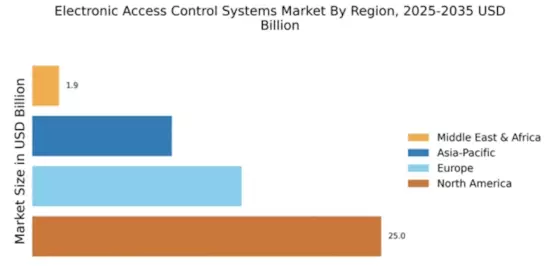
North America is poised to maintain its leadership in the Electronic Access Control Systems market, holding a significant market share of 25.0 in 2024. The region's growth is driven by increasing security concerns, technological advancements, and stringent regulatory frameworks. The demand for integrated security solutions is on the rise, fueled by the need for enhanced safety in commercial and residential sectors. The competitive landscape is robust, with key players like Johnson Controls, Honeywell, and Genetec leading the charge. The U.S. is the primary market, supported by a strong infrastructure and investment in smart technologies. The presence of major corporations and a focus on innovation further solidify North America's position as a hub for electronic access control solutions.

Europe : Emerging Market with Growth Potential

Europe is witnessing a growing demand for Electronic Access Control Systems, with a market size of 15.0 in 2024. Factors such as increasing urbanization, rising security threats, and regulatory initiatives aimed at enhancing safety are driving this growth. The region is also focusing on integrating advanced technologies like IoT and AI into access control systems, which is expected to further boost market expansion. Leading countries in this market include Germany, the UK, and France, where companies like ASSA ABLOY and Bosch Security Systems are prominent. The competitive landscape is characterized by innovation and strategic partnerships, as firms aim to meet the evolving needs of consumers. The European market is set to benefit from supportive regulations that encourage the adoption of advanced security solutions.

Asia-Pacific : Rapid Growth in Security Solutions

The Asia-Pacific region is emerging as a significant player in the Electronic Access Control Systems market, with a market size of 10.0 in 2024. The growth is driven by rapid urbanization, increasing investments in infrastructure, and a heightened focus on security in both public and private sectors. Governments are implementing regulations to enhance safety standards, which is further propelling market demand. Countries like China, India, and Japan are leading the charge, with a growing number of local and international players entering the market. Companies such as Allegion and Siemens are expanding their presence, focusing on innovative solutions tailored to regional needs. The competitive landscape is dynamic, with a mix of established firms and startups driving technological advancements in access control systems.

Middle East and Africa : Emerging Market with Challenges

The Middle East and Africa region, with a market size of 1.91 in 2024, is gradually developing in the Electronic Access Control Systems sector. The growth is primarily driven by increasing security concerns, urbanization, and government initiatives aimed at enhancing public safety. However, challenges such as economic instability and varying regulatory environments can hinder market expansion. Countries like the UAE and South Africa are at the forefront, with investments in smart city projects and infrastructure development. Key players such as AMAG Technology are focusing on tailored solutions to meet local demands. The competitive landscape is evolving, with both The Electronic Access Control Systems share, indicating a promising future despite existing challenges.

Key Players and Competitive Insights

The Electronic Access Control Systems Market is characterized by a dynamic competitive landscape, driven by technological advancements and increasing security concerns across various sectors. Key players such as Johnson Controls (US), Honeywell (US), and ASSA ABLOY (SE) are at the forefront, each adopting distinct strategies to enhance their market positioning. Johnson Controls (US) emphasizes innovation through the integration of AI and IoT technologies, aiming to provide smarter and more efficient access control solutions. Meanwhile, Honeywell (US) focuses on strategic partnerships and acquisitions to expand its product offerings and enhance its technological capabilities, thereby strengthening its competitive edge. ASSA ABLOY (SE) is actively pursuing regional expansion, particularly in emerging markets, which appears to be a critical component of its growth strategy.

The market's competitive structure is moderately fragmented, with numerous players vying for market share. Key business tactics include localizing manufacturing to reduce costs and optimize supply chains, which is increasingly vital in a globalized economy. The collective influence of these major players shapes the market dynamics, as they compete not only on product quality but also on service delivery and technological innovation.

In November 2025, Johnson Controls (US) announced the launch of a new cloud-based access control platform designed to enhance user experience and security. This strategic move is significant as it aligns with the growing trend towards digitalization in security systems, allowing for remote management and real-time monitoring, which could potentially set a new standard in the industry.

In October 2025, Honeywell (US) completed the acquisition of a leading cybersecurity firm, which is expected to bolster its access control solutions by integrating advanced security features. This acquisition underscores the increasing importance of cybersecurity in access control systems, as threats evolve and organizations seek comprehensive solutions that address both physical and digital security needs.

In September 2025, ASSA ABLOY (SE) launched a new line of sustainable access control products, utilizing eco-friendly materials and energy-efficient technologies. This initiative not only reflects the growing consumer demand for sustainable solutions but also positions the company as a leader in environmental responsibility within the market.

As of December 2025, current competitive trends indicate a strong shift towards digitalization, sustainability, and AI integration in access control systems. Strategic alliances are increasingly shaping the landscape, as companies recognize the value of collaboration in enhancing technological capabilities and market reach. Looking ahead, competitive differentiation is likely to evolve from traditional price-based competition to a focus on innovation, technology integration, and supply chain reliability, suggesting that companies that prioritize these areas may gain a substantial advantage in the market.

Key Companies in the Electronic Access Control Systems Market market include

Industry Developments

  • Q2 2024: Allegion Acquires Boss Door Controls Allegion plc, a global security products and solutions provider, announced the acquisition of Boss Door Controls, a UK-based manufacturer of door closers and exit hardware, expanding Allegion’s portfolio in electronic access control and door hardware.
  • Q2 2024: Brivo Announces Partnership with Eagle Eye Networks to Deliver Cloud-Based Access Control and Video Surveillance Brivo, a cloud-based access control provider, entered a strategic partnership with Eagle Eye Networks to integrate access control and video surveillance solutions, enhancing security offerings for commercial clients.
  • Q2 2024: Johnson Controls Launches New C•CURE 9000 v3.0 Access Control Platform Johnson Controls released the latest version of its C•CURE 9000 access control platform, featuring enhanced cybersecurity, mobile credential support, and advanced integration capabilities for enterprise security management.
  • Q2 2024: ASSA ABLOY Appoints New President of Global Technologies Division ASSA ABLOY, a leading provider of access solutions, announced the appointment of a new president for its Global Technologies division, responsible for driving innovation in electronic access control and digital security.
  • Q2 2024: LenelS2 Wins Major Access Control Contract for U.S. Federal Agency LenelS2 secured a significant contract to provide electronic access control systems for a U.S. federal agency, supporting secure facility management and compliance with government security standards.
  • Q3 2024: dormakaba Opens New Manufacturing Facility in North America dormakaba, a global leader in access control solutions, inaugurated a new manufacturing facility in North America to expand production capacity and support growing demand for electronic access control products.
  • Q3 2024: SALTO Systems Launches New BLUEnet Wireless Access Control Platform SALTO Systems introduced its BLUEnet wireless access control platform, enabling real-time access management and enhanced connectivity for commercial and institutional clients.
  • Q3 2024: HID Global Acquires Vizinex RFID to Expand Access Control Offerings HID Global, a leader in secure identity solutions, acquired Vizinex RFID, strengthening its portfolio in electronic access control and asset tracking technologies.
  • Q4 2024: Openpath Raises $50 Million in Series C Funding to Accelerate Access Control Innovation Openpath, a provider of mobile and cloud-based access control solutions, secured $50 million in Series C funding to expand product development and market reach.
  • Q4 2024: Honeywell Launches Pro-Watch Integrated Security Suite Honeywell unveiled its Pro-Watch Integrated Security Suite, combining access control, video surveillance, and intrusion detection into a unified platform for enterprise security management.
  • Q1 2025: Genetec Announces Partnership with Axis Communications for Integrated Access Control Solutions Genetec partnered with Axis Communications to deliver integrated access control and video management solutions, targeting enhanced security for commercial and public sector clients.
  • Q2 2025: Allegion Acquires Farpointe Data to Strengthen Electronic Access Control Portfolio Allegion completed the acquisition of Farpointe Data, a provider of RFID access control solutions, further expanding its electronic access control product offerings.

Future Outlook

Electronic Access Control Systems Market Future Outlook

The Electronic Access Control Systems Market is projected to grow at a 10.0% CAGR from 2024 to 2035, driven by increasing security concerns, technological advancements, and regulatory compliance.

New opportunities lie in:

  • Integration of AI-driven analytics for enhanced security insights.
  • Development of mobile access control solutions for remote management.
  • Expansion into emerging markets with tailored access solutions.

By 2035, the market is expected to be robust, driven by innovation and increased demand for security solutions.

Market Segmentation

Electronic Access Control Systems Market End Use Outlook

  • Residential
  • Commercial
  • Industrial
  • Government

Electronic Access Control Systems Market Component Outlook

  • Hardware
  • Software
  • Services

Electronic Access Control Systems Market Technology Outlook

  • Fingerprint Recognition
  • Facial Recognition
  • Keypad Entry
  • Smart Card Technology

Electronic Access Control Systems Market Application Outlook

  • Biometric Access Control
  • Card-Based Access Control
  • Mobile Access Control
  • Cloud-Based Access Control

Electronic Access Control Systems Market Deployment Type Outlook

  • On-Premises
  • Cloud-Based
  • Hybrid

Report Scope

MARKET SIZE 202451.91(USD Billion)
MARKET SIZE 202557.1(USD Billion)
MARKET SIZE 2035148.14(USD Billion)
COMPOUND ANNUAL GROWTH RATE (CAGR)10.0% (2024 - 2035)
REPORT COVERAGERevenue Forecast, Competitive Landscape, Growth Factors, and Trends
BASE YEAR2024
Market Forecast Period2025 - 2035
Historical Data2019 - 2024
Market Forecast UnitsUSD Billion
Key Companies ProfiledJohnson Controls (US), Honeywell (US), ASSA ABLOY (SE), Allegion (IE), Bosch Security Systems (DE), Siemens (DE), Genetec (CA), AMAG Technology (US), Morse Watchmans (US)
Segments CoveredApplication, End Use, Technology, Deployment Type, Component
Key Market OpportunitiesIntegration of artificial intelligence enhances security and efficiency in the Electronic Access Control Systems Market.
Key Market DynamicsRising demand for enhanced security solutions drives innovation and competition in the Electronic Access Control Systems market.
Countries CoveredNorth America, Europe, APAC, South America, MEA

Market Highlights

Author
Aarti Dhapte
Team Lead - Research

She holds an experience of about 6+ years in Market Research and Business Consulting, working under the spectrum of Information Communication Technology, Telecommunications and Semiconductor domains. Aarti conceptualizes and implements a scalable business strategy and provides strategic leadership to the clients. Her expertise lies in market estimation, competitive intelligence, pipeline analysis, customer assessment, etc.

Leave a Comment

FAQs

How much is the Electronic Access Control Systems market?

The Electronic Access Control Systems market size was valued at USD 51.91 billion in 2024.

What is the growth rate of the Electronic Access Control Systems market?

The market is projected to grow at a CAGR of 10.00% during the forecast period, 2025 to 2035.

Which region held the largest market share in the Electronic Access Control Systems market?

North America had the largest share in the Electronic Access Control Systems market.

Who are the key players in the Electronic Access Control Systems market?

The key players in the market are TRUSTSEC, Johnson Controls International plc, Allegion plc, Honeywell Security Group, Identiv, Inc., Nedap N.V., Suprema HQ Inc., Bosch Security Systems Inc., Gemalto N.V., NEC Corporation, IDEMIA, FINGERPRINTS, Axis Communications, Lenel Systems International, Time and Data Systems International, AMAG Technology, Gunnebo.

Which components led the Electronic Access Control Systems market?

The biometric reader category dominated the market in 2022.

Which vertical had the largest market share in the market?

The residential had the largest share in the market for Electronic Access Control Systems.

Who are the key manufacturers of the global electronic access control systems market?

Nedap N.V., Bosch Security Systems Inc., Suprema HQ Inc., Identiv, Inc., Dormakaba Holding AG, Honeywell Security Group, Allegion plc, ASSA ABLOY AB, Gemalto N.V., and Johnson Controls International plc are key manufacturers of the global electronic access control systems market.

Download Free Sample

Kindly complete the form below to receive a free sample of this Report

Compare Licence

×
Features License Type
Single User Multiuser License Enterprise User
Price $4,950 $5,950 $7,250
Maximum User Access Limit 1 User Upto 10 Users Unrestricted Access Throughout the Organization
Free Customization
Direct Access to Analyst
Deliverable Format
Platform Access
Discount on Next Purchase 10% 15% 15%
Printable Versions