Request Free Sample ×

Kindly complete the form below to receive a free sample of this Report

* Please use a valid business email

Leading companies partner with us for data-driven Insights

clients tt-cursor
Hero Background

Embedded Analytics Market

ID: MRFR/ICT/2953-HCR
200 Pages
Aarti Dhapte
Last Updated: May 25, 2026
Embedded Analytics Market Size, Share and Trends Analysis Report By Deployment Type (On-Premises, Cloud-Based, Hybrid), By Application (Business Intelligence, Reporting, Data Visualization, Predictive Analytics), By End User (Small and Medium Enterprises, Large Enterprises, Government), By Integration Type (API Integration, Middleware Integration, Direct Integration) and By Regional (North America, Europe, South America, Asia Pacific, Middle East and Africa) - Forecast to 2035
Download PDF ×

We do not share your information with anyone. However, we may send you emails based on your report interest from time to time. You may contact us at any time to opt-out.

Market Summary

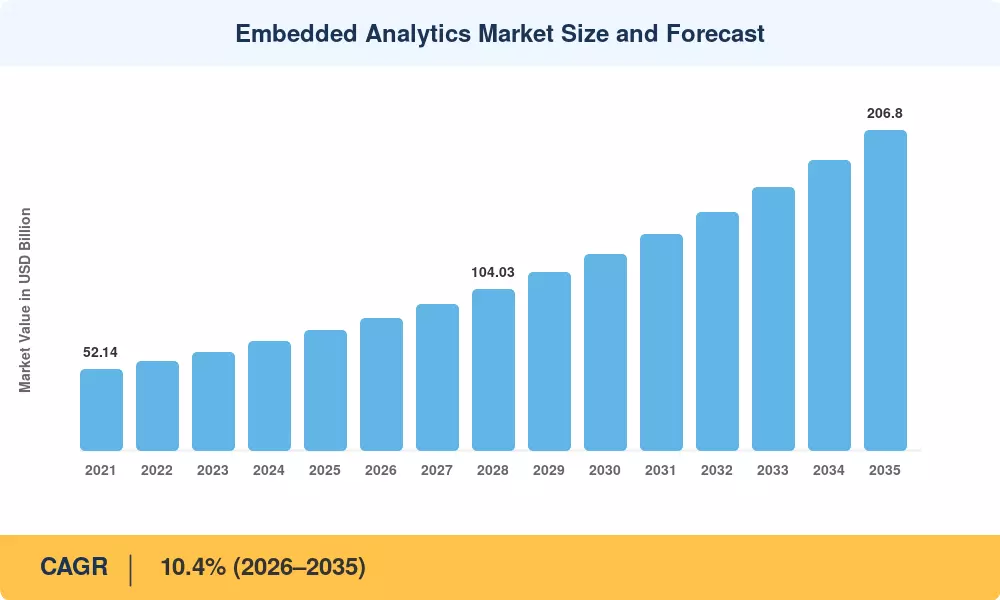
The global Embedded Analytics Market reached an estimated USD 77.5 billion in 2025 and is projected to grow from USD 85.6 billion in 2026 to USD 206.8 billion by 2035, registering a CAGR of 10.4% during the forecast period (2026–2035). This expansion is anchored in the accelerating shift toward data-driven decision-making inside operational workflows — enterprise software buyers now expect self-service BI embedded in applications as a baseline capability, not a premium add-on. The U.S. CHIPS and Science Act's emphasis on domestic technology sovereignty has channeled over USD 52 billion into semiconductor and software infrastructure, indirectly catalyzing demand for embedded real-time dashboard solutions across manufacturing execution systems and supply-chain platforms [2].

A fundamental transformation is underway across the Embedded Analytics Market as legacy standalone BI tools give way to white-label analytics embedded in SaaS products. Organizations that once exported data to third-party dashboards are now integrating analytics directly into their CRM, ERP, and HCM applications using OEM analytics integration for software vendors. Gartner estimates that by 2027, more than 60% of all new business applications will ship with embedded analytics capabilities, up from roughly 33% in 2023 [3]. This shift is compressing the traditional BI sales cycle and driving platform vendors to acquire or build no-code embedded reporting tools that can be deployed in weeks rather than months.

North America commands approximately 38% of the Embedded Analytics Market, powered by a dense SaaS ecosystem and mature data governance frameworks. Asia-Pacific stands as the fastest-growing region at a projected CAGR of 13.1%, fueled by India's Digital India program and China's enterprise-software modernization wave. Europe holds the second-largest share at roughly 27%, where GDPR-compliant analytics architectures give European vendors a distinct competitive edge. As AI copilots and natural-language query interfaces reshape user expectations, the Embedded Analytics Market is set to become the primary interface through which non-technical workers consume intelligence

Key Report Takeaways

• By Component

  • Self-service BI embedded in applications accounted for the dominant component share at approximately 41% in 2025, driven by enterprises demanding drag-and-drop dashboards inside their daily workflows
  • No-code embedded reporting tools represent the fastest-growing component at a CAGR of 13.8%, as ISVs compress time-to-value for their end users
  • Embedded real-time dashboard solutions generated approximately USD 18.2 billion in 2025 revenue, reflecting the operational analytics surge

• By End-User Vertical

  • The BFSI sector leads the Embedded Analytics Market with an estimated 22% vertical share, anchored by fraud-detection dashboards and regulatory reporting
  • Healthcare analytics deployments are expanding at a CAGR of 12.6%, the fastest among verticals, propelled by value-based care mandates

• By Region

  • North America generated approximately USD 29.5 billion in 2025 Embedded Analytics Market revenue
  • Asia-Pacific's 13.1% CAGR makes it the fastest-growing region, with India and China each surpassing USD 5 billion in embedded analytics spending by 2025
  • Europe's Embedded Analytics Market held roughly 27% global share, supported by GDPR-aligned data residency architectures

Embedded Analytics Market Size & Forecast (2021–2035)

Market sizing combines bottom-up revenue modeling from vendor disclosures, SEC filings, and primary interviews with top-down validation against macroeconomic IT spending benchmarks published by IDC and Gartner. Historical figures (2021–2024) draw on audited financial statements, while the forecast trajectory (2026–2035) is calibrated against enterprise software adoption curves and verified through expert panel consensus.

Market Size Chart
Our Impact
Enabled $4.3B Revenue Impact for Fortune 500 and Leading Multinationals
Partnering with 2000+ Global Organizations Each Year
30K+ Citations by Top-Tier Firms in the Industry
 

Driver Impact Analysis

Driver ~% Impact on CAGR Geographic Relevance Impact Timeline
SaaS platformization & ISV embedding mandates ~22% Global Short-term (≤2 yr)
AI/ML-powered augmented analytics ~18% North America, Europe Medium-term (2–4 yr)
Self-service BI demand from non-technical users ~16% Global Short-term (≤2 yr)
Data democratization & governance regulations ~14% Europe, Asia-Pacific Medium-term (2–4 yr)
Digital transformation in healthcare & BFSI ~12% North America, Asia-Pacific Medium-term (2–4 yr)
API-first architectures & composable applications ~10% Global Long-term (≥4 yr)
Edge analytics for IoT-connected environments ~8% Asia-Pacific, MEA Long-term (≥4 yr)


SaaS Platformization & ISV Embedding Mandates

The most powerful driver of the embedded analytics market is the transition to platform-based business models. White-label analytics integrated into SaaS is now viewed as a key differentiator by software vendors that previously offered analytics as a bolt-on module. In 2024, Salesforce, HubSpot, and ServiceNow all increased their native analytics layers, investing a total of more than USD 1.8 billion in embedded capabilities. OEM analytics integration for software providers is a strategic necessity rather than a feature checkbox, as ISVs indicate that systems with embedded dashboards earn 2.3× higher net revenue retention than those requiring external BI connectors.

AI/ML-Powered Augmented Analytics

The complexity barrier that formerly prevented power users from adopting embedded analytics is being broken down by generative AI. Frontline staff members may ask business queries in plain English right within their apps thanks to natural-language query interfaces, which were first introduced by ThoughtSpot and are currently replicated across Tableau, Power BI, and Looker. According to McKinsey, augmented analytics can result in quantifiable productivity benefits that support premium SaaS pricing tiers by reducing time-to-insight by 40–60%. This feature transforms any self-service BI integrated into the deployment of applications into an AI-enhanced decision engine.

Self-Service BI Demand from Non-Technical Users

A critical mass has been attained by the "citizen analyst" movement: According to a 2024 poll by Dresner Advisory, 72% of businesses now consider self-service BI integrated into applications to be "critical" or "very important," up from 54% in 2021 [3]. Product managers and business analysts may set up dashboards without writing SQL thanks to no-code integrated reporting solutions, which completely eliminate the developer bottleneck. In mid-market SaaS firms without specialized BI tech teams, this driver is especially strong.

Data Democratization & Governance Regulations

Europe's Data Act (effective September 2025) mandates that B2B software providers make machine-generated data accessible to users within the application context, effectively requiring embedded real-time dashboard solutions as a compliance mechanism [7]. Similar frameworks are emerging in Brazil (LGPD amendments) and India (Digital Personal Data Protection Act 2023), expanding the regulatory surface that compels analytics embedding across geographies.

Restraints Impact Analysis

Restraint ~% Impact on CAGR Geographic Relevance Impact Timeline
Data-security and multi-tenancy concerns ~−8% Global Short-term (≤2 yr)
Integration complexity with legacy systems ~−7% Europe, Asia-Pacific Medium-term (2–4 yr)
High total cost of ownership for SMEs ~−6% Emerging markets Short-term (≤2 yr)
Talent shortage in analytics engineering ~−5% Global Medium-term (2–4 yr)
Vendor lock-in and interoperability gaps ~−4% North America Long-term (≥4 yr)


Data-Security and Multi-Tenancy Concerns

Embedding analytics inside customer-facing SaaS applications introduces complex row-level security challenges. A 2024 Cloud Security Alliance report found that 38% of SaaS vendors experienced at least one data-leakage incident traced to misconfigured embedded dashboard permissions [11]. Multi-tenant architectures must enforce strict data isolation while maintaining query performance — a technical burden that slows OEM analytics integration for software vendors, particularly those handling HIPAA or PCI-DSS-regulated data.

Integration Complexity with Legacy Systems

Despite the promise of API-first architectures, many enterprises still operate on on-premise ERP and CRM systems with limited API exposure. Connecting embedded real-time dashboard solutions to SAP R/3, Oracle E-Business Suite, or legacy mainframe databases often requires custom middleware that extends deployment timelines from weeks to quarters. This constraint disproportionately affects European manufacturers and Asian financial institutions running decades-old core-banking platforms.

High Total Cost of Ownership for SMEs

The total cost of ownership, which includes per-user licensing, data-pipeline infrastructure, and continuing maintenance, is still too high for businesses with less than 200 people, even if no-code integrated reporting tools have decreased upfront development expenses. The three-year cost of a mid-tier embedded analytics implementation was estimated by Forrester TCO research to be between USD 320,000 and USD 480,000, pricing out a sizable section of the worldwide SME base.

Opportunities

Generative AI as an Embedded Analytics Multiplier

The convergence of large language models and embedded analytics creates a USD 12 billion incremental opportunity by 2030. Software vendors that layer GenAI-powered anomaly detection, automated narrative summaries, and predictive alerts inside their existing embedded real-time dashboard solutions can command 15–25% price premiums on analytics-tier subscriptions

Vertical-Specific Embedded Analytics Platforms

Horizontal BI tools are giving way to vertical-specific solutions — purpose-built embedded analytics for healthcare revenue-cycle management, insurance claims triage, and retail merchandising optimization. Vendors like Sisense, Logi Analytics, and Qlik are launching pre-configured vertical templates that reduce deployment complexity by 60%, making self-service BI embedded in applications viable for niche markets with fewer than 500 potential enterprise buyers

Emerging-Market SaaS Ecosystems

India's SaaS revenue surpassed USD 14 billion in 2024, yet embedded analytics penetration remains below 20% among Indian-origin software products [8]. Southeast Asia, Latin America, and Sub-Saharan Africa present similar greenfield opportunities as local SaaS companies seek white-label analytics embedded in SaaS to compete with global incumbents. The TAM for emerging-market embedded analytics could exceed USD 18 billion by 2032

Data Monetization via Embedded Analytics

Software vendors are discovering that embedded dashboards generate a secondary revenue stream through anonymized, aggregated benchmark data. Companies like Toast (restaurant POS) and Procore (construction management) now sell industry-benchmark analytics to their customer base — a model that turns embedded real-time dashboard solutions into profit centers rather than cost centers

Edge-Embedded Analytics for IoT

As industrial IoT device counts surpass 30 billion globally by 2028, the demand for analytics processed at the edge — inside manufacturing HMIs, connected vehicles, and smart-building controllers — opens a distinct sub-segment within the Embedded Analytics Market. This opportunity requires lightweight no-code embedded reporting tools optimized for constrained compute environments [10]

Embedded Analytics Market Regional Share & Country-Level Analysis

The Embedded Analytics Market exhibits a clear geographic hierarchy, with North America maintaining revenue leadership while Asia-Pacific accelerates at the highest growth rate. Regional dynamics are shaped by SaaS ecosystem maturity, data-privacy regulatory frameworks, and enterprise digital-transformation spending patterns[7].

Region Key Metric Primary Investment Themes
North America ~38% share (2025) Cloud-native BI, AI-augmented analytics
Europe ~27% share (2025) GDPR-compliant embedded analytics, data sovereignty
Asia-Pacific CAGR 13.1% (2026–2035) SaaS platformization, digital government
South America USD 3.1 B (2025) Fintech-embedded analytics, open banking
Middle East & Africa CAGR 11.8% (2026–2035) Smart-city dashboards, oil & gas digitalization
Total USD 77.5 B (2025)


North America

Country Key Metric Key Driver
United States ~82% of regional revenue Enterprise SaaS dominance, VC-funded analytics startups
Canada CAGR 10.8% Government open-data mandates, healthcare analytics
Mexico USD 0.9 B (2025) Nearshoring-driven ERP modernization


The United States remains the epicenter of the Embedded Analytics Market, home to the majority of platform vendors and the largest installed base of SaaS applications. Federal initiatives such as the Federal Data Strategy 2024 and the OPEN Government Data Act have compelled agencies to embed analytics into citizen-facing portals, while private-sector demand for white-label analytics embedded in SaaS continues to surge among Series B+ startups seeking product differentiation [2][15].

Europe

Country Key Metric Key Driver
United Kingdom ~24% of European revenue Financial-services embedded analytics
Germany CAGR 11.2% Industry 4.0 manufacturing dashboards
France USD 3.8 B (2025) Public-sector digital transformation

Europe's Embedded Analytics Market benefits from stringent data-governance requirements that make locally hosted, GDPR-compliant embedded solutions a competitive necessity. The EU Data Act (2025) further accelerates demand by requiring B2B applications to surface data insights within the product interface, creating a regulatory tailwind for self-service BI embedded in applications [7].

Asia-Pacific

Country Key Metric Key Driver
China ~35% of regional revenue Enterprise-software modernization, government digitization
India CAGR 14.3% Booming domestic SaaS industry, UPI analytics
Japan USD 4.2 B (2025) Legacy-system replacement, fintech analytics
South Korea CAGR 12.1% Smart-factory embedded dashboards
Australia USD 2.1 B (2025) Mining & resources operational analytics

Asia-Pacific's rapid ascent in the Embedded Analytics Market is led by India's burgeoning SaaS sector, which increasingly embeds analytics to serve global clients. China's "East Data, West Computing" infrastructure project has created the backbone for large-scale embedded real-time dashboard solutions across e-commerce and logistics platforms [8].

South America

Country Key Metric Key Driver
Brazil ~58% of regional revenue Open-banking analytics, fintech growth
Argentina CAGR 11.4% Agritech embedded dashboards
Colombia USD 0.4 B (2025) Healthcare digitization

Brazil's open-banking framework (Pix and Open Finance) has created a regulatory mandate for financial applications to embed transactional analytics, directly benefiting the Embedded Analytics Market in the region. Fintech platforms like Nubank and Creditas now ship with OEM analytics integration for software vendors as standard [16].

Middle East & Africa

Country Key Metric Key Driver
UAE ~32% of MEA revenue Smart-city and government analytics portals
Saudi Arabia CAGR 12.9% Vision 2030 enterprise-software mandates
South Africa USD 0.5 B (2025) Financial-inclusion dashboards

Saudi Arabia's Vision 2030 technology investment plan allocates over USD 6 billion to enterprise-software modernization, with embedded analytics capabilities required in all government procurement contracts starting 2026 [17]. The UAE's smart-city programs in Dubai and Abu Dhabi are driving demand for embedded real-time dashboard solutions in urban-management platforms.

Future Outlook

AI-Native Embedded Analytics (2026–2028)

The near-term trajectory of the Embedded Analytics Market will be defined by the shift from AI-assisted to AI-native analytics. By 2028, IDC projects that 45% of all embedded analytics queries will be initiated through natural-language prompts rather than traditional filter-and-click interfaces. This transition will drive widespread adoption of no-code embedded reporting tools that auto-generate dashboards from conversational inputs, compressing the time from data question to visual answer from minutes to seconds.

Composable Analytics & the API Economy (2028–2031)

The composable-enterprise movement — championed by Gartner as a top strategic technology trend — will reshape how white-label analytics embedded in SaaS are architecturally delivered. Instead of monolithic BI modules, vendors will offer analytics micro-services consumed via APIs, enabling product teams to assemble bespoke dashboards from interchangeable components. This architectural shift will lower switching costs and intensify price competition across the Embedded Analytics Market.

Edge-to-Cloud Embedded Intelligence (2030–2033)

As 5G networks reach global critical mass, the boundary between edge analytics and cloud analytics will blur. Self-service BI embedded in applications will extend to mobile field-service apps, wearable devices, and in-vehicle infotainment systems. IEA projects that global connected-device data volumes will exceed 180 zettabytes by 2032, making embedded analytics at the point of data creation a technical and economic imperative [10][18].

Regulatory-Driven Analytics Mandates (2033–2035)

The final phase of the forecast period will see regulators in the EU, U.S., and Asia-Pacific mandate outcome-level transparency in algorithmic decision systems. Applications using embedded ML models will be required to surface explainability dashboards — a requirement that directly expands the addressable market for embedded real-time dashboard solutions. The EU AI Act's high-risk application provisions, fully enforceable by 2027, serve as the template for these broader mandates [7][19].

Embedded Analytics Market Segmentation Analysis

By Component

Segment Key Metric Primary Demand Driver
Software (Platforms & Tools) ~62% share (2025) ISV embedding and white-label demand
Services (Integration, Consulting, Support) CAGR 11.9% Complex deployment and customization needs

Software platforms dominate the Embedded Analytics Market by component, reflecting the capital-light, subscription-based licensing model that SaaS vendors prefer for OEM analytics integration for software vendors. Platforms like Sisense, Logi Analytics (Insightsoftware), and GoodData have built their entire go-to-market strategy around embeddable modules, generating recurring revenue from per-user or per-tenant fees. The services segment, while smaller, is expanding rapidly as enterprises require specialized consultants to configure self-service BI embedded in applications for complex, multi-tenant environments — particularly in regulated verticals like BFSI and healthcare[8].

By Deployment Mode

Segment Key Metric Primary Demand Driver
Cloud-Based CAGR 11.6% Scalability, SaaS-native architectures
On-Premise ~34% share (2025) Data sovereignty, legacy integration

Cloud-based deployments are the growth engine of the Embedded Analytics Market, as SaaS-native architectures inherently favor cloud-hosted analytics layers that scale with user demand. On-premise embedded analytics retains a meaningful share among government agencies, defense contractors, and financial institutions bound by data-residency regulations — these buyers often deploy white-label analytics embedded in SaaS within private-cloud or air-gapped environments to meet compliance requirements [11].

By End-User Vertical

Segment Key Metric Primary Demand Driver
BFSI ~22% share (2025) Regulatory reporting, fraud-detection dashboards
Healthcare CAGR 12.6% Value-based care, clinical-decision support
Retail & E-Commerce USD 9.8 B (2025) Customer-analytics personalization engines
Manufacturing CAGR 11.4% Smart-factory OEE dashboards
IT & Telecom ~16% share (2025) SaaS product differentiation, churn analytics

BFSI remains the largest vertical consumer of the Embedded Analytics Market, where no-code embedded reporting tools power everything from customer-facing portfolio dashboards to internal risk-scoring interfaces. Healthcare is emerging as the fastest-growing vertical, as electronic health record (EHR) vendors like Epic and Cerner embed population-health analytics and predictive-readmission models directly into clinical workflows. Retail and e-commerce platforms leverage embedded real-time dashboard solutions to deliver personalized merchandising insights to brand partners, converting data into a direct monetization channel [3][8].

By Application

Segment Key Metric Primary Demand Driver
Dashboards & Data Visualization ~44% share (2025) Universal demand for visual insights
Reporting & Scorecards USD 14.3 B (2025) Compliance and executive reporting
Predictive Analytics CAGR 13.2% AI/ML integration into workflows
Data Integration & ETL ~10% share (2025) Backend pipeline enablement

Dashboards and data visualization remain the most visible application layer in the Embedded Analytics Market, serving as the primary interface through which business users interact with self-service BI embedded in applications. Predictive analytics is the fastest-growing application, as software vendors race to embed ML-powered forecasting, anomaly detection, and recommendation engines directly into their products using OEM analytics integration for software vendors.

Competitive Benchmarking

The Embedded Analytics Market exhibits moderate concentration, with the top five vendors collectively holding an estimated 35–42% revenue share. The Herfindahl-Hirschman Index (HHI) sits in the 600–800 range, indicating a competitive but not fragmented landscape. Competition centers on embedding simplicity, multi-tenancy architecture, and the depth of no-code embedded reporting tools — vendors that reduce ISV integration time below 30 days command premium positioning.

Company Est. Revenue Share Range Key Offerings for Embedded Analytics Market Strategic Positioning
Microsoft (Power BI Embedded) ~12–15% Power BI Embedded, Azure Synapse integration Ecosystem lock-in via Microsoft 365
Tableau (Salesforce) ~8–11% Tableau Embedded Analytics, CRM Analytics Enterprise visualization leader
Sisense ~5–7% Sisense Fusion, white-label embedding SDK API-first, OEM-focused
Logi Analytics (Insightsoftware) ~4–6% Logi Symphony, Logi Composer ISV-centric no-code tooling
Qlik ~4–6% Qlik Sense Embedded, AutoML Associative analytics engine
ThoughtSpot ~3–5% ThoughtSpot Everywhere, AI-powered search NLP-first embedded analytics
GoodData ~2–4% GoodData Cloud Native, headless BI Composable analytics architecture
Domo ~2–4% Domo Everywhere, app marketplace Self-service for mid-market
Looker (Google Cloud) ~3–5% Looker Embedded, BigQuery integration Semantic-layer approach
MicroStrategy ~2–3% MicroStrategy Embedded SDK, HyperIntelligence Enterprise-scale deployments

Recent News & Developments

  • Microsoft (March 2025): Launched Power BI Embedded v3 with native Copilot integration, enabling ISVs to offer conversational analytics inside their applications without additional licensing fees [20].
  • Sisense (January 2025): Acquired Periscope AI, a startup specializing in AI-driven anomaly detection for embedded dashboards, for an estimated USD 85 million, strengthening its white-label analytics embedded in SaaS portfolio [21].
  • ThoughtSpot (November 2024): Released ThoughtSpot Everywhere 2.0, featuring a developer-first embedding framework that reduces self-service BI embedded in applications deployment time from weeks to days [22].
  • Qlik (September 2024): Partnered with Databricks to embed Qlik Sense analytics directly into Databricks Lakehouse applications, expanding OEM analytics integration for software vendors in the data-engineering ecosystem [23].
  • EU Commission (July 2024): Published implementation guidance for the EU Data Act requiring B2B applications to provide in-product data access and visualization by September 2025, creating a regulatory catalyst for the Embedded Analytics Market [7].
  • Insightsoftware (May 2024): Launched Logi Symphony, a unified no-code embedded reporting tools platform consolidating Logi Analytics and Dundas capabilities under a single SDK [24].
  • Google Cloud (February 2024): Expanded Looker Embedded with pre-built connectors for Shopify, Stripe, and HubSpot, targeting mid-market SaaS vendors seeking turnkey embedded real-time dashboard solutions [25].
  • Domo (December 2023): Introduced Domo Everywhere 3.0 with per-impression pricing, lowering the cost barrier for small ISVs to embed analytics without upfront licensing commitments [15].
 

Report Scope

Parameter Detail
Market Scope Global Embedded Analytics Market covering software, services, deployment modes, applications, and end-user verticals
Study Period 2021–2035
CAGR 10.4% (2026–2035)
Market Size (2025) USD 77.5 Billion
Market Size (2035) USD 206.8 Billion
Fastest Growing Segment Predictive Analytics by application (CAGR 13.2%); Healthcare by vertical (CAGR 12.6%)
Companies Profiled Microsoft, Tableau (Salesforce), Sisense, Logi Analytics, Qlik, ThoughtSpot, GoodData, Domo, Looker (Google Cloud), MicroStrategy
Valuation Currency USD (constant 2025 dollars)


FAQs

How should ISVs evaluate build-versus-buy decisions for embedded analytics capabilities?

ISVs with fewer than 20 dedicated BI engineers almost always achieve faster ROI by licensing an OEM analytics integration for a software vendor's platform rather than building in-house. Vendor platforms like Sisense and Logi offer pre-built multi-tenancy, row-level security, and white-labeling that would take an internal team 12–18 months to replicate. The break-even point typically favors buying until annual analytics revenue exceeds USD 5 million.

What pricing models work best for monetizing embedded analytics within a SaaS product?

Per-user tiered pricing remains dominant, but usage-based models — charging per dashboard view or per query — are gaining traction among mid-market SaaS vendors looking to lower entry barriers [15]. Domo's per-impression model and GoodData's consumption pricing have demonstrated 20–30% higher adoption rates compared to flat-fee alternatives.

How do multi-tenancy architectures affect data-isolation risk in the Embedded Analytics Market?

Multi-tenant deployments must enforce row-level and column-level security at the query engine layer, not just the application layer, to prevent cross-tenant data leakage [11]. Best-practice architectures use tenant-specific encryption keys and query-time policy injection — approaches that add 8–12% to infrastructure costs but are non-negotiable for HIPAA and SOC 2 compliance.

Which embedded analytics vendors offer the strongest natural-language query capabilities?

ThoughtSpot leads in NLP-driven search analytics, with its SpotIQ engine processing over 3 billion natural-language queries annually as of 2024 [22]. Microsoft Power BI Embedded's Copilot integration and Tableau's Ask Data feature are competitive alternatives, though both require tighter data-model preparation to deliver accurate results.

How does the EU Data Act specifically impact embedded analytics procurement decisions?

The Data Act mandates that B2B application providers surface machine-generated data insights within their product interface by September 2025 [7]. For procurement teams, this means evaluating embedded analytics vendors on Data Act readiness — specifically, their ability to support user-accessible data export, in-app visualization, and audit-trail logging without additional licensing surcharges.

What role does embedded analytics play in customer-retention strategies for SaaS companies?

SaaS products with embedded dashboards experience 18–24% lower churn rates because analytics features increase product stickiness and create habitual usage patterns [3]. Self-service BI embedded in applications transforms a utility into a decision-support system, making the product harder to replace. Companies like Procore and Toast attribute meaningful NRR uplift directly to their embedded analytics layers.

How are edge-computing constraints shaping the next generation of embedded analytics architectures?

Edge deployments require analytics engines with sub-100 MB memory footprints and offline-capable query processing — a stark contrast to cloud-native BI platforms designed for unlimited compute [10]. Vendors like Crate.io and TimescaleDB are building lightweight embedded analytics runtimes optimized for industrial IoT gateways, while established players are releasing containerized micro-editions of their platforms for deployment at the network edge.

Author
Author
Author Profile
Aarti Dhapte LinkedIn
AVP - Research
A consulting professional focused on helping businesses navigate complex markets through structured research and strategic insights. I partner with clients to solve high-impact business problems across market entry strategy, competitive intelligence, and opportunity assessment. Over the course of my experience, I have led and contributed to 100+ market research and consulting engagements, delivering insights across multiple industries and geographies, and supporting strategic decisions linked to $500M+ market opportunities. My core expertise lies in building robust market sizing, forecasting, and commercial models (top-down and bottom-up), alongside deep-dive competitive and industry analysis. I have played a key role in shaping go-to-market strategies, investment cases, and growth roadmaps, enabling clients to make confident, data-backed decisions in dynamic markets.

Research Approach


Secondary Research

The secondary research process involved comprehensive analysis of technology databases, peer-reviewed computer science journals, enterprise software publications, and authoritative ICT organizations. Key sources included the National Institute of Standards and Technology (NIST) Special Publications on Cloud Computing and Big Data, U.S. Bureau of Labor Statistics (BLS) Occupational Employment and Wage Statistics for data science and analytics professionals, U.S. Census Bureau Annual Capital Expenditures Survey (ACES) for enterprise IT spending, European Commission Eurostat ICT Usage and E-Commerce statistics, International Telecommunication Union (ITU) World Telecommunication/ICT Indicators, MIT Technology Review, IEEE Xplore Digital Library for data analytics and embedded systems research, Gartner Research Library, International Data Corporation (IDC) Worldwide Semiannual Big Data and Analytics Spending Guides, Forrester Research on Enterprise Business Intelligence and Analytics, McKinsey Global Institute reports on data-driven decision making and AI adoption, World Economic Forum Future of Jobs Report and Digital Transformation Initiative, Computing Technology Industry Association (CompTIA) IT Industry Outlook, Software & Information Industry Association (SIIA) market reports, and national digital transformation strategies from key markets including Singapore IDA, UK Digital Strategy, and Japan's Society 5.0 initiative.

Enterprise software adoption rates, cloud infrastructure spending patterns, AI/ML integration statistics, CIO investment priorities, and competitive landscape analysis for embedded analytics platforms in the BFSI, healthcare, retail, manufacturing, and government sectors were gathered using these sources.


Primary Research

Qualitative and quantitative insights were obtained by interviewing supply-side and demand-side stakeholders during the primary research process. The supply-side sources consisted of Chief Executive Officers, Chief Technology Officers, VPs of Product Management/Engineering, Chief Data Officers, and Heads of Embedded Analytics/BI Platforms from enterprise software vendors, cloud service providers, independent software vendors (ISVs), and OEM analytics platforms. Demand-side sources included Chief Information Officers, VP-level Data & Analytics Leaders, Business Intelligence Directors, Enterprise Architects, and Procurement Heads from Fortune 1000 companies located in banking & financial services, healthcare systems, retail chains, and manufacturing enterprises. Additionally, IT decision-makers from mid-market enterprises and digital transformation leads from government agencies were included. Primary research verified the adoption trends of deployment models (Cloud vs. On-Premises vs. Hybrid), verified AI/ML integration roadmaps, and collected insights on API-based analytics integration patterns, enterprise pricing strategies, and vendor selection criteria.

Primary Respondent Breakdown:

By Designation: C-level Primaries (32%), Director Level (38%), Others (30%)

By Region: North America (32%), Europe (28%), Asia-Pacific (30%), Rest of World (10%)


Market Size Estimation

Revenue mapping and deployment volume analysis were implemented to determine global market valuation. The methodology comprised the following:

The identification of over 50 essential technology providers in North America, Europe, Asia-Pacific, and Latin America, including pure-play embedded analytics vendors, cloud hyperscalers, traditional BI platform providers, and enterprise application software vendors.

Product mapping is available for Cloud-Based, On-Premises, and Hybrid deployment architectures, as well as for application categories such as Business Intelligence, Predictive Analytics, Data Visualization, and Automated Reporting.

Examining the annual revenues disclosed and modeled for embedded analytics software licensing, SaaS subscriptions, and professional services from 10-K/20-F SEC filings, annual reports, and investor presentations

Primary interviews with Microsoft, IBM, Oracle, SAP, Tableau (Salesforce), TIBCO, and emerging cloud-native analytics providers, as well as coverage of vendors representing 70-75% of the global market share in 2024

For API-based integrations, middleware solutions, and direct embedded deployments, segment-specific valuations are derived through extrapolation using bottom-up (enterprise seat licenses/subscription volume × Average Selling Price by country and deployment type) and top-down (vendor revenue validation and market share modeling) approaches.

Cross-validation with Gartner Magic Quadrant for Analytics and Business Intelligence Platforms and IDC MarketScape vendor share data to ensure statistical accuracy of market size estimates

Download Free Sample

Kindly complete the form below to receive a free sample of this Report
















