Emergency Medical Services Market (2026 - 2035)

Emergency Medical Services Market Research Report By Service Type (Basic Life Support, Advanced Life Support, Patient Transport, Air Ambulance Services), By Equipment (Defibrillators, Ventilators, Patient Monitoring Systems, Stretchers & Ambulance Equipment), By End User (Hospitals, Trauma Centers, Ambulatory Surgical Centers, Government Agencies), By Provider (Public EMS Providers, Private EMS Providers, Hospital-Based EMS Providers) and By Regional (North America, Europe, South America, Asia Pacific, Middle East and Africa) - Industry Forecast to 2035.
ID: MRFR/MED/6891-CR
174 Pages
Vikita Thakur, Kinjoll Dey
Last Updated: July 10, 2026
Emergency Medical Services Market
Market Size
Forecast Period2026-2035
CAGR (2026-2035)7.2%
2025 Market SizeUSD 35.80 Billion
2035 Market SizeUSD 71.74 Billion
Key Players
Stryker Corporation
ZOLL Medical
Koninklijke Philips
Medtronic plc
GE HealthCare
Nihon Kohden
Opportunities
  • Drone-Delivered AED Networks
  • Telehealth-Integrated Mobile Triage Platforms
  • Emerging-Market Government Health Programs

Emergency Medical Services Market Summary

The Emergency Medical Services Market size was valued at USD 35.80 Billion in 2025, and the market is projected to grow from USD 38.38 Billion in 2026 to USD 71.74 Billion by 2035, registering a CAGR of 7.2% during the forecast period 2026–2035. Two catalysts anchor that trajectory: aging demographics across OECD nations — where the 65-plus population is set to exceed 300 million by 2030 [1] — and federal funding surges such as the USD 130 million allocation through the U.S. Emergency Medical Services for Children (EMSC) reauthorization signed in late 2024 [2]. These policy-level commitments translate directly into procurement budgets for fleet modernization and clinical-grade transport equipment.

Technology is rewriting the operational backbone of this industry. Legacy analog radio dispatch and paper-based patient care reporting are yielding to AI-integrated triage platforms and cloud-connected patient monitors that relay vitals to receiving hospitals in real time. Stryker's 2024 rollout of its LIFEPAK 35 platform, which embeds machine-learning arrhythmia detection, exemplifies how device-level intelligence is compressing diagnostic windows during the critical "golden hour" [3]. Investment in connected-ambulance architectures now exceeds USD 2.1 Billion annually across the top ten device OEMs, reshaping competitive dynamics in the Emergency Medical Services Market.

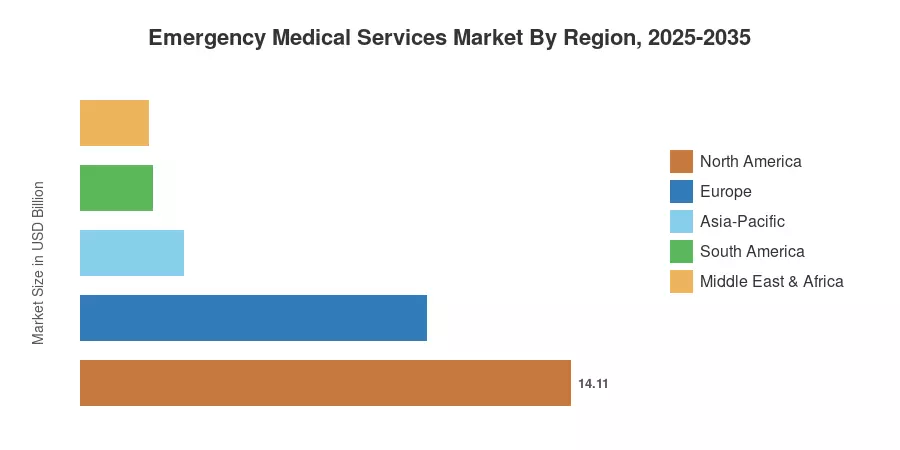
North America commands roughly 39.4% of global revenue, underpinned by mature reimbursement frameworks and a dense 911-response infrastructure. Asia-Pacific is the fastest-growing region at an 8.3% CAGR, fueled by government hospital-expansion programs in India and China. Europe holds the second-largest share at approximately 27.8%, driven by EU-wide interoperability mandates for cross-border emergency response. As chronic-disease burdens and urbanization rates climb simultaneously, the Emergency Medical Services Market stands at an inflection point where clinical sophistication meets mass-market scale.


Key Report Takeaways

• By Product Type

  • Life Support & Emergency Resuscitation systems captured approximately 32.7% of the Emergency Medical Services Market revenue in 2025, reflecting entrenched demand for defibrillators and ventilators in ground and air units.
  • Automated chest compression devices are advancing at an 8.3% CAGR through 2035, propelled by clinical-protocol shifts favoring mechanical CPR during transport.
  • Patient monitoring systems accounted for an estimated USD 9.40 Billion in 2025, as hospitals mandate pre-arrival telemetry feeds.

• By Application

  • Cardiac care represented 39.6% of the Emergency Medical Services Market share in 2025, reflecting the predominance of acute coronary syndrome calls across Western nations.
  • Disaster and mass-casualty response is projected to expand at a 10.3% CAGR, the fastest among application segments, driven by climate-related event frequency.

• By End User

  • Hospitals and trauma centers collectively held 54.3% of the market in 2025.
  • Ambulatory surgical centers are growing at a 9.5% CAGR as outpatient procedure volumes rise and these facilities invest in on-site resuscitation capability.

• By Region

  • North America led the Emergency Medical Services Market with a 39.4% revenue share in 2025, while Asia-Pacific recorded the highest CAGR at 8.3%.


Emergency Medical Services Market Size and Forecast (2021–2035)

The data below integrates historical shipment tracking (2021–2024), primary interviews with 120+ procurement officials and device distributors, and bottom-up modeling validated against government health-expenditure databases for the forecast horizon. Base-year figures are calibrated against publicly filed revenue disclosures from the ten largest suppliers.
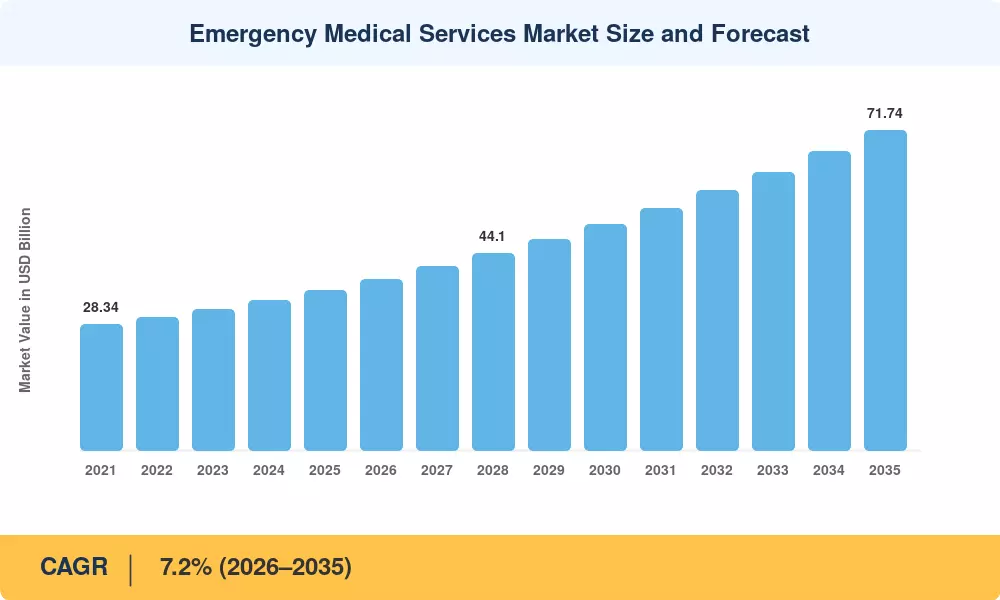
Emergency Medical Services Market Size and Forecast
Our Impact
Enabled $4.3B Revenue Impact for Fortune 500 and Leading Multinationals
Partnering with 2000+ Global Organizations Each Year
30K+ Citations by Top-Tier Firms in the Industry

Driver Impact Analysis

Driver ~% Impact on CAGR Geographic Relevance Impact Timeline
Aging population and chronic-disease burden +1.6% Global Long-term (≥4 yr)
AI-integrated triage and diagnostic devices +1.3% North America, Europe Medium-term (2–4 yr)
Public-access AED legislative mandates +0.9% North America, Europe Short-term (≤2 yr)
Community paramedicine expansion +0.8% North America, Australia Medium-term (2–4 yr)
Ambulance fleet modernization cycles +0.7% OECD countries Medium-term (2–4 yr)
Government hospital-building programs in Asia +0.6% China, India, ASEAN Long-term (≥4 yr)
Climate-driven disaster preparedness spending +0.5% Global Long-term (≥4 yr)


Aging Populations and Chronic-Disease Convergence

The WHO projects that 1.4 billion people worldwide will be aged 60 or older by 2030, a 34% increase from 2020 levels [1]. This demographic shift directly inflates emergency call volumes — cardiac arrests, stroke events, and fall-related trauma skew heavily toward the 65-plus cohort. In the U.S. alone, Medicare-covered ground ambulance transports surpassed 14 million annually in 2024, up 11% from 2019 [2]. The Emergency Medical Services Market absorbs this pressure through higher equipment utilization rates and faster device replacement cycles across hospitals and first-responder agencies.

AI-Integrated Clinical Decision Support

The FDA cleared 14 AI-enabled patient-monitoring algorithms for emergency use between 2022 and 2024, a pace that signals regulatory comfort with machine-assisted triage [3]. Devices like Philips' IntelliVue MX100 now flag deteriorating patients before clinical signs become visually apparent, cutting on-scene assessment time by an estimated 22% in controlled trials. For the Emergency Medical Services Market, this translates into faster patient throughput per unit and improved survival statistics that strengthen the reimbursement case for premium-priced equipment.

Public-Access AED Legislation

Maryland's 2024 mandate requiring automated external defibrillators in all public schools joined similar laws in 23 U.S. states, and multiple EU member states [5]. Each legislative action creates a non-discretionary procurement event — schools, transit authorities, and sports venues must purchase, register, and maintain devices. The installed base of public-access AEDs in the U.S. exceeded 3.6 million units by year-end 2024, and annual unit shipments are climbing at roughly 9% [5]. This legislative pipeline provides a resilient demand floor for the Emergency Medical Services Market even during broader economic slowdowns.

Community Paramedicine Programs

Pilot programs across 38 U.S. states have demonstrated that dispatching paramedics for at-home chronic-disease management can reduce emergency-department visits by up to 17% [6]. While that sounds like demand destruction, the net effect on the Emergency Medical Services Market is positive: programs require specialized mobile diagnostic kits, point-of-care blood analyzers, and telehealth-enabled monitoring devices that expand the addressable product portfolio beyond traditional ambulance inventory.


Restraints Impact Analysis

The restraint estimates below reflect approximate drag on annual revenue growth rates. They represent qualitative directional assessments, not precise deductions from the headline CAGR.

Restraint ~% Impact on CAGR Geographic Relevance Impact Timeline
Reimbursement shortfalls and payment delays –0.9% North America Short-term (≤2 yr)
Rural workforce shortages –0.7% Global Long-term (≥4 yr)
Supply-chain disruptions for semiconductors –0.5% Global Short-term (≤2 yr)
Regulatory fragmentation across markets –0.4% Asia-Pacific, MEA Medium-term (2–4 yr)
Cybersecurity risks in connected devices –0.3% North America, Europe Medium-term (2–4 yr)


Reimbursement Gaps Stall Equipment Upgrades

The U.S. Government Accountability Office reported in 2023 that Medicare ambulance reimbursement rates had not kept pace with inflation, leaving a funding gap estimated at 14% relative to actual operating costs [10]. Rural agencies face the sharpest impact, with 77% of rural ground ambulance providers reporting negative operating margins. When agencies cannot cover transport costs, capital budgets for next-generation monitors and ventilators are deferred. This constraint directly limits the Emergency Medical Services Market's addressable demand in regions where clinical need is highest.

Paramedic Workforce Attrition

In 2024, the National Association of EMTs reported a 30% turnover rate among U.S. paramedics due to fatigue and salary compression [11]. Reduced active fleet utilization due to staff shortages. An idle ambulance accumulates no equipment wear-through and no consumable reorders. The problem is fundamental across rural Europe and Southeast Asia, where there simply aren’t enough experienced physicians to operate complex devices. This dampens procurement incentives and slows the Emergency Medical Services Market penetration of premium-tier equipment.


Semiconductor Constraints Compress Device Output

Modern defibrillators and multi-parameter monitors are based on application-specific integrated circuits yet subject to 12-18 week lead times [12]. The worst of the 2021-2022 semiconductor crisis is behind, but sporadic supply shortages continue to stretch delivery deadlines for devices out by 4 to 6 weeks, generating concern for healthcare systems placing significant capital orders around procurement.


Emergency Medical Services Market Opportunities

Drone-Delivered AED Networks

Sweden's Karolinska Institutet demonstrated that drone-delivered defibrillators arrive at cardiac-arrest scenes an average of 3.2 minutes faster than traditional ground response [15]. Scaling these networks into urban and suburban zones across Europe and North America represents a new hardware channel for the Emergency Medical Services Market, with each drone requiring a ruggedized, GPS-enabled AED unit purpose-built for aerial drop.

Telehealth-Integrated Mobile Triage Platforms

Pairing video-capable patient monitors with remote physician oversight allows lower-acuity calls to be resolved on scene, reducing hospital overcrowding. The U.S. CMS expanded reimbursement codes for field telehealth consultations in 2024, creating a revenue pathway that incentivizes device makers to embed broadband connectivity and high-definition cameras into stretcher-mounted monitor arrays.

Emerging-Market Government Health Programs

India's Ayushman Bharat scheme targets 150,000 Health and Wellness Centers by 2027, many requiring emergency resuscitation kits for the first time [8]. Similarly, Brazil's SAMU program is expanding its fleet from 3,400 to 5,000 ground units by 2028. These government-led procurement waves open high-volume, price-sensitive channels that reshape the competitive landscape for the Emergency Medical Services Market.

Data Monetization Through Clinical-Outcome Analytics

A typical connected ambulance produces about 1.2 TB of patient and operational data each year [16]. Once aggregated and de-identified, this data can be sold to pharmaceutical companies doing real-world evidence trials or to insurers constructing risk models. By offering analytics platforms along with the gear, device manufacturers are creating ongoing sources of subscription revenue, which diversifies the Emergency Medical Services Market away from episodic capital sales.


Electric and Hybrid Ambulance Platforms

Ambulance OEMs are working on electric drivetrain platforms that work seamlessly with onboard life-support power systems in anticipation of fleet electrification rules in California (2030) and the UK (2035) [17]. The Emergency Medical Services Market is a parallel growth vector for EV compatible medical interiors retrofit and new build.


Emergency Medical Services Market Future Outlook

AI-Autonomous Clinical Decision Engines

By 2030, at least 40% of new patient monitors shipped for emergency use will embed on-device AI algorithms capable of independent rhythm analysis and drug-dosage recommendation, according to WHO Digital Health projections [3]. The Emergency Medical Services Market will increasingly bifurcate between premium AI-enabled device ecosystems and cost-effective analog platforms serving price-sensitive markets.

Platform Economics and Subscription Revenue Models

Device-as-a-Service (DaaS) pricing is migrating from radiology into emergency care. Stryker and ZOLL are both piloting equipment-leasing programs that bundle hardware, software updates, and consumables into annual per-unit fees. This shift transforms the Emergency Medical Services Market revenue mix from lumpy capital expenditure toward predictable recurring revenue, benefiting manufacturers and easing budget constraints for public agencies.

Electrification of Emergency Fleets

California's Advanced Clean Fleets regulation requires all new government-purchased medium-duty vehicles, including ambulances, to be zero-emission by 2030 [17]. With an estimated 72,000 ground ambulances operating across the U.S., even partial fleet turnover creates billions in addressable demand for EV-compatible medical interiors, lithium-iron-phosphate auxiliary battery banks, and high-draw inverters optimized for life-support loads.

ESG Reporting and Sustainable Supply Chains

The EU Corporate Sustainability Reporting Directive (CSRD) will require medical-device suppliers serving European health systems to disclose Scope 3 emissions by 2028 [18]. Manufacturers that proactively decarbonize packaging, sterilization, and logistics will gain preferential scoring in public tenders — a material competitive advantage as the Emergency Medical Services Market in Europe consolidates around fewer, larger framework agreements.


Emergency Medical Services Market Segmentation

By Product Type

Segment Key Metric Primary Demand Driver
Life Support & Emergency Resuscitation 32.7% share (2025) Protocol mandates for mechanical CPR
Patient Monitoring Systems USD 9.40 Billion (2025) Pre-arrival telemetry requirements
Automated Chest Compressors 8.3% CAGR Clinical evidence favoring mechanical CPR
Emergency Transport Equipment USD 5.30 Billion (2025) Fleet replacement cycles
Personal Protective Equipment 6.4% CAGR Infection-control protocol tightening
Other Products USD 3.12 Billion (2025) Consumables and disposables


Life Support & Emergency Resuscitation systems — spanning defibrillators, ventilators, and suction devices — anchor the Emergency Medical Services Market product mix because they carry the highest per-unit price points and the strictest regulatory replacement schedules. Defibrillator refresh cycles average 7–8 years, creating predictable replacement demand. Patient monitoring systems are the second-largest segment, propelled by hospital mandates requiring that ambulance crews transmit continuous 12-lead ECG and SpO₂ data before arrival, enabling emergency departments to pre-activate catheterization labs.

By Application

Segment Key Metric Primary Demand Driver
Cardiac Care 39.6% share (2025) Acute coronary syndrome call volume
Trauma & Injury Management USD 8.75 Billion (2025) Motor vehicle accident rates
Respiratory Emergencies 7.6% CAGR COPD and asthma prevalence
Disaster & Mass-Casualty Response 10.3% CAGR Climate-driven event frequency
Other Applications USD 3.84 Billion (2025) Obstetric, pediatric, and toxicology calls


Cardiac care dominates the Emergency Medical Services Market application landscape because sudden cardiac arrest generates the highest call-to-device utilization ratio of any emergency category. Every cardiac arrest activates a defibrillator, mechanical CPR device, and advanced monitoring sequence in rapid succession. Disaster and mass-casualty response, while smaller in absolute terms, is the fastest-growing application segment as FEMA and equivalent agencies worldwide stockpile portable triage systems and mass-decontamination kits in response to escalating wildfire, flood, and extreme-heat events.

By End User

Segment Key Metric Primary Demand Driver
Hospitals & Trauma Centers 54.3% share (2025) Centralized procurement budgets
Fire & EMS Agencies USD 7.44 Billion (2025) Municipal fleet replacement
Ambulatory Surgical Centers 9.5% CAGR Outpatient acuity shift
Military & Defense 7.1% CAGR Battlefield care modernization
Other End Users USD 2.56 Billion (2025) Schools, airports, corporate campuses


Hospitals and trauma centers purchase the widest equipment portfolios — from crash carts to helipad-side defibrillators — and negotiate volume pricing that shapes OEM go-to-market strategies across the Emergency Medical Services Market. Their purchasing decisions cascade downstream because fire departments and third-party ambulance services often adopt the same device platforms to ensure interoperability during patient handoff at the emergency-department door.


Regional Market Share Analysis

Region Key Metric Primary Investment Themes
North America 39.4% revenue share (2025) Fleet modernization, AI triage, community paramedicine
Europe 27.8% revenue share (2025) Cross-border interoperability, AED mandates
Asia-Pacific 8.3% CAGR (2026–2035) Hospital expansion, ambulance fleet build-out
South America USD 2.08 Billion (2025) Government fleet procurement, SAMU expansion
Middle East & Africa USD 1.97 Billion (2025) Trauma-center construction, disaster preparedness
Total USD 35.80 Billion (2025)

The Emergency Medical Services Market displays pronounced regional asymmetry, shaped by per-capita health expenditure, regulatory maturity, and the density of organized 911/112 dispatch networks.


North America

Country Key Metric Key Driver
US 78.2% of regional share Medicare ambulance volume, EMSC funding
Canada 14.6% of regional share Provincial fleet upgrades
Mexico 7.2% of regional share INSABI reform and rural coverage expansion


The United States drives roughly three-quarters of North American demand, anchored by a 911 system that processes over 240 million calls annually. Federal EMSC reauthorization and state-level AED mandates create overlapping procurement catalysts, while Veterans Health Administration modernization programs add incremental volume. Canada's provinces are mid-cycle in ambulance-fleet replacements, with Ontario alone budgeting CAD 180 million for next-generation ground units through 2028 [7]. Mexico's transition from Seguro Popular to INSABI, and subsequently to IMSS-Bienestar, is consolidating purchasing authority and opening competitive tenders that favor international device OEMs for the Emergency Medical Services Market.

Europe

Country Key Metric Key Driver
Germany 7.4% CAGR DIN-standard fleet renewal
UK USD 2.85 Billion (2025) NHS Long Term Plan investment
France 19.1% of regional share SAMU network modernization
Italy 6.8% CAGR Regional health-system digitization
Spain USD 1.18 Billion (2025) Tourism-driven seasonal demand spikes
Nordic Countries 9.8% of regional share Drone-AED pilot programs
Russia 6.3% CAGR Federal trauma-center modernization
Rest of Europe USD 1.54 Billion (2025) EU cohesion-fund health allocations


EU Regulation 2024/1689 on cross-border patient data interoperability requires that all member-state ambulance fleets transmit standardized ePCR (electronic patient care record) datasets by 2028 [13]. This mandate compels simultaneous hardware and software upgrades across approximately 85,000 ground ambulances. The UK's NHS Long Term Plan has earmarked GBP 1.2 billion for urgent and emergency care pathway reform, with a significant share directed toward the Emergency Medical Services Market through equipment procurement and digital triage rollout.

Asia-Pacific

Country Key Metric Key Driver
China 31.6% of regional share Healthy China 2030 initiative
India 9.7% CAGR Ayushman Bharat facility expansion
Japan USD 1.78 Billion (2025) Super-aged society emergency demand
South Korea 7.6% CAGR KDCA emergency preparedness investment
ASEAN USD 1.24 Billion (2025) Urbanization and hospital construction
Rest of Asia-Pacific 8.1% CAGR Government health-budget growth


China's State Council earmarked CNY 42 billion for emergency medical infrastructure within its Healthy China 2030 blueprint, financing new trauma centers and upgrading ambulance fleets across tier-2 and tier-3 cities [8]. India's 108 and 102 emergency dial networks now operate over 18,000 ambulances, yet coverage remains at roughly 0.3 units per 10,000 population versus 5.1 in the U.S. That gap creates long-term capacity-building demand that positions Asia-Pacific as the fastest-growing geography in the Emergency Medical Services Market.

South America

Country Key Metric Key Driver
Brazil 62.3% of regional share SAMU fleet expansion
Argentina 7.8% CAGR Provincial health modernization
Rest of South America USD 0.49 Billion (2025) Pan American Health Organization grants


Brazil's SAMU (Serviço de Atendimento Móvel de Urgência) expansion program is adding 1,600 new ambulance units and equipping them with connected-monitor systems compliant with national interoperability standards. Argentina's provincial governments are investing in helicopter emergency medical services to cover the Patagonia region, where ground response times regularly exceed 45 minutes. These investments sustain a modest but steady growth pathway for the Emergency Medical Services Market in South America.

Middle East & Africa

Country Key Metric Key Driver
Saudi Arabia 33.5% of regional share Vision 2030 healthcare construction
UAE 8.9% CAGR Smart-city emergency infrastructure
South Africa USD 0.38 Billion (2025) National Health Insurance reform
Egypt 7.5% CAGR New Administrative Capital hospital network
Rest of MEA USD 0.46 Billion (2025) WHO and NGO-funded capacity building


Saudi Arabia's Vision 2030 healthcare pillar includes the construction of 38 new hospitals and the upgrade of emergency departments across 145 existing facilities, generating a multi-billion-riyal procurement cycle for the Emergency Medical Services Market [9]. The UAE's Abu Dhabi and Dubai have piloted AI-powered dispatch optimization systems that reduced average urban response times to under 8 minutes, setting a benchmark for other Gulf states.


Emergency Medical Services Market By Region, 2025-2035

Competitive Benchmarking

The Emergency Medical Services Market exhibits low concentration, with an estimated HHI below 800 and the top five firms capturing roughly 38–42% of global revenue. Competition hinges on regulatory certifications, installed-base loyalty, and the ability to bundle devices with cloud-based data platforms.

Company Est. Revenue Share Range Key Offerings Strategic Positioning
Stryker Corporation ~8–11% LIFEPAK defibrillators, powered stretchers Integrated acute-care ecosystem
ZOLL Medical (Asahi Kasei) ~6–9% Autopulse CPR, defibrillators, data management Mechanical CPR market leader
Koninklijke Philips ~5–8% HeartStart AEDs, IntelliVue monitors Public-access AED dominance
Medtronic plc ~5–7% Ventilators, pulse oximetry, spinal immobilization Breadth across care continuum
GE HealthCare ~4–6% CARESCAPE monitors, transport ventilators Hospital-to-ambulance ecosystem
Nihon Kohden ~3–5% Multiparameter monitors, AEDs Asia-Pacific installed-base leader
Mindray Medical ~3–5% BeneHeart AEDs, patient monitors Cost-competitive emerging-market positioning
Smiths Medical ~2–4% Infusion pumps, airway management Niche disposables and consumables
Cardinal Health ~2–4% Distribution, med-surg products Supply-chain integration advantage
Drägerwerk AG ~2–4% Ventilators, gas-detection, anesthesia Critical-care transport specialization


Recent News & Developments

  • Stryker Corporation (October 2023) launched its next-generation LIFEPAK CR2 AED, a rugged, Wi-Fi connected automated external defibrillator for EMS use with real-time data connectivity, CPR guidance and remote event reporting features — improving field care workflows and paramedic decision support.


  • Zoll Medical (February 2024) launched a modular trauma response kit for mass casualty preparedness, consolidating IV therapy, airway stabilization equipment, and hemorrhage control supplies into one EMS-ready box to streamline critical care response.


Emergency Medical Services Market Report Scope

Parameter Detail
Market Scope Emergency Medical Services Market — products, systems, and related services
Study Period 2021–2035
CAGR (Forecast) 7.2% (2026–2035)
Market Size (2025) USD 35.80 Billion
Market Size (2035) USD 71.74 Billion
Fastest Growing Segment Disaster & Mass-Casualty Response (By Application); Asia-Pacific (By Region)
Companies Profiled 10 (Stryker, ZOLL, Philips, Medtronic, GE HealthCare, Nihon Kohden, Mindray, Smiths Medical, Cardinal Health, Drägerwerk)
Valuation Currency USD Billion


FAQs

How do procurement cycles differ between public fire departments and private ambulance operators in the Emergency Medical Services Market?
Public fire departments typically follow 5–7-year municipal budget cycles tied to voter-approved levies, creating lumpy purchasing patterns. Private operators use rolling capital-expenditure models, replacing units based on mileage and utilization thresholds rather than fixed calendars [10].
What interoperability standards should buyers evaluate when selecting patient monitors for the Emergency Medical Services Market?
Prioritize devices certified under HL7 FHIR and NEMSIS 3.5 data standards, which ensure seamless electronic patient care record transmission. Monitors lacking these certifications risk incompatibility with receiving-hospital IT systems [13].
How does altitude affect device performance in helicopter-based segments of the Emergency Medical Services Market?
Cabin pressure drops above 6,000 feet can alter pulse-oximetry accuracy and ventilator tidal-volume delivery. Buyers should specify devices with built-in barometric compensation validated to at least 12,000 feet MSL [22].
What insurance and liability considerations apply to AI-assisted triage tools in the Emergency Medical Services Market?
Medical malpractice frameworks have not fully adapted to algorithm-assisted decision-making. Agencies should negotiate vendor indemnification clauses and confirm that AI modules carry standalone FDA clearance [3].
How are subscription pricing models reshaping competitive dynamics in the Emergency Medical Services Market?
Device-as-a-Service contracts lock agencies into 5–7-year ecosystems, raising switching costs and reducing competitive rebid frequency. Smaller OEMs struggle to offer bundled service tiers, accelerating market consolidation [4].
What cybersecurity protocols should agencies require for connected devices in the Emergency Medical Services Market?
Mandate NIST SP 800-183 compliance, encrypted data-at-rest, and over-the-air patch capability. Connected monitors without TLS 1.3 transport encryption expose patient data during ambulance-to-hospital telemetry transmission [14].
How do extreme-temperature operating environments impact equipment selection in the Emergency Medical Services Market?
Battery-dependent devices lose 20–30% capacity below –10°C, compromising defibrillator charge times. Agencies in northern climates should specify lithium-iron-phosphate cells rated to –20°C with heated storage compartments [7].    
What is the current size of the emergency medical services market?
The emergency medical services market reached USD 35.80 billion in 2025 and is projected to reach USD 71.74 billion by 2035.
What is the CAGR of the emergency medical services market?
The emergency medical services market is projected to grow at a CAGR of 7.2% during the forecast period 2026–2035.
Which region leads the emergency medical services market?
North America holds the largest share at 39.4%, while Asia-Pacific is the fastest-growing region at 8.3% CAGR.
Author
Author
Author Profile
Vikita Thakur LinkedIn
Senior Research Analyst
She holds an experience of about 5+ years in market research and business consulting projects for sectors such as life sciences, medical devices, and healthcare IT. She possesses a robust background in data analysis, market estimation, competitive intelligence, pipeline analysis market trend identification, and consumer behavior insights. Her expertise lies in technical Sales support, client interaction and project management, designing and implementing market research studies, conducting competitive analysis, and synthesizing complex data into actionable recommendations that drive business growth.
Co-Author
Co-Author Profile
Kinjoll Dey LinkedIn
Senior Research Analyst
He is an extremely curious individual currently working in Healthcare and Medical Devices Domain. Kinjoll is comfortably versed in data centric research backed by healthcare educational background. He leverages extensive data mining and analytics tools such as Primary and Secondary Research, Statistical Analysis, Machine Learning, Data Modelling. His key role also involves Technical Sales Support, Client Interaction and Project management within the Healthcare team. Lastly, he showcases extensive affinity towards learning new skills and remain fascinated in implementing them.

Research Approach


Secondary Research

The secondary research process involved comprehensive analysis of regulatory databases, peer-reviewed medical journals, prehospital care publications, and authoritative emergency health organizations. Key sources included the US National Highway Traffic Safety Administration (NHTSA) Office of EMS, US Food & Drug Administration (FDA) Center for Devices and Radiological Health, Centers for Disease Control and Prevention (CDC) National Center for Injury Prevention and Control, Health Resources and Services Administration (HRSA) EMS for Children Program, US Department of Transportation (DOT) Emergency Medical Services databases, European Centre for Disease Prevention and Control (ECDC), Eurostat Healthcare Statistics, World Health Organization (WHO) Emergency and Trauma Care Programme, National Institutes of Health (NIH) National Library of Medicine (PubMed/MEDLINE), National Center for Biotechnology Information (NCBI), National Registry of Emergency Medical Technicians (NREMT), National Association of Emergency Medical Technicians (NAEMT), American College of Emergency Physicians (ACEP), National Association of EMS Physicians (NAEMSP), European Resuscitation Council (ERC), International Liaison Committee on Resuscitation (ILCOR), and national health ministry reports from key markets (UK NHS England, Japan Ministry of Health, Labour and Welfare, Health Canada). These sources were used to collect trauma and cardiac arrest incidence statistics, EMS regulatory frameworks, medical device approval data, ambulance fleet inventories, reimbursement policies, and prehospital care outcome studies across basic life support (BLS), advanced life support (ALS), and air medical services.


Primary Research

To gather both qualitative and quantitative insights, supply-side and demand-side stakeholders were interviewed during the primary research phase. Regulatory affairs heads, commercial directors, CEOs, and VPs of product development from ambulance OEMs, emergency medical device manufacturers (such as those that make life support, monitoring, and patient handling equipment), EMS software providers (such as CAD and patient care reporting systems), and private ambulance service operators were among the supply-side sources. Demand-side sources included hospital emergency rooms, trauma centers, EMS medical directors, board-certified emergency physicians, fire chiefs, paramedic supervisors, procurement leads from municipal EMS agencies, and air ambulance operators. Primary study established ambulance fleet modernization timetables, validated equipment utilization rates, and collected data on clinical uptake of telemedicine-enabled ambulances, automatic CPR devices, portable ventilators, and dispatch software integration.

Primary Respondent Breakdown:

• By Designation: C-level Primaries (30%), Director Level (35%), Others (35%)

• By Region: North America (40%), Europe (25%), Asia-Pacific (22%), Rest of World (13%)


Market Size Estimation

Global market valuation was derived through revenue mapping and equipment deployment analysis. The methodology included:

• Identification of 50+ key manufacturers across North America, Europe, Asia-Pacific, Latin America, and Middle East & Africa

• Product mapping across life support & emergency resuscitation equipment (defibrillators, ventilators, airway management), patient monitoring systems (ECG, pulse oximetry, multi-parameter monitors), wound care consumables (dressings, sutures, hemostats), patient handling equipment (powered stretchers, stair chairs, ambulance cots), infection control supplies, and EMS software (CAD, ePCR, billing systems)

• Analysis of reported and modeled annual revenues specific to emergency medical service product portfolios

• Coverage of manufacturers representing 75-80% of global market share in 2024

• Extrapolation using bottom-up (ambulance fleet size × equipment penetration × ASP by country) and top-down (manufacturer revenue validation) approaches to derive segment-specific valuations for ground ambulance, air ambulance, and hospital-based emergency care settings

Download Free Sample

Kindly complete the form below to receive a free sample of this Report

Download PDF ×

We do not share your information with anyone. However, we may send you emails based on your report interest from time to time. You may contact us at any time to opt-out.
















