Emergency Medical Services Market (2026 - 2035)

ID: MRFR/MED/6891-CR
174 Pages
Vikita Thakur
Last Updated: July 10, 2026
Emergency Medical Services Market Research Report By Service Type (Basic Life Support, Advanced Life Support, Patient Transport, Air Ambulance Services), By Equipment (Defibrillators, Ventilators, Patient Monitoring Systems, Stretchers & Ambulance Equipment), By End User (Hospitals, Trauma Centers, Ambulatory Surgical Centers, Government Agencies), By Provider (Public EMS Providers, Private EMS Providers, Hospital-Based EMS Providers) and By Regional (North America, Europe, South America, Asia Pacific, Middle East and Africa) - Industry Forecast to 2035.
Emergency Medical Services Market
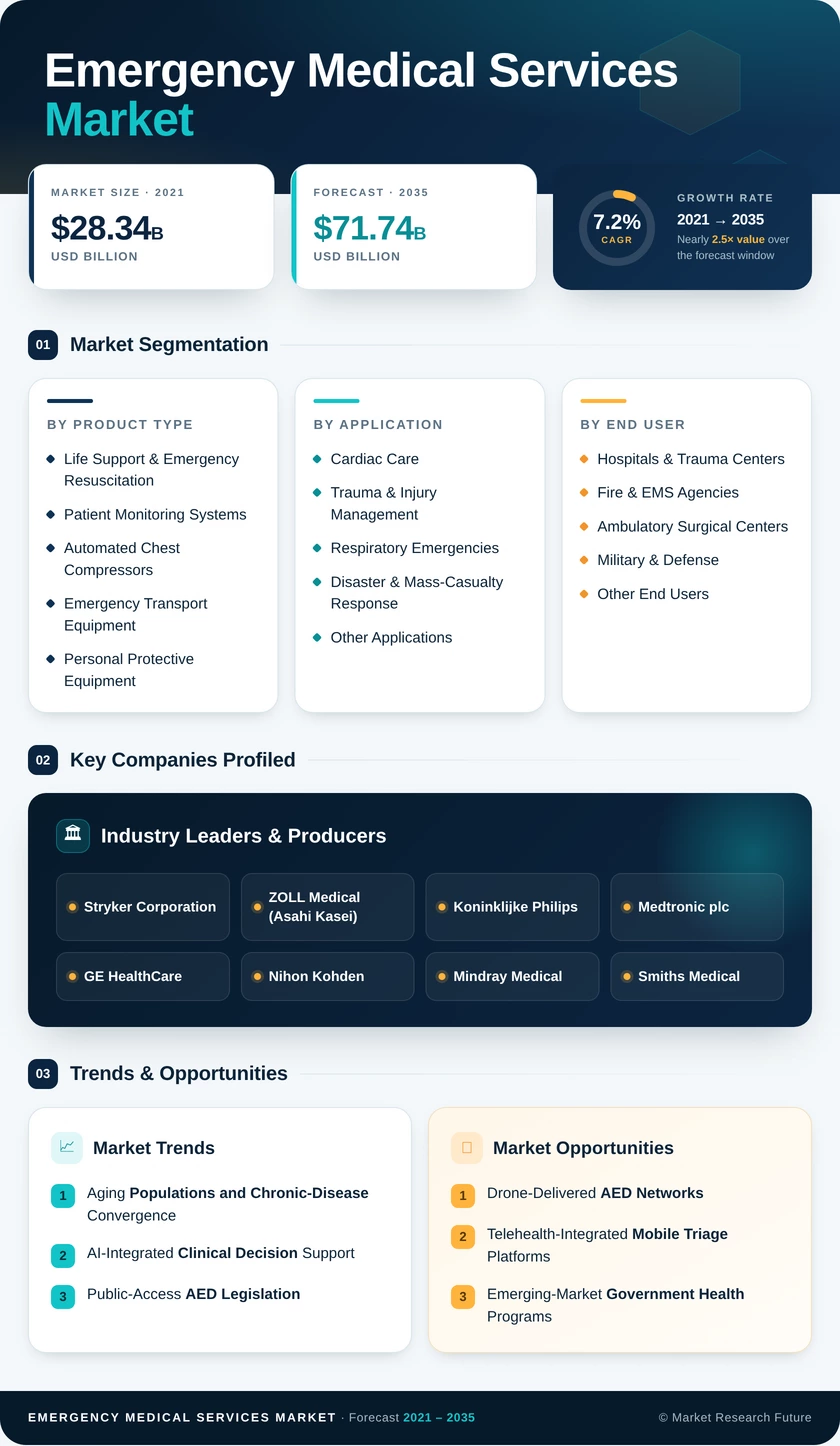
Market Size
Forecast Period2026-2035
CAGR (2026-2035)7.2%
2025 Market SizeUSD 35.80 Billion
2035 Market SizeUSD 71.74 Billion
Key Players
Stryker Corporation
ZOLL Medical
Koninklijke Philips
Medtronic plc
GE HealthCare
Nihon Kohden
Opportunities
  • Drone-Delivered AED Networks
  • Telehealth-Integrated Mobile Triage Platforms
  • Emerging-Market Government Health Programs
  1. 1 Market Overview |
    1. 1.1 Study Assumptions & Market Definition |
    2. 1.2 Scope of the Study |
    3. 1.3 Research Methodology
  2. 2 Market Summary & Key Takeaways
  3. 3 Market Dynamics |
    1. 3.1 Market Drivers Analysis | |
      1. 3.1.1 Aging Populations and Chronic-Disease Convergence | |
      2. 3.1.2 AI-Integrated Clinical Decision Support | |
      3. 3.1.3 Public-Access AED Legislation | |
      4. 3.1.4 Community Paramedicine Expansion | |
      5. 3.1.5 Ambulance Fleet Modernization Cycles | |
      6. 3.1.6 Government Hospital-Building Programs in Asia | |
      7. 3.1.7 Climate-Driven Disaster Preparedness Spending |
    2. 3.2 Market Restraints Analysis | |
      1. 3.2.1 Reimbursement Shortfalls and Payment Delays | |
      2. 3.2.2 Rural Workforce Shortages | |
      3. 3.2.3 Supply-Chain Disruptions for Semiconductors | |
      4. 3.2.4 Regulatory Fragmentation Across Markets | |
      5. 3.2.5 Cybersecurity Risks in Connected Devices |
    3. 3.3 Market Opportunity Analysis | |
      1. 3.3.1 Drone-Delivered AED Networks | |
      2. 3.3.2 Telehealth-Integrated Mobile Triage Platforms | |
      3. 3.3.3 Emerging-Market Government Health Programs | |
      4. 3.3.4 Data Monetization Through Clinical-Outcome Analytics | |
      5. 3.3.5 Electric and Hybrid Ambulance Platforms |
    4. 3.4 Industry Value Chain Analysis |
    5. 3.5 Porter's Five Forces Analysis
  4. 4 Emergency Medical Services Market Size & Forecast (2021–2035) |
    1. 4.1 Historical Market Size (2021–2025) |
    2. 4.2 Current & Forecast Market Size (2026–2035) |
    3. 4.3 Market Size by Revenue (USD Billion) |
    4. 4.4 Year-over-Year Growth Analysis
  5. 5 Segmentation Analysis |
    1. 5.1 By Product Type | |
      1. 5.1.1 Life Support & Emergency Resuscitation | |
      2. 5.1.2 Patient Monitoring Systems | |
      3. 5.1.3 Automated Chest Compressors | |
      4. 5.1.4 Emergency Transport Equipment | |
      5. 5.1.5 Personal Protective Equipment | |
      6. 5.1.6 Other Products |
    2. 5.2 By Application | |
      1. 5.2.1 Cardiac Care | |
      2. 5.2.2 Trauma & Injury Management | |
      3. 5.2.3 Respiratory Emergencies | |
      4. 5.2.4 Disaster & Mass-Casualty Response | |
      5. 5.2.5 Other Applications |
    3. 5.3 By End User | |
      1. 5.3.1 Hospitals & Trauma Centers | |
      2. 5.3.2 Fire & EMS Agencies | |
      3. 5.3.3 Ambulatory Surgical Centers | |
      4. 5.3.4 Military & Defense | |
      5. 5.3.5 Other End Users
  6. 6 Regional Analysis |
    1. 6.1 North America | |
      1. 6.1.1 United States | |
      2. 6.1.2 Canada | |
      3. 6.1.3 Mexico |
    2. 6.2 Europe | |
      1. 6.2.1 Germany | |
      2. 6.2.2 United Kingdom | |
      3. 6.2.3 France | |
      4. 6.2.4 Italy | |
      5. 6.2.5 Spain | |
      6. 6.2.6 Nordic Countries | |
      7. 6.2.7 Russia | |
      8. 6.2.8 Rest of Europe |
    3. 6.3 Asia-Pacific | |
      1. 6.3.1 China | |
      2. 6.3.2 India | |
      3. 6.3.3 Japan | |
      4. 6.3.4 South Korea | |
      5. 6.3.5 ASEAN | |
      6. 6.3.6 Rest of Asia-Pacific |
    4. 6.4 South America | |
      1. 6.4.1 Brazil | |
      2. 6.4.2 Argentina | |
      3. 6.4.3 Rest of South America |
    5. 6.5 Middle East & Africa | |
      1. 6.5.1 Saudi Arabia | |
      2. 6.5.2 UAE | |
      3. 6.5.3 South Africa | |
      4. 6.5.4 Egypt | |
      5. 6.5.5 Rest of MEA
  7. 7 Competitive Landscape |
    1. 7.1 Market Share Analysis (2025) |
    2. 7.2 Competitive Benchmarking Matrix |
    3. 7.3 Company Profiles | |
      1. 7.3.1 Stryker Corporation | |
      2. 7.3.2 ZOLL Medical (Asahi Kasei) | |
      3. 7.3.3 Koninklijke Philips | |
      4. 7.3.4 Medtronic plc | |
      5. 7.3.5 GE HealthCare | |
      6. 7.3.6 Nihon Kohden | |
      7. 7.3.7 Mindray Medical | |
      8. 7.3.8 Smiths Medical | |
      9. 7.3.9 Cardinal Health | |
      10. 7.3.10 Drägerwerk AG
  8. 8 Future Outlook & Strategic Recommendations (2026–2035) |
    1. 8.1 AI-Autonomous Clinical Decision Engines |
    2. 8.2 Platform Economics and Subscription Revenue Models |
    3. 8.3 Electrification of Emergency Fleets |
    4. 8.4 ESG Reporting and Sustainable Supply Chains
  9. 9 Recent Developments & News
  10. 10 Frequently Asked Questions (FAQs)
  11. 11 Report Scope & Methodology |
    1. 11.1 Study Period & Base Year |
    2. 11.2 Data Sources & Citations |
    3. 11.3 Abbreviations
  12. 12 LIST OF TABLES |
  13. TABLE 1 Emergency Medical Services Market Size & Forecast, by Revenue (USD Billion), 2021–2035 |
  14. TABLE 2 Emergency Medical Services Market — Year-over-Year Growth Analysis, 2021–2035 |
  15. TABLE 3 Driver Impact Analysis — Emergency Medical Services Market |
  16. TABLE 4 Restraints Impact Analysis — Emergency Medical Services Market |
  17. TABLE 5 Regional Market Share Summary — Emergency Medical Services Market, 2025 |
  18. TABLE 6 North America Emergency Medical Services Market Size, by Country, 2021–2035 (USD Billion) |
  19. TABLE 7 Europe Emergency Medical Services Market Size, by Country, 2021–2035 (USD Billion) |
  20. TABLE 8 Asia-Pacific Emergency Medical Services Market Size, by Country, 2021–2035 (USD Billion) |
  21. TABLE 9 South America Emergency Medical Services Market Size, by Country, 2021–2035 (USD Billion) |
  22. TABLE 10 Middle East & Africa Emergency Medical Services Market Size, by Country, 2021–2035 (USD Billion) |
  23. TABLE 11 Emergency Medical Services Market Size, by Product Type, 2021–2035 (USD Billion) |
  24. TABLE 12 Emergency Medical Services Market Size, by Application, 2021–2035 (USD Billion) |
  25. TABLE 13 Emergency Medical Services Market Size, by End User, 2021–2035 (USD Billion) |
  26. TABLE 14 Competitive Benchmarking Matrix — Emergency Medical Services Market, 2025 |
  27. TABLE 15 Company Profiles — Key Players, Emergency Medical Services Market |
  28. TABLE 16 Recent Developments & Strategic Announcements, 2023–2025 |
  29. TABLE 17 Report Scope & Methodology Summary |
  30. TABLE 18 Detailed Sources and Citations
  31. 13 LIST OF FIGURES |
  32. FIGURE 1 Emergency Medical Services Market Dynamics — Drivers, Restraints & Opportunities |
  33. FIGURE 2 Industry Value Chain Analysis — Emergency Medical Services Market |
  34. FIGURE 3 Porter's Five Forces Analysis — Emergency Medical Services Market |
  35. FIGURE 4 Emergency Medical Services Market Size Trend (USD Billion), 2021–2035 |
  36. FIGURE 5 Emergency Medical Services Market Share, by Product Type, 2025 |
  37. FIGURE 6 Emergency Medical Services Market Share, by Application, 2025 |
  38. FIGURE 7 Emergency Medical Services Market Share, by End User, 2025 |
  39. FIGURE 8 Emergency Medical Services Market Share, by Region, 2025 |
  40. FIGURE 9 North America Emergency Medical Services Market Size, by Country, 2025 |
  41. FIGURE 10 Europe Emergency Medical Services Market Size, by Country, 2025 |
  42. FIGURE 11 Asia-Pacific Emergency Medical Services Market Size, by Country, 2025 |
  43. FIGURE 12 Competitive Landscape — Market Share Heat Map, 2025

Segmentation Quick Reference

DimensionSub-SegmentsDominant SegmentFastest Growing Segment
Product TypeLife Support & Emergency Resuscitation; Patient Monitoring Systems; Automated Chest Compressors; Emergency Transport Equipment; Personal Protective Equipment; Other ProductsLife Support & Emergency ResuscitationAutomated Chest Compressors
ApplicationCardiac Care; Trauma & Injury Management; Respiratory Emergencies; Disaster & Mass-Casualty Response; Other ApplicationsCardiac CareDisaster & Mass-Casualty Response
End UserHospitals & Trauma Centers; Fire & EMS Agencies; Ambulatory Surgical Centers; Military & Defense; Other End UsersHospitals & Trauma CentersAmbulatory Surgical Centers
GeographyNorth America; Europe; Asia-Pacific; South America; Middle East & AfricaNorth AmericaAsia-Pacific


Market Segmentation Overview

By Product Type

Sub-SegmentKey Trend
Life Support & Emergency ResuscitationAI-embedded defibrillators replacing analog platforms
Patient Monitoring SystemsReal-time telemetry transmission to receiving hospitals
Automated Chest CompressorsClinical protocol shifts favoring mechanical over manual CPR
Emergency Transport EquipmentPowered stretcher systems reducing provider injury rates
Personal Protective EquipmentPost-pandemic infection-control standards raising baseline requirements
Other ProductsConsumable kits and single-use airway management devices growing steadily


Life Support & Emergency Resuscitation remains the highest-value product segment due to stringent regulatory replacement schedules and high per-unit pricing for defibrillators and ventilators. Automated chest compressors represent the fastest-growing subsegment as clinical evidence increasingly demonstrates their superiority during patient transport scenarios.

By Application

Sub-SegmentKey Trend
Cardiac CareAED ubiquity in public spaces expanding addressable use occasions
Trauma & Injury ManagementPoint-of-care ultrasound adoption in field triage
Respiratory EmergenciesPortable ventilator miniaturization enabling wider deployment
Disaster & Mass-Casualty ResponseClimate-event frequency driving government stockpile purchases
Other ApplicationsPediatric and neonatal transport equipment gaining specialization


Cardiac care dominates because sudden cardiac arrest commands the highest device-activation rate per emergency call. Disaster and mass-casualty response is expanding fastest, propelled by government stockpile refreshes and FEMA surge-capacity requirements linked to increasing wildfire and flood event frequency.

By End User

Sub-SegmentKey Trend
Hospitals & Trauma CentersCentralized group-purchasing organizations negotiating multi-year contracts
Fire & EMS AgenciesMunicipal bond-funded fleet replacement programs
Ambulatory Surgical CentersOn-site resuscitation mandates expanding equipment footprint
Military & DefenseTactical Combat Casualty Care (TCCC) protocol modernization
Other End UsersCorporate AED programs and school-based mandates growing


Hospitals and trauma centers lead by a wide margin due to their centralized procurement budgets and the breadth of equipment they purchase. Ambulatory surgical centers are the fastest-growing end-user segment as rising outpatient procedure volumes trigger regulatory requirements for on-site advanced life support capability.


 

Download PDF ×

We do not share your information with anyone. However, we may send you emails based on your report interest from time to time. You may contact us at any time to opt-out.